Just now, Meta open-sourced Muse Gadgets, enabling developers around the world to "build AI peripherals" on their own.
Meta's Muse is still gaining continuous momentum.
This newly launched personal AI Agent has already become a key product in Meta's AI strategy this year. Different from traditional chatbots, Muse is designed as an intelligent assistant that can perform tasks on behalf of users: processing emails, shopping, planning itineraries, and even completing a number of complex operations continuously in the background.
And just now, Meta has announced a new move: officially launching the Muse Gadgets open source project to fully delegate hardware capabilities, enabling global makers and developers to build exclusive peripheral hardware devices for Muse.
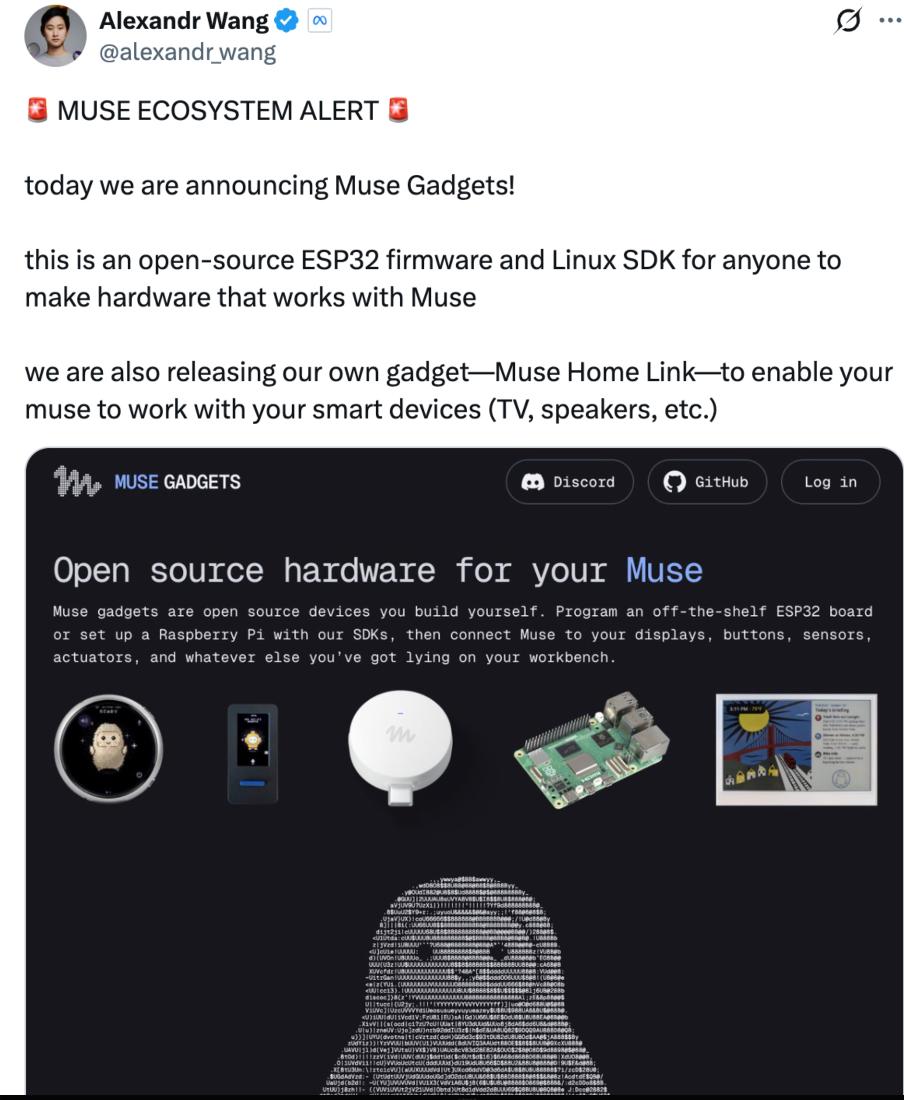
According to the information released by Meta, developers can use the ESP32 development board to run the Muse firmware, or use the Linux SDK to connect more complex devices, which means that developers can not only deploy the Muse interaction logic on low-cost microcontrollers, but also directly run the Muse client on more powerful edge computing devices such as Raspberry Pi 5.
The official side has also listed a variety of highly practical DIY form references:
Color E Ink Display: As a low-power reminder or smart dashboard on the desktop, it can display the schedule and to-do items synchronized by Muse in real time.
HDMI Display Stick / Large Screen Expansion: Project the interface or interaction of the Muse Agent directly to a TV or external monitor.
Touch-controlled Handheld Pendant: Make a portable interactive terminal similar to Muse Charm, so that you can talk to the Agent at any time without wearing smart glasses.
For developers who want to get started and try it out, you can follow the steps below to start building your own exclusive Muse peripheral right now:
Obtain Credentials: Visit gadgets.muse.ai to register and get your personal API Token;
Connect Development Tools: Import the official GitHub code repository into your commonly used AI programming agent programs (such as Claude Code, Cursor, GitHub Copilot CLI, etc.), and use the Agentic Coding capability to quickly understand the protocol and generate peripheral driver code;
Firmware Flashing and Debugging: Flash the code into the ESP32 development board or run the SDK client on Linux / Raspberry Pi devices, then you can complete the real-time two-way connection between the hardware terminal and Muse.
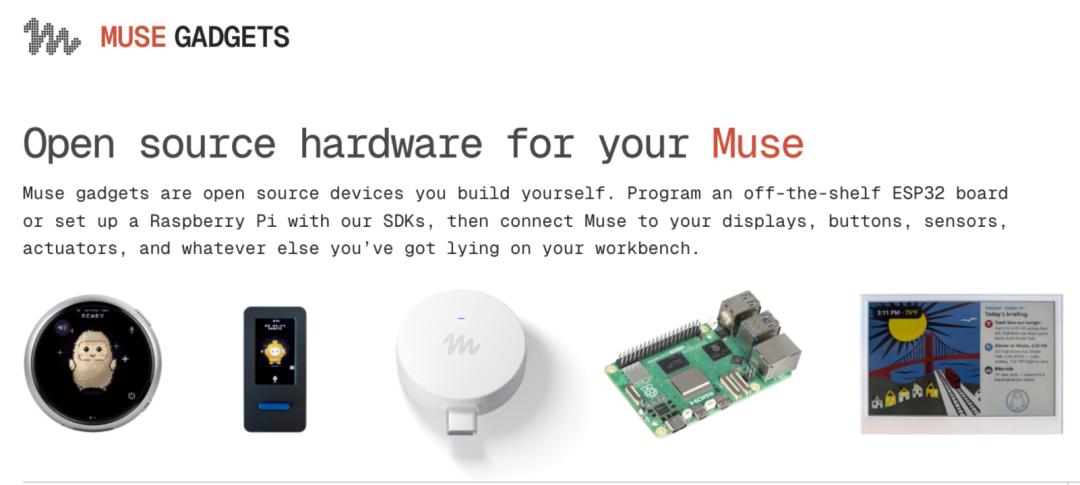
At the same time, Meta has also launched an official device: Muse Home Link, a small USB-C powered device, which allows Muse to connect to your home network to communicate with smart home devices, such as TVs, speakers, and any devices that support HTTPS interfaces, further bringing the AI Agent into real life scenarios.
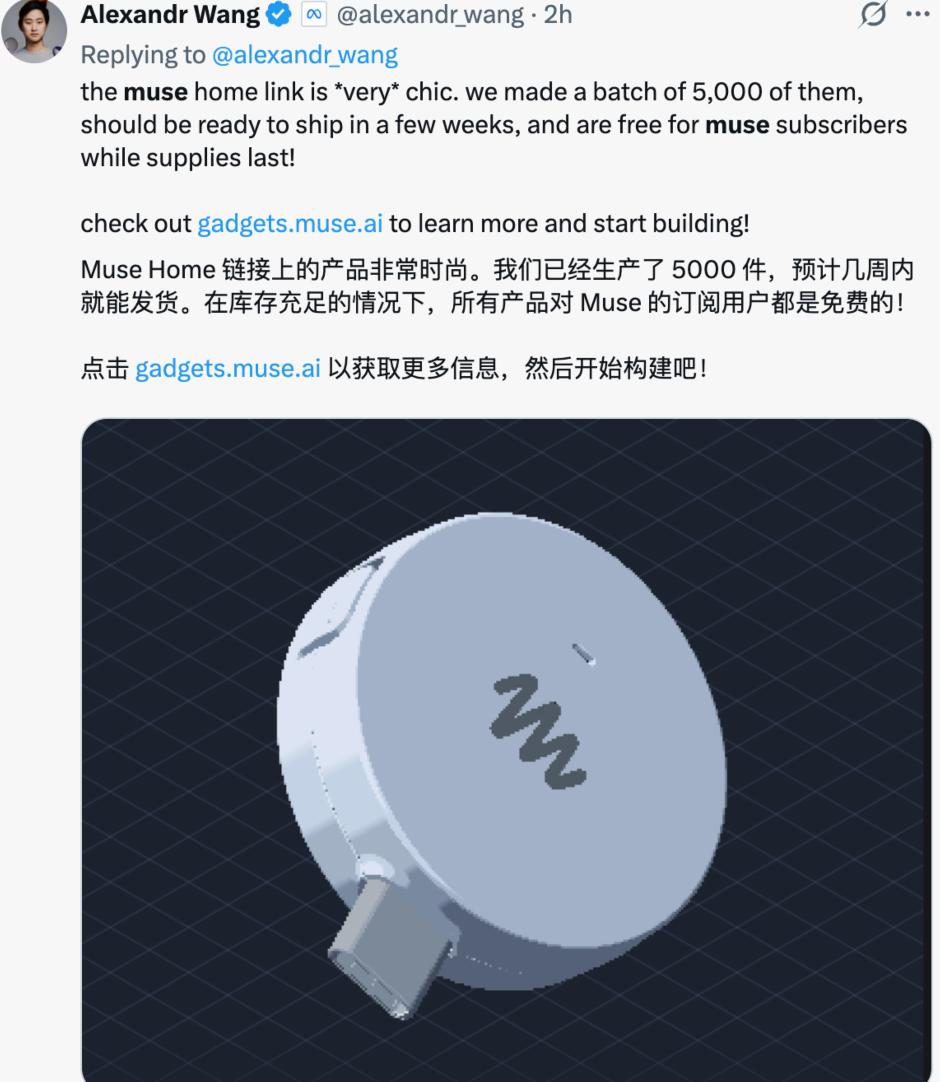
The official stated that 5000 units of Muse Home Link have been produced in the first trial production run, and shipments are expected to start in a few weeks. While stocks are sufficient, the devices will be distributed directly for free to eligible Muse subscription users for experience.
In response to everyone's curiosity about why Meta took the open source move, Alexandr Wang said, "First of all, building all kinds of small gadgets is fun in itself.
Secondly, we hope to unlock the creativity of developers and let everyone explore all kinds of brand new, even crazy ideas. We believe that Muse is at a special moment, it provides unlimited possibilities for people to create new types of hardware devices, and we are very much looking forward to seeing what kind of works everyone will end up building!"
From this perspective, Meta seems to hope that Muse is not just an official product, but an extensible platform.
As soon as the project was released, it immediately attracted the attention of netizens, and even some netizens got started and DIYed their own Muse devices.
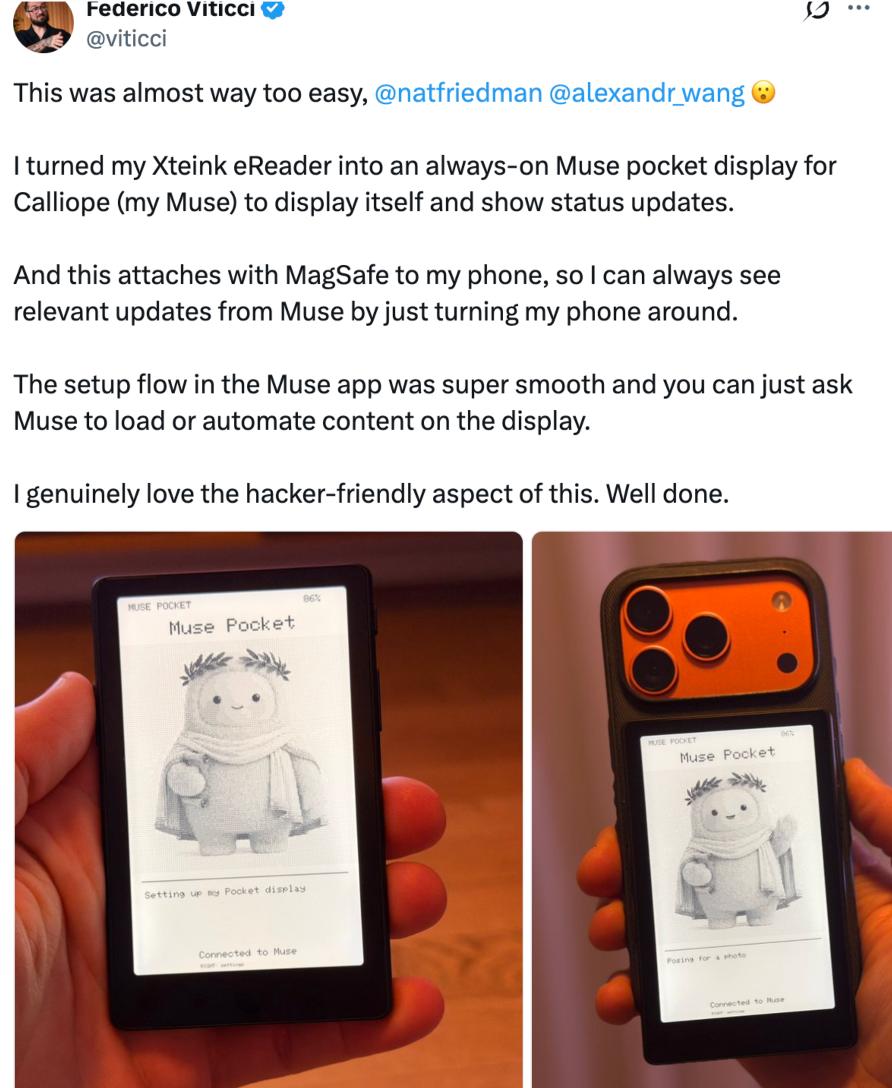
Netizen Federico Viticci@viticci tried to transform his Xteink e-ink reader into an always-on Muse portable display, on which Muse (Calliope) can display its own avatar and show status updates. Moreover, this device can be connected to the back of the blogger's mobile phone through MagSafe magnetic attraction, so you only need to flip the phone over to check the relevant updates pushed by Muse at any time.
"The setup process of the Muse App is very smooth. You can even let Muse load content directly, or automatically control the information on the display. I really like this developer and hacker-friendly design concept."
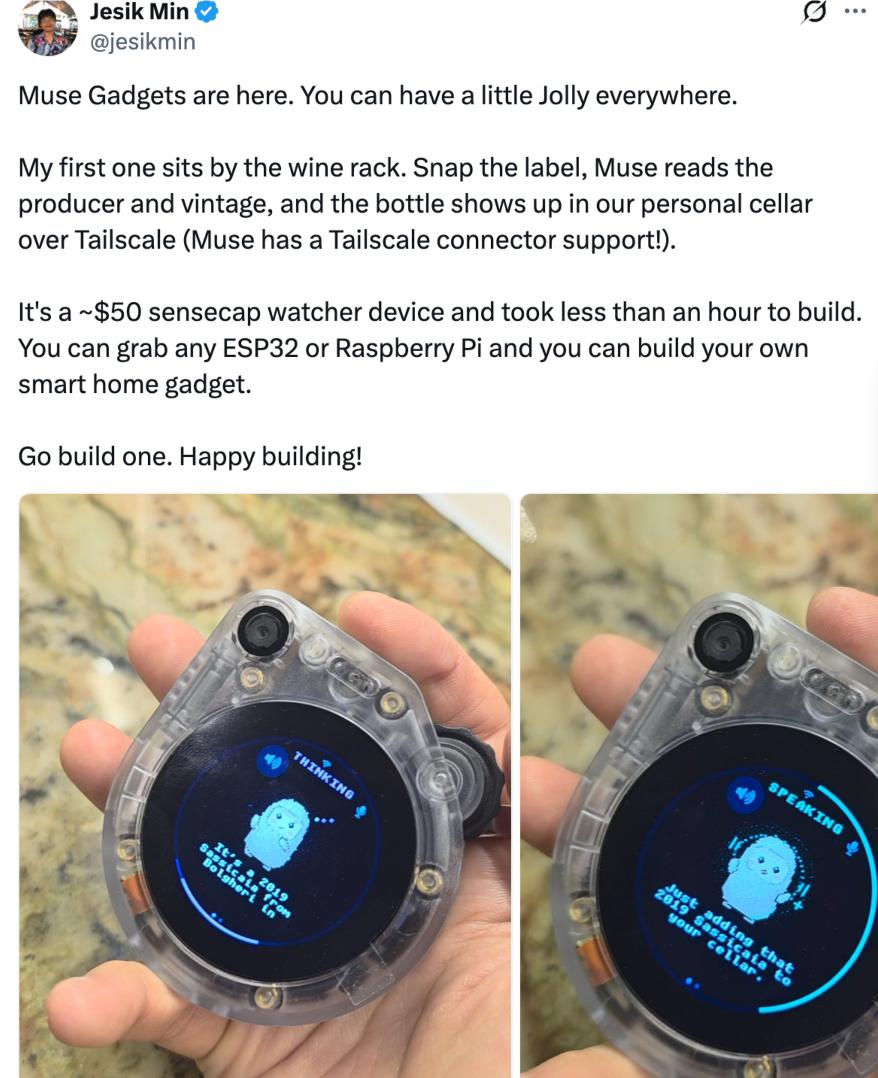
Another developer used a SenseCAP Watcher device worth about 50 US dollars to build a smart hardware connected to his personal wine cellar. Users only need to take a photo of the wine bottle label, Muse can identify the winery and vintage, and synchronize the information to the personal wine cellar system through the Tailscale connector. The whole device took less than an hour from setup to operation.
There are many more user cases like this. Through this attempt of Muse, we can also see a change in the Agent era: In the past, the development path of smart hardware was usually: Company designs hardware — Users purchase devices — Develop applications. But AI Agent may move towards another model: The company provides models and Agent capabilities — Developers create devices of various forms.
In fact, starting from AI Pin, the industry has made a lot of explorations in AI hardware, and has tried to replace the mobile phone entry through independent devices, but many products are affected by problems such as functional restrictions and poor interactive experience. Now, manufacturers seem to be changing their minds: directly build a powerful AI Agent first, and then let it enter different hardware.
Meta's route may be exactly this: Muse is responsible for the intelligent capabilities, and developers are responsible for creating various carriers. In the future, Muse may exist in smartphones, smart glasses, various home devices, and even new hardware created by developers...
So what about you, what do you think of Meta's this attempt? Welcome to leave a message and communicate in the comment area!
Reference Links:
https://x.com/alexandr_wang/status/2106113742266089526
https://www.theverge.com/tech/1004330/meta-muse-ai-gadgets-home-link
https://gadgets.muse.ai/
https://x.com/viticci/status/2106139174604816765
This article is from the WeChat Official Account Synced (ID: almosthuman2014), written by AI-focused contributors, and authorized for release by 36Kr.