Orders have skyrocketed dozens of times: Why are all AI players across the world vying for Chinese batteries?
In the past two years, the AI arms race has been in full swing, serving as a major driver of investment in both China and the United States.
GPU, storage, optical modules, liquid cooling, the market hotspots of computing power infrastructure have erupted in successive waves.
In addition, GPUs consume extremely large amounts of electricity. A large-scale AI computing power center can easily cost billions of yuan in electricity bills a year, which is comparable to the electricity consumption of a small city.
Even if you can afford billions of yuan, you may not be able to secure sufficient power supply.
In some regions of the United States, it takes 3 to 7 years to queue for an AI computing center to connect to the power grid. As a result, figures like Elon Musk and Mark Zuckerberg can no longer wait, and have begun to purchase gas turbines to build their own power plants.
This has driven a whole range of power equipment that seemingly has nothing to do with AI computing power, including gas turbines, transformers, high-voltage switches and so on, to see a sharp surge in market value and demand.
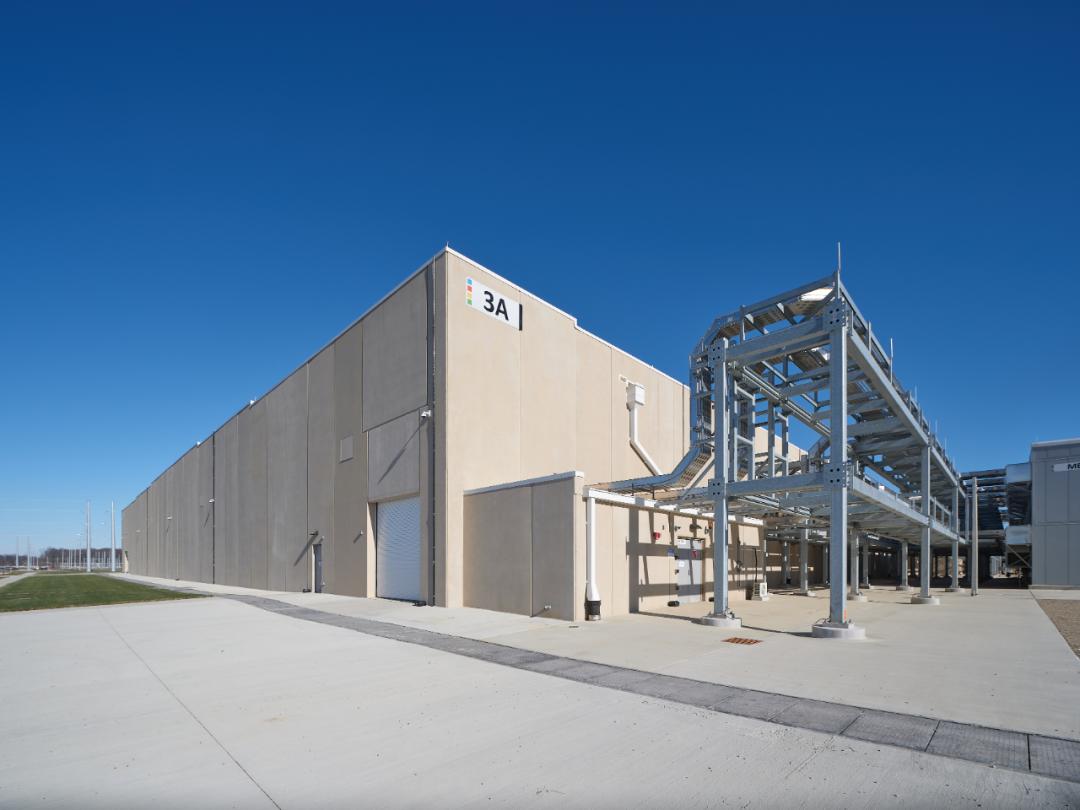
But in a corner that most people have not noticed, energy storage related to AI, that is the battery business, is also experiencing explosive growth.
In the first 5 months of 2026, the global energy storage shipment for AI computing centers reached 10GWh, equivalent to 10 million kWh calculated by battery capacity, which has exceeded the total shipment of 2025. The industry predicts that by 2030, the shipment of AIDC energy storage lithium batteries will exceed 300GWh. Judging from the current shipment volume, there is a dozens-fold growth space in just a few years. It is no surprise that most of the new orders are flowing to Chinese battery manufacturers.
Why does AI computing require so many batteries? Today we will have an in-depth discussion on this topic.
01 Tens of thousands of GPUs stepping on the accelerator at the same time
Your impression of a data center may be like this: rows of servers quietly flashing green lights, humming, with relatively stable power consumption.
This is indeed the case for traditional data centers. A single cabinet has a power consumption of 4 to 8 kilowatts, with a steady load like cruise control, making the power grid operate easily and smoothly.
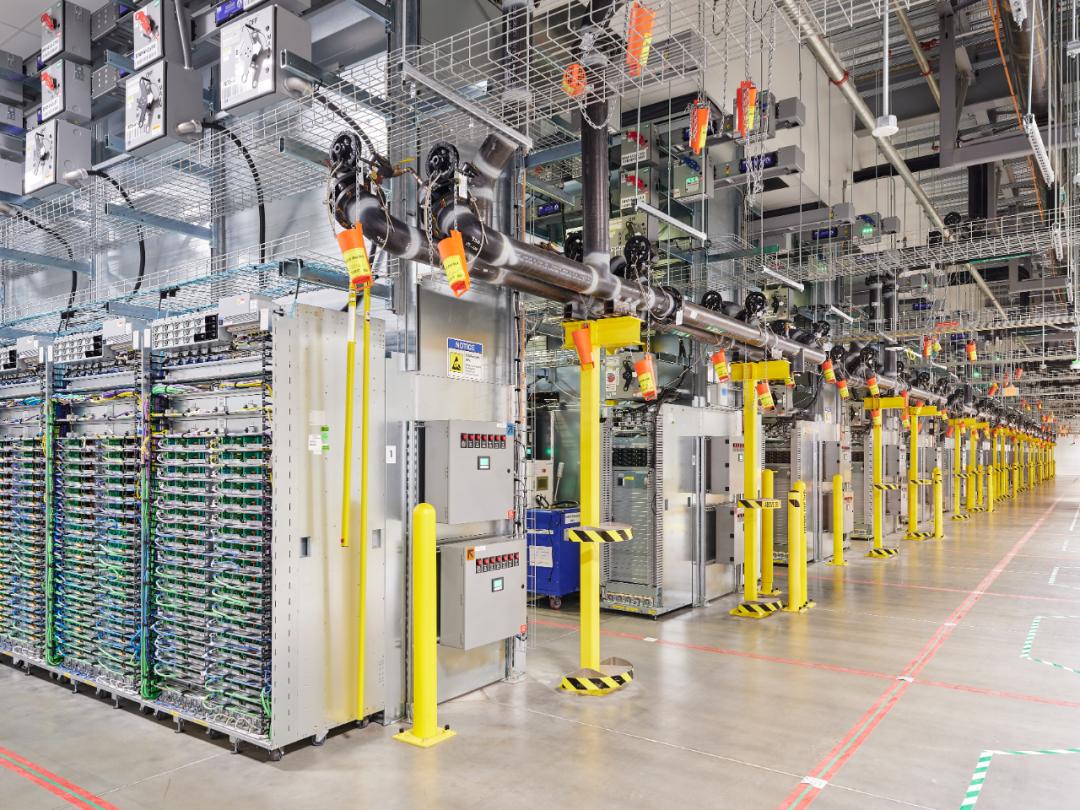
But AI computing centers are completely different.
For example, an NVIDIA B200 GPU can reach a power consumption of 1200 watts when running at full load; a complete GB200 superchip can reach 2700 watts.
An NVL72 cabinet is equipped with 72 GPUs, and the total power consumption of the entire cabinet soars to 120 to 140 kilowatts, which is 20 times that of a traditional cabinet.
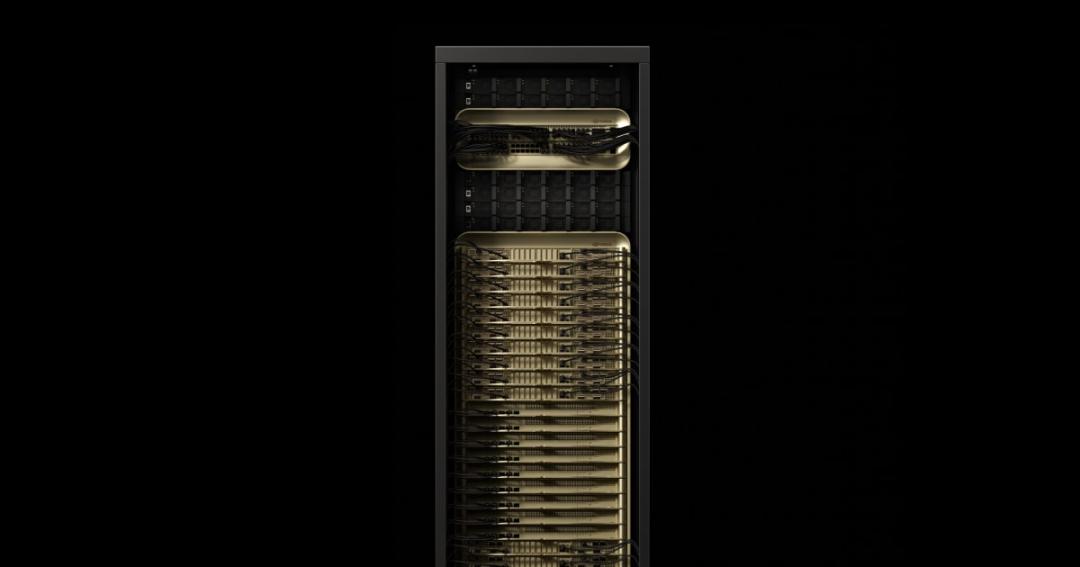
NVIDIA GB200 NVL72 Liquid-Cooled Cabinet | Source: NVIDIA
However, high power consumption is not the most critical problem. The most critical issue is that the power consumption of AI "jumps" sharply.
During large model training, thousands upon thousands of GPUs perform calculations simultaneously, and exchange calculation results after each round, a process called AllReduce. You can imagine it as a large choir with tens of thousands of people: after singing each section, everyone has to stop to check the sheet music, wait for the slowest person to catch up, and then start singing together again.
The result is that all GPUs either run at full power at the same time, or idle and wait at the same time. The power consumption curve becomes a "square wave": full power → idling → full power → idling, repeating continuously.
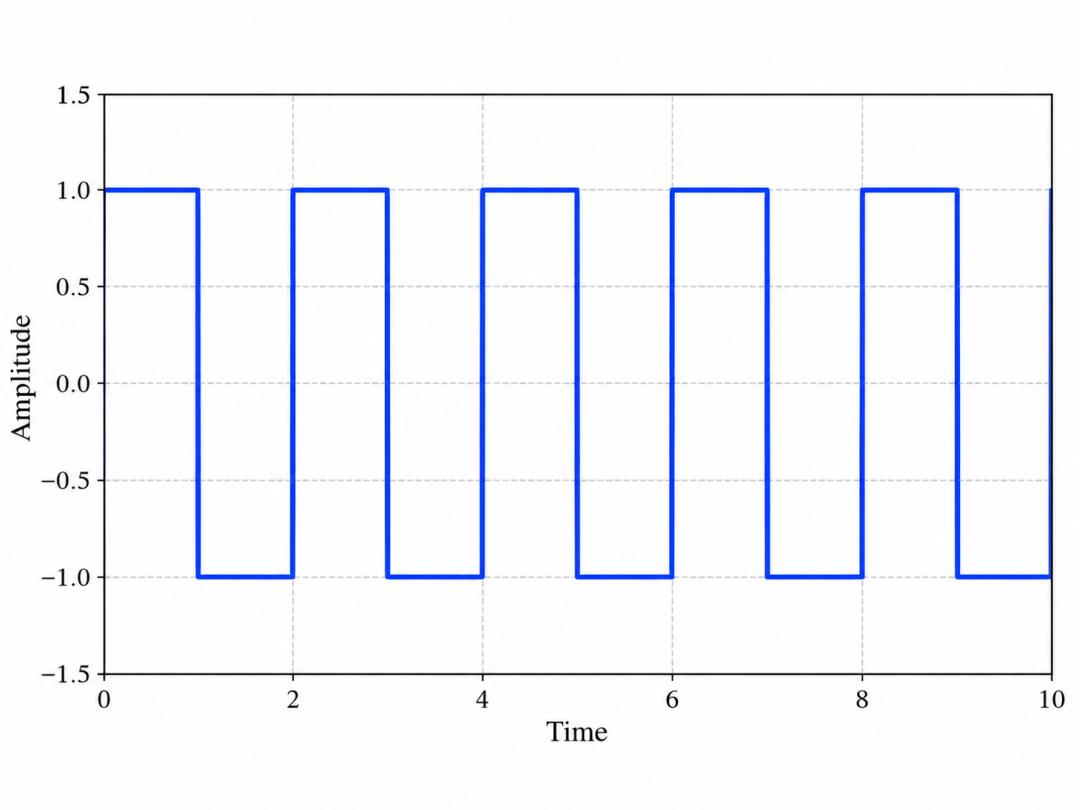
The square wave roughly looks like this
An energy storage engineer once made an analogy: the power consumption of a GPU is like a sports car that steps on the accelerator from idle speed to full power and then releases it every second.
Actual measurement data from Vertiv shows that the load of a GPU cabinet can jump from about 10% to full load in a very short time, even exceeding 150% of the rated power, showing high-frequency pulse fluctuations.
When this kind of fluctuation is amplified to a cluster of tens of thousands of GPUs, if not handled properly, it is equivalent to your graphics card attacking your power supply with electromagnetic pulse oscillation.
When Meta trained Llama 3, it used two clusters each with about 24,000 H100 GPUs. In a single cluster, the total power consumption of IT equipment such as servers alone reached tens of megawatts. During large-scale training, thousands of GPUs switch states synchronously, which converges to the power grid side and forms a power impact of tens of megawatts.
Some people may think: let it jump, isn't the power grid designed exactly for this kind of situation?
The problem is that the power grid is designed for stable power consumption. After the dispatching instruction is issued, the response from the power plant increasing capacity to the current reaching the user end is calculated in seconds; but the power jump of the GPU is calculated in milliseconds, which is completely out of sync.
If the power grid cannot respond in time, the voltage may drop suddenly.
When the light in your home flickers, you may not even notice it; but for a GPU that is training a large model, even a 10-millisecond voltage anomaly may cause the failure of this round of training, ranging from rolling back to the last checkpoint to recalculating the entire segment.
What is the solution?
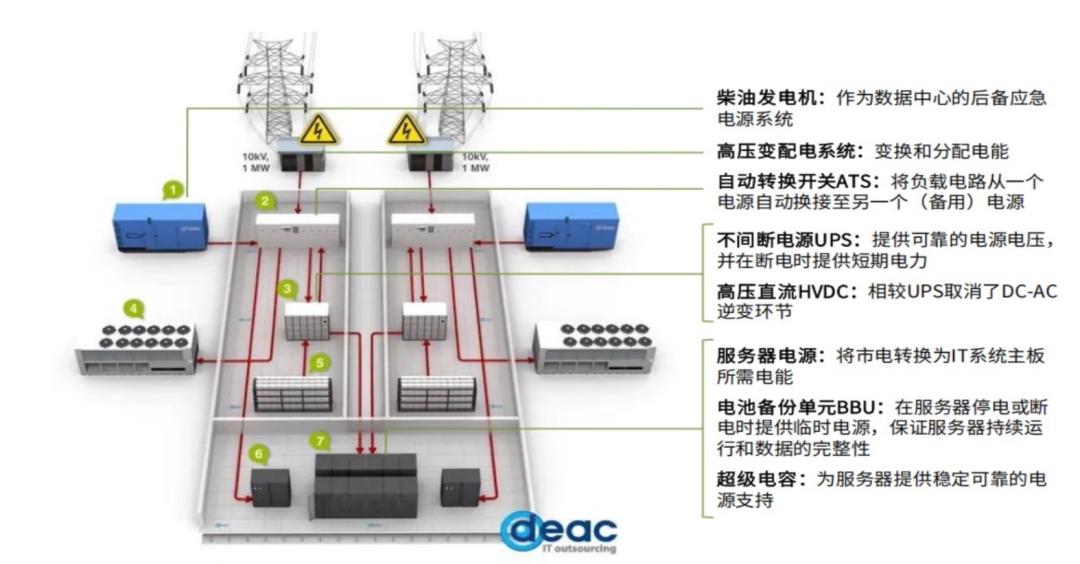
The standard configuration solution for traditional data centers is called UPS, or Uninterruptible Power Supply. Essentially, it is a set of large lead-acid batteries placed in the power distribution room downstairs, kept fully charged and on standby at ordinary times. Once the external power supply is cut off, it will take over and support the system until the diesel generator starts up.
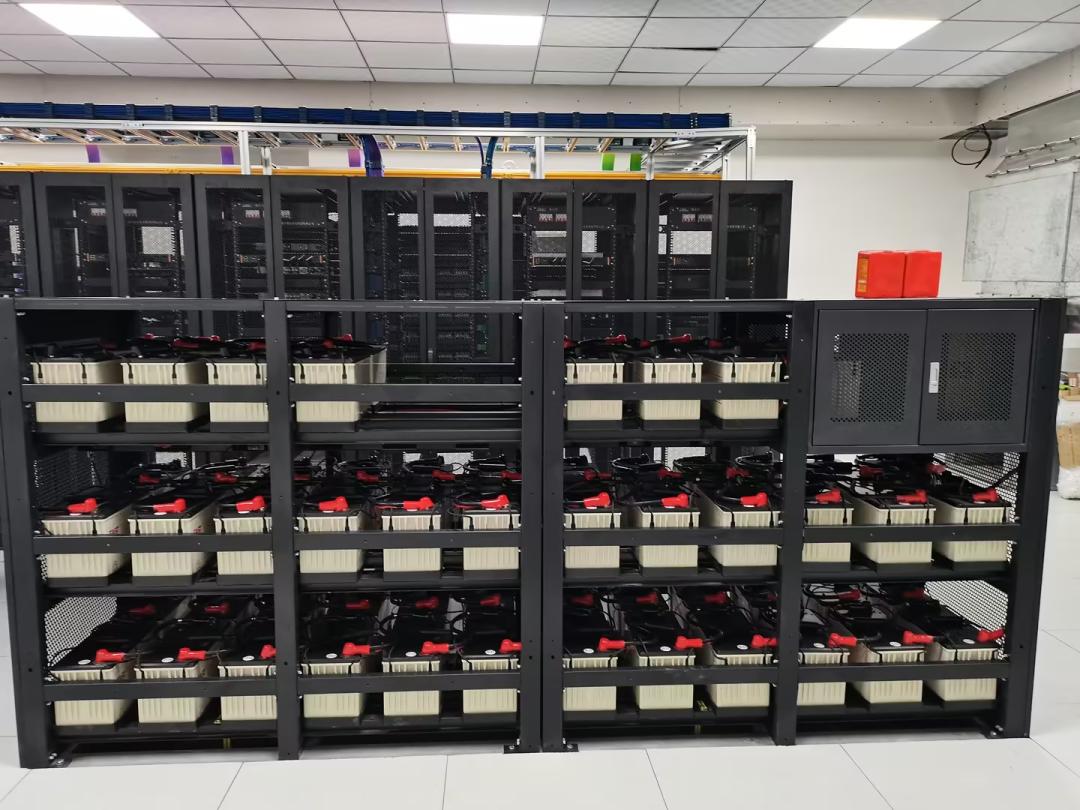
Data Center UPS
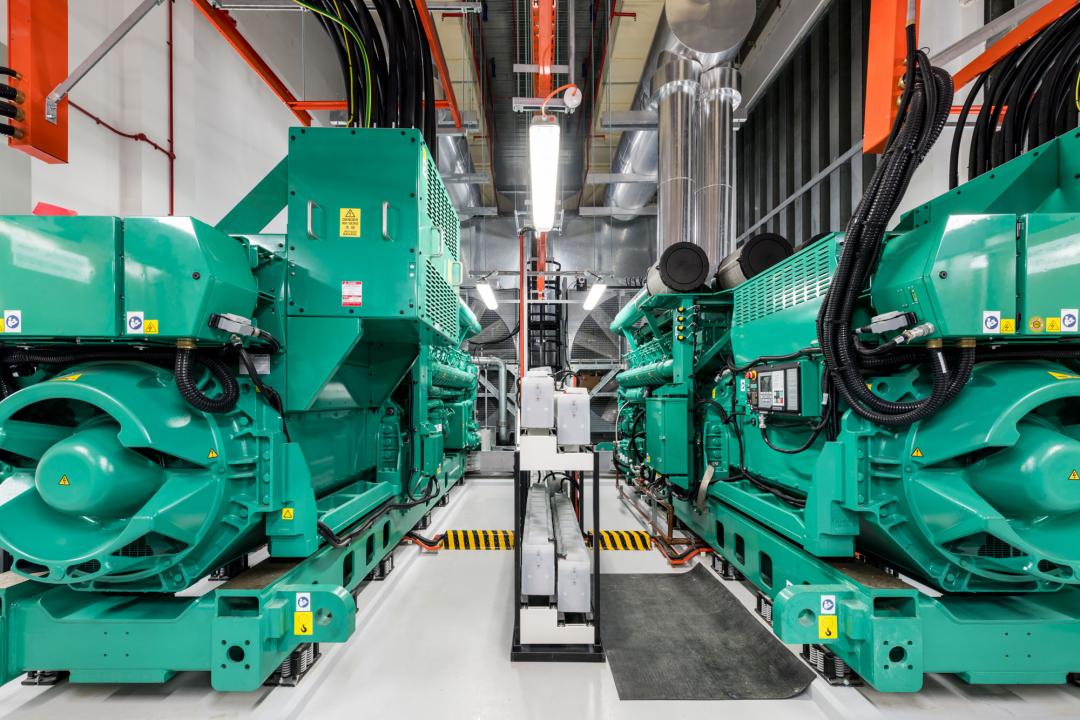
Backup Diesel Generator | Source: Google Data Centers
For decades, data centers have been operating relying on this system.
But UPS is designed to prevent sudden power outages, not voltage fluctuations. Lead-acid batteries have a response speed of more than 10 milliseconds, and are deployed in a centralized manner, with one set of UPS shared by an entire building, separated by long transmission lines.
What GPUs need is millisecond-level, distributed close-range power supply. The UPS cannot meet the requirements from the perspective of architecture: it responds too slowly, is too far away from the GPU, and once it fails, it will affect a large area of equipment.
The first line of defense closest to the GPU is the capacitor.
NVIDIA fills all the remaining space in the power shelf of the GB300 cabinet with capacitors. When the GPU power consumption surges, it discharges; when the power consumption drops, it charges, to smooth out the most frequent small spikes locally.
Capacitors store electricity through physical methods, unlike batteries which rely on chemical reactions, so charging and discharging every few seconds will not damage their service life. But the electricity they store is extremely small. Each GPU only gets 65 joules, which is roughly enough for a 60-watt light bulb to light up for one second, so it can only handle small jitters, not large fluctuations.
The battery demand generated by AI computing centers is called BBU, or Battery Backup Unit.
The biggest difference between BBU and UPS is that BBU is not downstairs, but inside the cabinet, sharing the same cabinet with the GPU.
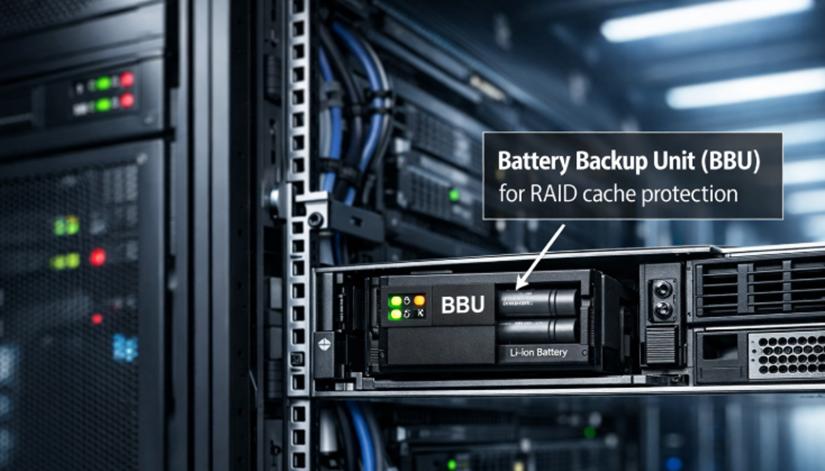
An NVL72 cabinet is equipped with 24 BBUs, whose cells are 21700 high-rate cylindrical lithium batteries, with a discharge rate ≥10C and a response time of less than 2 milliseconds.
The moment the GPU power consumption rises sharply, the adjacent BBU discharges to supplement power within 2 milliseconds to stabilize the voltage. After the power grid completes the adjustment a few seconds later, the BBU exits smoothly.
However, capacitors and BBUs only handle millisecond-level emergency support inside the cabinet. When hundreds or thousands of cabinets in a large AI data center jump sharply at the same time, the superimposed impact can reach tens of megawatts.
This requires a park-level energy storage system to withstand: dozens of container-sized energy storage cabinets are arranged around the park, with a total capacity of hundreds of MWh, specially designed to deal with the second-level to minute-level power fluctuations superimposed by all cabinets.
In general, traditional energy storage is like a reservoir, charging slowly and discharging slowly, focusing on large capacity and low cost.
AIDC energy storage is like an emergency rescue team. As soon as the GPU demands power, the electricity must be delivered instantly. Capacitors and BBUs handle millisecond-level scenarios, while park-level energy storage handles second to minute-level scenarios. The three layers combined can fully meet the huge power demand of GPUs.
02 Computing Centers Are Scrambling for Batteries
The explosion of AIDC energy storage demand is global.
Cabinet-level BBUs are quickly falling short of supply. The global BBU market was about 35 billion yuan in 2025, and it is expected to reach 350 billion yuan in 2030, ten times growth in five years with a CAGR of nearly 60%.
This sudden surge in demand is directly caused by the fact that computing centers are being built faster than the power grid can expand.
Connecting to the power grid usually requires a 3 to 7-year queue, but business owners cannot wait. A one-month delay in production will lead to a huge loss of revenue from computing power services.
So what can be done? There are generally two solutions, and both of them are increasingly inseparable from energy storage.
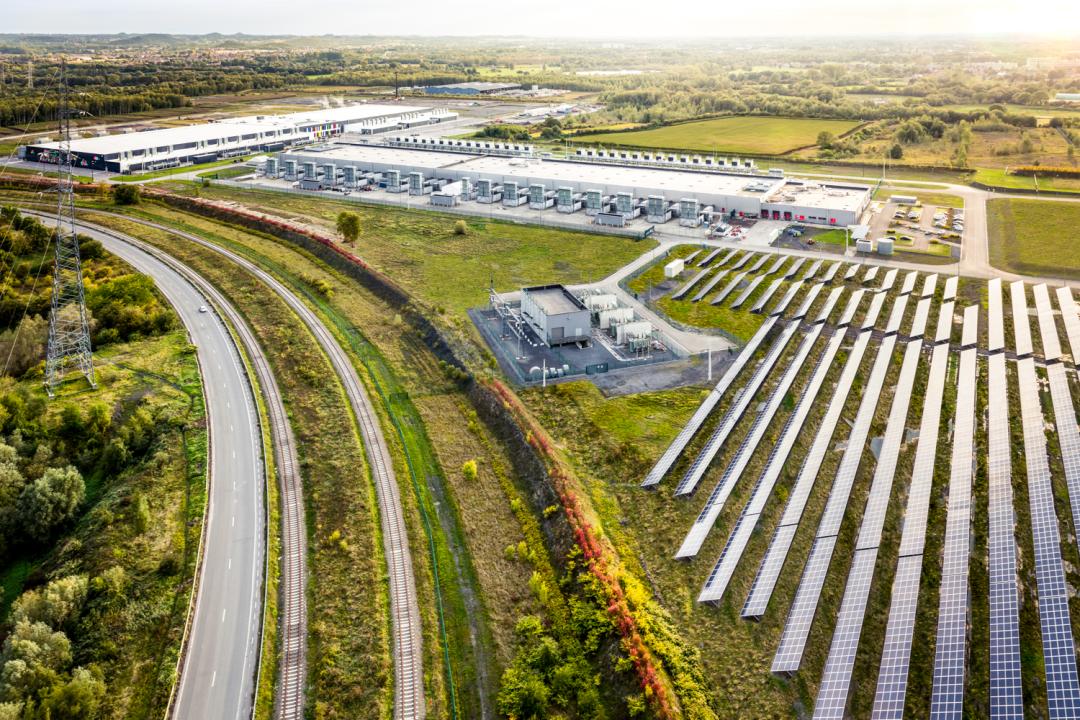
One solution is self-generated power. But the stability and response speed of independent small grids are far inferior to large public power grids. Gas turbines adjust their output in seconds or even minutes, which cannot keep up with the frequent fluctuations of GPU power consumption. Photovoltaic power generation even depends on the weather. To stabilize a self-built power station, a large number of batteries must be deployed in between. For example, the supercomputing center built by Elon Musk in Memphis, USA, is equipped with more than 100 additional Tesla Megapack energy storage cabinets in addition to gas turbines for power generation, specially dealing with power outages and power consumption impacts;
The other solution is to connect to a part of the power grid first. Power grid companies are most afraid of connecting a large load with fluctuating power consumption during peak hours. Equipping data centers with energy storage allows them to draw less power from the grid during peak hours or even support their own operation, so that the power grid does not need large-scale renovation, and the approval process can be advanced. A study funded by Google estimates that data centers equipped with self-owned power sources such as energy storage, combined with this "flexible access" mode, can be connected to power 3 to 5 years earlier than the traditional queuing mode.
Therefore, for more and more projects, energy storage has become a prerequisite for the computing center to be put into operation on schedule.
The first people to feel this change are the salespeople working on the front line.
According to Economic Observer, a Chinese practitioner engaged in energy storage sales in Europe said that in 2024, when he was doing business in Europe, customers were still concerned about how to store wind power and photovoltaic power, and how to use electricity price differences to reduce costs; in 2025, the number of customers actively inquiring about energy storage supporting computing power increased by about half; by 2026, almost every customer is asking about computing center related issues.
As demand changes, a one-size-fits-all solution no longer works. Lithium iron phosphate batteries have a long cycle life and are the main force in the energy storage market, but their low-temperature performance will decline; sodium-ion batteries