Meta has created yet another track illusion
Meta's new product Muse has gone viral.
Launched for only half a month, its downloads in the first two weeks exceeded 2.8 million. By September 24, that figure had risen to over 3.4 million, easily topping the free charts of the U.S. App Store and Google Play.
The capital market is more excited than users.
The blueprint of Personal Agent depicted by Muse directly drove Meta's market value to surge by nearly 200 billion U.S. dollars at one point.
The tech circle is already very familiar with this pattern: when a product explodes in popularity, a massive track story emerges as the times require.
In the past year, the AI industry has been repeating this scene over and over. Before the product even gains a foothold and users form usage habits, capital has already blown up the bubble.
I. The product has not yet gained a firm foothold, but the "entry point" narrative has already arrived
The AI industry is extremely good at positioning new products.
AI assistants are not grand enough, so the industry talks about Agent; while the AI office track is in fierce competition, Personal Agent has been elevated to the altar.
Muse does show breakthrough capabilities that previous AI assistants did not have: it can open web pages, fill out forms, send emails, book services, and even complete a series of real continuous operations on behalf of users in an isolated virtual environment.
Meta has specially designed Secure VM for this purpose, giving the Agent an independent browser and operating environment.
Almost at the same time, Manus, which failed to be acquired by Meta, also made a comeback with its product Cue. It is equipped with an independent email account, phone number and digital wallet, to take over more specific real-world tasks for users.
That's not all. OpenAI soon launched a similar AI assistant product Dots, and these moves collectively pushed up the market enthusiasm.
But the danger is that before users can even figure out how to use the product properly, the market has forcibly taken the next step.
This "entry point" theory itself ignores the game of the underlying ecosystem.
On one hand, the controllers of operating systems will never be willing to give up their underlying permissions. Both Apple and Google are building system-level closed loops through large models deployed on hardware end-sides, and they will hardly allow third-party Agents to overstep their authority to take over core interactions.
On the other hand, every time a Personal Agent performs a complex cross-software task, it consumes cloud inference computing power and generates network latency. Using high-cost API calls to complete several low-unit-price tasks such as ordering food or buying tickets for users naturally has a cost structure paradox in the underlying commercial logic.
This narrative that AI doing things for individuals is quickly elevated to the scenario where Personal Agent will replace mobile phones and become the next-generation super entry point is not unfamiliar in the history of technology.
II. From 1840 to 2026
The current market frenzy over Muse follows exactly the same logic as the British people's attitude towards railways in the 1840s.
In the 1840s, railways in the UK were a real productivity revolution. After the Liverpool-Manchester Railway opened in 1830, the efficiency of passenger and cargo transportation changed dramatically. Later, Britain fell into the famous "Railway Mania", with a large amount of capital pouring in and stock prices soaring.
Railways eventually did change the world, but a large amount of capital that poured into the railway stock market back then did not get equivalent returns.
Capital further deduced the fact that railways would change the world into the conclusion that all railway companies would make huge profits.
The former later became history, while the latter became a bubble.
The dot-com bubble at the turn of the century repeated the same script of the railway mania.
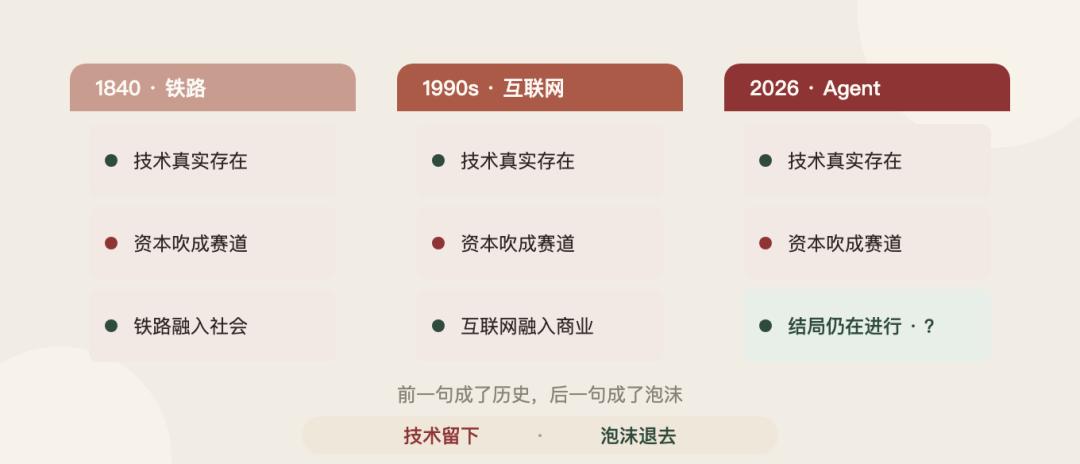
In the late 1990s, the Nasdaq skyrocketed by 170% in 18 months, then collapsed completely, and countless concept companies vanished. But the Internet did not disappear. It was not until after the bubble burst that it truly integrated into business and society.
History has repeatedly proved that the real existence of technology can never endorse the commercial value of market hype.
More importantly, whether it is railways or the Internet, the places that truly generate commercial value have never been empty individual concepts. Behind them are extremely pragmatic corporate account books.
The same is true for Agent today. Compared with the individual-side frenzy triggered by Muse, the enterprise side has already started to calculate rationally.
III. AI office no longer believes in Demos
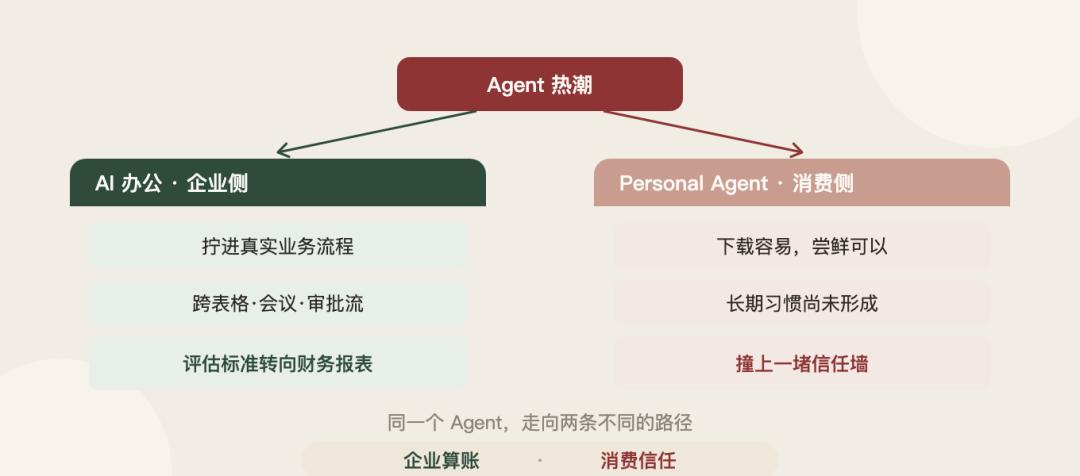
AI office and Personal Agent are moving towards two completely different paths.
Enterprises are no longer obsessed with the "entry point" story, and have forcibly integrated Agents into real business processes.
Since the beginning of this year, products such as WorkBuddy, Doubao Work and Qianwen Office have emerged one after another. Major tech giants have collectively shifted their focus to the AI office track, leading to intense competition. Even investor Zhu Xiaohu asserted that the future of AI office will be dominated by large tech companies.
The reason why large giants regard AI office as a decisive battlefield is that it is essentially an all-round street fight covering product forms, organizational structures and ecological moats.
At the product level, all players have rapidly evolved from the initial single-point document generation to process connection across spreadsheets, meetings and approval workflows.
As for organizational adjustments, large giants have broken the original barriers between business departments, vertically integrated AI teams with original collaborative software such as DingTalk, Feishu and WeCom, trying to promote organizational efficiency innovation in an AI-Native way, and reserve strength for the competition between ecosystems.
A McKinsey survey this year shows that among large enterprises with annual revenue of more than 1 billion U.S. dollars, 40% have been using AI Agents on a large scale (compared with only 27% last year).
However, another set of data from Deloitte reveals the cruel reality: only 5% of enterprises believe they are truly ready for Agentic Workflow, and no more than 15% of enterprises can complete cross-department, multi-Agent collaboration.
Putting the two sets of data together, the stage of enterprise Agent is very clear: usage has already started, but large-scale deployment, automation and governance are still on the way.
Every account that enterprises need to calculate is very realistic: what processes can an Agent get involved in? How many permissions need to be granted? How to isolate data assets?
The evaluation criteria for AI office are completely shifting from Demo shows to financial statements. As a result, the market's judgment has been forced to calm down.
IV. What is harder to cross than download volume is trust
Compared with the penetration of AI office into enterprise processes, the Personal Agent boom triggered by Muse is hitting a very thick wall of consumer-level trust. It is easy for users to download it out of curiosity, but long-term usage habits have not been formed at all.
Adobe's consumer research shows that 43% of respondents are willing to try Personal Agent, but only 19% believe it will become their dominant way to interact with brands, and nearly 40% have not even thought about needing a personal intelligent agent at all.
The more fatal bottleneck lies in money and transactions. Users are happy to look up information and compare products, but as long as it involves automatic payment, sending emails, and placing purchase orders, the threshold for users to hand over control will rise significantly.
Muse is currently at this extremely sensitive boundary. Its paradox is that the more it wants to show the power of Agent, the more in-depth personal permissions it needs to request. The deeper the permissions are, the more unbearable the cost will be once the system makes a mistake.
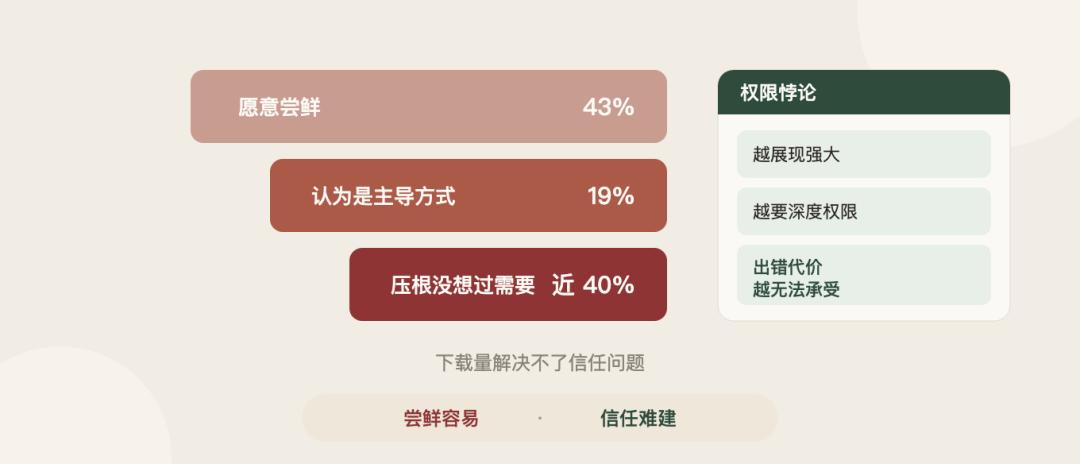
When a chatbot says something wrong, users can just ask again. But once a Personal Agent sends the wrong official letter or buys the wrong asset, the consequences will directly spill over into the real world.
It takes time to build trust about how much permissions users are willing to hand over, and millions of downloads cannot solve this problem.
V. Meta's open moves and hidden lines
While Muse has attracted enough attention, another commercialization main line that Meta has laid out secretly reveals the truth.
On September 28, Meta officially announced the establishment of Meta Enterprise Platform, led by former MongoDB CEO Chirantan Desai, packaging all capabilities including Muse, Meta Business Agent, Muse API and Muse Code, and opening them to enterprises and developers uniformly.
This forms a very thought-provoking contrast with the high-profile Personal Agent story that Muse has previously promoted.
The consumer market sells concepts, entry points and trust, with monetization far out of reach. The enterprise market pursues efficiency, cost reduction and clear budgets, where payment and service delivery happen at the same time.
Meta obviously does not intend to make a choice between the two.
At this point, Muse's commercial role is also clearer: it not only carries Meta's ambition to compete for the personal AI entry point, but also serves as a springboard for Meta to expand into the enterprise AI market.
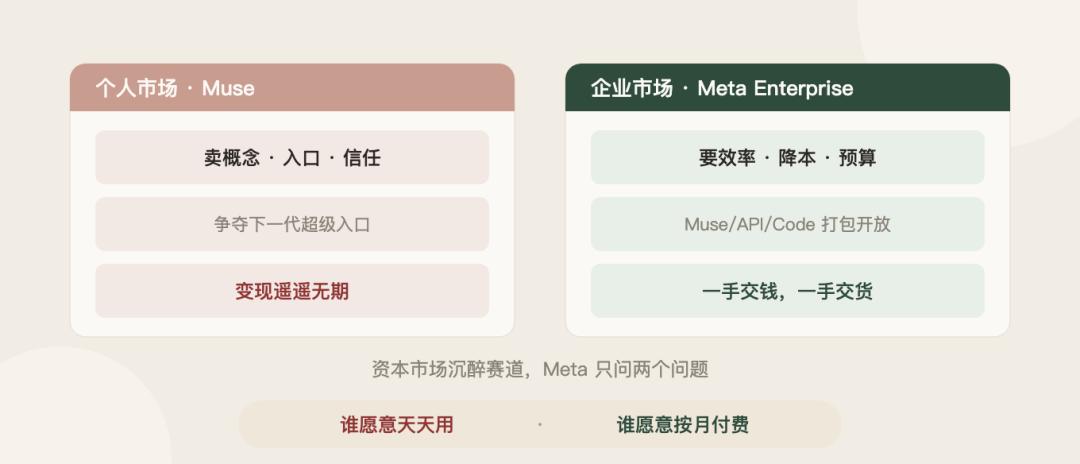
The capital market is indulging in a grand new track, but Meta itself knows very well that in practice there are only two extremely down-to-earth questions:
Who is willing to use it every day? Who is willing to pay for it on a monthly basis?
VI. Great technologies will eventually disappear from the spotlight
After the railway mania faded, no one regarded railways as a new track anymore. After the dot-com bubble burst, Internet companies gradually stripped off their previous aura.
They eventually all became the infrastructure of society.
This is exactly the most easily ignored endgame of technological revolution: the truly successful technologies will eventually disappear from the spotlight.
The steam engine did not always exist in the name of an innovative industry. Electricity was not always highly praised as a disruptive track, and the Internet is no exception. They penetrated factories, cities and families, and turned into underlying capabilities that exist by default, just like water and electricity.
If AI can really go through this path, Agent will be no exception.
On that day, users will not care whether what they are using is a Personal Agent, and enterprises will no longer need to discuss whether Agent is a trend. It will shed all packaging, become the most basic software interaction capability, and a completely natural way of working.
What Muse really needs to prove is never the download volume, but whether these users will stay, and whether enterprises are willing to pay for it continuously.
Technological revolutions never lack amazing imagination. What really determines the distribution of value is how many things remain in real scenarios after the imagination recedes.
Words Beyond the Layout:
Human beings always overestimate the speed at which technology changes the world, and underestimate the depth at which technology changes the world.
The best ending for new technology is never to become a trend, but one day, people no longer find it novel at all.
This article is from the WeChat official account "Beyond the Layout", written by Huahua, and published with authorization from 36Kr.