SpaceWit launches the "Space String" thousand-satellite blueprint, and aims to benchmark against SpaceX Starmind program in 2028.
In September 2026, China's commercial aerospace sector entered a period of intensive explosive growth, with multiple companies completing financing totaling hundreds of millions of yuan, and at least 10 space launches conducted within a single month, sending 44 satellites into orbit.
The combined heat of capital and intensive launches points to one trend: commercial aerospace is shifting from the technology verification phase to large-scale deployment. However, the more satellites are launched, the closer the industry gets to the limit of the "space-sensing and ground-computing" path, which further drives the industry's attention to and layout of space computing.
On September 25, the launch ceremony of the "String of Space" computing constellation program was held in Hangzhou. According to the thousand-satellite roadmap announced on site, this space computing constellation, the first in China targeting the global market, is planned to deploy more than 1,000 space agents in the long term, and the G1 satellite is scheduled to be launched in 2027, with a computing load of 11.5KW and computing power of 40-60P (calculated based on existing computing power standards).

Schematic diagram of G3 concept
The "String of Space" computing constellation is jointly promoted and constructed by Earthii, co-builder of the Trisomy Computing Constellation, and Oriental Starlink. Oriental Starlink is responsible for the overall design and operation, while Earthii provides AI capability support and expands the international market, promoting the connection of "AI + aerospace" technology with global digital service demands.
Founded in 2021, Earthii is committed to building a space computing network, providing services including space computing systems, intelligent satellites, on-orbit constellation operation, and AI + big data applications.
Song Bingchen, co-founder of Oriental Starlink, told 36Kr that the goal Earthii has set for itself is to create an integrated space agent that integrates chips, algorithms and models, "becoming a space computing node that can think, make decisions and evolve."
At present, Earthii's business has expanded to more than 40 countries around the world, making it the first private commercial aerospace enterprise in China to realize overseas delivery of satellites and ground systems. The company's revenue reached 130 million yuan in 2025, with overseas market revenue accounting for more than half and realizing profitability.
1. Build an integrated space agent that integrates chips, algorithms and models
On August 5 this year, the first reasoning verification satellite of the "String of Space" computing constellation - "Oriental Starlink 05/06" (Oriental Huiyan Hyperspectral AI Twin Satellites), carrying the self-developed "String" AI on-board computing platform of Earthii, was successfully launched by the JL-3 Y12 carrier rocket.
In August 2023, the "Earthii Intelligent Emergency No.1" carrying the first-generation "String" platform was launched into orbit, with a computing power of 60TOPS at that time. It realized on-satellite real-time observation, real-time processing and space intelligence through more than 100 algorithms, eliminated invalid data, and then transmitted the calculation results back to the ground. Taking satellite images of 10,000 square kilometers as an example, the traditional satellite method takes 180 days, while the intelligent satellite only needs several hours of on-orbit processing to complete dynamic target extraction.
In 2024, the computing power of the "String" platform was further increased to 400TOPS. However, to raise the single-satellite computing power to more than 400TOPS, it is necessary to systematically solve the problems of increased energy consumption and heat dissipation caused by synchronization in engineering.
In the vacuum environment of space, chips can only dissipate heat through radiation. Therefore, Earthii independently developed high thermal conductivity composite materials, which increases the thermal conductivity to several times that of aluminum alloys, and is used in conjunction with deployable radiators. Song Bingchen revealed that in the future, Earthii will also introduce self-developed heat pump technology to further improve the heat dissipation capacity of space servers.
The founder of Earthii once said frankly, "At present, whether in terms of rocket technology, mass satellite production capacity or capital scale, we are not at the same level as SpaceX."
To realize the thousand-satellite blueprint, Earthii plans to make continuous breakthroughs in three technical routes: first, cooperate with domestic manufacturers to develop radiation-resistant chips, and it is expected to deploy the world's first reconfigurable chip with Qingwei Intelligence by the end of this year; second, explore new materials such as perovskite to improve the conversion efficiency of solar panels; third, deploy the first domestic space liquid-cooled agent next year to optimize the heat dissipation performance of satellites.
2. Remote sensing first then computing, from regional commercial use to global commercial use
As of June 2026, the 6 satellites of the two companies have a maximum cumulative in-orbit time of more than 2600 days, accumulating a large amount of actual performance data of chips in the space radiation environment.
In the past few years, the domestic space computing power market has not yet achieved a commercial closed loop as a whole. Therefore, Earthii chose to make money with mature remote sensing data services to accumulate customers and trust, and then gradually cultivate and superimpose space computing capabilities. Due to the limited demand in the domestic remote sensing satellite market, and the team has a group of talents from ZTE with more than ten years of overseas market experience, the overseas market has become the primary priority for Earthii to realize marketization.
"Many countries in the Middle East, Central Asia and Southeast Asia are also eager to build their own aerospace capabilities and space sovereignty." Song Bingchen said, By adopting the combination of "whole satellite export + data service + talent training", Earthii cuts into the niche market of the third world countries, which is ignored by the traditional European and American aerospace system, but has strong willingness to pay and relatively less fierce competition.
On November 11, 2024, Earthii delivered the first "OmanSat" to Oman. This intelligent remote sensing satellite is mainly loaded with an optical camera with a panchromatic resolution of 1 meter and a multispectral resolution of 4 meters, and has the capability of continuous push-broom imaging for up to 45 minutes. It can be applied to fields such as land detailed survey, urban planning, forest survey, and disaster monitoring.
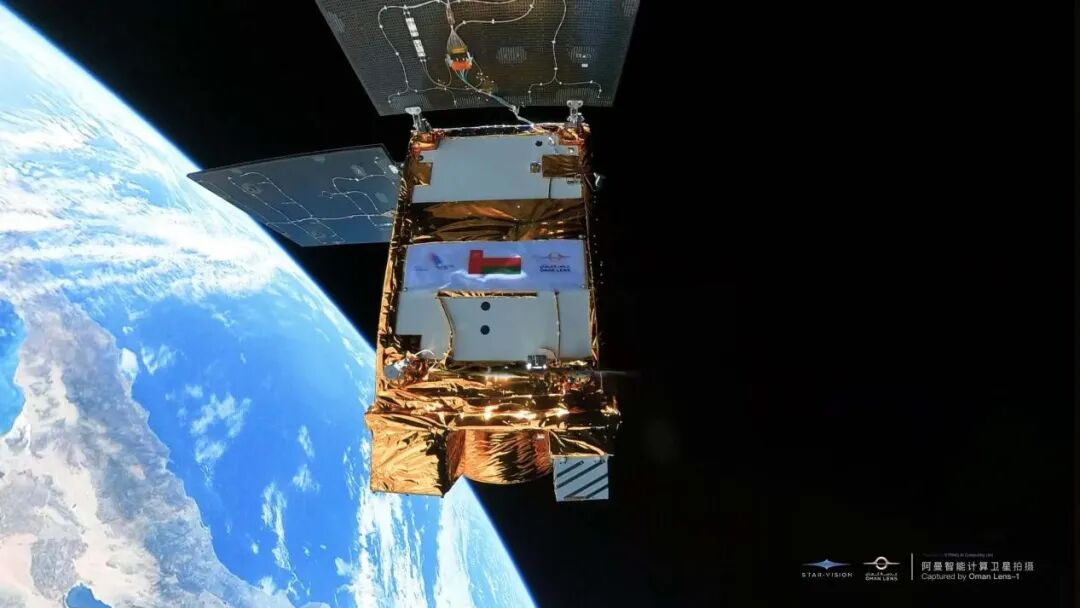
Space selfie of OmanSat
After two months of in-orbit operation, "OmanSat" has flown more than 1200 circles around the earth, completed more than 300 measurement and control tasks and more than 100 data transmission tasks, received about 3000GB of data, and successfully realized the first space practice verification of on-orbit AI identification of ships and aircraft, space-based distributed operating system and space-based remote sensing large model, as well as the satellite-ground network interconnection.
"No private company in China has ever done satellite export. We are not crossing the river by feeling the stones, we can't even feel the stones." From contacting customers, demand docking, scheme design, satellite development, launch coordination, in-orbit testing, to the final successful launch of "OmanSat", Earthii spent nearly two years, running through the whole process from satellite export approval, in-orbit delivery to foreign exchange settlement. "It is equivalent to opening up a commercial path that did not exist before."
The success of "OmanSat" was included in the middle school textbooks of Oman, and it also became a stepping stone for Earthii to open up more overseas markets. Since then, its business has expanded to Indonesia, Uzbekistan, Turkey, and more than 40 countries in southern Africa and Central Asia.
In the process of serving more sovereign countries, Earthii provides product combinations adapted to local needs according to the differentiated demands of different continents and regions. For example, countries in the Middle East have relatively sufficient funds, pay more attention to sovereign capabilities, and need whole-satellite export and talent training; Southeast Asian countries focus on livelihood applications such as agriculture and fisheries, and mainly purchase data and services; Africa attaches great importance to disaster early warning and resource management.
Song Bingchen concluded that the core competitiveness behind the differentiated service of "satellite going global" lies in three points: Technical strength is the admission ticket, delivery capability is the foundation of trust, and long-term operation builds trust relationships.
Compliance is the prerequisite and lifeline of all the above. "The particularity of this industry determines that we would rather lose customers than cross the red line." Song Bingchen said that Earthii will carry out a complete set of internal training from post training, delivery internal control to audit specifications, all services go through formal national approval, and do not involve sensitive fields such as military affairs.
3. Build the strategic framework of "Remote Sensing + Computing + Communication" and create the future "Space Store"
As the company's cash flow business, remote sensing data services support the company's operation and customer accumulation, and are also the first step for Earthii to realize the final "Remote Sensing + Computing + Communication" strategic framework.
Song Bingchen introduced that Earthii plans to combine remote sensing satellites and computing satellites into one in the next step to form a sensing-computing integrated satellite, use space-based data to test and verify the value of the computing platform, and gradually form the core product of the space computing platform.
For the space computing constellation to operate, communication capability is a crucial prerequisite. To achieve full-link capability autonomy, Earthii has obtained communication licenses in overseas markets and started to build its own communication network. The "String" platform itself is also equipped with functions such as narrowband communication and networked distributed computing.
"Our ultimate goal is to form a fully independent and controllable space capability of "Remote Sensing + Computing + Communication" with three constellations complementing each other, which is the underlying guarantee for us to advance the thousand-satellite blueprint at our own pace." Song Bingchen said.
The premise for the space computing platform to achieve a commercial closed loop is that the comprehensive cost of space is lower than that of the ground, so that customers will be willing to buy computing power in the sky. This is also one of the reasons why Earthii chose to expand overseas first and then domestically.
"The cost of ground computing power in these overseas countries is much higher than that in China, so the reversal of the cost difference will come faster." Song Bingchen said that the Earthii team judges that it will take at least 7-10 years for space computing to achieve a global commercial closed loop, "We may achieve it first in the Middle East and the Belt and Road countries, around 2031."
This time judgment is not much different from the cost modeling calculation of SpaceX's orbital data center by many international investment banks. Deutsche Bank's calculation in July 2026 shows that the current deployment cost of space data centers is about 6 times that of the ground. By 2032, at the SpaceX AI 2 satellite stage, the launch cost will drop to 170 US dollars per kilogram, and the cost multiple is expected to become 0.6 times. Morgan Stanley also predicts that the orbital computing cost of SpaceX will drop to 6.5 US dollars per watt per year by 2031, lower than the 6.8 US dollars of ground data centers.
Song Bingchen believes that there are two main variables that ultimately determine the time for the space computing commercial closed loop. The first is the rocket launch cost. At present, the comprehensive cost of space computing power is about 8 times that of the ground, a large part of which comes from launch costs. The second is technology iteration, including chip radiation resistance, energy efficiency, heat dissipation efficiency, and networking scale.
Before the commercial closed loop is realized, the technical closed loop must be completed first, that is, satellites with computing power above 10P can work in the sky all the time, receive data at any time, maintain stable reasoning and return results at any time, "as stable as a ground data center. From the current technical point of view, this is not yet achievable, and completely replacing ground data centers is also a false proposition in business." Song Bingchen said.
He described the specific product form to realize the commercial closed loop of space computing power as a "Space Store": after the satellite is in orbit, new algorithms can be continuously loaded, deleted and uploaded just like a mobile phone, and different customers can call the computing power of the same satellite on demand.
This capability has been verified to a certain extent in Earthii's past products. In 2025, Earthii cooperated with Turkey to successively complete three different tasks of agricultural detection, urban planning and disaster assessment on the same satellite through dynamic deployment of on-board algorithms.
"The technology has been realized, and the real challenge lies in the ecosystem." Song Bingchen said that the construction of the ecosystem requires more developers to be willing to write algorithms for space, and establish standardized interfaces and payment systems, the premise of which is that the constellation scale is large enough to realize all-time communication. This is exactly the problem that the "String of Space" thousand-satellite blueprint will solve next.