White Paper on AI Virtual Cell Industry: US$3 billion capital influx kicks off the first year of commercialization, dissecting the bottlenecks and solutions for large-scale implementation
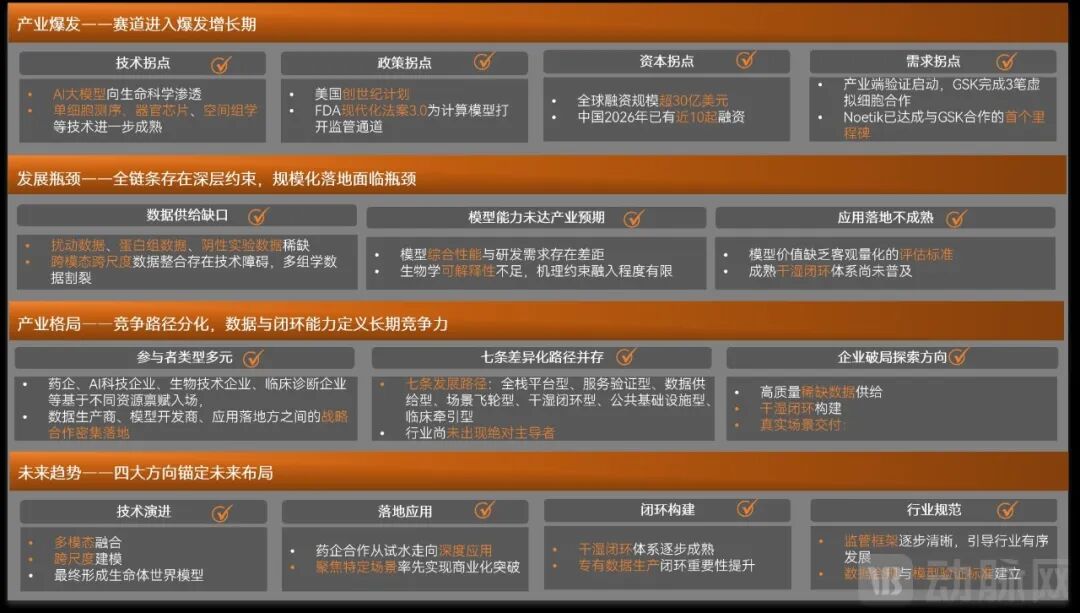
2026 is defined as the first year of commercialization for AI Virtual Cells. Technological breakthroughs, policy support, capital inflow and demand release converge in the same time window, and the industry has officially entered the industrialization implementation cycle. Behind the hype, all parties in the industry still lack a unified understanding of the conceptual boundary, technical route, competition pattern and real bottlenecks of AI Virtual Cells.
This white paper aims to answer three questions: What kind of competition pattern have global participants formed, and which paths have longer-term vitality? From data to models to application implementation, where are the real bottlenecks? What innovative solutions worthy of attention have emerged in the industry?
To this end, Artery Think Tank has sorted out the technological evolution and industrial context of global AI Virtual Cells, interviewed a number of enterprises, and reviewed the layout of participants in all links of data supply, model development and commercial implementation. We found that despite the booming industry hype, the lack of high-value data at the data layer, the failure of prediction capabilities at the model layer to meet industrial expectations, and the absence of verification standards and closed-loop mechanisms at the application layer constitute key constraints. At the same time, a number of enterprises are exploring data production, cross-modal alignment, dry-wet closed loop and real-scenario delivery, providing practical and feasible breakthroughs for the industry to move towards large-scale implementation.
Core Content and Opinions:
The following is an excerpt from the white paper:
Explosive Growth: AI Virtual Cells Open a New Paradigm for Life Sciences
1. Definition and Three-Layer Technical Architecture
A Virtual Cell refers to the use of mathematical equations, physical simulations and AI technology to build a digital model of cell behavior in the computing space, enabling researchers to predict the response of cells to external perturbations (drugs, gene editing, environmental changes, etc.) without relying on physical wet experiments.
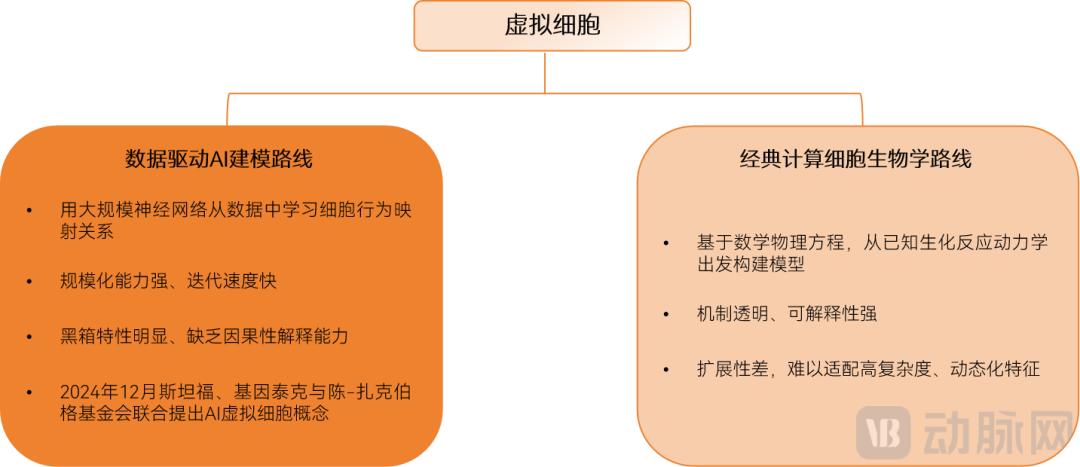
It should be pointed out that a virtual cell is not a single product, but a general term for a class of technical systems. According to different modeling methods, there are currently two main technical routes.
Data-driven AI modeling route, which uses large-scale neural networks to learn the mapping relationship of cell behavior from data. It has strong scalability and fast iteration speed, but has obvious black-box characteristics and lacks causal explanatory capabilities. In December 2024, the AI Virtual Cell concept jointly proposed by Stanford University, Genentech and the Chan Zuckerberg Foundation in Cell is a representative framework of this route.
Classical computational cell biology route, which is based on mathematical and physical equations and constructs models starting from known biochemical reaction kinetics. It has transparent mechanism and strong interpretability, but poor scalability, and is difficult to adapt to the high complexity and dynamic characteristics of real biological systems.
The current frontier exploration direction in the industry is to integrate biological mechanism constraints into the data-driven framework, trying to take into account both scalability and interpretability.
Technical Routes of Virtual Cells
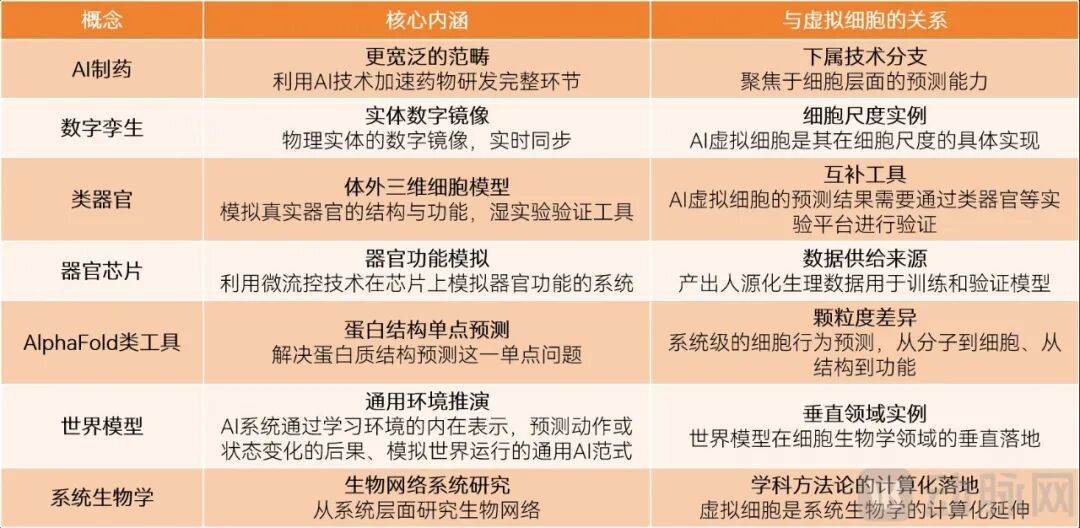
When discussing AI Virtual Cells, it is necessary to clarify the boundaries of several related concepts.
Connotation and Relationship between AI Virtual Cells and Related Concepts
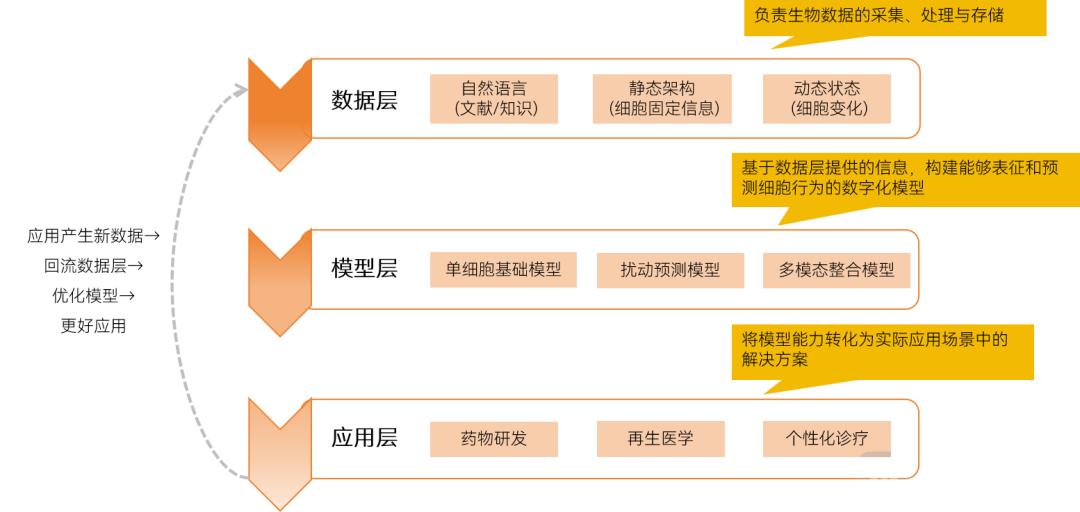
Based on the actual process from technology construction to industrial implementation, Artery Think Tank divides AI Virtual Cell technology into three layers of architecture: data layer, model layer and application layer, which is driven by closed-loop active learning for continuous evolution.
Three-Layer Technical Architecture of AI Virtual Cells
(1) Data Layer: Composed of Prior Knowledge, Static Architecture and Dynamic State
Prior knowledge integrates published biomedical literature, known molecular expression rules and multi-scale imaging data to clarify the basic rules of cellular life activities. Static architecture collects fixed information such as cell morphological structure and molecular spatial distribution to restore the inherent physical characteristics of cells. Dynamic state is the key to building a model with real deduction capabilities. It focuses on state changes under external disturbances such as natural cell development, aging, drug intervention, and gene editing, and is the core data base supporting AI Virtual Cells to achieve dynamic simulation.
(2) Model Layer: Capability Matrix Composed of Multiple Types of Models
Based on the information provided by the data layer, the model layer builds a digital model that can characterize and predict cell behavior. The product forms are roughly divided into the following categories.
Cell characterization models are the most numerous type at present. Perturbation prediction models are the core competition direction at present. Based on the single-cell base model, they are optimized for the modeling ability of external perturbation response to predict the impact of interventions such as drugs and gene editing on cell state. Multi-modal integration and cross-scale modeling models are the long-term evolution direction, which is an inevitable development trend to fit the law of real cell life activities and break through the bottleneck of existing simulation accuracy.
(3) Application Layer: Value Implementation for the Whole Chain of Life Sciences
The application layer transforms model capabilities into solutions in actual application scenarios, including the field of drug R&D, which can cover target discovery and verification, virtual screening of candidate drugs, efficacy evaluation, toxicity prediction, indication expansion, etc., as well as regenerative medicine, synthetic biology and other fields.
(4) Closed-Loop Active Learning: The Evolution Engine of AI Virtual Cells
Between the data layer, model layer and application layer, there is a key dynamic mechanism — closed-loop active learning.
In the application process, AI Virtual Cells autonomously identify model cognitive gaps and prediction uncertainty areas, design targeted new wet experimental schemes such as gene editing and small molecule drug treatment to generate new data, and then return the new data to the data layer to drive model iteration and optimization. This enables AI Virtual Cells to evolve from a static prediction tool to a learning system that can continuously approximate real cell behavior.
2. Industry Explosion Window: Four-Dimensional Resonance of Technology, Policy, Capital and Market
Technical Inflection Point: Dual Breakthroughs in AI Modeling and Data Acquisition Technologies. At the AI modeling level, AI large model technology penetrates into the field of life sciences, the industry gets rid of the traditional mode of manually presetting biological rules, and forms a new modeling logic of data-driven, autonomous learning and dynamic deduction. At the data acquisition level, the gradual maturity of technologies such as single-cell sequencing, proteomics, and organ-on-a-chip has provided an indispensable fuel foundation.
Policy Inflection Point: Major Economies Simultaneously Increase Investment in AI for Science. Since 2025, major economies such as the United States, the United Kingdom, the European Union, Japan, and China have intensively introduced AI for Science policies, and have generally elevated it to a national strategic project.
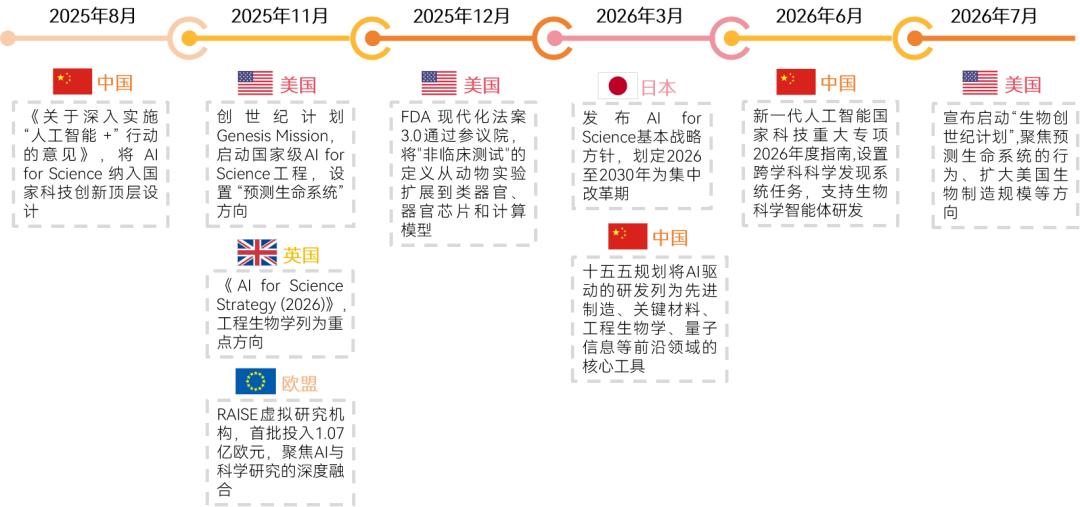
Key AI for Science Policies of Major Economies (2025—2026)
Capital Inflection Point: Global Capital Accelerates Entry, and Industrial Capital Conditions Gradually Mature. As of the end of August 2026, the total financing scale in the global AI Virtual Cell field has exceeded 30 billion US dollars, making it a key investment track in the intelligent direction of life sciences. The domestic market is accelerating later, and the financing boom is concentrated in 2026, showing early-stage characteristics.
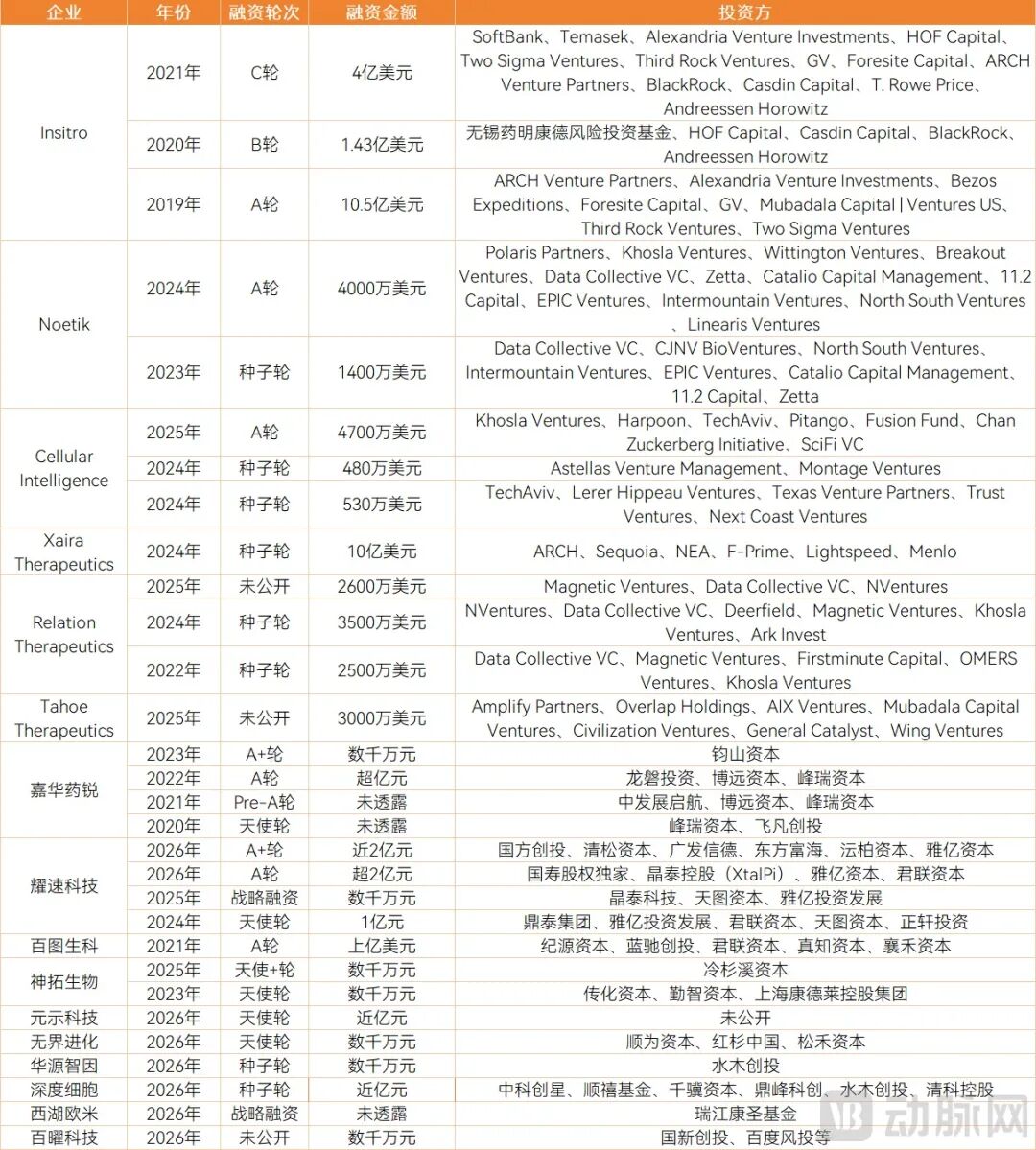
Review of Global AI Virtual Cell Investment and Financing Events
Demand Inflection Point: Traditional R&D System is Under Pressure, and the Industry Faces Rigid Demand. The explosion of AI Virtual Cells is inseparable from the long-standing drawbacks accumulated in the traditional new drug R&D system. Downstream demand has shifted from cutting-edge technology exploration to substantive procurement, a change driven by multiple industry pressures.
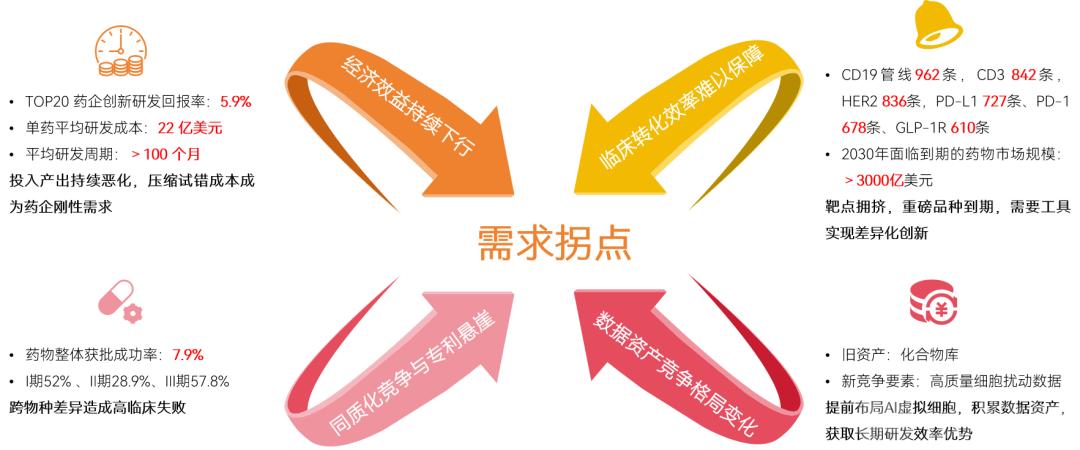
Drug Demand Inflection Point Driven by Four Pressures
Contradictions in Data, Model and Verification Remain to Be Solved, and Large-Scale Implementation Faces Bottlenecks
Under the industrial boom, there are still many deep-seated contradictions in the whole chain from data production, model construction to scenario verification. Along the three industrial chains of data, model and application, Artery Think Tank dismantles the core pain points restricting industry expansion layer by layer, and sorts out the existing constraints.
1. Data Layer Constraints: High-Value Data Production and Standardization Raise the Threshold of Industrial Implementation
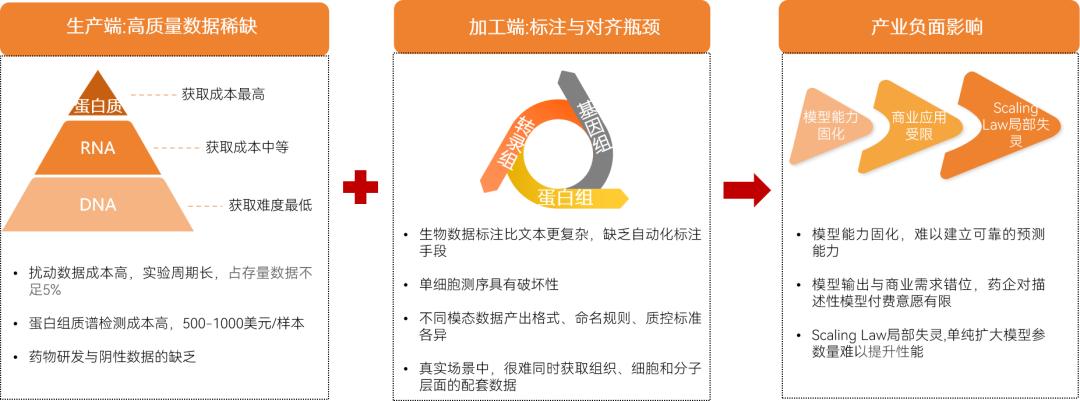
Pain Points in Data Acquisition and Processing
(1) Production End: Insufficient Supply of Perturbation, Protein and Negative Data
Perturbation data has high cost, long experimental cycle, and obvious gap in supply. Perturbation data needs to be generated through targeted intervention experiments, which has high acquisition cost and long experimental cycle. The overall accumulation speed is much slower than static observation data, and it is difficult to support continuous model iteration.
Protein data acquisition faces cost and technical bottlenecks, and the supply is seriously insufficient. In the composition of cellular information, DNA only carries about 10% of static information, RNA reflects about 20%-30% of the preparatory state, and the functional modification of proteins carries more than 60% of the information weight. However, the cost of mass spectrometry detection has not shown an exponential decline trend, and the protein coverage is limited, which makes the difficulty and cost of proteomics data acquisition relatively high.
The lack of drug R&D and negative data also has an important impact on the performance of AI Virtual Cell models. The internal R&D data of pharmaceutical companies is the core material for models to learn the real mechanism of drug action. In particular, negative data covers boundary scenarios such as invalid molecules, toxic reactions, and failed perturbations, which can improve the prediction stability and reliability in real R&D scenarios. However, internal R&D data of pharmaceutical companies is usually not shared externally, and industry practice only retains positive results, a large number of failed experimental data are discarded, and only positive results are retained when cleaning public data, resulting in the model being unable to learn the failure boundary.
(2) Processing End: Two Obstacles of Annotation and Alignment Restrict Data Availability
Even if the data is produced, the processing link before entering the model still faces double obstacles. Biological data annotation is far more complex than text. A single cell state needs to be annotated with multiple dimensions such as gene expression profile, protein abundance, and epigenetic state at the same time. There is almost no automatic annotation method, and it is highly dependent on experts.
Cross-modal and cross-scale data alignment is also difficult. Single-cell sequencing is destructive. After measuring one omics, other omics cannot be measured anymore, so it is naturally difficult to achieve modal alignment. Cross-data source alignment and integration require a lot of batch effect correction and normalization processing, and there is no unified process recognized by the industry at present.
Defects at the data level will form negative conduction along model capabilities, commercial implementation, and scale effects. First, the model capabilities are solidified, and it is difficult to establish reliable prediction capabilities. Second, the model output is misaligned with commercial demand, and pharmaceutical companies have limited willingness to pay for descriptive models. Third, the Scaling Law fails locally, and simply expanding the number of model parameters cannot improve performance.
2. Model Layer Bottleneck: Structural Mismatch Between General Architecture and Biological System Operation Laws
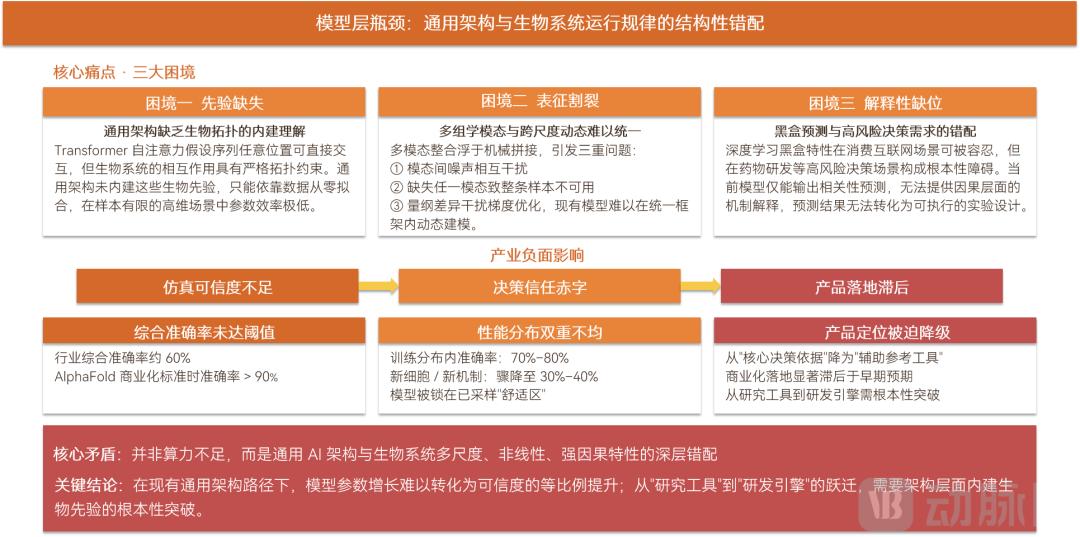
Core Pain Points at the Model Layer
■ Dilemma 1: Lack of Prior Knowledge, General Architecture Lacks Built-in Understanding of Biological Topology
Structural prior mismatch induces core function failure of general AI architecture. The self-attention mechanism of Transformer assumes that any position in the sequence can interact directly, but the interaction of biological systems has strict topological constraints. The general architecture does not have these biological priors built in, and can only fit from scratch relying on data. In high-dimensional biological scenarios with limited samples, the parameter efficiency is extremely low.
■ Dilemma 2: Fragmented Representation, Omics Modalities and Cross-Scale Dynamics Are Difficult to Unify
The formats of multi-omics data are not unified, and cross-modal integration remains at the feature splicing level. This leads to three problems: First, the noise of different modalities interferes with each other, and high-noise modalities will dilute the effective signals of low-noise modalities. Second, the model has too high requirements for modal completeness, and the absence of any modality will lead to the unavailability of the entire sample, and the data utilization rate will decrease significantly. Third, the differences in dimensions and distributions of different modalities interfere with gradient optimization, leading to unstable training.
Spatiotemporal scales span multiple orders of magnitude, and existing models are difficult to achieve dynamic modeling of processes from molecules