How can product managers develop effective career plans in the AI era?
The key to career planning in the AI era is not predicting which positions will disappear, but learning to break down job tasks. Based on reports from the World Economic Forum and real recruitment cases from JD, Moonshot AI and other enterprises, this article reveals the evolution trend of human-AI division of labor, and provides a practical method from task decomposition to competence matrix to help you build competitiveness that will not be eliminated.
Many people ask, with AI developing so rapidly, will the career you choose now still exist in a few years?
This question sounds important, but it is actually difficult to get a useful answer. No one can know in advance which positions will definitely exist in ten years, and no report can directly tell you: what you learn now will definitely keep you from being unemployed in the future.
What career planning really needs to solve is another problem: When work content keeps changing, can I clearly understand what I am doing, know which abilities are depreciating and which are becoming more important, and make timely adjustments?
Instead of asking "Should I enter the AI industry", it is better to first split a career and see what tasks it consists of every day.
01 How Does the Workplace Change?
The 2025 Future of Jobs Report from the World Economic Forum contains a chart illustrating who completes different tasks.
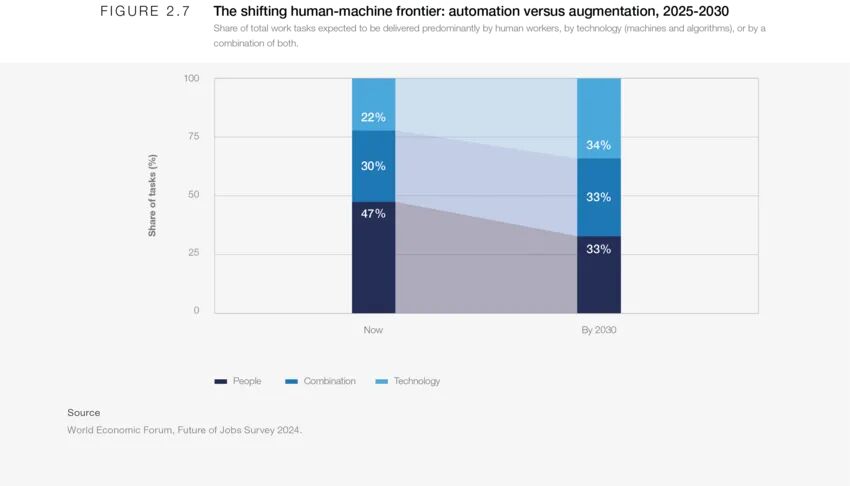
Figure 1 The Shift of the Human-AI Frontier: Automation and Augmentation 2025-2030
According to the survey results in the chart, currently about 47% of tasks are completed by humans alone, about 30% are completed by the combination of humans and technology, and about 22% are completed by technology alone. By 2030, the proportion of the first two will become approximately 33% and 33% respectively, and the proportion of tasks completed by technology alone will rise to about 34%.
The most noteworthy point here is not the exact percentage of a certain number, but the unit of change: What is changing first is the "division of tasks", rather than a list of occupations being crossed out all at once.
In a position, some tasks may be automated, some may be assisted by AI, and some tasks will even require more people to make judgments, coordinate and take responsibilities as AI is introduced into the workflow. The job title remains, but part of the work content has been replaced.
Research on generative AI from the International Labour Organization also provides a similar reminder: about 1/4 of the global workforce is in occupations with a certain degree of generative AI exposure. However, the study believes that work transformation is more likely to happen than the complete disappearance of an entire occupation.
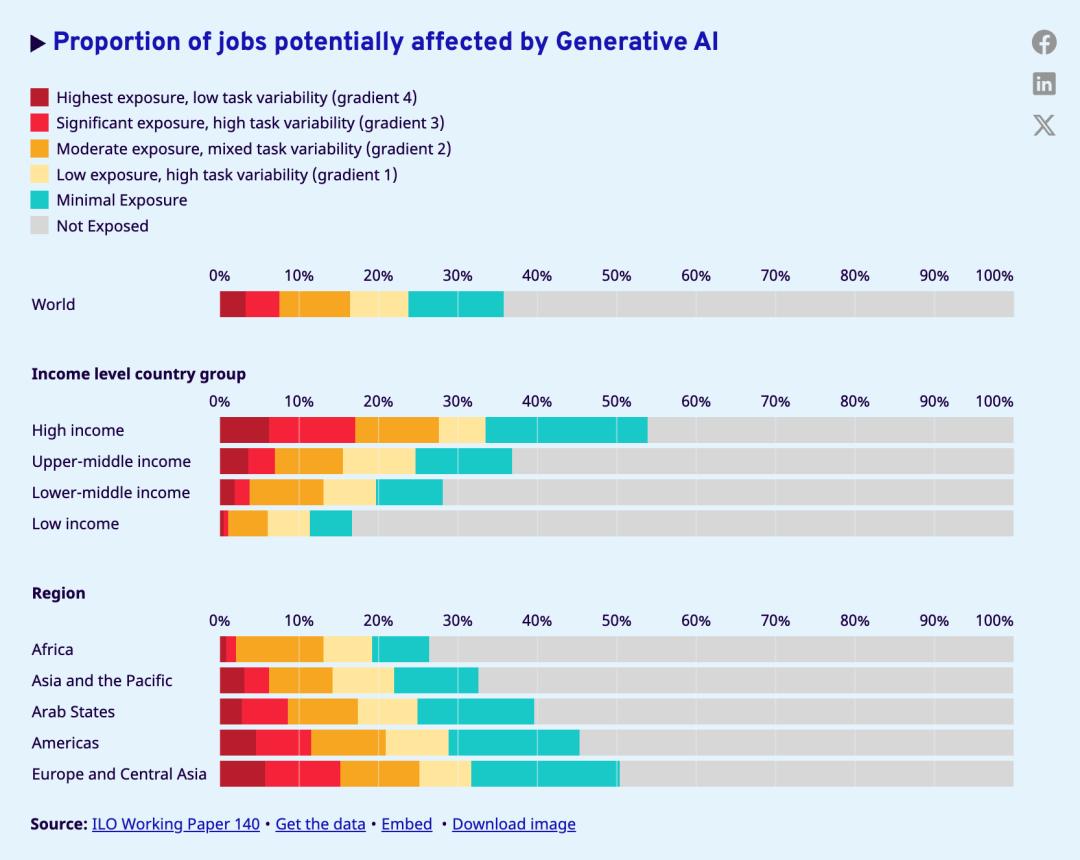
Figure 2 International Labour Organization - What Possible Impacts Can Generative AI Have on Employment?
"Exposure" means that some tasks in this job may be technically affected by AI. Whether an enterprise adopts AI, to what extent it adopts it, and whether employees can transfer to other tasks also depend on cost, workflow, infrastructure and organizational decisions.
Therefore, the first step of career planning is to split your ideal job apart, instead of rushing to label it as "AI will replace" or "AI will not replace".
There is also a scatter plot of occupations:
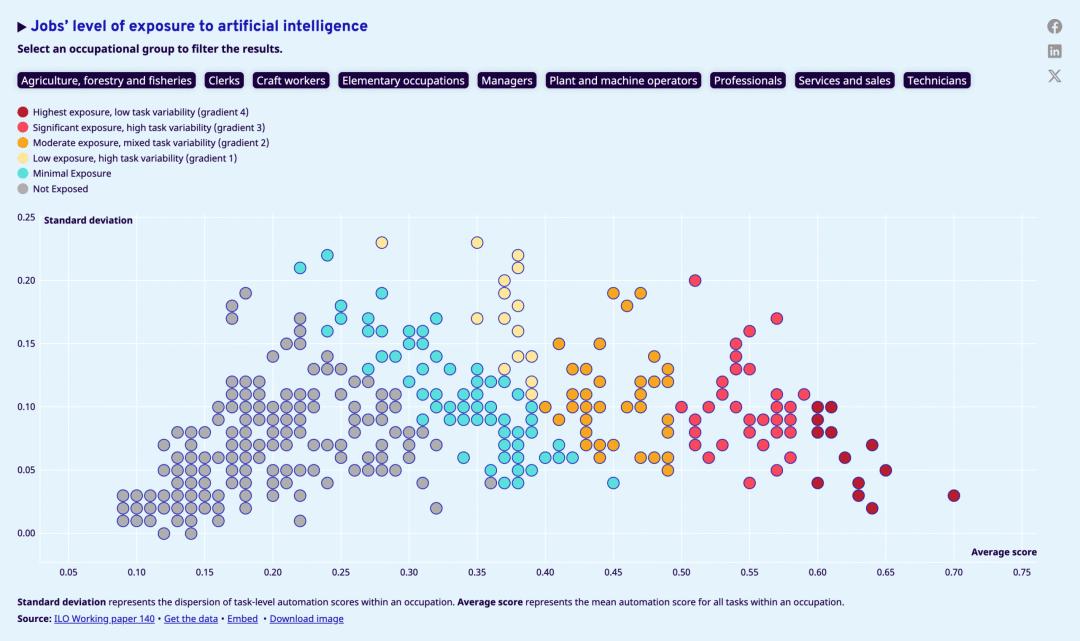
Figure 3 Data from the International Labour Organization - How Generative AI Affects Different Occupations. The horizontal axis represents the average automation score of all tasks within an occupation, and the vertical axis represents the degree of difference between these tasks.
It reminds us: Even within the same occupation, there may be completely different tasks. Some tasks have clear rules and high repeatability; some tasks require on-site judgment, communication, coordination or taking consequences. If you only look at the job title, you are very likely to draw wrong conclusions.
In other words, job titles such as "Product Manager", "Designer", "Operations Specialist" and "Finance Staff" are not detailed enough. The real question you should ask is:
What problems am I solving every day?
Which steps are performed repeatedly?
Where do I need to understand the business?
Which mistakes in judgment must I take full responsibility for in the end?
Looking at recruitment information along this line of thinking will be more specific than looking at a "ranking of popular future occupations".
02 Let's Look at Several Real Cases
1. AI Product Manager at JD Technology: Focus on Implementing Models in Real Business Scenarios
The position in this screenshot is from JD Technology, focusing on intelligent customer service, intelligent speech and intelligent conversational robots. Its responsibilities include solution architecture, production project implementation of technologies such as large models and Agents, the whole process of product launch, data feedback after launch, and cooperation with operations and R&D teams to promote large-scale coverage.
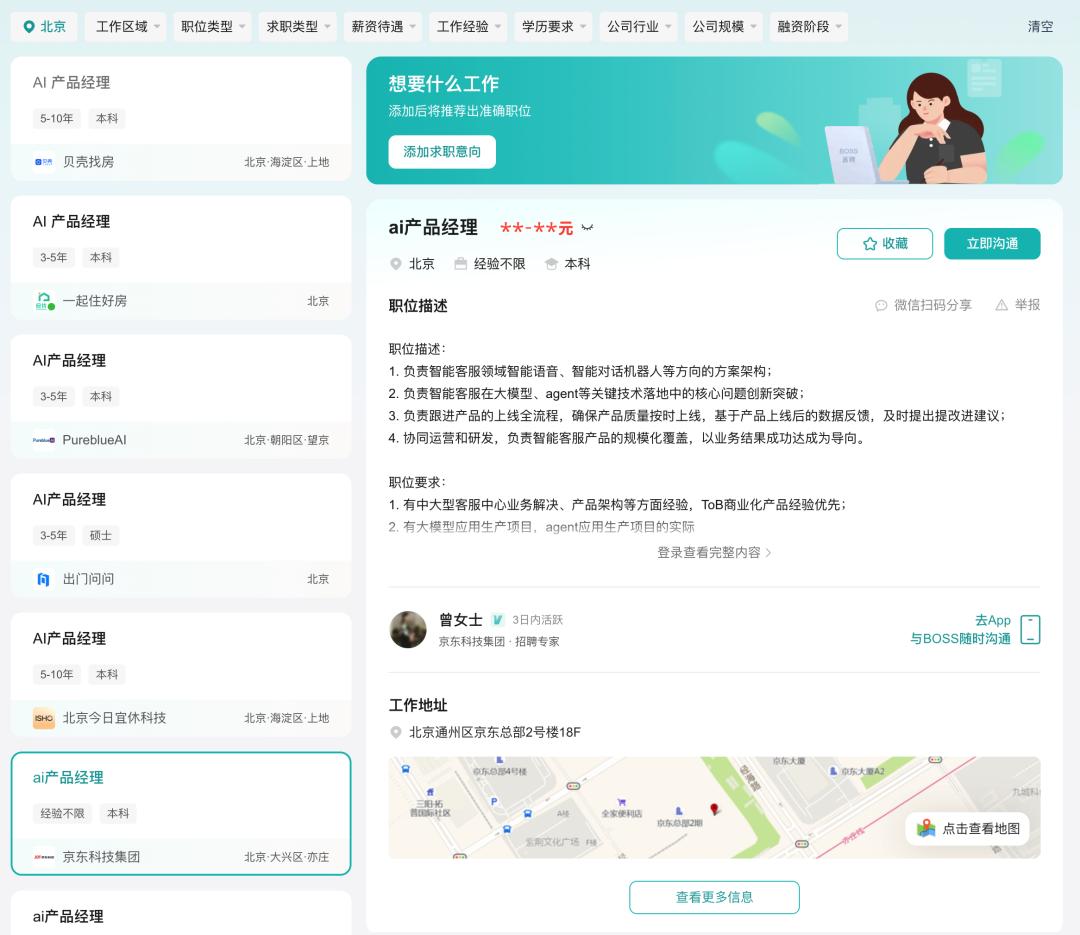
Figure 4 AI Product Manager Recruitment Information in Beijing, Source: BOSS Zhipin
It also puts special emphasis on business results, as well as experience in solving large customer service center business problems and product architecture design.
But the task portfolio of this position is very clear: technology is only one layer, the second layer is business scenarios, and the third layer is quality, data and results after product launch.
A person who only knows how to call models may not be able to finish this job. Because the real difficulty is not connecting the model to the product, but judging which part of the customer service process it is suitable for solving, how to make fallback measures when errors occur, and how to know from the data whether the product has really been improved.
2. AI Product Manager in Shenzhen: The Foundation is Still Basic Product Competencies
The AI product manager position recruited by a company in Shenzhen has labels including cross-border e-commerce, ERP, C-end products and AI projects. Its responsibilities start from product planning, business process sorting, prototype design and function description, and further include requirement verification, user verification, promotion, iteration, as well as full-process management from project initiation to implementation and launch.
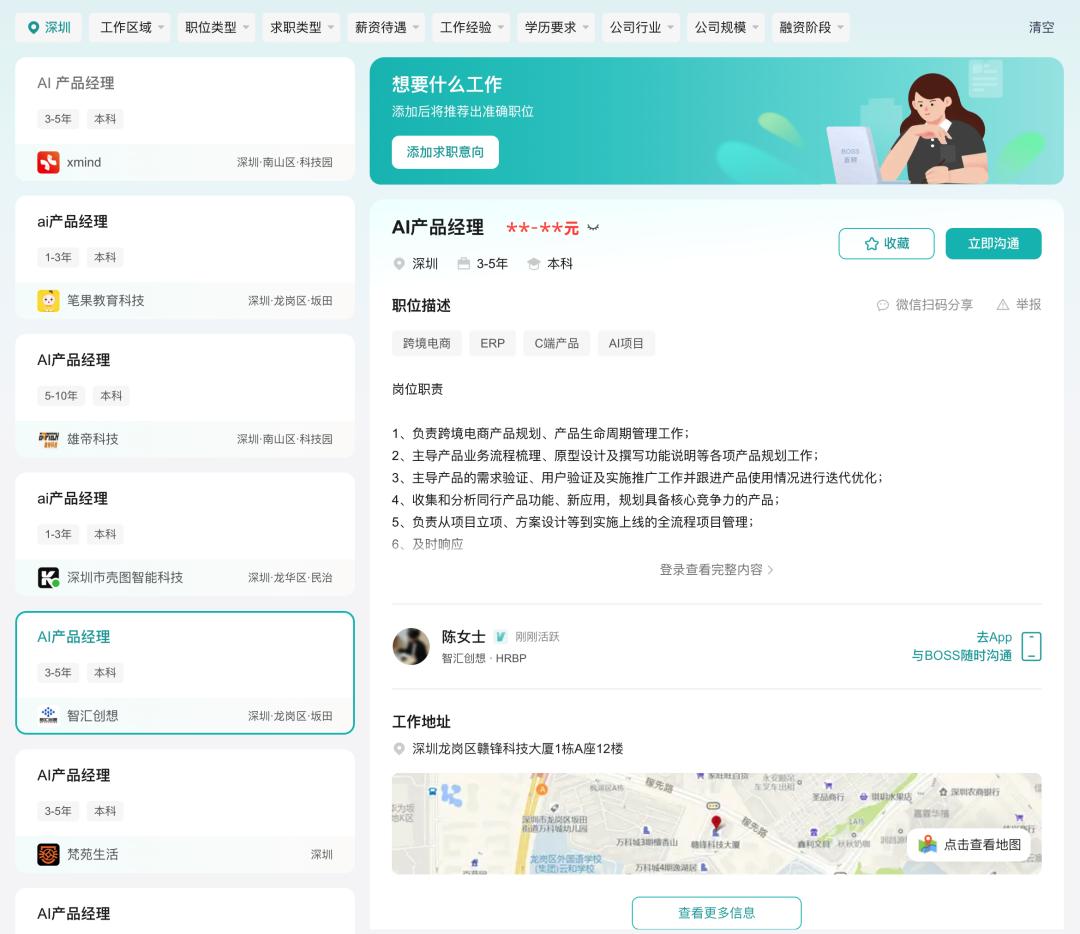
Figure 5 AI Product Manager Recruitment Information in Shenzhen, Source: BOSS Zhipin
This position is more like a traditional product manager job, except that the product has been integrated into AI projects and cross-border e-commerce business.
The reminder this kind of position brings to career planning is very straightforward: many people think that entering the AI industry means starting to learn algorithms, models and prompts, but in fact, basic product competencies may be the foundation. The abilities to clarify business processes, convert requirements into prototypes, verify whether users really need the functions, and promote projects to launch will not disappear automatically just because AI is added to the product.
AI is more like an augmentation layer here. It can help you analyze materials, generate solutions and verify prototypes faster, but product direction, priority setting and launch responsibility still need to be undertaken by humans.
3. AI Product Manager at Moonshot AI: Required to Adopt AI-Native Work Methods
The AI product manager position recruited by Moonshot AI focuses on Kimi Web experience. The screenshot shows the salary range is 35-55K with 16 monthly payments, requiring 5-10 years of Internet product experience and a bachelor's degree.
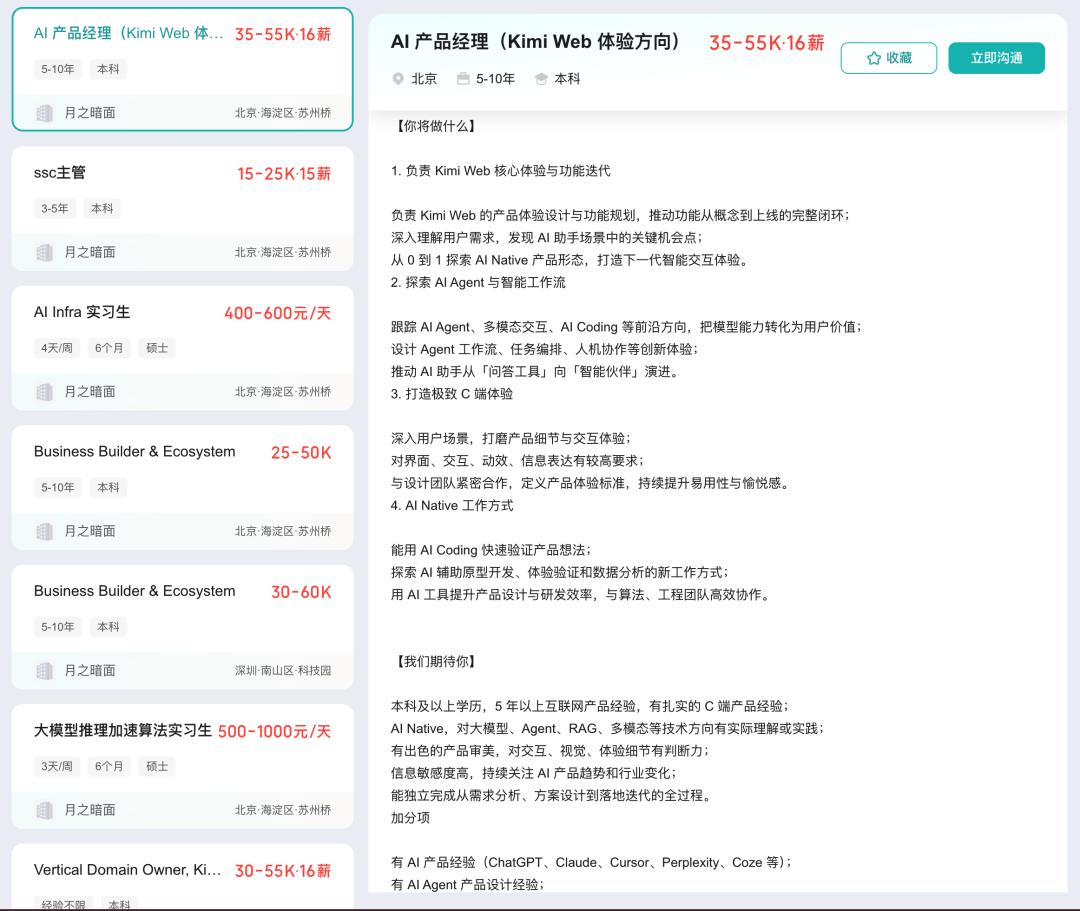
Figure 6 AI Product Manager Recruitment Information in Beijing from Moonshot AI, Source: BOSS Zhipin
Its work content is significantly different from that of traditional product managers: it is responsible for the core experience and function iteration of Kimi Web, explores AI Agents and intelligent workflows, pays attention to multi-modal interaction, task orchestration and human-AI collaboration, and also uses AI Coding to quickly verify product ideas, explore AI-assisted prototype development, experience verification and data analysis.
Terms such as RAG, multi-modality, product aesthetics, C-end experience and end-to-end implementation also appear in the job requirements. It is looking for someone who can understand the capability boundary of new technologies and judge what users really need in the new interaction mode, not someone who can only write a complete requirement document.
The threshold for this kind of position is not just "being able to use several tools". If a person only lists tools such as ChatGPT, Claude, Cursor or other tools on the resume, but cannot clearly explain what problems he used them to solve, how he verified the results, and what product impact he finally brought, the tool names themselves cannot form competitiveness.
Putting the Three Positions Together: What Are Enterprises Actually Recruiting For
Putting the three specific samples together, we can see three different task portfolios.
JD Technology is more focused on AI implementation: integrating large models and Agents into specific businesses such as customer service and speech, and finally evaluating the work based on launch quality and business results.
The position in Shenzhen is more focused on the augmentation of traditional product capabilities: requirements, processes, prototypes, verification and project management are still the main work. AI has been introduced into business scenarios, but it does not replace basic product competencies.
Moonshot AI is more focused on AI-native experience: product managers need to understand Agents, workflows, multi-modality and AI Coding, and be responsible for C-end experience, interaction details and product aesthetics at the same time.
The common points of the three positions are more worthy of attention than their job titles:
Able to understand specific businesses and user problems;
Able to judge which link the AI technology is suitable for being applied to;
Able to promote the solution to launch and iterate according to feedback;
Able to work together with R&D, design and operation teams;
Able to convert tool usage into results, rather than just expanding the list of tools you have used.
What really determines whether you are suitable for a position is the task portfolio within that position.
03 How Ordinary People Do Career Planning
Combining the previous macro reports and the specific cases of the three positions, our career planning can start from the following steps:
First, narrow your goal from the whole industry to specific job tasks.
"Entering the AI industry" is too broad a goal. You can rewrite it as "working on intelligent customer service products", "doing AI projects in cross-border e-commerce", "developing AI-native C-end experience", or even more specifically writing down what the target position needs to deliver every day.
The more specific the goal is, the more targeted your subsequent learning will be, instead of just collecting various tools.
Second, collect a set of real recruitment information.
First collect 10 to 20 similar positions, and record their job responsibilities, business scenarios, experience requirements, educational requirements, technical requirements and result requirements respectively.
What you need to find is not "what all positions require", but which requirements appear repeatedly in the target positions, and which are only the special preferences of a certain company.
Third, build your own competence matrix.
It can be divided into at least three layers:
Domain and business competence: understand users, workflows, industries and business goals;
AI and product competence: understand how tools, models, Agents or data are integrated into workflows, and can also complete requirement sorting, design, verification and iteration;
Human-centric competence: analysis, judgment, communication, collaboration, aesthetics, and the ability to take responsibility when facing uncertainties.
These three layers need to be combined in a real task. For example, when developing an AI customer service product, you not only need to understand the customer service process, but also know which problems the model is prone to make mistakes on, and be able to promote the operation and R&D teams to jointly develop the fallback solution.
Fourth, form competence proof with real projects.
Courses and certificates can help you get started, but recruiters are more eager to know whether you can get the work done. When you complete a full project by yourself, you should at least be able to clearly explain: what the problem is, why AI is used, how the solution is designed, how to verify it, what the result is, and which parts still need human responsibility.
The project does not have to be very large. A small closed-loop that can run smoothly is more persuasive than a solution full of technical terms.
Fifth, review regularly instead of making a one-time lifelong decision.
You can check every 3-6 months: Has the target position changed? Have the projects you completed really filled your competence gaps? Where do you get stuck most often in application and interview feedback? Does your current work allow you to access higher-value tasks?
If the feedback shows that your direction is not correct, adjust the position or task portfolio; if there is only a competence gap, continue to improve it; if there is no real opportunity in a direction for a long time, you can also exit in time. The value of planning is not to make people stick to their original choice forever, but to make every adjustment you make supported by evidence.
Effective career planning is not to guess the only correct career in the future in advance, but to choose a specific task scenario, continuously accumulate competence proof, and then adjust your position according to real feedback.
This article is from the WeChat Official Account "Everyone is a Product Manager" (ID: woshipm), the author is Lao Miao, an AI product manager. 36Kr publishes this