Manus is back, but the battlefield for Agents is already crowded with competitors
By Li Zhaofeng
Edited by Zhang Yuxin
On March 6, 2025, the day Manus was launched, a group of engineers in the office looked at an NBA player quadrant chart generated by Manus and found it extremely impressive — the chart was lined with player avatars distributed based on scores and shot attempts. Xiao Hong, the founder, later recalled that what surprised them was not how difficult the quadrant chart was to draw, but that the work that used to be done step by step by humans could now be completed by the Agent all the way to delivery as long as the requirements were specified.
A year later, the Manus team included this memory in an open letter. At the beginning of the letter, Xiao Hong summed up the original idea in one sentence: "AI should not only think, but also act."
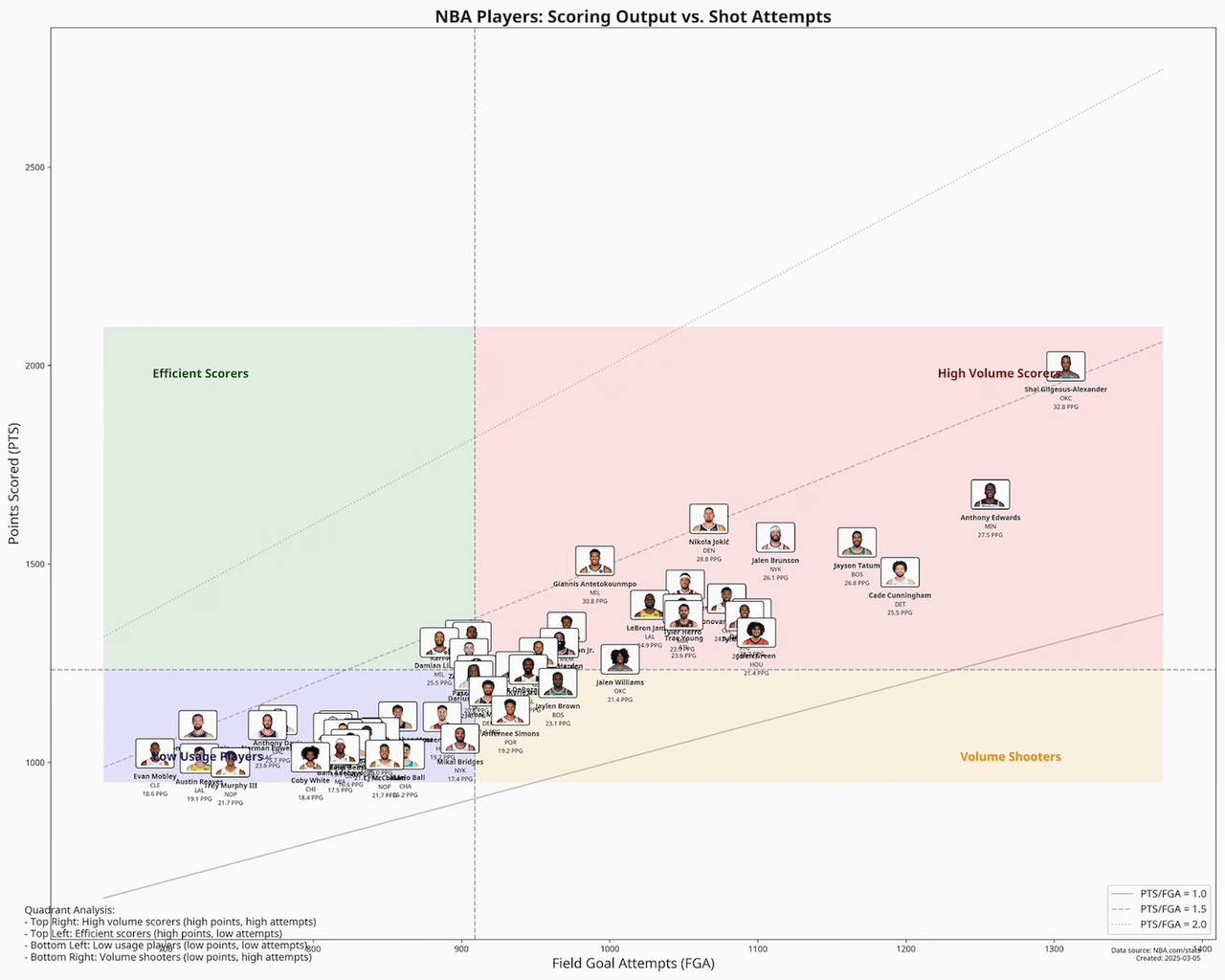
Analysis chart generated by Manus
Yesterday, Manus, which resumed independent operation, released version 2.0, and launched an independent application Cue for personal affairs at the same time. According to official introduction, version 2.0 upgraded Cascade, its self-developed Agent framework; automated tasks can be triggered by new emails, calendar events and other signals. The original desktop application has been upgraded to Manus Studio, with a video editor that can modify the rough cut timeline and a game development environment. Cue, which is more focused on personal life, claims that it can send messages, answer incoming calls for users, and handle trivial matters in daily life.
Going back to the time when it was first launched in 2025, Manus could only be used with an invitation code. Some people on Xianyu claimed to sell Manus invitation codes with a price tag of more than 40,000 yuan. The Manus team later responded that the official had never opened a channel for paid invitation codes.
In the launch video at that time, Ji Yichao, chief scientist of Manus, demonstrated how this Agent screened resumes, analyzed stocks, and looked for properties in New York, which also attracted competing reports from Chinese and American technology media. Manus let more people see for the first time that an Agent can take over a task, complete it step by step on its own, and then deliver the result.
In the following year, Manus experienced several changes in its fate. At the end of 2025, it announced that it would join Meta. On September 1 this year, Manus announced that it would resume independence and remain led by the founding team. Less than a month after the official announcement of its return, the Manus team launched version 2.0. Only this time, the Agent track is already crowded with competitors.
A year ago, automatically generating a picture, a report or a website was very new to many users who were new to AI. Today, a year later, "AI doing things on its own" is no longer unusual. Programming Agents include OpenAI's Codex and Anthropic's Claude Code; products such as Microsoft Copilot Cowork and Tencent WorkBuddy are also taking over ordinary people's office tasks.
Personal affairs have also begun to be taken over. Meta's Muse has been gradually opened in the United States and can receive tasks from WhatsApp. According to Sensor Tower's estimate, as of September 24, the cumulative downloads of Muse's independent App have exceeded 3.4 million times. In China, Alibaba's Qwen App has demonstrated placing orders through Taobao Flash Purchase and making payments in conversations; ByteDance's Doubao Mobile Assistant is also trying to cut into ordinary people's life scenarios from the mobile end.
This time, Manus 2.0 and Cue are facing a competition crowded with rivals, and it is not easy to reproduce the amazing performance of 2025.
01 While upgrading the workbench, it also wants to "Cue" personal affairs
In addition to upgrading the existing Agent framework, Manus 2.0 also brings a new name: Manus Studio. As early as March this year, Manus launched a desktop application that allowed users to authorize it to operate local files and tools; Studio is an upgraded version of this desktop application.
Cue is another independent application that shares the underlying facilities with Manus and targets personal life tasks. Manus officially stated that Cue supports web, desktop and mobile terminals, and is currently available for early access with an invitation code; as of the release of the product announcement last night, the iOS version was still waiting for App Store review.
This round of release is mainly for overseas users. At the same time, Manus is also preparing products for the domestic market separately.
Efficiency is the key point of Manus's optimization in this round.
Cascade is exactly the latest iteration of Manus's self-developed Agent framework. Manus claims that in one test configuration, it uses 23.2% less Tokens than the old system, the task time is shortened by 28.2%, and the operating cost is reduced by 32%.
For long-running tasks, Manus 2.0 adds a new event trigger function: new emails, calendar events, or information updates in Slack and Notion can all start preset workflows. The cloud computer continues to undertake long-running tasks and can also host multiplayer game servers. This seems to fit the vision that Xiao Hong and the team wrote in the annual letter in March this year: let Manus work around the clock, and find tasks that users are willing to hand over to it for a long time and whose operating cost is affordable.
At the application layer, Manus Studio upgraded from the desktop version puts documents, spreadsheets, PDFs, and slides in the same workspace, and also covers websites, codes, games and videos. The newly added video editor and game development environment allow users to continue to make modifications after getting the first draft.
In addition to the work scene, Cue, which focuses on personal affairs, has also entered the daily life track. According to Manus's introduction, each Agent in Cue can have its own email address, phone number, wallet and computer; it can send messages, answer incoming calls and leave summaries, and can also make payments within the budget set by the user.
However, the product concept of Cue was not a temporary decision made by the Manus team. Manus had previously tried to let Agents enter the chat scene: in February this year, it connected Agents to Telegram, allowing users to assign tasks in ready-made chat software. When Cue was launched in September, Manus let the Agent go to work with its own identity. One scene depicted by the official is: the user scans a code at a restaurant and asks the Agent to order food or take a queue number on his behalf.
The current interaction mode of Cue is still more in line with the habits of overseas users. When using Cue for the first time, the App pops up several prompts marked with "use case from X", including sending an email to the restaurant to ask for the address and checking the bills in Gmail. It is not difficult to find that these usages are far different from the way of handling daily trivialities in China.
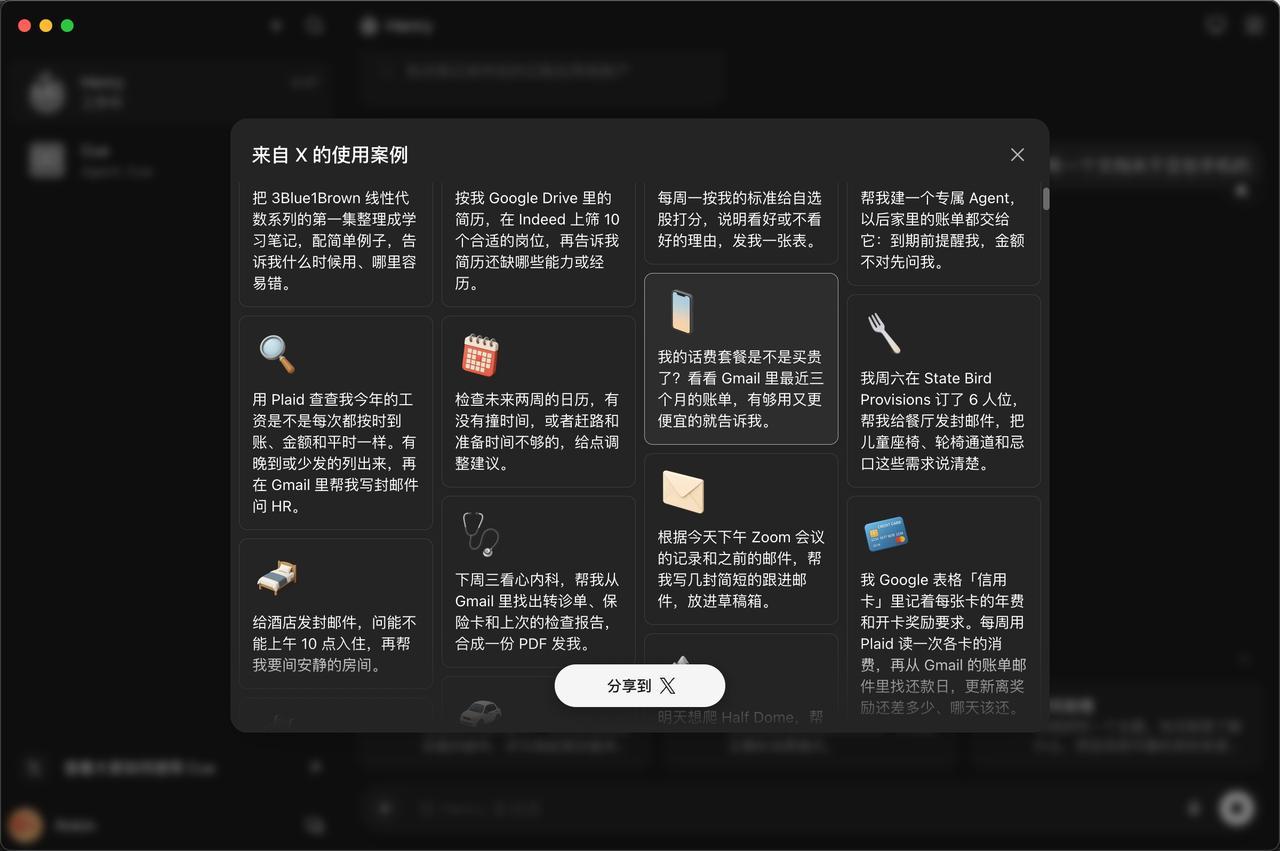
Official case of Manus 2.0
Although the Manus team said it would launch products for the domestic market, these life demands in China have long been tied to a large number of super Apps. To find restaurants, order food, take a taxi and make payments, many people will directly open WeChat Mini Programs, Alipay, Douyin, Meituan or Didi. Merchants, orders and payments are all kept in these platforms.
To put it more bluntly, in China, the space left for independent Agents in personal life is still a question mark.
02 The Agent war, from coding, office work to daily life, is crowded with competitors
"It is very dangerous when large companies understand your innovation." Xiao Hong said in an interview before Manus was launched last year. At that time, he was talking about the Monica browser plug-in being followed up by large companies, and the ensuing entrepreneurial anxiety: as soon as an AI application comes up with something new, large companies may put similar capabilities into their own products.
When the first generation of Manus was released, it was still an avant-garde product in the eyes of the public. Now that Manus 2.0 is back, Agent is no longer a fresh concept.
In programming and deep work scenarios, Coding Agents have begun to take over more and more long-chain tasks. In June this year, OpenAI disclosed that Codex had more than 5 million weekly active users, of which according to the company's caliber, about 20% were knowledge workers, and some used it to do non-coding tasks such as reports and spreadsheets.
Microsoft previously demonstrated a sales case: the person in charge asked Copilot Cowork to find out which potential customers had not made progress for a long time, and Cowork found where the follow-up was interrupted. Microsoft said that it completed the records that originally required manual investigation for a whole morning.
With the permission of the company, Cowork can access the data in tools such as Outlook and Teams. Microsoft disclosed in July this year that Microsoft 365 Copilot has more than 30 million paid seats, which means that Microsoft already has a group of paid customers who can promote new functions.
During the year when Manus experienced ups and downs, office Agents have entered the market in batches. In March, Tencent launched WorkBuddy; in August, Alibaba integrated the capabilities of QoderWork, Wukong and MuleRun to launch Qwen Office; ByteDance upgraded TRAE SOLO to TRAE Work on the one hand, and launched "Doubao Work" in Feishu on the other hand, allowing Agents to enter the office process.
According to statistics from Analysys in June this year, a total of 17 domestic desktop office Agents under monitoring have received more than 60 million visits, of which Tencent WorkBuddy has 20.97 million visits, ByteDance's TRAE IDE domestic version has 12.79 million visits, and Alibaba QoderWork has 7.88 million visits.
On the personal Agent side, Muse also has Meta's ready-made resources available. In the example given by Meta, Muse can organize the Instagram recipes collected by users into a shopping list and remember the food restrictions of guests; when it comes to purchases, it can also get the user's consent first and then pay with a one-time Stripe Link card. To handle these daily affairs for people, it has to connect to the services that users originally use, which is not easy for independent Agent companies.
In China, some AI applications have also begun to take over specific life tasks. In January this year, at the Qwen App launch conference, Wu Jia, Vice President of Alibaba Group, used it to order 40 drinks: Qwen placed an order through Taobao Flash Purchase, Wu Jia confirmed and paid with Alipay in the conversation, and the drinks were delivered later. In September, CaoCao Mobility announced that the AI taxi service in cooperation with Doubao was first launched in Beijing, Hangzhou and Suzhou. When users check routes and find restaurants in Doubao, they can then choose travel plans, and CaoCao Mobility will provide vehicle services.
Cue has also proposed the scenario of scanning codes in restaurants and letting Agents order food on behalf of users. But if it wants to gain a share in the domestic market, how to access merchants and services on various platforms is a problem that the domestic version of the product needs to solve in the future.
The greater unknown comes from commercialization. Manus reported in December last year that its ARR exceeded 100 million US dollars. But today, it is facing a group of rivals who compete for users by giving free quotas first: the WorkBuddy experience version gives 500 points per month, and new free TRAE users can get 4000 points.
The upgrade page of Manus Studio shows that the Manus Pro package is $20 per month. However, after the upgrade of Manus 2.0, free users received 1500 credits. All parties are giving quotas and competing for entrances. It is still unknown whether Manus can leverage a new round of commercialization with version 2.0.
In more daily usage scenarios, the basic functions of Doubao and Qwen can also be used for free; WeChat's AI assistant "Xiaowei" has entered the gray test.
In fact, it has only been more than a year since that amazing demonstration in 2025. But for ordinary users today, the moment when a product can be remembered just by saying "AI will do things on its own" seems to have been gone for a long time.
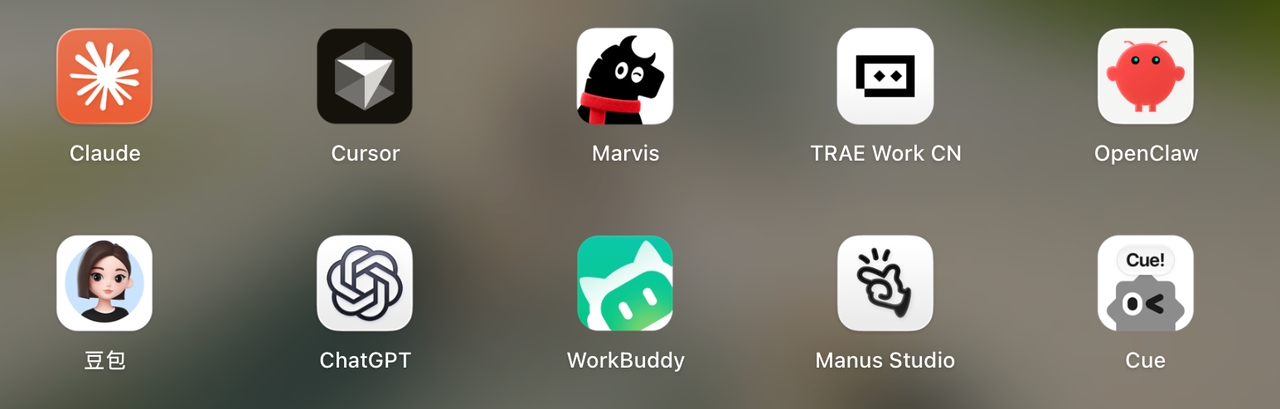
There are already a wealth of Agent products on the market
After experiencing Manus 2.0, it is still an efficient Agent tool. Although it is not known which models are called behind it for the time being, in actual use, Manus Studio can meet demands in multiple scenarios, including some scenarios involving multi-modal capabilities: making a PPT or generating a renderings. Opening the Cue that is still in the testing phase, you can quickly find some small ingenious designs: you can customize the working mode of the Agent, and the interaction has a more distinct personality, which are the plus points of Manus 2.0.
Only, at the present of 2026, looking at the icons of Agent/AI applications on the computer screen, Manus no longer seems to be the only amazing option.