From the paradigm of segregated space and terrestrial computing to integrated space-ground collaboration, how is space computing being turned into reality?
Putting servers into rockets, sending them to orbits hundreds of kilometers away, and even enabling large models to run in space was a sci-fi-sounding vision just a few years ago. Today, with the continuous evolution of computing payloads, inter-satellite communication and commercial launch capabilities, "computing power going to space" has moved from conceptual discussion to engineering verification. At the 2026 Yunqi Conference, space computing has also become a highly concerned technical path under the "future computing" topic.
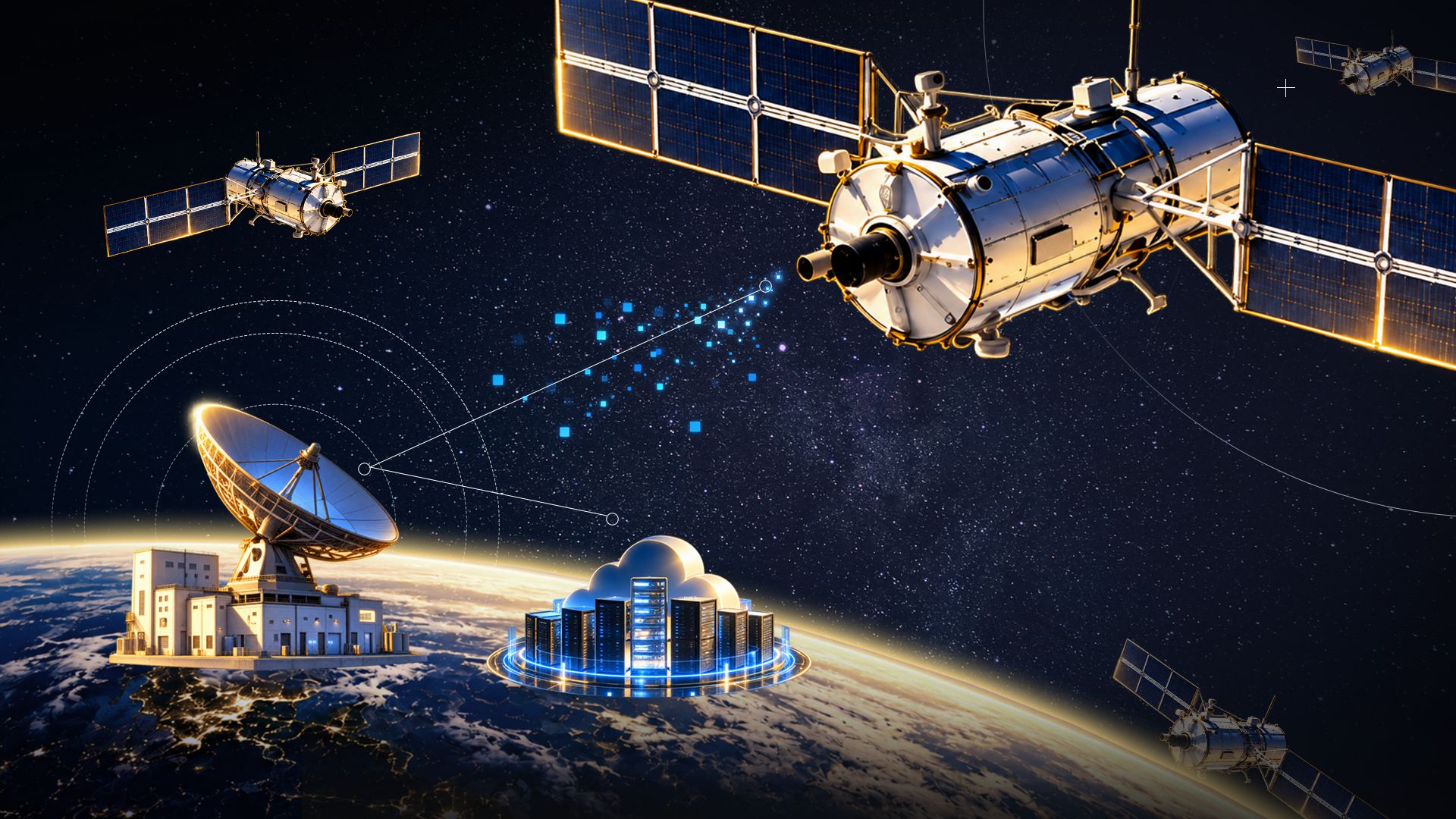
However, space computing does not mean simply moving ground data centers to space as they are. It is closer to a computing system that connects the sky and the earth: capabilities of chips, networks, data, models and agents are distributed on both satellites and the ground, working collaboratively according to mission requirements. As a result, satellites are no longer only responsible for collecting and transmitting data back, but gradually have the capabilities of on-orbit processing, understanding and response.
Over the past decades, the mainstream operation mode of remote sensing satellites can be summarized as "space data, ground processing". After the satellite completes shooting, it transmits the original data back to the ground for processing by the data center. This mode has supported the mature remote sensing industry, but it is also constrained by ground-space bandwidth, communication windows and processing delay. As the remote sensing resolution improves and the constellation scale expands, the data volume grows rapidly. If all original data is downloaded completely, the pressure on cost and timeliness will rise accordingly.
01. Satellites are starting to "think"
In scenarios such as disaster monitoring, this contradiction is particularly prominent. After severe convective weather, fire spots, floods or surface changes occur, the time left for emergency response may be very short. If satellites can only transmit massive images first and then queue up for ground processing, the value of information will decay over time. A more ideal approach is to let satellites filter and identify data on-orbit first, and only transmit high-value data or preliminary results back to the ground, so as to gain time for subsequent analysis and judgment.
As a result, "space data, space processing" has become a new exploration direction. A straightforward metaphor is: traditional remote sensing satellites are like film cameras, which need to be "developed" back on the ground after shooting; computing satellites are more like smartphones, which can complete part of the identification and processing while shooting. SpaceWill has achieved 400TOPS computing power per satellite through self-developed computing payloads; StarX Space has embedded computing capabilities into the imaging link of SAR satellites to explore on-orbit calculation and intelligent processing.
But satellites are not miniaturized versions of data centers. The orbital environment has strict restrictions on power consumption, heat dissipation, volume and reliability, and the on-board computing resources cannot expand infinitely. Complex model training, massive historical data comparison and cross-constellation mission scheduling are still more suitable to be undertaken by ground cloud computing infrastructure. Simply emphasizing "sending more computing power to space" will easily ignore the real engineering difficulties of space computing.
02. On-orbit judgment, ground training
Therefore, the industry is forming a more practical path: full-stack intelligent collaboration between space and ground. Satellites in space are equipped with highly reliable computing chips and lightweight models to undertake real-time perception, data filtering and on-orbit reasoning; the ground is responsible for large model training, model services, data governance and unified scheduling. The ground sends mission instructions, model parameters and scheduling strategies to space, and satellites return collected data, identification results and operation information, forming a two-way closed loop.
The value of this architecture lies in allowing the space and the ground to handle the tasks they are better at respectively. Taking meteorological early warning as an example, satellites can first capture abnormal clues and generate preliminary results, and the ground cloud can then combine multi-source data for fine prediction. For 3D mapping and spatial governance, satellites can quickly detect surface changes, and the ground can then integrate remote sensing, positioning and other data to complete reconstruction. The former saves response time, while the latter provides stronger computing and data capabilities.
03. From "selling images" to "selling results"
The change of computing architecture is also driving the change of business models. In the past, remote sensing services were more about "original data delivery": after customers obtained the images, they still needed to organize teams to complete processing, identification and analysis. The data itself is valuable, but there is still a set of professional processes between it and business decision-making, leading to a high threshold for use.
Under the space-ground collaboration architecture, the deliverables have the opportunity to change from original files to results that can be directly imported into business processes. Customers submit an observation, identification or emergency analysis mission, the system matches the corresponding satellites, computing power and models, and finally returns change identification, risk warning or scheduling suggestions. For industries such as emergency response, transportation, energy and agriculture, a satellite photo is only raw material, and customers care more about whether the judgment behind the photo can arrive in time.
The content purchased by customers will also change accordingly: a one-time data download may become a continuous service. The system needs to continuously accumulate mission data, iterate models, and adjust scheduling strategies according to new satellites and computing resources. Whether this service form can be established ultimately depends on whether the results are stable, the timeliness is sufficient, and the cost is better than the original process. The ability to perform on-orbit computing technically is only the starting point; only when people are willing to pay continuously can it prove that real demand has been found.
This also means that the industrial chain of space computing cannot be developed only around a single satellite or a single chip. It requires computing chips adapted to the space environment, satellite platforms, inter-satellite networks and ground stations to provide bearing and connectivity, as well as cloud computing, resource scheduling, data pipelines, large models and agents to provide processing capabilities. Going one step further, large-scale networking also depends on launch costs, transport capacity supply, system standards and open interfaces. The absence of any link may make technical verification stay at the single-point demonstration stage.
04. Looking up at the stars from the cloud
For the industry at the current stage, there are still many questions to be answered for space computing. Should on-board chips be reinforced from mature ground products, or should space-native architectures be designed from scratch? Is on-orbit computing power a capability that can be priced separately, or should it be hidden in services, with its value reflected by faster and more accurate results? When the number of satellites increases, how to solve the problems of transport capacity cost, network collaboration and safe operation? These questions together determine whether space computing can move from "being achievable" to "being affordable".
This discussion took place in Yunqi Town, Hangzhou. More than a decade ago, Alibaba Cloud was also here, introducing cloud computing to the entire industry for the first time; today, people are beginning to try to extend the boundary of computing from ground computer rooms to low-Earth orbits. The two are not simple copies. Ground cloud computing pursues large-scale, standardized and elastic supply, while space computing must face harsh environments, limited resources and high deployment costs.
Precisely because of this, the realistic path for space computing is not to replace the ground with orbits, but to form collaboration between the two. When satellites can understand data on-orbit, the ground can continuously train and schedule models, and users can obtain results just like calling services, computing power will truly become part of the space-ground integrated digital infrastructure. At that time, when users call a computing task, they may no longer need to care whether it comes from a ground data center or a low-Earth orbit hundreds of kilometers away.