Guide for Product Managers Transitioning to FDE.pdf
Over the past year, "FDE" (Forward Deployed Engineer) has evolved from an internal job title at Palantir to one of the hottest recruitment keywords in the AI industry. Large model companies such as OpenAI and Anthropic are hiring for this role, and domestic companies focused on Agent and industry-specific large models are also recruiting FDEs. Meanwhile, a large number of product managers have begun to seriously consider a question: should I switch to FDE?
This article will first pour a basin of cold water, then show a clear path forward. The cold water is: FDE is not a "product manager who can write code", nor is it an "upgraded version" of product managers, and many PMs have a wrong imagination of this role. The path is: if you are truly suitable for this role, PMs are indeed one of the groups with the greatest potential to transition to FDE, but the premise is that you are willing to let go of some of the things that PMs are most proud of.
01. First make it clear: what exactly does an FDE do
The essence of FDE can be summed up in one sentence: Bring the company's products and technologies, embed yourself in the customer's site, truly solve the customer's business problems, and bring back the on-site insights to iterate and improve the product.
There are three key points here. The first is "embed in the site": FDE is not remote support, but to integrate into the customer's business process and sit side by side with the customer's front-line employees. The second is "truly solve the problem": the performance assessment of FDE is not based on how many features are delivered, but whether the customer's business indicators have improved, such as how much customer service costs have been reduced, and how much the order review efficiency has been increased. The third is "bring back insights": a good FDE is the farthest tentacle of the product team extending to the market, and the common problems found on site need to be precipitated and fed back to the platform.
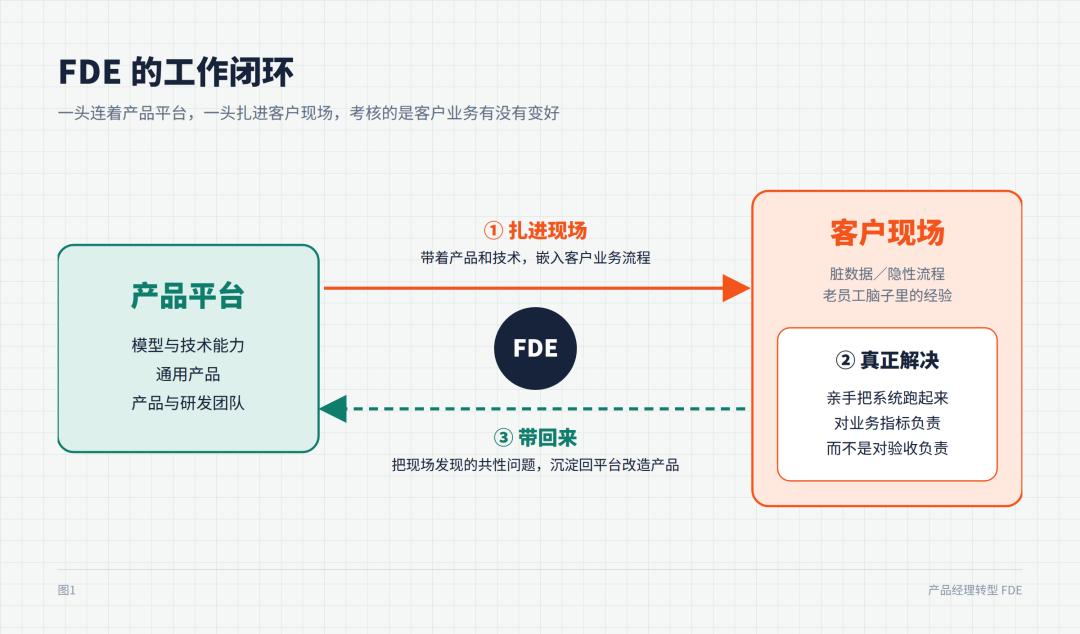
Why did FDE suddenly become important in the AI era? Because there is a wide gap between the capabilities of large models and the actual value of enterprises: enterprise data is messy, processes are implicit, knowledge is stored in the minds of senior employees, and the criteria for judging "good or bad" have never been written down. No matter how powerful the model is, if no one connects it to the business, it is just a chat box. FDE is the one who fills this gap.
Comparing FDE with several easily confused roles will make the difference clearer:
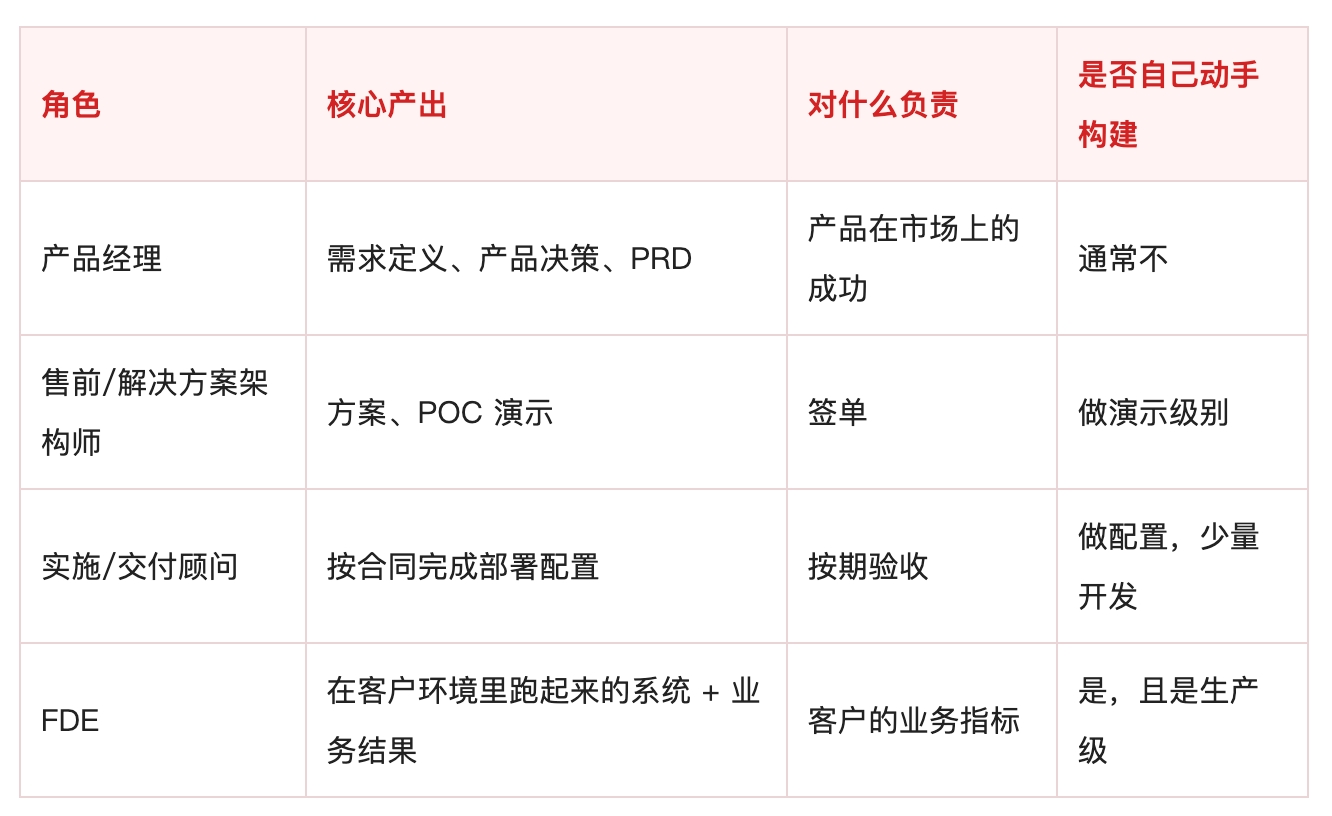
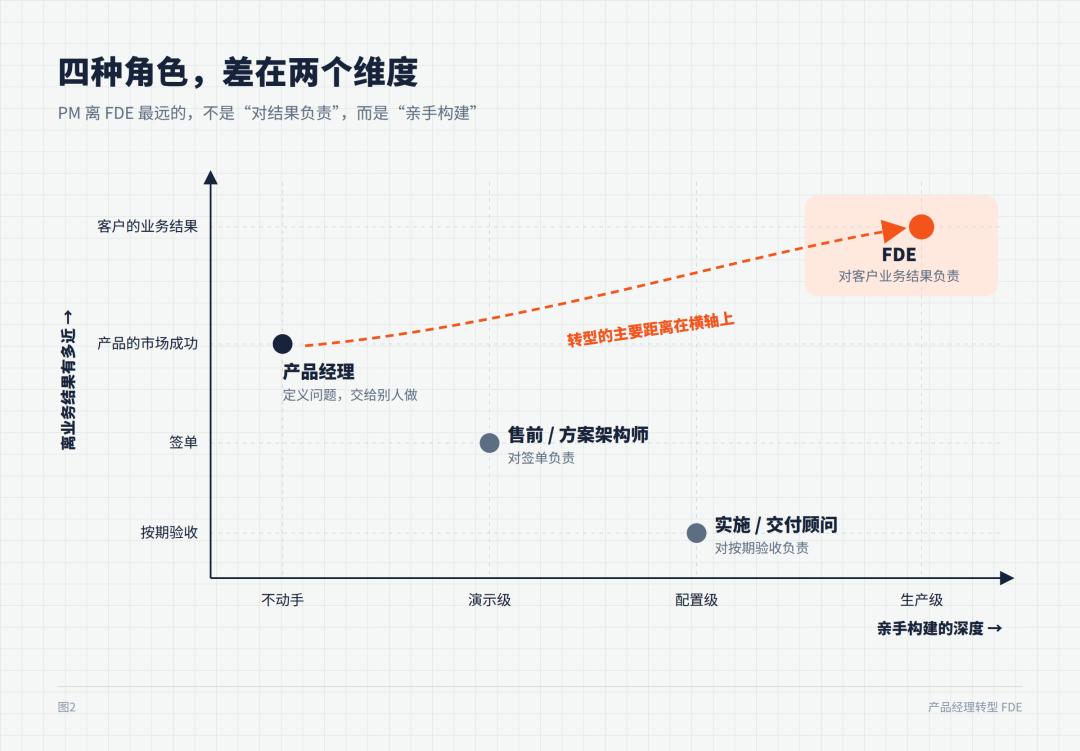
After reading this table, you will find that FDE is actually most similar to a "one-person startup team": you discover problems by yourself, define solutions by yourself, write code by yourself, and take full responsibility for the results.
02. PM transitioning to FDE: advantages are real, and misconceptions are also real
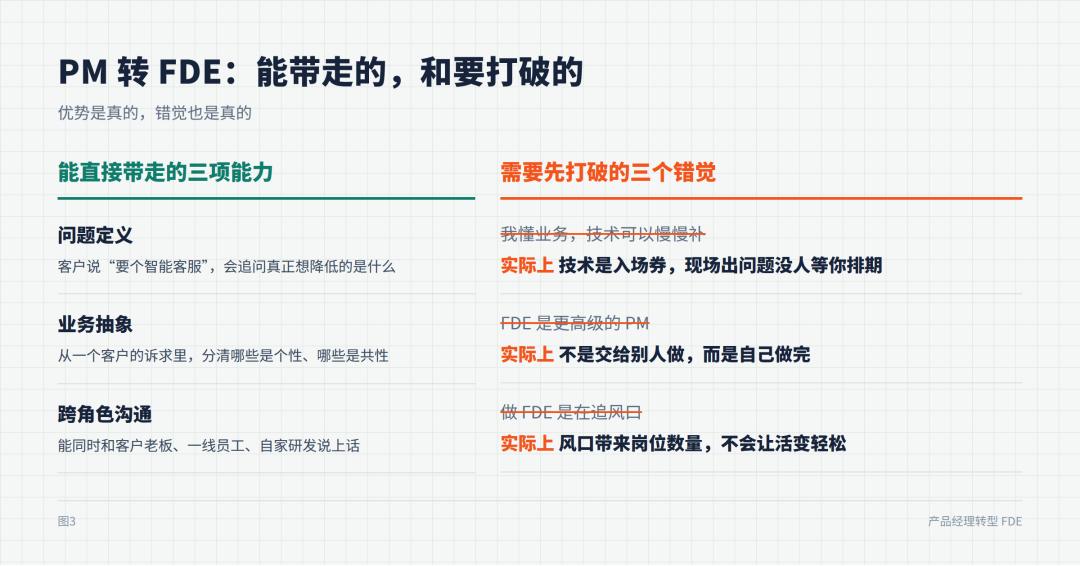
Let's talk about the advantages first. For PMs transitioning to FDE, there are three types of capabilities that are difficult to quickly master for people from other backgrounds. The first is problem definition capability: when a customer says "I want an intelligent customer service", PMs will naturally ask "what is the cost you really want to reduce". The second is business abstraction capability: they can distinguish which demands are personalized and which are common from the specific requirements of a single customer. The third is cross-role communication capability: they can talk to the customer's management, front-line employees, and their own R&D team at the same time. These three capabilities are precisely the shortcomings of many FDEs with pure engineering backgrounds.
But several misconceptions are more worthy of vigilance.
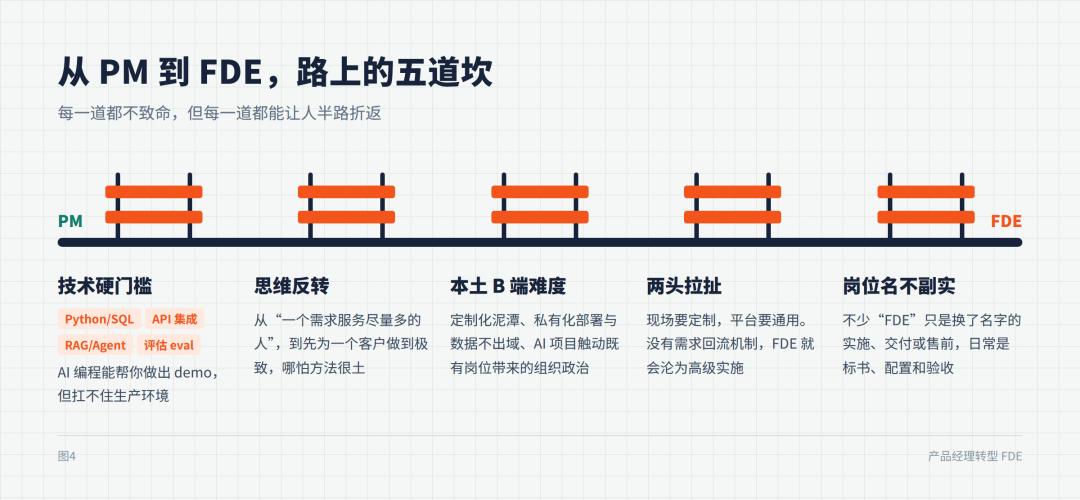
Misconception 1: I understand the business, and I can make up for technical knowledge slowly. For the FDE role, technology is not a plus, but an admission ticket. When you are at the customer site, if the customer's data interface reports an error, the recall effect is poor, or the Agent keeps making mistakes on a certain branch, no one will wait for you to go back to the headquarters to arrange a schedule for the R&D team. AI coding tools have indeed greatly lowered the threshold for writing code, but they can only help you make a demo, and it is difficult to help you independently support a production environment.
Misconception 2: FDE is a more advanced PM. On the contrary, in a sense, FDE is doing "lower-level" work. One of the core values of a PM is "judge what to do, and then assign it to others to complete"; while the working mode of FDE is "judge what to do, and then complete it by yourself". What many PMs are best at in the past few years is promoting things through documents, reviews and alignment, but the weight of these capabilities will drop significantly at the customer site.
Misconception 3: Becoming an FDE is chasing the trend. If your main motivation for transitioning to FDE is "this role is popular", you will most likely suffer a lot. The daily work of FDE includes a lot of unglamorous tasks: cleaning data, arguing with the customer's IT team for permissions, and troubleshooting a strange online problem in the middle of the night. The trend only brings more job openings, it will not make the work itself easier.
03. Where are the real challenges
1. Hard threshold of technical capabilities
A qualified AI-focused FDE needs to at least be able to independently complete the following tasks: write business logic and data processing scripts in Python, extract and analyze data with SQL, call and integrate various APIs, build RAG and Agent workflows, design an evaluation system (eval) to quantify effects, and deploy the solutions to an environment that customers can use.
The most easily overlooked part by PMs is evaluation. In AI projects, it is not difficult to "build something", but it is difficult to "prove it works, know where it does not work, and keep improving it". The evaluation capability is exactly where PMs have the opportunity to build advantages, because it essentially translates business standards into measurable indicators.
2. From "scalability thinking" to "doing non-scalable things"
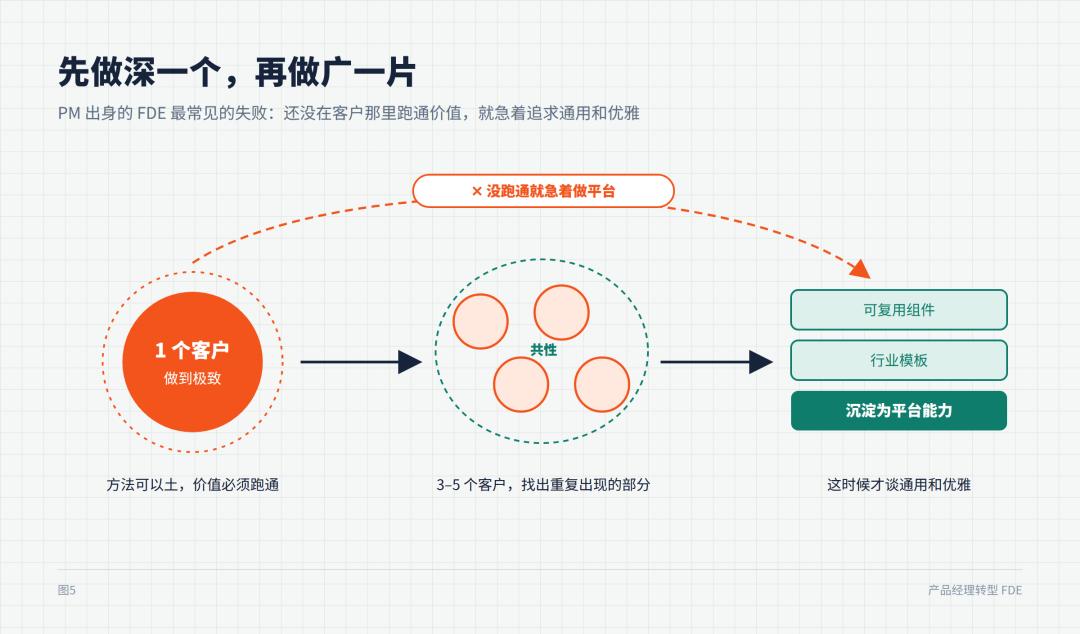
PMs are professionally trained for scalability: one requirement should serve as many users as possible, and one feature should be as general as possible. The starting point of FDE is exactly the opposite. It requires you to do your best for one customer first, even if the method looks very "rudimentary" and highly customized.
This will bring continuous psychological struggle: you will instinctively feel that "this approach is not elegant and cannot be reused". But the logic of FDE is to first verify the value with one customer, and then extract reusable parts from the practices of three to five customers. Skipping the first step and directly pursuing the second step is the most common failure mode for FDEs with a PM background.
3. Special difficulties in China's B2B market
Working as an FDE in China also means facing some problems that are rarely discussed in overseas articles. The first one is the customization quagmire: Party A (the client) easily regards FDEs as free outsourced developers, with infinitely expanding requirements, and eventually the project becomes a delivery black hole that makes no profit and precipitates no valuable assets. The second one is data and compliance: private deployment, intranet environment, data not leaving the customer's domain, many tasks that can be completed in a few hours on the public cloud will take weeks at the customer site. The third one is organizational politics: AI projects often touch existing positions and processes, so the business leader who promotes the project and the front-line employees who may be affected will have completely different attitudes towards you.
4. Tension with the headquarters product team
FDEs are at the customer site, while the product team stands from the platform perspective, and conflicts naturally arise between the two sides. You will feel that the product team does not understand the front line, and the product team will feel that you are always putting forward customized requirements. If the company does not have a clear "on-site requirement feedback mechanism", FDEs are easily marginalized and become senior implementation personnel. This point is especially important to check clearly when choosing a company.
5. Mixed quality of the role concept
The term FDE is still very new in China, and many companies just renamed their original implementation, delivery, and pre-sales positions. If you transition to this role full of expectations, only to find that your daily work is writing bids, making configurations, and running acceptance checks, the gap between expectation and reality will be very large.
04. An unpopular judgment: not all PMs should transition to FDE
To put it bluntly, the following types of PMs have a higher success rate of transitioning to FDE: those who have real curiosity about technology and are willing to tinker with code in their spare time; those with B2B, industry or data product backgrounds who understand enterprise processes and data; those who enjoy the sense of achievement of solving specific problems rather than only enjoying the sense of achievement of "defining the direction"; those who can accept high-intensity business trips and on-site work, and can accept working in uncertainty.
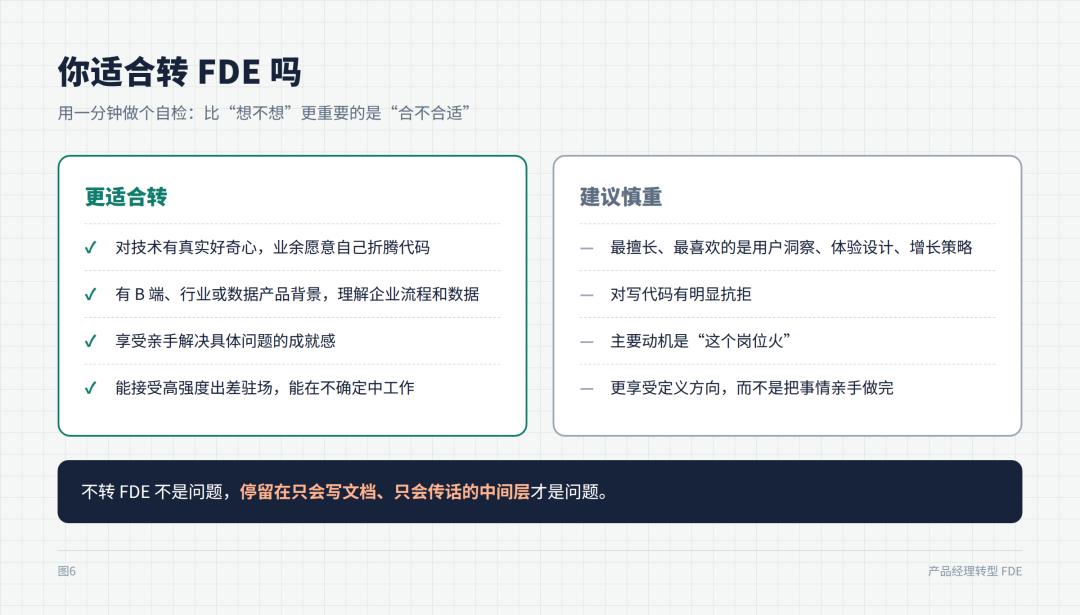
However, if what you are best at and love most is user insight, experience design, and growth strategy, and you have obvious resistance to writing code, transitioning to FDE is likely to mean using your own shortcomings to compete with others' strengths. In this case, a better choice may be to dig deeper in the direction of AI product manager, rather than forcing the transition.
FDE is not the only way out for PMs. The real crisis is not whether you are an FDE or not, but whether you stay in the middle layer of "only writing documents and only passing messages", which will be rapidly compressed in the AI era.
05. If you decide to transition, what should you do
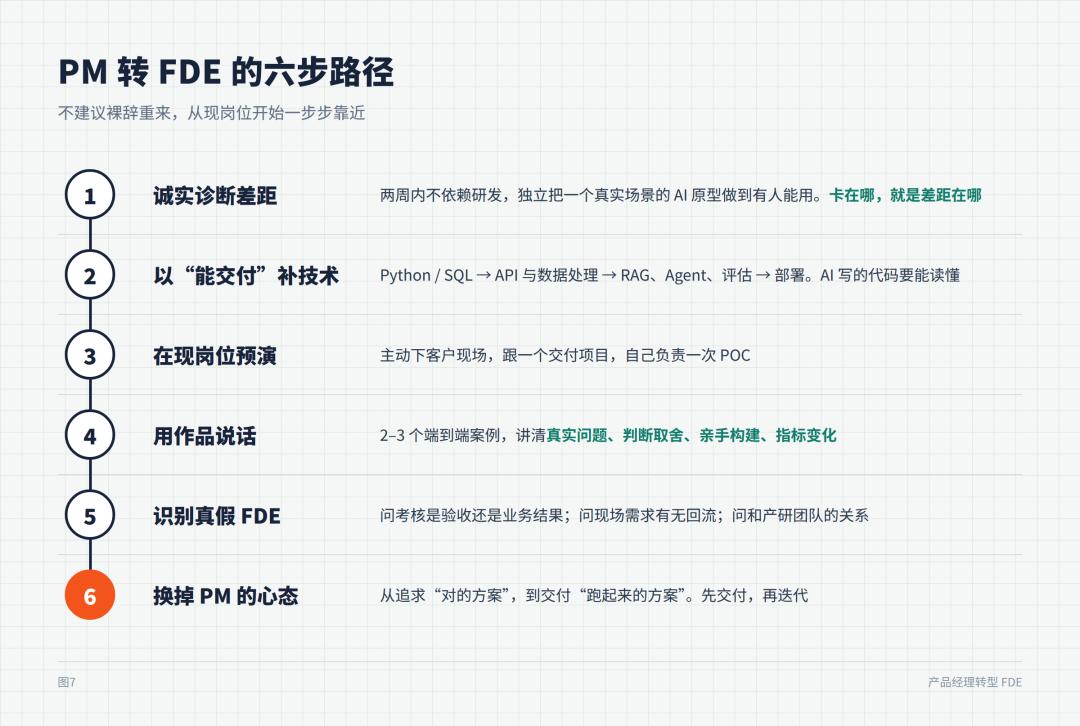
Step 1: Honestly diagnose the gap
Take a real business scenario you are familiar with, give yourself two weeks, and try to independently make a usable AI application prototype for real users, from data preparation to launch, without relying on R&D colleagues. After you finish it, you will know very clearly where you are stuck. This is more useful than reading ten articles about the "FDE capability model".
Step 2: Learn targeted technical skills with "delivery capability" as the standard
You do not need to become an algorithm expert, but you need to reach the level of "being able to deliver independently". The recommended learning sequence is: first lay the foundation with Python and SQL, then learn API calling and data processing, then go deep into RAG, Agent orchestration and evaluation systems, and finally supplement basic deployment and operation and maintenance knowledge. Make full use of AI coding tools throughout the process, but require yourself to understand every piece of code generated, because when problems occur at the customer site, AI may not be able to help you solve them.
Step 3: "Rehearse" FDE work in your current position
The best transition path is often not to quit your job and start all over again, but to actively approach the working mode of FDE in your current position. Take the initiative to apply to go to the customer site, follow the delivery team to run a project, take charge of a POC by yourself, and turn "demand research" into "working with customers to solve problems". These experiences can not only verify whether you really like this kind of work, but also become the most convincing resume content for your transition.
Step 4: Speak with your works instead of your resume
Prepare two to three end-to-end cases, and explain four things clearly for each case: what is the customer's real problem, what judgments and trade-offs you made, what you built with your own hands, and how much the final business indicators have improved. What FDE interviewers most want to see is the complete evidence chain of you "turning an ambiguous thing into a success".
Step 5: Choose the right company and identify real and fake FDE roles
During the interview, you can focus on asking several questions: what are the assessment indicators for FDEs, are they based on project acceptance or customer business results? Is there a mechanism to feed back the common requirements found on site to the product team? What is the relationship between the FDE team and the product and R&D teams? Does the company's business model support FDEs to dig deep into the work, or force FDEs to pursue speed? The answers to these questions can basically help you distinguish whether this is a real FDE role or just an implementation role with a new name.
Step 6: Adjust your mindset, shift from "perfect solution" to "working solution"
This is the hardest and most important step. PMs are used to pursuing complete logic and elegant solutions, but in the world of FDE, a rough system that actually runs at the customer site and brings 20% efficiency improvement is far more valuable than a perfect but unimplemented solution. Learning to accept imperfection, learning to deliver first and then iterate, is the real "rite of passage" for PMs transitioning to FDE.
06. A few more words
The rise of FDE is, to some extent, a re-evaluation of the value of the product