Just now, Elon Musk "scattered beans" in space
At Beijing Time September 28, SpaceX successfully carried out the 14th integrated flight test of Starship (hereinafter referred to as "the 14th flight").
This flight vehicle consists of the Ship 41 spacecraft and the Super Heavy booster, with a total height of the combined stack of about 124 meters. Approximately 7 minutes after liftoff, the Super Heavy booster completed its mission and made a controlled splashdown in the Gulf of Mexico. However, the classic "chopsticks catching the rocket" scene did not reappear.
About 8 minutes after liftoff, Starship completed its first engine ignition and entered the coasting phase. According to the mission plan previously released by SpaceX, the spacecraft was still on a passively safe suborbital trajectory at this time. The team would use this period to check the state of the vehicle before deciding whether to perform the orbital insertion ignition.
An accident occurred during this inspection process: one of Ship 41's "Raptor 3" engines shut down prematurely. SpaceX activated an emergency plan: it diverted the fuel from the tank originally reserved for the landing phase inside the nose cone, and assigned the orbital insertion ignition task to a single engine.
Finally, the spacecraft was pushed into a low Earth orbit at an altitude of about 275 kilometers. This is the first time the Starship project has truly entered an orbit around the Earth since its first flight in April 2023.
About 10 minutes after entering orbit, the spacecraft began to deploy 26 Starlink V3 satellites, and the entire deployment process lasted about 30 minutes. According to the original plan, Starship would continue to fly around the Earth for 6 laps, and the entire mission would last nearly 10 hours. However, SpaceX announced that Starship would perform a controlled deorbit after operating in orbit for about 3 hours, and safely splash down in a pre-designated area of the Pacific Ocean.
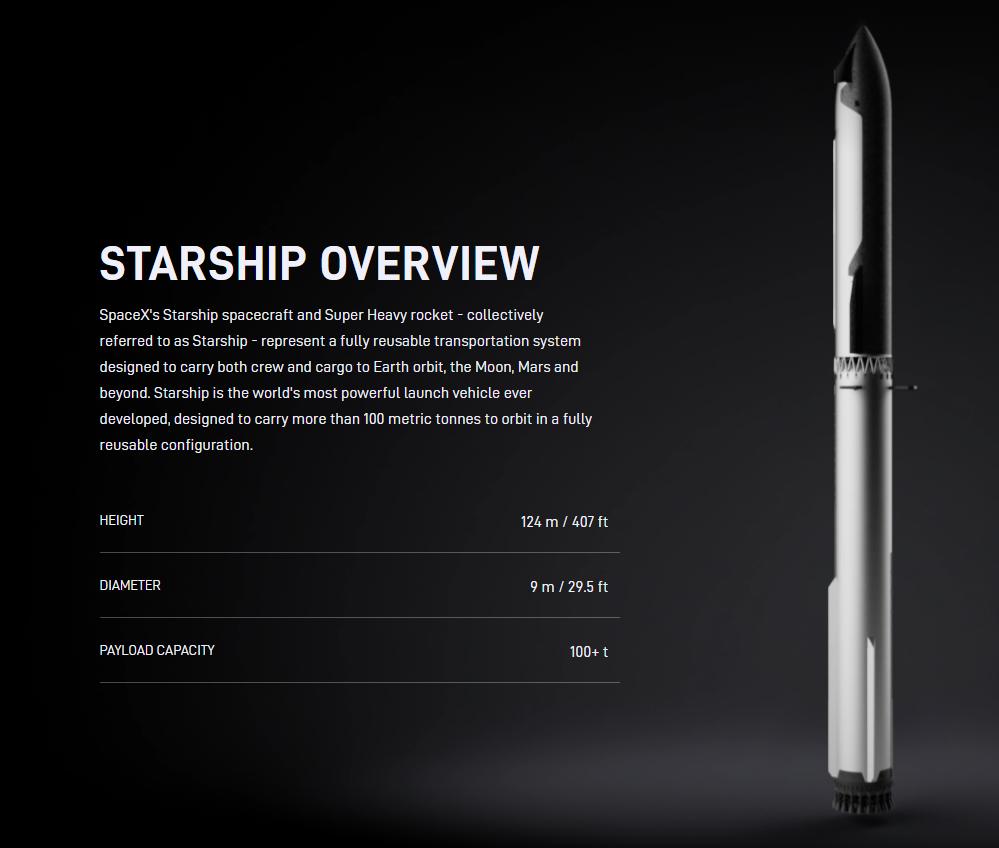
Starship composed of the spacecraft and the booster. Source: SpaceX
This flight marks that Starship has officially advanced from the suborbital test phase to the orbital operation phase, and also paves the way for subsequent large-scale Starlink deployment, on-orbit refueling and deep space transportation missions.
Crossing the Suborbital Threshold
The "14th flight" took place less than two months after the last Starship launch. Compared with the seven-month long interval between the previous "11th flight" and "12th flight", the test rhythm has been significantly accelerated.
Musk previously predicted that Starship would reach a launch frequency of at least one launch per day in about a year. With the maturity of the V3 design, the gradual resolution of key issues such as thermal protection, and the parallel advancement of production and testing processes, SpaceX is accelerating the transition to high-frequency reusability.
In the previous 13 flights, Starship deliberately chose a "passively safe" suborbital trajectory. Even if the vehicle completely lost control, it would naturally re-enter the atmosphere and splash down in the predetermined sea area. This strategy maximized public safety and also allowed SpaceX to quickly accumulate flight data in the early stage.
However, suborbital flight has a fundamental limitation: the spacecraft cannot obtain the forward velocity required to enter orbit.
The "14th flight" broke this limitation.
After liftoff, the spacecraft first flew along the suborbital trajectory. After confirming that all key hardware had sufficient redundancy, the flight control team issued the orbital insertion command. One of the Starship's Raptor engines re-ignited in space, pushing it into a low Earth orbit at an altitude of about 275 kilometers.
This is the first time in Starship's history that it has truly "stayed" in space.
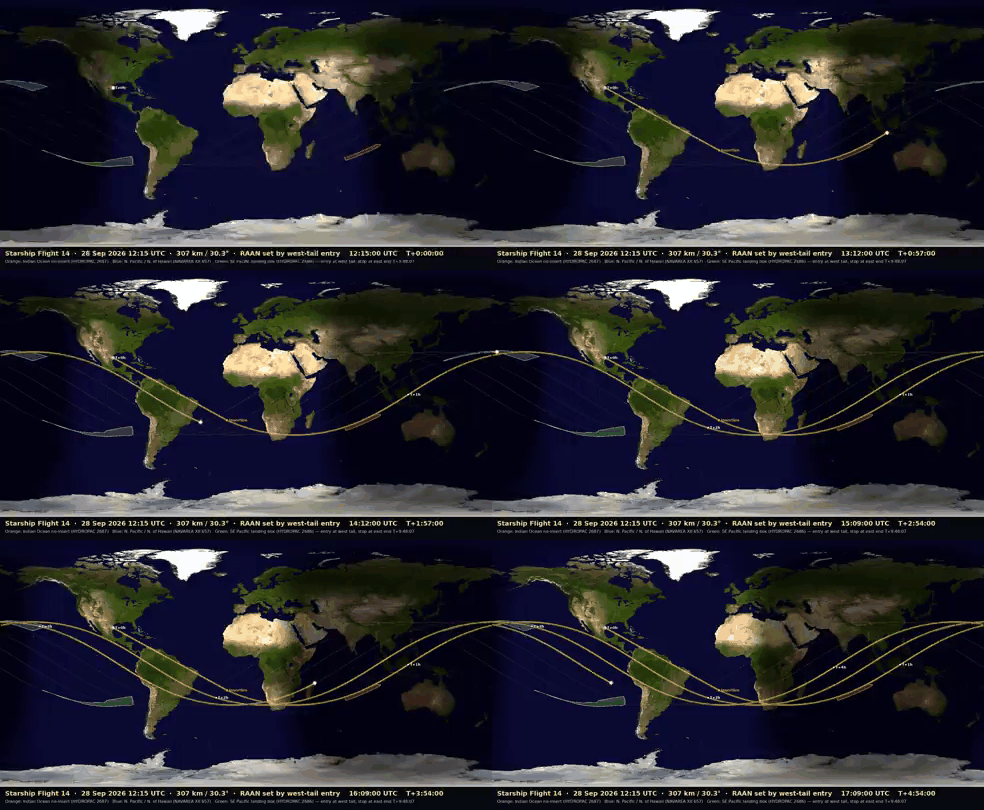
Starship flight trajectory
After entering orbit, the spacecraft will fly around the Earth for six laps, with the whole process lasting nearly ten hours. The engineering team will conduct a comprehensive test on all systems of the spacecraft, including propellant management in the orbital environment, avionics system performance and thermal protection system status. Finally, the spacecraft performs a deorbit ignition, one Raptor engine restarts in space, pushing the spacecraft out of orbit and starting the re-entry procedure. The spacecraft completes a controlled splashdown in the Pacific Ocean west of Chile.
SpaceX emphasized in the mission description: "By reaching orbit, the next phase of Starship's development toward full and rapid reusability can begin."
Only by entering orbit can Starship truly start verifying key capabilities such as on-orbit refueling, long-term residence and deep space transportation. Suborbital flight can test re-entry, but cannot test orbital operations. The success of the "14th flight" means that Starship has finally crossed this threshold.
At the same time, the Super Heavy booster also completed its mission.
In the "13th flight", the booster successfully used all 33 engines for the boostback burn for the first time after stage separation. However, at the end of the ignition, 3 central engines showed signs of suspected "ice blockage", that is, moisture in the propellant pipelines or valves freezes in a low-temperature environment, which may affect the normal supply of liquid oxygen and liquid methane. Telemetry data showed that the engine subsequently malfunctioned, and the booster eventually failed to complete the scheduled landing, falling into the Gulf of Mexico in a "hard splashdown" manner.
SpaceX has made targeted improvements to the booster for the "14th flight". In terms of hardware, the team upgraded the engine's filtration system to prevent the ice blockage problem from recurring. In terms of software, the reliability logic of engine restart is improved. Judging from the flight results, these improvements have achieved the expected effect. The booster successfully completed the whole process of boostback ignition and landing ignition, and finally achieved a controlled soft splashdown in the predetermined sea area of the Gulf of Mexico.
Although the booster still did not attempt to return to Starbase to be captured by the launch tower "chopsticks" this time, the success of the controlled splashdown has laid a foundation for realizing booster recovery in subsequent flights.
Starlink V3 Enters Service in Orbit
Another milestone of the "14th flight" is the first deployment of fully functional Starlink V3 satellites.
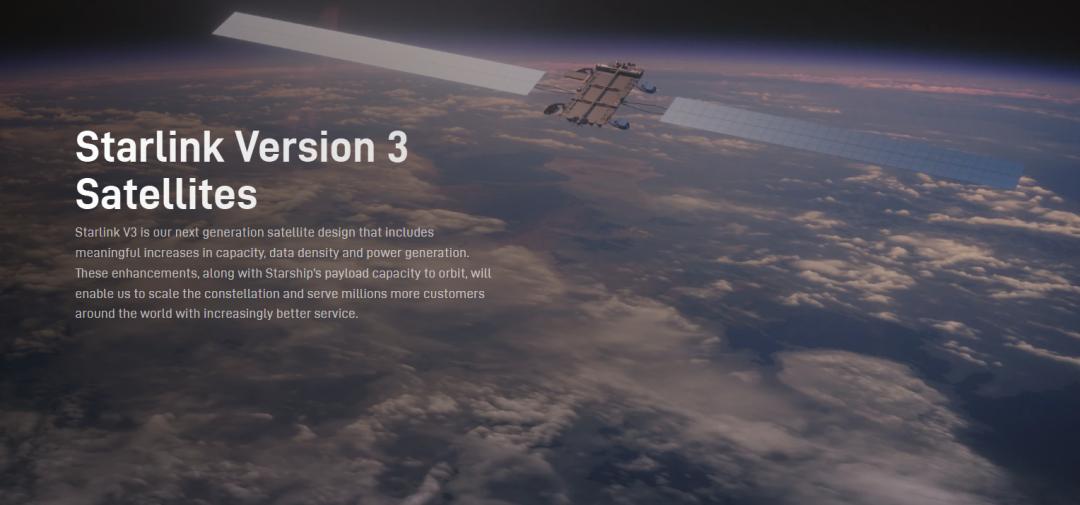
Concept of operations for Starlink V3 in space
In previous flights, Starship had carried simulators or test versions of Starlink V3 satellites, but these satellites would eventually re-enter and be destroyed, and would not be put into network service.
This time it is different. After deployment, the 26 V3 satellites will deploy solar arrays and antennas, establish connections with ground stations and other Starlink satellites through radio frequency and laser links, and officially start serving customers after completing on-orbit checks.
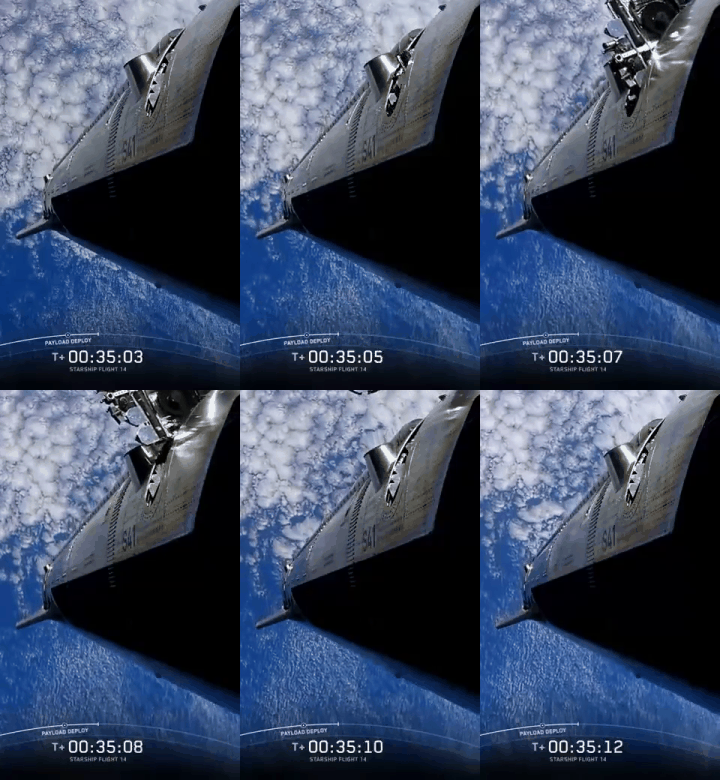
Starship deploys Starlink V3 satellites
The capabilities of Starlink V3 satellites far exceed those of previous generations. Each V3 satellite can provide 1Tbps downlink capacity and 160Gbps uplink capacity, which is about 10 times and 22 times higher than that of V2 satellites respectively.
The phased array antenna of the V3 satellite supports 2048 downlink and uplink beams, while the V2 only supports 192 downlink beams and 144 uplink beams. Each V3 satellite is equipped with 6 400Gbps space laser inter-satellite links, supporting uninterrupted transmission of high-bandwidth traffic between any two points in the world, forming a petabit-level laser mesh network.
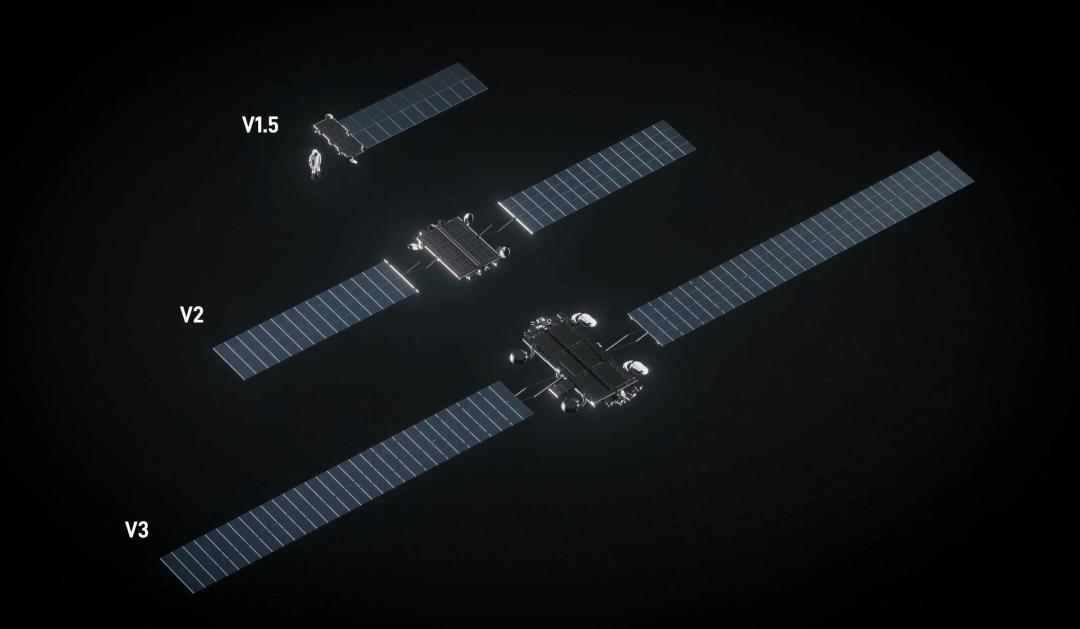
Starlink V1.5, V2 and V3 satellites. Source: X
The satellites are also equipped with 4 quad-band RF backhaul antennas (Ka, E, V, W bands), with a backhaul capacity of 1.2Tbps, which is more than 8 times that of V2. To support stronger capacity and capabilities, the solar array of the V3 satellite generates about twice as much power as that of the V2. New manufacturing technology can continuously produce solar blankets, which are cut into 19-meter-long segments and stitched into a complete array.
According to SpaceX's estimates, a fully loaded Starship launch can carry 60 V3 satellites, and each launch can deploy about 20 times the capacity of a Falcon 9 launch carrying V2 satellites for the constellation. The reason why this "14th flight" carries 26 satellites is that the spacecraft needs to reserve propellant for deorbit operations in the orbital mission, and this is also the first actual combat deployment of V3 satellites.
At present, the Starlink constellation consists of more than 11,000 active satellites, but none of them is the V3 version. Musk once stated that the company hopes to eventually expand Starlink to 100,000 V3 satellites. To achieve this goal, it must rely on Starship's large-scale deployment capabilities.
It is worth noting that 3 of the 26 satellites have been specially modified and equipped with camera systems. After being deployed from Starship, they turned around to perform a panoramic scan of the spacecraft's thermal protection system, and transmitted the images back to ground operators in real time.
The purpose of this technology is to verify the method of assessing the integrity of the thermal protection system in future missions. Musk has publicly stated that Starship's current "biggest remaining problem" is to make the thermal protection system reusable. By performing a long-distance rapid scan of the thermal protection system with satellites, SpaceX hopes to get rid of the dilemma of "tediously inspecting 40,000 tiles one by one".
Thermal Protection System Starts Reuse
The Starship spacecraft of the "14th flight" has made a number of upgrades to the thermal protection system.
These improvements are partly directly derived from the data of the "13th flight". In that mission, after the Ship 40 spacecraft splashed down in the Indian Ocean, it unexpectedly slowly capsized and floated on the sea surface without exploding or sinking.
This gave SpaceX a rare opportunity. The engineering team towed the spacecraft back to the shore and transported it back to Starbase for analysis.
Specific upgrades include: adding additional heat shield tile fastening mechanisms in areas considered to have the highest risk of shedding during the ascent phase; making sealing improvements for areas where plasma was recently found to potentially flow behind the heat shield tiles; adopting curved heat shield tile designs in multiple areas, which have been proven to reduce the thermal load at the tile gaps.
The most notable thing is that two heat shield tiles recovered from Ship 40 were reinstalled on Ship 41 for flight. This is the first time the Starship project has achieved the reuse of heat shield tiles. Although it is only two tiles, the reusability of the thermal protection system is the key to Starship's vision of "rapidly taking off and landing repeatedly like an aircraft".

Starlink V1.5, V2 and V3 satellites. Source: X
Nearly ten hours of orbital flight will provide SpaceX with a large amount of data. In the orbital environment, the spacecraft will be exposed to various space environmental factors such as microgravity, extreme temperature cycles, and atomic oxygen erosion. The spacecraft's propellant management system will also be tested in a microgravity environment. Starship is equipped with a high-power electric drive cryogenic recirculation system, which is specially designed to manage the interaction between cryogenic propellant and engines during long-duration coasting.
The avionics system operates continuously in the orbital environment for nearly ten hours. About 60 custom avionics units on the spacecraft integrate batteries, inverters and high-voltage power distribution into a single component, and the entire vehicle can provide a peak power of about 9 megawatts.
The multi-sensor navigation system works continuously during the orbital phase. A new type of precision radio frequency sensor is used to measure the propellant liquid level in a microgravity environment, which is a key technology for future space propellant transfer. Cameras with 50 perspectives cover the entire ship, and real-time image transmission is provided by a 480Mbps Starlink connection.
The Next Hurdle for Starship
The success of the "14th flight" is a key market validation for the publicly listed SpaceX.
Just four months ago, two days before the launch of the "12th flight", SpaceX submitted a prospectus to the U.S. Securities and Exchange Commission, disclosing for the first time the investment scale of the Starship project to the outside world: the company has spent more than 15 billion U.S. dollars on Starship, including 3 billion U.S. dollars in 2025 and nearly 900 million U.S. dollars in the first quarter of 2026.
The prospectus explicitly promised: "We expect Starship to begin delivering payloads to orbit in the second half of 2026." The success of the "14th flight" is exactly the fulfillment of this promise.
SpaceX revealed that Starship V3 can send up to 100 tons of payload into orbit, and future versions will increase to 200 tons. Once Starship achieves stable and reliable operation, the cost of sending 1 kilogram of payload into orbit will drop to 1% of the average cost of space launches in the past, or even lower.
In addition to commercial pressure, NASA's lunar landing schedule imposes another hard constraint on Starship. Under the Artemis program to return to the Moon, NASA has selected Starship as the crewed landing system, and plans to land astronauts on the Moon in 2028. This means that SpaceX must not only complete the technical verification of Starship, but also ensure that it has the safety and reliability for crewed flight.
SpaceX holds a contract of about 4 billion U.S. dollars from NASA to send astronauts to the Moon as early as 2028. To this end, SpaceX will have to refuel the vehicle in space, launch more than a dozen times in a row, and ensure that it can safely carry people. The orbital success of the "14th flight" is a key step towards these goals.
However, the challenges remain severe. On-orbit refueling, crewed flight, and lunar landing are all unprecedented engineering challenges. Starship needs to complete the leap from unmanned testing to crewed lunar landing in less than two years in the future.
In the missions after the "14th flight", Starship will attempt to capture and recover the upper stage of the spacecraft