Roundtable Theme: Embodied Intelligence and Hardware Innovation, How to Create New Imaging Scenes? | SmallRig 3rd Global Imaging Scene Industry Conference (2026)
When the "new scenario" is pushed one step further, the outcome will no longer be a better camera or a more stable gimbal — it may be a robot, a pair of glasses, or a full exoskeleton. On the morning of September 22, the 3rd Global Imaging Scenario Industry Conference (2026) was held in Shenzhen. The third themed roundtable brought "Embodied Intelligence and Hardware Innovation" to the forefront: how exactly can these new hardware create new imaging scenarios. This session was hosted by Peng Xiaoqiu, Chief Editor of 36Kr Hard-Kr.
The five guests on the stage have almost no overlapping positions: Photon Transition develops wearable cameras, XbotPark Robotics Base operates an incubation platform that supports young people to develop products, Honor represents the most fiercely competitive terminal track of mobile imaging, ShellX Technology sells consumer-grade exoskeletons, and Huafeng Capital observes the track and window period from the investor's perspective. Peng Xiaoqiu gave a very straightforward definition of "scenario" — instead of asking "who is my user", we should ask "under what circumstances do users need me".
Two rounds of Q&A split the topic into two parts. One half is "change": AI pushes cameras from "capturing objects" to "understanding objects", mobile imaging shifts from competing on parameters to competing on emotional value, and exoskeletons regard the creator's own body as the core hardware. The other half is "constancy": Jiang Chunyang's judgment is that usually 1 million people in China come up with the same idea at the same time, and there is only a 6 to 12 month window period from ideation to implementation. Honor's answer is more straightforward — the relationship between imaging devices and human beings is changing from "tools" to "partners".
Peng Xiaoqiu raised a contrast at the end: he stayed in Europe for more than ten days and met more than a dozen investors, who are using money from family funds that have been passed down for 6 to 7 generations to look for Chinese entrepreneurs and Chinese LPs; while Chinese entrepreneurs are in Shenzhen at the moment, discussing how to expand into the global market.
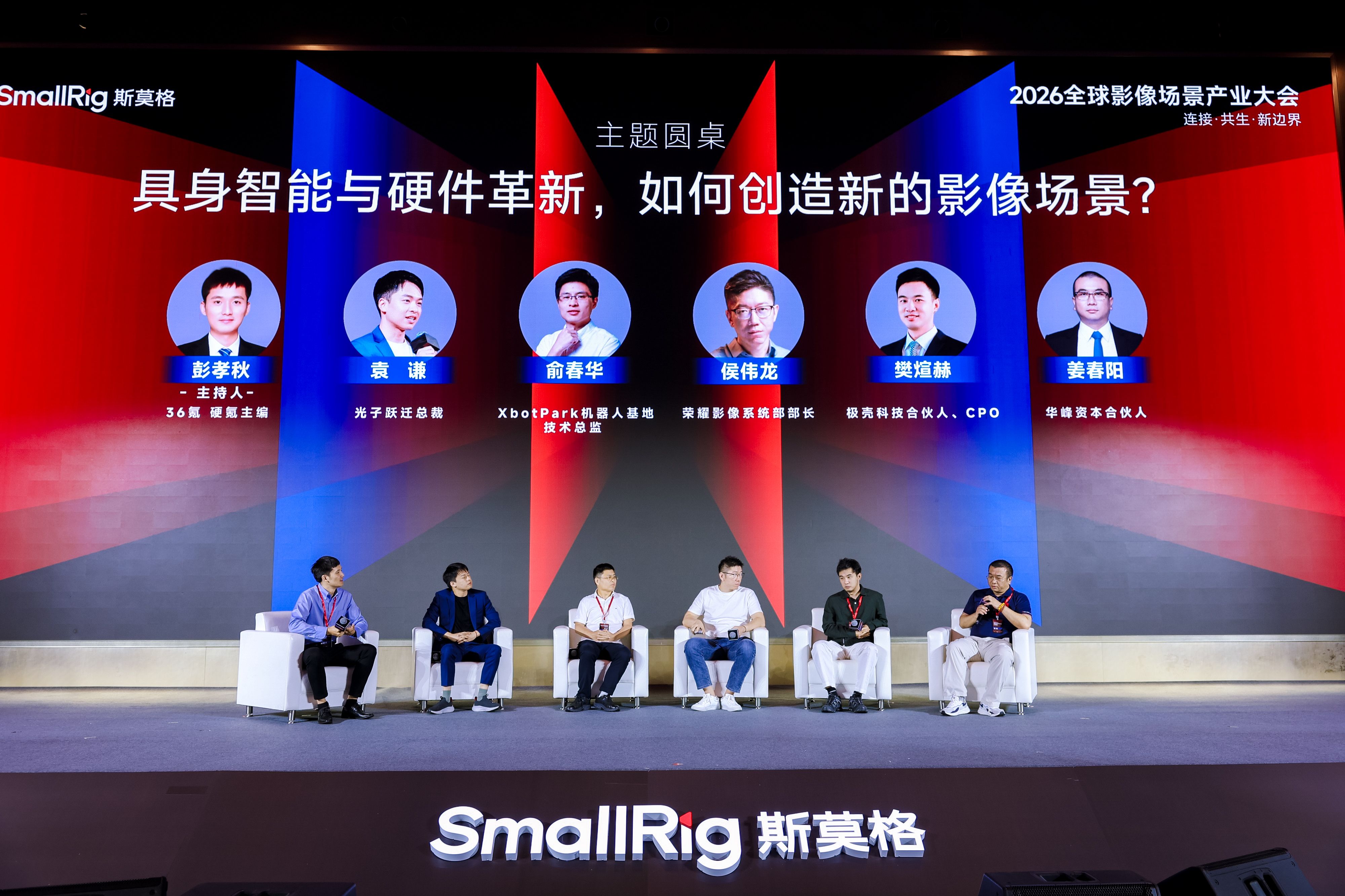
The following is the edited and organized dialogue content:
Peng Xiaoqiu | Chief Editor, Hard-Kr, 36Kr (Host)
Yuan Qian | President, Photon Transition
Yu Chunhua | Technical Director, XbotPark Robotics Base
Hou Weilong | Director of Imaging System Department, Honor
Fan Xuanhe | Partner & CPO, ShellX Technology
Jiang Chunyang | Partner, Huafeng Capital
I. New Scenarios Usually Start From "What Was Impossible in the Past"
Peng Xiaoqiu | 36Kr: I want to lead to the first question with a definition: how should I understand scenarios? As a reporter of 36Kr, when I conduct interviews, how do I write and submit my drafts? I need functions like audio recording noise reduction or other similar capabilities. An excellent product manager does not only ask who his users are, but thinks about under what exact circumstances users need his product, which is the definition of scenario.
Please share with us, based on your own industry and your company, what is the biggest change you have observed? We have guests from robotics companies, mobile phone manufacturers and investment institutions, so what we see must be different. What is the most impressive change in imaging scenarios that you have witnessed in the past two years?
Yuan Qian | Photon Transition: Our company has a very important premise that we hope to combine imaging with AI, which can perfectly answer your question. This trend has become particularly obvious this year: in the past, imaging was mostly limited to whether you can shoot things well, whether the image quality can be improved, and how the final output looks like. Starting from this year, not only imaging, there are also many interesting AI hardware products besides cameras, including AI pendants and other accessories. With the empowerment of AI, combined with imaging capabilities, cameras can evolve from capturing objects to understanding objects, which I believe is the future development direction of the imaging industry. In the past, photographers use their own brain to compose and create with cameras. In the near future, can we delegate this work to cameras? We can give instructions to cameras to let them complete better composition, optimization and post-processing automatically. This is also the direction our own products are exploring and developing.
Peng Xiaoqiu | 36Kr: When AI comes into play, figuring out where users need you to complete what kind of tasks also creates very good scenarios. Director Yu, you have so many incubated companies and projects, what changes have you observed?
Yu Chunhua | Technical Director, XbotPark Robotics Base: We do not develop products ourselves, we support young people to build the products they want. From the perspective of imaging in the past two years, we found that young entrepreneurs nowadays have a wide range of interests, their vision is getting broader, and they can discover more and deeper insights in various different scenarios and environments. The projects we invested in and supported in incubation have completed imaging innovation in different tracks and fields. Several guests today are also enterprises incubated by our platform. These young entrepreneurs and potential innovators are constantly changing their perspectives, and we hope to see how these changing perspectives can develop better projects and innovative products. These products will empower more content creators, so that ordinary people can also see scenarios and images that are usually inaccessible, immerse themselves in the constantly changing situations, experience the changes without stepping out of their homes, and enthusiasts from all walks of life can record content conveniently, creating new categories of hardware products.
Peng Xiaoqiu | 36Kr: There are many wonderful stories in the industry Director Hou is in recent years, what is your opinion?
Hou Weilong | Director of Imaging System Department, Honor: I have been working in the imaging industry for about ten years, neither too long nor too short, and I have been working in mobile terminal manufacturers all the time. Imaging of mobile phone and terminal manufacturers is a highly competitive track. No matter driven by the demand for product iteration or the change of user needs, great changes have taken place in this decade. We have witnessed a lot of technological iterations, the empowerment of many AI technologies, including hardware iterations. The mobile phone we released recently has a built-in gimbal. Through the evolution of technology and product iteration, it actually reflects the change of people's demand for their own sense of existence. Honor Imaging has a vision, which is to endow everyone with the ability and right to record and express their life. Looking back over the past few years, the imaging industry has provided various tools, and cameras serve the value of tools, recording, human beings and survival. In recent years, people's aesthetic awareness has awakened, they have started to think about life and the times, and hope to express their own emotions and share their own survival value.
Based on these changes in demands, the imaging industry has gradually shifted from competing on parameters, hardware configurations, shooting clarity, and telephoto focal length, to a more high-level issue: where to shoot well, how to compose pictures conveniently, and how to reflect the demand for emotional value. This is a huge transformation — from focusing on survival and recording itself, to expressing oneself, exploration and the meaning of existence, taking imaging as a means of expression, and triggering innovative changes in hardware, algorithms and AI empowerment at the same time.
Fan Xuanhe | Partner & CPO, ShellX Technology: ShellX Technology is currently the world's top brand in consumer-grade exoskeleton sales. The main vision of our company is to enhance human capabilities, which is different from many perspectives of artificial intelligence. The connection with the imaging industry comes from users, it is users that build the link between us and the imaging industry. We found that many outdoor photographers record the most precious moments in extreme environments. From our perspective, for photography creators, the real hardware is the human body: for some masters with rich experience and artistic taste, as they grow older and their mobility declines, whether they can reach better locations, and whether they have enough energy and creativity to frame the shots, the state of the human body itself has a huge impact. What we are doing is to use the power of robotics and artificial intelligence to help and support creators to better reach the places they want to go, maintain good energy, and leave more time for creation. This is a very good scenario worthy of exploration for the exoskeleton industry to combine with the imaging industry, and it is also a new demand we have discovered recently.
Jiang Chunyang | Partner, Huafeng Capital: Today, listening to the sharing of all guests, demands and product innovation are mentioned repeatedly, I will not go into details on this part, and I will share some different ways of thinking from another perspective. We participate in many different tracks on a daily basis, let me give you an example: many people invested in Li Auto and made profits, but the fundamental reason for investing in Li Auto is not because Li Auto has certain advantages on some indicators among "Wei Xiao Li" (NIO, Li Auto, XPeng), it may be based on another set of logic. We have reviewed many cases of this logic, and there is one point worthy of everyone's attention, which is called "the generalization of track definition". When it comes to the imaging industry, we can make various decompositions of it. Today we are talking about visible light, can infrared light and ultraviolet light be applied? Including laser scanning, or using infrared rays to perceive the space, these are all key points brought by imaging science.
Some tracks may not be widely touched in the industry. There is a case of scanning gas leakage for high-risk chemicals, which has very good performance, but why there is no incremental market? Because the warehouse cannot afford the cost — the performance of this enterprise is already very good, and some individual segmented tracks are so niche that there is only one operating enterprise, no second competitor. If we generalize the definition of imaging and break it down, we can find countless opportunities. This is the generalization of track definition.
Second, the impact of AI. Almost all opportunities in every track are caused by two events: the first is huge changes in rules. Why are so many opportunities emerging amid China-US competition? Why are there so many integrations between AI and different industries after AI came out? We are living in this era, and we are welcoming these two opportunities at the same time. When AI integrates with various industries, does it involve multi-account operation? Is there a risk of multi-accounts being banned? Are there any GEO-related issues? Are there any companies that do this particularly well? There are very few of them. Is there any methodology behind it? AI can help review and optimize, Silicon Valley has already realized fully anthropomorphic operation, you can assign tasks to it, you can give it feedback when it does a bad job, and reward it when it performs well, the reward is Token. After reconstructing all the details of the entire imaging industry with AI, all of you have the opportunity: based on your own strengths, some of you focus on products and pursue product perfection, like Director Hou who is a vertical player that pursues the ultimate product; are there any horizontal players? You can also pursue the ultimate service.
Third, we are all carbon-based creatures, we tend to overestimate the short-term impact brought by technology, and ignore the long-term dividends that the long-term pattern and long-term competition can bring to the track and the enterprise, which are sometimes overlooked. Methodology is very important, believing in methodology is very important, meetings and communications are all processes of exploring rules and accumulating methodology.
II. Technology Is Constantly Changing, But Ultimately We Still Need To Answer "Who We Are Solving Problems For And What Problems We Solve"
Peng Xiaoqiu | 36Kr: Technology is always changing, all companies will make strategies for this. As a media, especially 36Kr, what is the value of this company and this industry? What is value? To define it clearly and accurately, value means what is more important and what is the most important. Director Hou is quite right, when everyone is competing on parameters, is there something more important than parameters? We have talked about a lot of changes, I am curious about all of you: when we see these changes and trends, what do you think most about regarding value and the obstacles to industry implementation? There will be new technologies after AI in the next round. Among all the changes you have observed, what do you think the most about? You can talk about value and obstacles — what do you think is the most important, what is more important?
Fan Xuanhe | Partner & CPO, ShellX Technology: What remains unchanged amid all the changes? In the era of rapid integration of interdisciplinary subjects, the underlying technical routes of exoskeleton and embodied intelligence are similar: we need motors, excellent AI algorithms, and the ability to understand human movements. In our company, besides scientists from the machinery industry, we also have colleagues who specialize in human body research. The most difficult part of this track is how to make good use of the hardware product that ordinary people perceive — the other half of the product is human beings: how people move in different periods, how joints and muscles exert force, which is coupled with many real user scenarios. For our company, the constant thing is how technology serves human beings. In the current embodied intelligence track, including the AI control of exoskeletons, new papers are published every few days. What kind of technical routes are worthy of our exploration? We have a different perspective from the academic circle, we truly apply technology on users: can we predict muscle exertion and reduce the burden on knees? The reduction of knee burden can extend how many years of the creator's career? If the knees can no longer support carrying so much equipment, the creative career of photographers will be shortened. The constant thing is to use the booming technology to solve problems that could not be solved in the past, and return to the essence of serving human beings.
Hou Weilong | Director of Imaging System Department, Honor: In the process of change, innovative technology, hardware and software must bring value to users. Why am I invited here? I want to give an example to illustrate what we think value is: in the process of change, we adhere to the unchanged value, which we believe is that the subordinate relationship between human and imaging will change in the future. In the past, we thought all imaging products are tools, but later we believe this value will be reflected in the concept of "partners" — in the future, all imaging devices, whether mobile phones or other products, will establish a partnership with users. The foothold of us developing this kind of equipment is the combination of hardware, to figure out how to shoot videos better. You have been talking about scenarios, recent years are the era of explosive growth of videos, people not only watch videos, but also have interest in shooting videos. How to shoot well? We have developed a gimbal that can be folded and unfolded, which is still part of the device. How can we fulfill our vision? We hope to bridge the cognitive and aesthetic gap between ordinary users and professional photographers, and eliminate the situation that users cannot take good photos even with good equipment. We leverage mainstream AI technologies, I am engaged in software and algorithm development myself, for different shooting scenarios, the system can make composition judgment based on the scenario, automatically help you complete composition, zoom, and even actively control the camera movement.
What we are doing is combining innovative hardware with the rapidly developing Agent technology and AI technology, to make the device itself more like your partner, which can stimulate your creative inspiration, instead of letting your creative inspiration find corresponding devices to realize. This may be the focus of our work in the next few years: we will not focus on overly strong hardware parameters and specifications, we will focus on the scenarios that current users care more about, provide higher quality and smarter services through the system solution combining software and hardware, narrow the gap between ordinary users, creators and photographers, and endow everyone with the ability and right to record life and express their own emotions.
Yu Chunhua | Technical Director, XbotPark Robotics Base: Now when we support young people to start businesses, they can discover various user pain points, and come up with various different solutions, the products they deliver to users can meet the demands of users. The technologies that were previously used in military and high-precision scientific research scenarios have now been gradually popularized, and can also be used in the commercial market. These technologies can meet more user demands in the future, and also encourage more young entrepreneurs to develop technologies and develop a series of new products when they discover user pain points, then sell and deliver these products to users. The ultimate constant thing is to meet user demands.
Yuan Qian | President, Photon Transition: Our first product is a lightweight, multi-module wearable camera, and we considered AI voice control. We found that when users are wearing the camera and doing sports, they do not have spare hands to control the device. Cameras have many functions now, many modes are expected to be used during sports, but the post-processing is very troublesome. We hope that during shooting, users can only keep the best moments, and the post-processing can be very convenient with AI voice control. In the past, users had to input very precise five-word commands, why not support natural language? When we drive electric vehicles, the vehicle infotainment system has already achieved this function.
There is another point: some ordinary people do not understand the parameters in the camera, some people will give the camera to children, children cannot read but can understand the meaning of natural language commands. With such natural language control, children can also use the camera and all its functions. This also shortens the distance between technology and demands, and allows more people to use the product — no matter how good the hardware is, if people cannot use it, we think it is meaningless. For us, we will focus on this point, and make use of better cutting-edge technologies.