The world's first AI agent smartphone cannot run *Honor of Kings*: the Doubao phone has been targeted by the anti-cheat system.
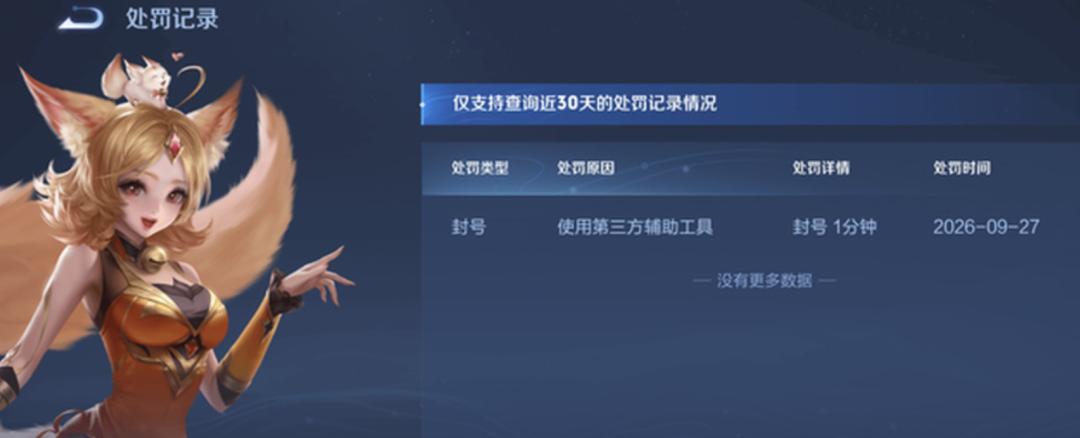
Recently, users of the nubia NaviX Ultra equipped with the Doubao mobile assistant were prompted with "Abnormal device environment" when logging into *Honor of Kings* and forced to log out, and some users were banned from their accounts for 1 minute.
Doubao issued an apology stating that the AI did not engage in any plug-in behavior; people familiar with the matter said the game's risk control strategy has been in use all along and no targeted adjustments have been made.
The long-standing conflict between AI phones and super apps has erupted once again.
On the eighth day after the new phone went on sale, players were collectively kicked offline
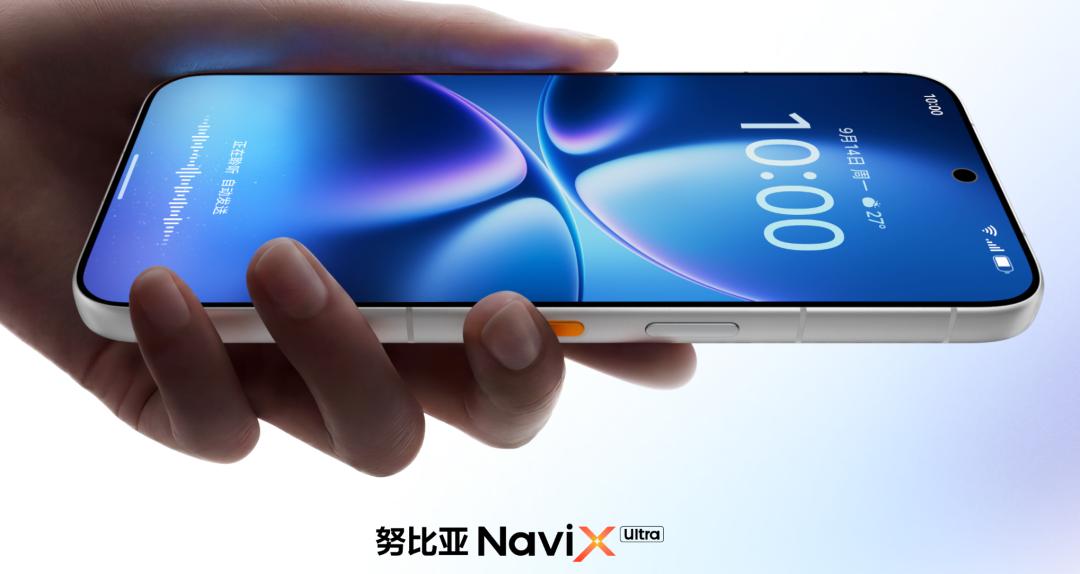
On September 16, the nubia NaviX Ultra was officially released — a joint R&D product of ByteDance and nubia, a subsidiary of ZTE. It is officially positioned as "the world's first AI agent phone", priced from 5999 yuan, equipped with the consumer version of the Doubao mobile assistant, and its selling point is end-side large model-driven one-sentence cross-app autonomous operation.
Eight days later, on the evening of September 24, the trouble came.
Multiple users reported that when logging into *Honor of Kings* or entering a match battle on this phone, the system popped up a prompt of "Abnormal device environment" and was immediately forced to log out. Screenshots shared by some players showed that the penalty record read "Using third-party auxiliary tools" and the account was banned for 1 minute.
The next day, the Doubao mobile assistant released a statement and apology on its official community: After confirmation, the assistant did not perform any operations on Tencent's game system throughout the process, and the AI did not have any illegal clicks, plug-ins or simulation behaviors; the team is in contact and communication with relevant Tencent parties, and no clear reply has been received as of the release of the statement.
It also advised users not to repeatedly log in on this model for the time being, and those who have been banned can appeal through the game's official customer service.
Both sides hold their own statements, and actual measurements provide key information
Tencent's position was released through people familiar with the matter.
On September 27, a person familiar with the matter told The Paper that *Honor of Kings* uses various security risk strategies to ensure game fairness, and these strategies have been used for a period of time in the past without any targeted adjustments.
Tencent customer service's reply to players is: We have received many feedbacks from the same model, but the detection logic and judgment details involve security identification information, which cannot be fully explained, and the security team has been submitted to follow up.
The truly key incremental information comes from actual tests by the media.
On September 27, a reporter from Xinhuanghe conducted an actual test with the NaviX Ultra: After downloading and installing *Honor of Kings*, you can log in to the game normally, but after a short period of play, you also receive an account ban prompt, the reason is still "Using third-party auxiliary tools" — note that the reporter did not turn on the phone's GUI operation function during the test, that is, did not let the AI play any part of the game on behalf of the user.
This detail basically rules out the scenario of "AI being caught for playing the game on behalf of users": Users who play the game manually are still judged as abnormal.
The anti-cheat system does not scan behavior, but "capability"
The problem lies in the judgment logic of the game's anti-cheat system.
The object detected by this system is not so much "what you did" as "what this device can do".
Any background program with automated capabilities such as screen reading and simulated clicks naturally carries high-risk characteristics from the perspective of risk control — the very existence of these capabilities is enough to trigger an alarm.
The Doubao mobile assistant is exactly system-level integrated: the end-side large model resides permanently, and has the underlying capabilities of cross-app screen reading and simulated clicks.
After the turmoil in December last year, Doubao did make restrictions — AI automatic operations in scenarios such as score-swiping incentives, financial apps, and competitive games have all been turned off.
But a report by Yicai pierced the key point: the restriction only acts on the upper-level switch of "AI operation", and the underlying simulated click capability of the device has not been removed. Therefore, even if the user does not wake up Doubao or give any instructions, the system features scanned by the app still hold, and the "Abnormal device environment" prompt will still pop up.
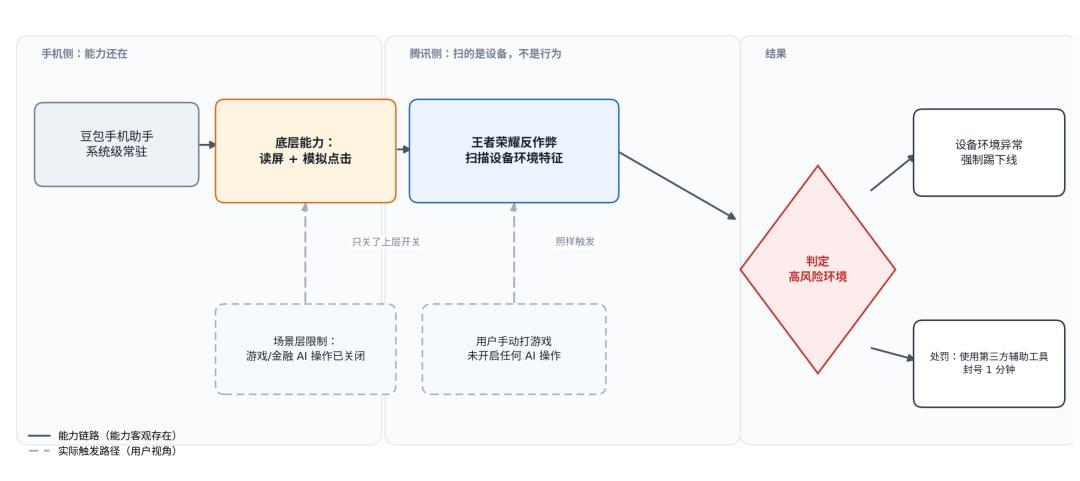
This explains why the statements of both sides are true but completely inconsistent: Doubao says "the AI did not engage in any illegal behavior" — that is true, the behavior level is clean; Tencent says "the risk control strategy has not been adjusted" — that is also true, it has always scanned the device environment. One side proves its innocence based on behavior, the other intercepts based on features, and the two sides are not even on the same checklist.
Why it breaks out now: the mass-produced version of the old conflict
This incident has a prequel.
In December 2025, the nubia M153, the technical preview engineering machine of the Doubao mobile assistant, also experienced the same series of risk control conflicts, and the spread was even wider: WeChat prompted abnormal environment and forced users to log out, and human-computer verification popped up frequently on Taobao, Xianyu and Damai.
At that time, Doubao removed the operation capability for WeChat, the accounts were unblocked one after another, and the incident was suppressed.
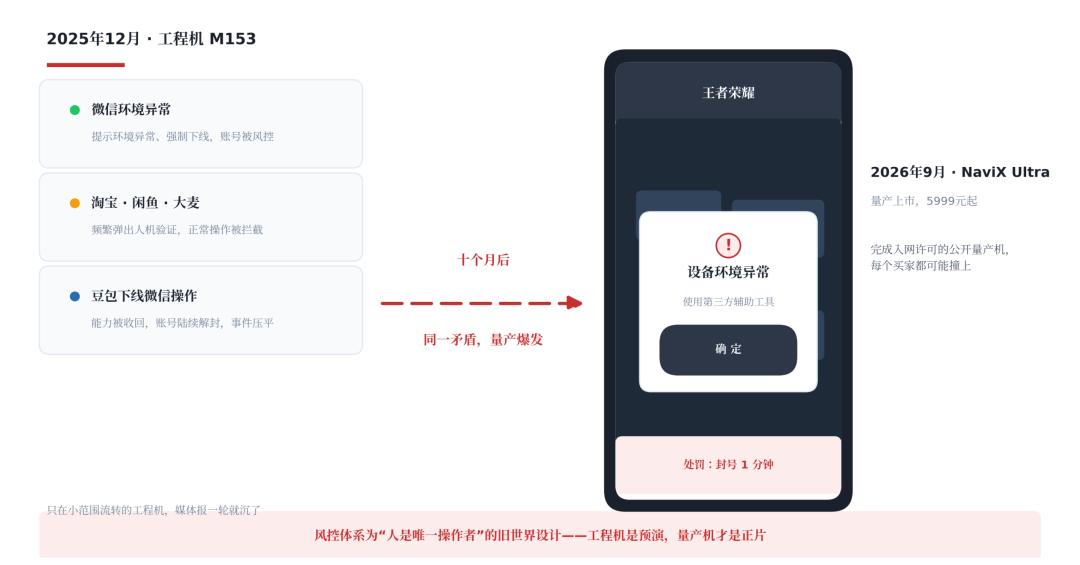
The difference is that the engineering machine was only circulated in a small scope, while the NaviX Ultra is a publicly mass-produced consumer version that has obtained the MIIT network access license, priced from 5999 yuan, and its user base and media attention are not at the same level.
The more subtle point is the timing: Agent phones are becoming the industry direction, and system-level AI of manufacturers such as Honor and Xiaomi are moving towards "cross-app autonomous operation", while the risk control systems of super apps such as games, finance and social interaction are designed for the old world where "human is the only operator".
The two sets of routing rules collide, and the NaviX Ultra is just the first one that makes a large-scale noise.
Public information can confirm that: the full text of Doubao's statement, the results of media actual tests (the account was still banned for 1 minute even without turning on the GUI), the statement from people familiar with the matter that the risk control strategy has not been adjusted, Tencent customer service's reply caliber, and the previous incident of the M153 in December last year. Neither side has announced the specific technical cause of the abnormal trigger.
Therefore, a reasonable deduction is that the short-term solution is most likely a whitelist system — Tencent's security team adds the legal features of this model to the whitelist, just like the final handling method of the WeChat turmoil last year; but this is a palliative not a radical cure.
The real structural problem is the lack of standards: the "capability features" of the system-level AI assistant and the "plug-in features" cannot be distinguished under the existing detection framework. Either mobile phone manufacturers open capability declaration interfaces to app parties, or the industry forms a set of identification and exemption protocols for AI capabilities. Otherwise, every new agent phone launched will go through the same path again.
For the Doubao mobile phone, the bigger hidden worry is consumer mindset — once labels like "can't play *Honor of Kings* after buying" are attached, it is more fatal than any parameter shortcoming.
Conclusion
As of now, Tencent has not yet given an official public response, and Doubao said the communication is still ongoing.
There is no villain in this turmoil: games need fairness, and risk control must rather kill by mistake than let go; AI phones need capabilities, and underlying interfaces must be open.
The two sets of legitimate demands collide head-on at the bottom of the system, and ordinary players who spent 5999 yuan are the ones who pay the price.
Technology can wait for the whitelist, but trust cannot — if agent phones want to enter the mainstream market, they must first learn to greet the risk control system of the world.