Insights from the Yuelu Conference: When AI moves beyond the chat box, Hunan's traditional industries have gained new value
By Yang Yuan
Edited by Peng Xiaoqiu
Recently, the 2026 Yuelu Conference was held in Changsha.
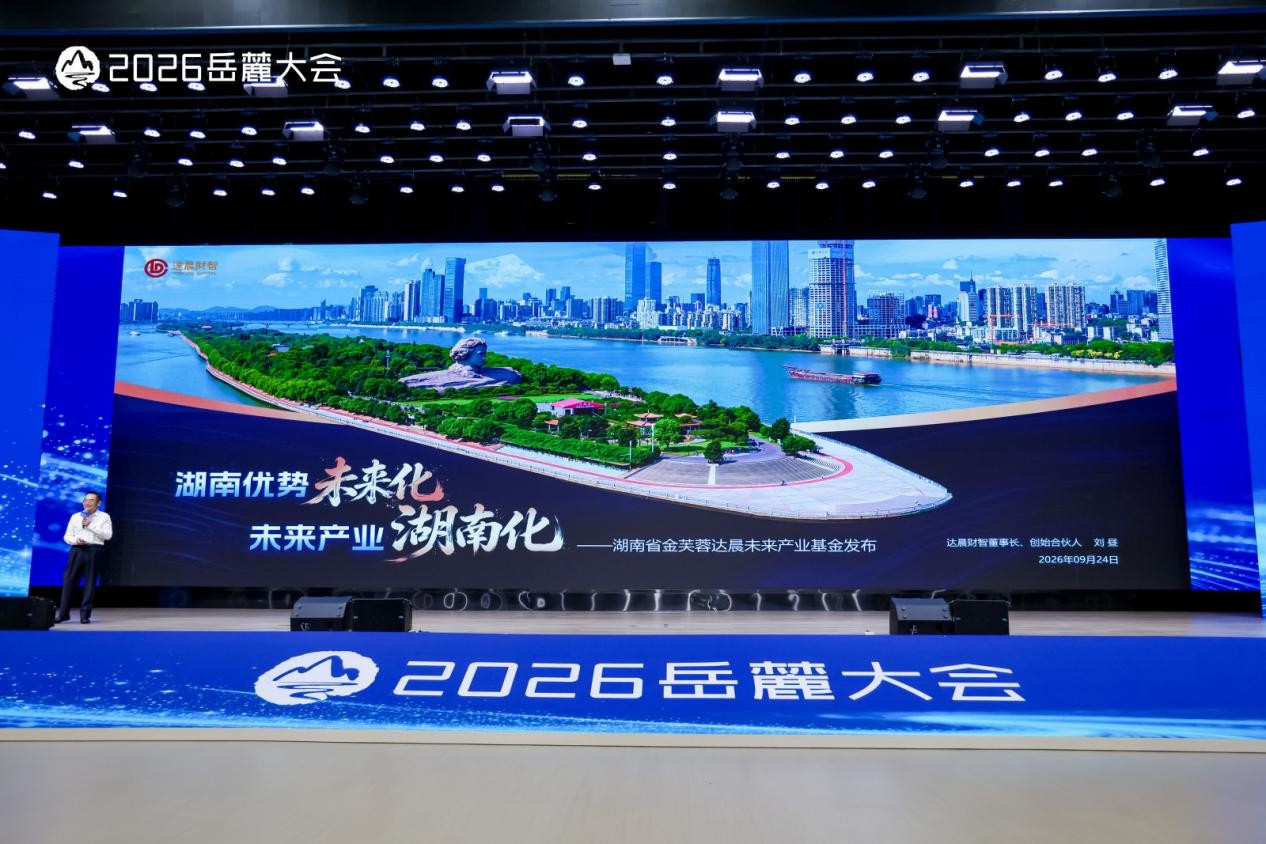
This year's conference is almost fully surrounded by AI. From AI+robotics, AI+advanced manufacturing to AI+brain-computer interface, AI+digital content, the conference has set up multiple AI-themed forums. The concurrent AI+Innovation and Entrepreneurship Exhibition arranges its 1600-square-meter exhibition area around three core technical elements: data, model and hardware, gathering 68 enterprises and 156 exhibits. Among them, the hardware and terminal product exhibition zone alone brings together 40 enterprises and 106 exhibits.
Robots, unmanned mining trucks, industrial vision, end-side models, high-quality datasets... Compared with simple discussions on model parameters, AI products that have already been put into specific industrial scenarios appear more frequently on site.
As the host location of the conference, Xiangjiang New Area is also the region with relatively concentrated AI industry in Hunan. The organizer stated that the new area currently gathers more than 1600 artificial intelligence and related application enterprises, with the revenue of enterprises above designated size reaching 44 billion yuan; nearly 100 key embodied intelligence enterprises are clustered here, and the revenue of related industries exceeds 10 billion yuan.
This also provides a window to observe how Hunan participates in this round of AI competition.
If measured by the density of foundation models, leading AI startups and venture capital, Hunan is not the most prominent region for the domestic AI industry. From a national perspective, cities such as Beijing, Shenzhen, Shanghai and Hangzhou have gathered more AI enterprises and large model resources; although the number of large models filed in Hunan ranks among the top in central China, its overall scale is still limited across the country.
However, when AI begins to enter the physical world from the digital world, another set of capabilities is becoming increasingly important. Factories, mines, construction machinery, as well as the engineering experience, production data and manufacturing capabilities formed around these industries in the past few decades, are becoming another type of infrastructure for AI implementation.
This is exactly Hunan's area of expertise.
AI Enters the Physical World
Robots are the most prominent type of exhibits in the Yuelu Conference exhibition hall.
Cloud Valley of CAS brings bipedal, wheeled humanoid robots and quadruped robotic dogs; Superb Display showcases a full-size industrial humanoid welding robot; Wanwei Robotics brings mobile robots applied in scenarios such as inspection and security.
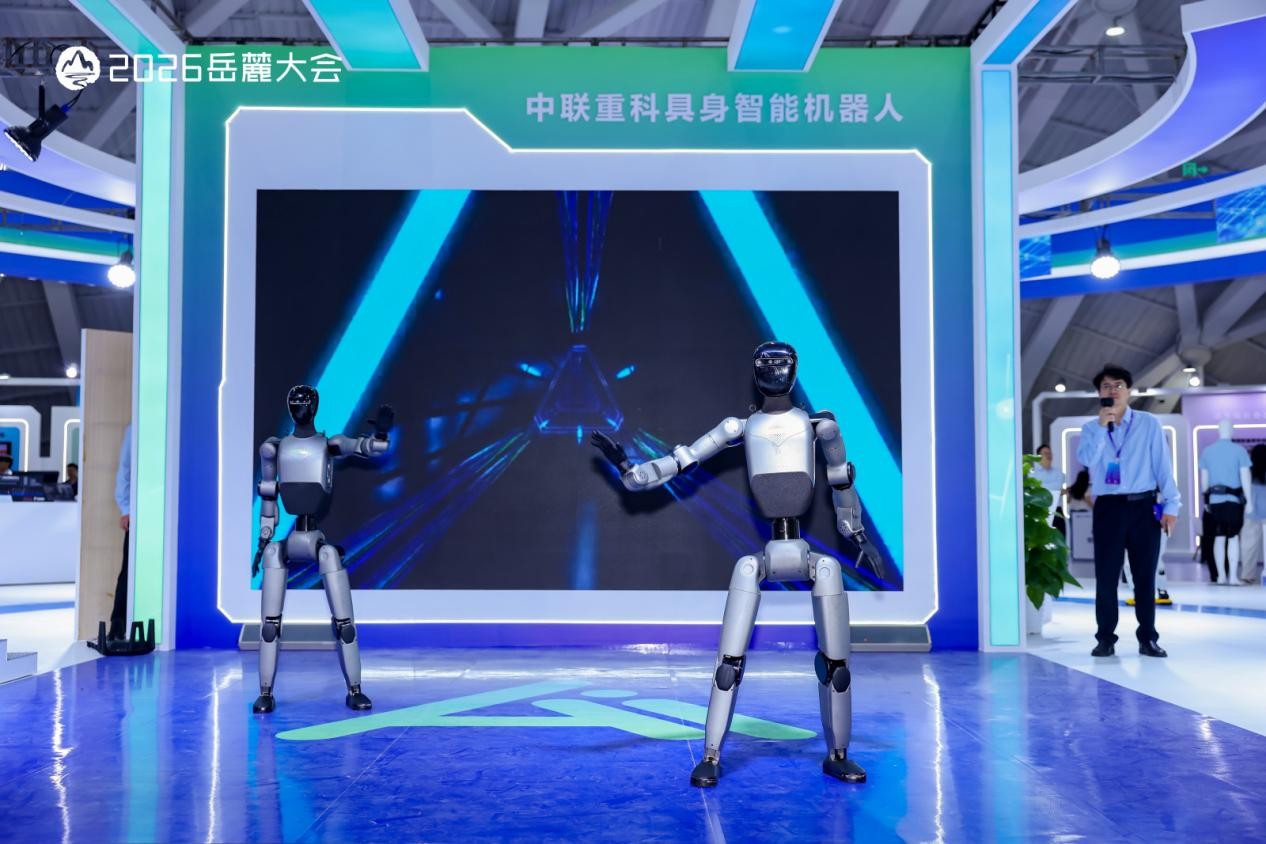
But when robots actually enter factories, mines and engineering sites, the problem is no longer just "whether we can manufacture robots".
She Lingjuan, Deputy General Manager of the Robotics Division of Zoomlion and Cloud Valley of CAS, told Hard Krypton that compared with the digital world, construction machinery faces a more complex real environment, and machinery, electrical, hydraulic systems as well as a large number of non-linear changes will cause the "Sim-to-Real Gap" between simulation training and real deployment.
The engineering capabilities accumulated by traditional manufacturing enterprises in the past are starting to play a role here.
"We used to have a lot of data, as well as rich accumulation of electromechanical principles and mechanism models," She Lingjuan said. Because they understand the mechanism behind equipment parameters and the source of errors, enterprises can complete the adaptation from the simulation environment to real equipment faster.
According to Zoomlion, it has currently developed 4 categories of 8 embodied intelligent robot prototypes, and dozens of humanoid robots have been verified in nearly 20 scenarios on more than 300 intelligent production lines.
The intelligentization of construction machinery also provides another implementation path.
She Lingjuan believes that truly versatile humanoid robots that can replace humans still take time, but engineering tasks such as ditching, slope finishing, and hoisting have clear construction methods and fault tolerance ranges, and do not need to wait for the full maturity of general robot capabilities. "The world model does not need to be as mature as that of humanoid robots, and it can be mounted on construction machinery to generate real practical value."
This means that when AI begins to enter the physical world, the machinery, electrical, hydraulic, process and engineering data that used to belong to the traditional manufacturing industry have also begun to become a type of technical asset required for AI implementation.
The Manufacturing Industry Is Providing Another Type of AI Infrastructure
In addition to engineering knowledge, another asset left by the manufacturing industry is data.
In the past few years, large models have relied heavily on Internet texts, images and videos for training. But when AI enters autonomous driving, robotics and industrial equipment, data of equipment operation, technological process and machine interaction in the real world is starting to become important.
Changsha is one of the first batch of national data labeling bases. The organizer stated that Xiangjiang New Area currently gathers 26 key data labeling enterprises, has built 23 high-quality industry datasets, and the total amount of labeled data exceeds 10000TB.
Local data companies are also evolving along with the AI industry.
Founded in 2015, PlanBlue Technology initially started with geographic information data labeling, then expanded to the autonomous driving sector, and now its business has extended to large models, embodied intelligence and other fields. The company says it has established platforms for data labeling, high-quality dataset evaluation and model training.
On the other end, models are also moving towards real terminals.
Hunan Huishiwei chooses end-side AI. The company says its visual generation model "Orange Island" is natively trained based on domestic computing power, and realizes offline operation on mobile phones. Its current business covers links such as model training compression and end-side deployment optimization.
These enterprises vary in size and technical routes, but point to the same change: when AI enters automobiles, robots and industrial equipment from the cloud, competition no longer only occurs in the model itself, but also extends to data, hardware adaptation, terminal deployment and engineering delivery.
These links have more intersections with Hunan's original manufacturing foundation.
Turn Scenarios into Resources
Of course, having a manufacturing industry does not mean that AI will naturally enter factories.
It is a long-standing problem in the technology implementation process that technology companies do not know what the industry really needs, and traditional enterprises may not necessarily know what problems AI can solve.
Hunan is trying to organize the "scenarios" themselves. This year, Hunan established an application scenario supermarket. The organizer stated that 279 scenarios and 294 capability supplies have been collected so far, with 457 enterprises settled in, to connect technology supply with industrial demand.
For AI, the significance of scenarios is not only to find customers. After the model enters the real industry, many problems can only be exposed on site; the operation of equipment generates new data, which can then be fed back to model training and iteration. Therefore, factories, mines and engineering sites are not only the final application outlets for AI, but also begin to participate in the iteration of the technology itself.
This is the more noteworthy point when Hunan participates in this round of AI competition.
Of course, manufacturing scenarios cannot be automatically transformed into AI competitiveness. At present, Hunan still has obvious room for improvement in links such as foundation models, some core software and hardware, and high-end talents. Compared with the AI industrial ecosystems formed in Beijing, Shenzhen, Shanghai and Hangzhou, there is still a gap in Hunan. However, new problems are also emerging in the AI industry itself.
In the past few years, people were concerned about: how much smarter can the model become? Now, when AI begins to control robots, automobiles and industrial equipment, another problem is becoming important: can the model actually do real work?
At this time, the evaluation system also changes accordingly. In addition to algorithms, machinery, electrical and hydraulic support are required; in addition to models, equipment, processes and on-site delivery are required; in addition to training, continuous feedback from real machines is also required.
From the embodied intelligent enterprises that are gathering in Xiangjiang New Area, to AI entering construction machinery, mines and production lines, a change has emerged: when AI starts to step out of the chat box and enter the physical world, the manufacturing capabilities accumulated by Hunan in the past few decades may be becoming another card for it to participate in this round of AI competition.