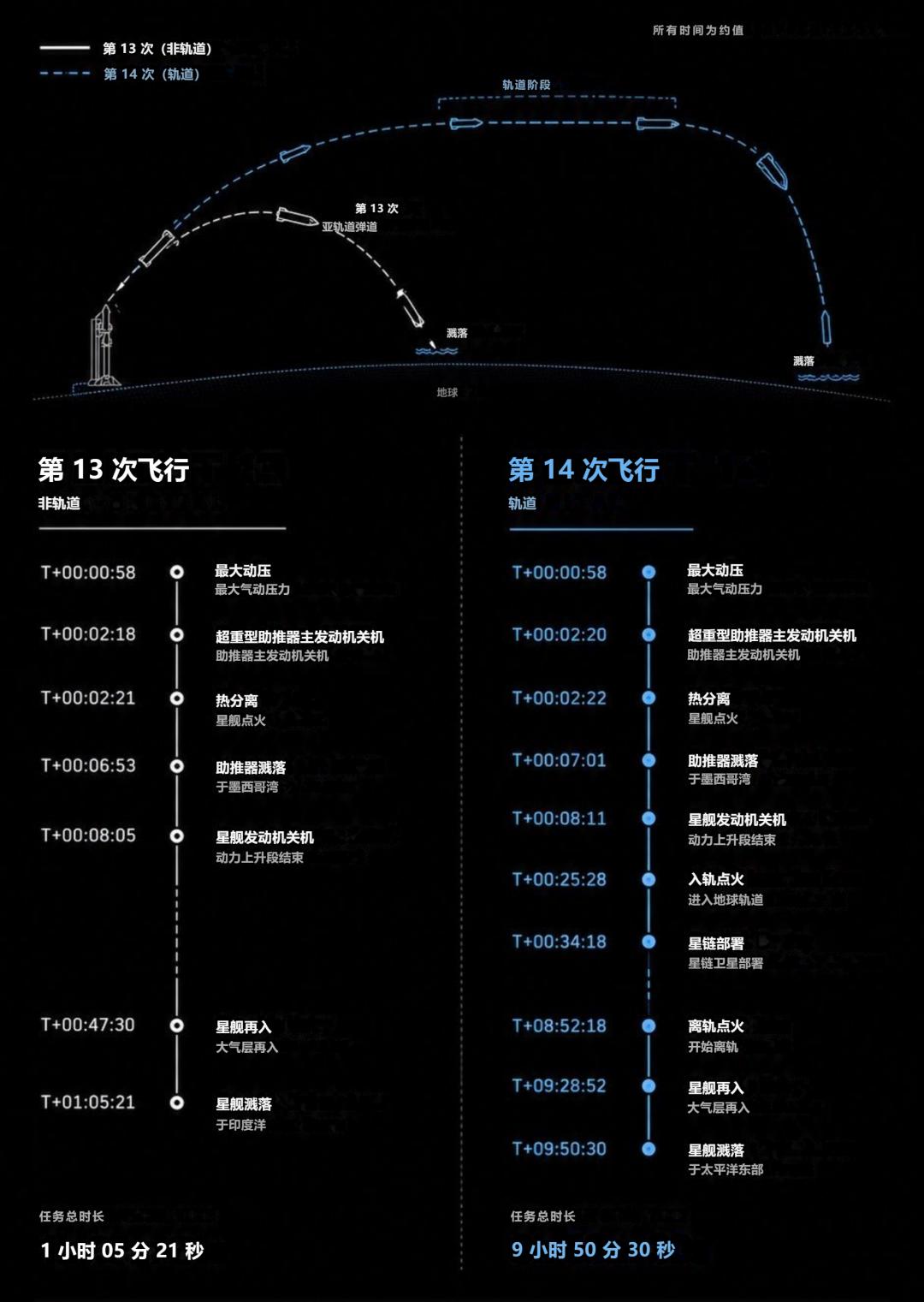
The wild boast Elon Musk made 10 years ago was finally fulfilled after 14 test flights that successfully put the spacecraft into orbit, yet it only completed two orbits around the Earth.
At 23:57 Beijing Time last night, the Starship spacecraft ignited its engines for final deceleration and gently landed in the Pacific Ocean north of Hawaii. It took off from the Starbase in Texas, the United States at 20:49 last night, flying for only about 3 hours in total, nearly 7 hours less than originally planned.
This is the 14th test flight of Starship, and also the first time it has ever entered a real orbit. During the flight, it deployed 26 V3-version Starlink satellites, marking the first time Starship has sent payloads into orbit.
This flight was far from perfect. Both the first stage and the second stage experienced engine shutdowns during ascent; the spacecraft was originally planned to orbit the Earth 6 times in space, but it returned in advance after less than 2 orbits.
In the previous 13 test flights, SpaceX only set flight plans for Starship to accelerate to a level just short of orbital velocity, and in several of these flights, the rocket exploded before reaching that stage.
SpaceX prevented Starship from entering orbit because a 52-meter-long stainless steel spacecraft weighing hundreds of tons, if it entered orbit but could not return, would only fly lower and lower in the thin atmosphere with its heat shield tiles, and no one could predict where it would finally fall.
Therefore, the real test of last night's test flight lay in the final stage, that is, the deorbit ignition at around 23:00 Beijing Time. The engines ignited, the spacecraft began to decelerate and fell back into the atmosphere, and Starship passed this test successfully.
It has been a full 10 years since this rocket was first publicly unveiled.
On September 27, 2016, Elon Musk, founder of the American aerospace company SpaceX, delivered the keynote speech at the International Astronautical Congress (IAC) in Guadalajara, Mexico. He announced the plan to colonize Mars and the rocket to implement this plan. This rocket was called the "Interplanetary Transport System" at that time, and was later renamed Starship, with a takeoff thrust of ten thousand tons. According to the design at that time, it could send 300 tons of cargo into low Earth orbit in a reusable state.
At that time, SpaceX's most powerful rocket was Falcon 9, which could only send a maximum of 22 tons of cargo into space in a single launch.
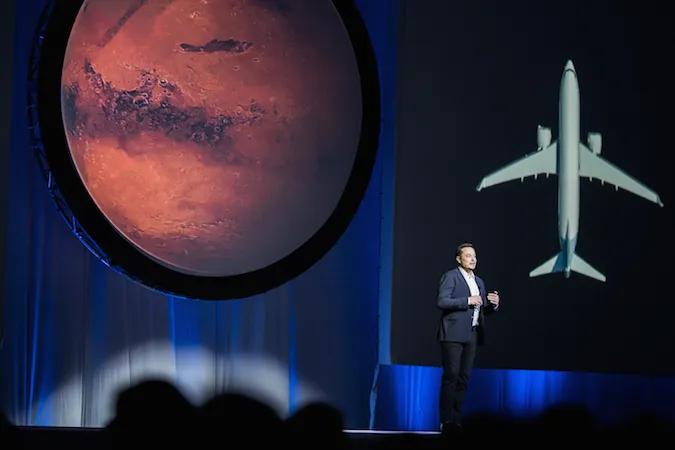
Keynote speech at the 2016 IAC Conference 丨 SpaceX
Most of the industry and the media regarded this plan as a fantasy. In the following 10 years, Starship was called a "PPT rocket", accused of being a financing scam, and even compared to the "reborn N1". The N1 was a lunar landing rocket developed by the Soviet Union in the 1960s, with 30 engines installed on its first stage, and all 4 test flights ended in failure. In the early stage of Starship's development, it also experienced frequent explosions, with prototypes exploding one after another during engine testing and landing.
Now, it has sent satellites into orbit. Measured by the strictest standards, Starship has already become a real launch vehicle.
13 Test Flights Without Orbital Insertion
If you throw a stone horizontally, the faster you throw it, the farther it will land. If the speed reaches a certain level, while the stone falls, the ground will also curve downward along the arc of the Earth, so the stone will never land and will only circle the Earth again and again.
This is orbital insertion. At an altitude of hundreds of kilometers, the required speed is about 7.8 kilometers per second.
In the first 13 trajectories of Starship, the lowest point (perigee) fell in the dense atmosphere, and the rocket would dive back before completing a full orbit. This is called suborbital flight. Even if the engine failed to ignite in space, the spacecraft would fall into the Indian Ocean on its own about 1 hour after takeoff, which was equivalent to adding a safety guarantee to the spacecraft.
After entering orbit, this safety guarantee no longer exists. To return, the spacecraft must re-ignite its engines in space to reduce its speed.
Once the deorbit ignition fails, the spacecraft will be trapped in orbit. There is still extremely thin air at an altitude of hundreds of kilometers, which will slowly drag the spacecraft down, making it fly lower and lower, and finally fall into the atmosphere at an unpredictable time and location.
The Starship spacecraft is designed to withstand the high temperature of re-entry, so it will not burn up completely in the air like most decommissioned satellites, and there is a considerable possibility that large debris will fall to the ground.
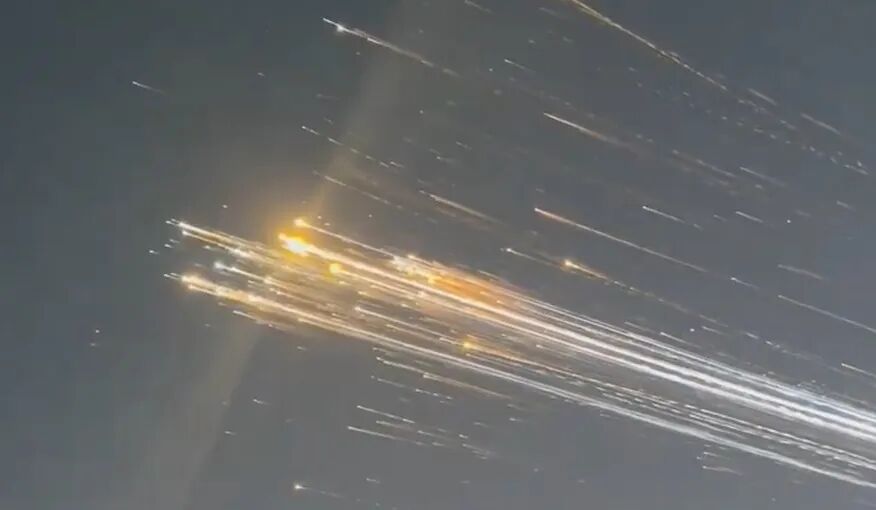
The spectacular scene of Starship falling into the atmosphere during its 7th test flight 丨 Alex Davenport
Such incidents have occurred in the history of aerospace. Skylab was the first space station of the United States, weighing about 77 tons, launched in 1973. According to the original plan, after the space shuttle was built, it would either be pushed to a higher orbit or guided to a controlled crash. However, the development of the space shuttle was delayed again and again, and solar activity was more intense than expected, which heated and expanded the upper atmosphere. As a result, Skylab was subjected to increasing resistance, and its orbit dropped faster and faster.
On July 11, 1979, Skylab fell into the atmosphere. Most of its structure burned up in the air, but a lot of debris still fell in Western Australia, fortunately no one was injured. The local town of Esperance even issued a A$400 littering ticket to NASA (National Aeronautics and Space Administration). This fine was not paid off until 2009, when an American radio host raised money from his listeners.
Skylab is the uncontrolled re-entry spacecraft with the largest mass in history. Since then, making large spacecraft perform controlled crashes at the end of their service life has gradually become a common practice in the aerospace industry. The Starship spacecraft is larger than Skylab, and its weight is also comparable to it.
Starship also experienced many setbacks in these 13 test flights before crossing the threshold of orbital insertion.
In April 2023, the first flight failed to separate the two stages, and finally self-destructed in the air. In the second flight, the spacecraft malfunctioned when the engine was about to shut down, and also self-destructed. In the third flight, the spacecraft lost contact when re-entering the atmosphere. It was not until the fourth flight in June 2024 that both the first stage and the second stage successfully fell into the sea completely for the first time.
In 2025, the fully upgraded 2nd-generation spacecraft (V2) debuted, but suffered 3 consecutive failures. During the 7th and 8th flights, the spacecraft exploded during ascent; the 9th flight entered the predetermined trajectory, then lost control and tumbled, and disintegrated when re-entering the atmosphere. Starship launched 5 times in this year, and only 2 of them succeeded.
In 2026, the 3rd-generation Starship (V3) debuted. Its maiden flight, the 12th test flight, had one engine shut down in advance during ascent, and the remaining engines extended their working time to barely send the spacecraft to the predetermined trajectory. The originally planned in-space ignition test was therefore cancelled, and the spacecraft finally landed smoothly in the Indian Ocean.
The 13th test flight was the most successful flight of Starship before. It completed the engine ignition test in space, deployed 20 real Starlink satellites for the first time, and finally fell into the Indian Ocean completely, floating steadily on the sea. But those 20 satellites also followed the suborbital trajectory, fell back soon, and burned up in the atmosphere.
During last night's 14th test flight, SpaceX finally decided to cross the threshold of orbital insertion.
The V3 Super Heavy Booster Fell Into Water Completely For The First Time
At 20:49 last night, the first stage of Starship numbered B21, carrying the second stage numbered S41, took off from Launch Pad 2 at Starbase in southern Texas. The first stage of Starship is called Super Heavy, and the second stage is the Starship spacecraft.
The entire Starship has a diameter of 9 meters and a height of 124.4 meters. It is a two-stage rocket without additional boosters, and both stages use liquid oxygen and liquid methane as propellants. If both stages are recovered and reused, it can send no less than 100 tons of cargo into low Earth orbit.
The first stage is 72.3 meters high, equivalent to a 24-story building, carrying 3650 tons of propellant. It is equipped with 33 3rd-generation Raptor engines at its tail, with a takeoff thrust of 8240 tons, making it the rocket with the largest thrust in the world so far.
The second stage is 52.1 meters high, equivalent to a 17-story building, carrying 1600 tons of propellant, and also uses 3rd-generation Raptor engines, with a total of 6 units. The 3 engines in the middle are sea-level versions; the 3 engines on the periphery are vacuum versions, with larger nozzles, which are suitable for working in space with almost no air.
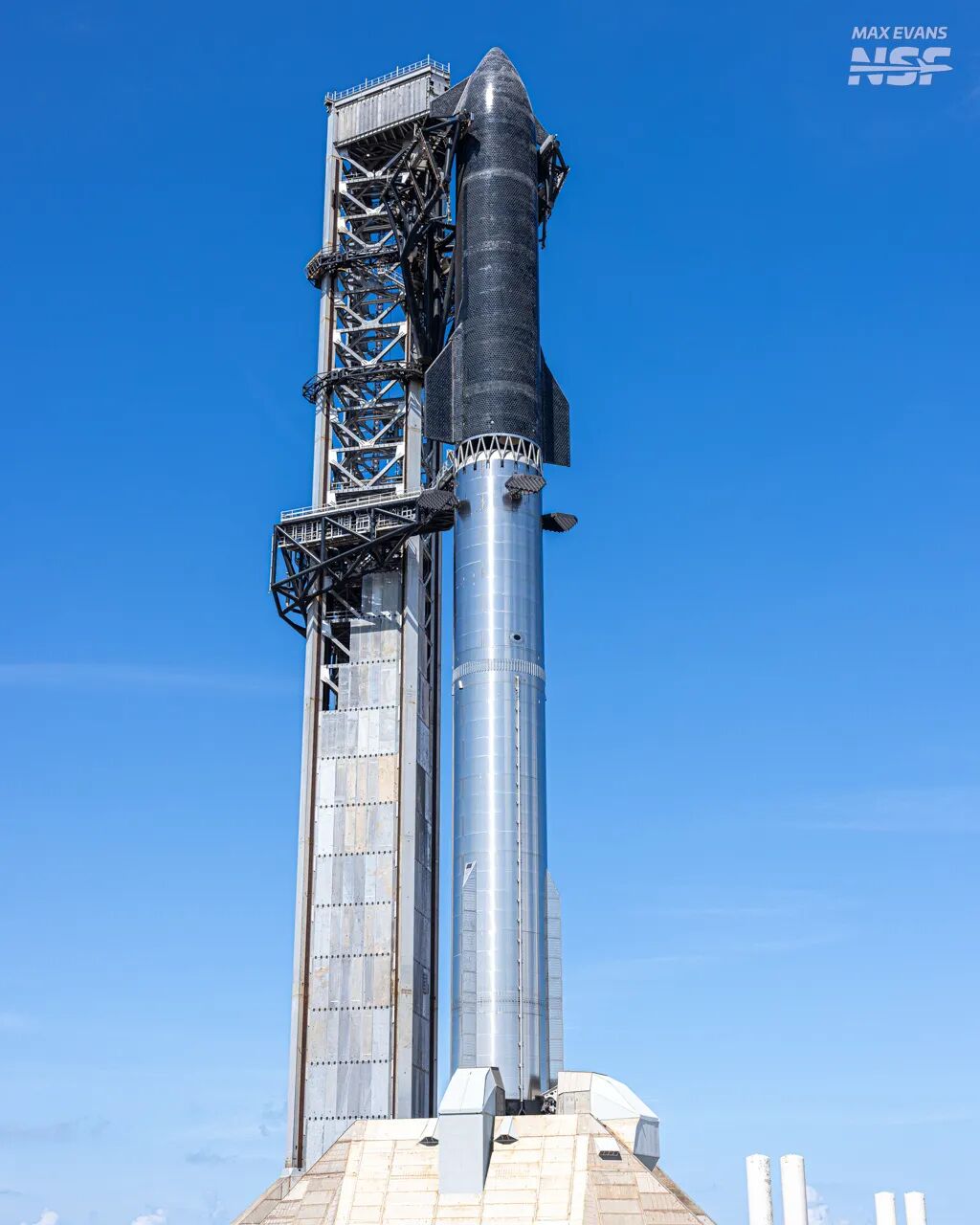
Starship S41 and Super Heavy B21 completed stacking at Launch Pad 2 丨 Max Evans / NSF
More than two minutes after takeoff, the two stages separated.
The recovery of Starship's first stage requires two ignition processes. The first one is the return-to-launch-site burn, which makes the first stage turn around and fly towards the recovery area. The second one is the landing burn, which reduces the speed before landing.
The old-generation Starship first stage flew back to the launch tower 3 times, and was caught in mid-air by two huge robotic arms on the tower, which were nicknamed "chopsticks". However, after switching to the V3 version of the Starship first stage, even these two ignition processes could not be completed smoothly.
The first stage of the 12th flight had one engine shut down at takeoff, and not all engines could be ignited during the return-to-launch-site burn, and finally exploded. The B20 of the 13th test flight made all 33 engines participate in the return-to-launch-site burn for the first time, but in the later stage of ignition, the 3 central engines showed signs of icing and shut down in advance, so the return-to-launch-site burn also ended early. During the landing burn, only 8 of the 13 planned engines were ignited, and B20 crashed into the Gulf of Mexico at high speed.
In response to these problems, B21 replaced the redesigned filter on the pipeline leading from the liquid oxygen tank to the central engine, and also modified the software to make the engine re-ignition more reliable. But B21 still could not completely get rid of the old problems. During ascent, one of its engines shut down; during the return-to-launch-site burn, 2 more engines failed to ignite.
Fortunately, it still completed the landing burn, slowly falling onto the sea surface of the Gulf of Mexico, which was the first time among the 3 V3 first stages. But shortly after falling into the water, B21 exploded.
With One Engine Shut Down, It Still Entered Orbit
On the spacecraft side, one of the vacuum-version engines also shut down in advance during ascent. Just like the 12th flight, the remaining engines extended their working time in the following ten minutes to send the spacecraft to the predetermined trajectory. At this time, its trajectory, like the previous 13 flights, was still suborbital.
The advantage of having a large number of engines is that if one engine fails, the rest can make up for it. Starship, which was once compared with the N1 rocket, still sent the spacecraft into orbit even though one engine of each stage shut down this time. But being able to compensate does not mean there is no problem. Every time an engine shuts down, more propellant has to be burned to make up for the loss, which reduces the remaining margin for subsequent tasks.
Including this flight, the V3 version of Starship has flown 3 times in total. The first stage has engine shutdown or ignition failure every time, and the spacecraft also experienced shutdown during ascent twice.
In the following ten minutes, the spacecraft glided forward with its engines off, and the ground was waiting for a decision. With one engine shut down, the SpaceX flight control team needed to further confirm that everything in the ascent stage was normal, especially that all equipment related to deorbit was in good condition. As long as one item failed to meet the standard, the spacecraft would no longer ignite, stay in suborbital orbit, and fall back to the Indian Ocean as usual.
25 minutes and 17 seconds after takeoff, the spacecraft ignited one Raptor engine, lifting the perigee from the dense atmosphere to outside the atmosphere. After the engine shut down, Starship entered a low Earth orbit at an altitude of about 275 kilometers.
About 34 minutes after takeoff, a long strip of hatch on the side of the spacecraft opened, and 26 flat V3 Starlink satellites slid out one by one. This deployment device is nicknamed the "card dealer", which pushes the satellites out one by one like playing cards.
This time, the satellites really stayed in orbit. They will deploy solar panels and antennas, establish contact with ground stations, complete various tests, and then use their own electric propulsion engines to gradually raise their orbit to the working altitude of more than 300 kilometers. The electric propulsion engine accelerates the gas to eject by electricity, with very small thrust, but it is extremely fuel-efficient.
Three of the satellites were modified to take pictures of S41 when leaving, to check the heat shield tiles on its body. The 13th test flight has verified that satellites can take pictures of the spacecraft. This time, in the real orbit, the satellites will experience longer flight time, more day and night cycles, and more complex temperature changes.
Originally Planned to Orbit 6 Times, It Returned Home After 2 Orbits
After deploying the satellites, the Starship spacecraft began to glide in orbit. According to the original plan, it would orbit the Earth 6 times and then glide for 7.5 hours.
After the engine of the spacecraft shut down during ascent, SpaceX said it would evaluate the problem to see if the mission could continue. At 22:29 Beijing Time, after evaluating the state of the spacecraft, SpaceX decided to let it return in advance.
Musk said: "We are extremely cautious this time." He explained that if the spacecraft disintegrated over land and the debris injured people, SpaceX's reputation would plummet.
Even so, this flight took about 3 hours from takeoff to water landing, while the previous test flight only took 1 hour, 5 minutes and 21 seconds.