Insights into Industrial Development from the Satellite Internet of Things Competition Landscape Matrix
Recently, market research institution Counterpoint Research released its annual Satellite IoT Connectivity CORE Evaluation Matrix. Based on data from the first half of 2026, the matrix systematically assesses 18 overseas satellite IoT players across two dimensions: Capabilities × Execution. The matrix divides the players into four quadrants: the Leader quadrant includes a sub-category of Pacesetters, and there are also multiple enterprises in the Challengers quadrant and the Niche quadrant.
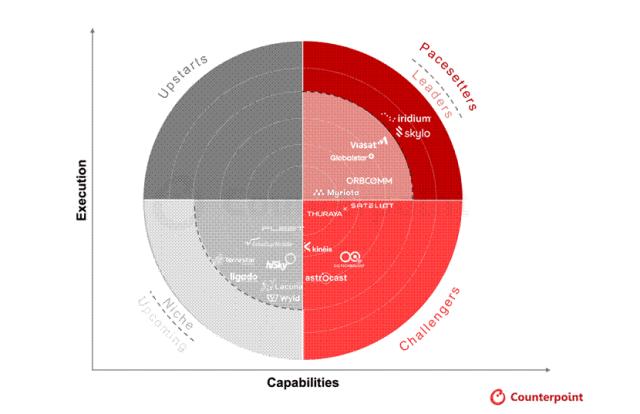
Counterpoint analysts point out that as the 3GPP NTN standard and satellite-terrestrial hybrid connectivity architecture mature, satellite communication is accelerating its integration into the cellular ecosystem. Mobile operators, virtual operators, chip and module manufacturers, terminal vendors and IoT platforms have all entered the market, and the competition focus has shifted from "whether a network is available" to "whether connection value can be delivered on a large scale". China has launched commercial trials of satellite IoT, and in-depth understanding and benchmarking against overseas satellite IoT manufacturers is of great significance.
Overseas Satellite IoT Competition Landscape
1. Pacesetters: Iridium and Skylo at the Top
In the matrix, Iridium and Skylo are both classified as Pacesetters in the Leader quadrant, but the two represent completely different development paths. Iridium adopts the route of deep cultivation of dedicated networks: relying on its mature in-orbit constellation, huge base of existing IoT users and extensive partner ecosystem, while continuously investing in hybrid connectivity and standardization. Its advantage lies in that its network reliability has been verified for more than 20 years, and it has a deep pool of paying customers in high-end markets such as global logistics tracking, maritime and aviation.
Skylo follows the route of standard ecosystem reconstruction: it does not build its own independent constellation, but deeply ties up with mobile operators, chip manufacturers and terminal ecosystems to promote standardized satellite connectivity based on 3GPP NTN, enabling ordinary cellular modules and terminals to access satellite networks without perception.
2. Leaders: Traditional Giants' Stewardship and Transformation
Viasat (after merging Inmarsat), Globalstar, ORBCOMM and Myriota form the leader camp. Viasat takes advantage of the width of its combined low-earth orbit and geostationary orbit product portfolio; ORBCOMM and Globalstar continue to expand relying on mature industrial IoT and tracking businesses; Australia's Myriota is known for its ultra-low power direct-to-device technology and is extending its capabilities to hybrid architectures. The common feature of this camp is that they have existing business and stable cash flow, but are facing transformation pressure under the wave of standardization.
3. Challengers: Clear Divisions in Technical Routes
Sateliot and OQ Technology build solutions tightly coupled with the cellular ecosystem around 3GPP NB-IoT NTN; Thuraya promotes 3GPP-compatible NTN through cooperation with Skylo; while Kinéis and Astrocast adhere to proprietary non-3GPP technologies. It can be predicted that for players with similar technical capabilities in the future, the final gap will mainly depend on the scale of commercial execution, market reach and application breadth.
4. Niche Players: Deep Cultivation in Regions and Scenarios
Fleet, EchoStar Mobile, Ligado, Lacuna, Wyld and other players focus on market segments and survive by virtue of regional presence and customized capabilities for specific scenarios. The matrix evaluation believes that as the market is still in the early stage, niche players still have a window to break upward with their professional capabilities.
Common Trends in the Development of Satellite IoT
The Counterpoint matrix reveals some common trends in the satellite IoT field, mainly including:
First, standardization has become an important "reshuffling" variable. After 3GPP R17/R18 introduced the NTN standard framework, satellite connectivity can reuse the scale effect of the terrestrial cellular industry chain, and the cost of terminal modules has dropped rapidly, which is an important reason for the rise of asset-light players such as Skylo and Sateliot.
Second, hybrid connectivity has become the default architecture. Satellites are no longer a substitute for terrestrial networks, but a part of the intelligent switching system of cellular-satellite multi-links, which requires players to have the ability to manage hybrid connectivity at the levels of core network convergence, unified billing and device management.
Third, the importance of commercial execution is getting higher and higher, and it jointly determines the competitiveness of enterprises together with network capabilities. Counterpoint clearly points out that secure, compliant and reliable connectivity is becoming an admission ticket rather than a differentiated advantage, and the key to winning lies in the depth of device integration, ecosystem interoperability and large-scale deployment.
Insights into China's Related Industrial Progress from the Overseas Satellite IoT Landscape
From the policy perspective, we have fully rolled out arrangements from top-level planning to commercial trials. Since 2024, satellite internet has been included in the strategic industrial layout. In August 2025, the Ministry of Industry and Information Technology issued the *Guiding Opinions on Optimizing Business Access to Promote the Development of the Satellite Communication Industry*, which clearly proposed to organize and carry out commercial trials of satellite IoT, and support eligible enterprises to rely on low-earth orbit satellite IoT constellations to provide wide-area IoT connectivity services for the sky, ocean and remote areas. In November 2025, the Ministry of Industry and Information Technology issued the *Notice on Organizing and Carrying out Commercial Trials of Satellite IoT Services*, officially launching commercial trials of satellite IoT, which is open to industrial users in the fields of industry, transportation, energy, agriculture, emergency response and other sectors. In September 2026, the *15th Five-Year Plan for the Development of the Information and Communication Industry* further clarified the promotion of the commercialization of satellite internet and satellite IoT, and the approval of a new round of commercial trials for China's low-earth orbit satellite IoT was implemented simultaneously.
In terms of constellation and network infrastructure, China is in a state of simultaneous development of multiple constellations. At the constellation level, China has formed a multi-level satellite IoT supply pattern. China Star Network's GW constellation is accelerating its networking as the national main force, and Shanghai Yuanxin Qianfan constellation has more than 200 satellites in orbit. Geespace's first phase of the Geely constellation with 64 satellites has completed networking, and Guodian Hi-Tech has 41 satellites in orbit, both of which are satellite operation enterprises focusing on IoT data services. In addition, high-throughput satellites, Tiantong-1 and Beidou short message services constitute existing resources for coordinated operation of high and low orbits.
From the perspective of standard deployment, the three major Chinese operators have made in-depth layouts for 3GPP NTN, and domestic 3GPP ecosystem vendors are also vigorously promoting the implementation of NTN standardized products.
Compared with the Counterpoint matrix, China's satellite IoT has some obvious advantages: strong policy support, outstanding constellation construction speed and manufacturing cost reduction capabilities, and the ultra-large-scale terrestrial cellular network provides a unique foundation for satellite-terrestrial integration. Of course, we must also see some gaps. For example, relevant satellite IoT operation enterprises in China have not achieved large-scale revenue, and the accumulation of international commercial brands, global service networks and multinational enterprise customers is still insufficient.
In the future, standardized NTN and proprietary networks may coexist for a long time, but the incremental market will belong more to standardized solutions. At the same time, the competition direction has shifted from constellations to the integration of constellation, operation and terminals. In addition, the Skylo model proves that asset-light integrators can leverage the entire cellular ecosystem, and similar ecosystem integrators like Skylo may emerge in China in the future.
For domestic enterprises, they should adhere to the 3GPP NTN standard route, avoid technical silos, and directly reuse the achievements of the global cellular industry chain. Focus on key areas and implement commercialization strategies for breakthroughs in key scenarios, such as prioritizing the formation of replicable models in scenarios such as connected vehicles, low-altitude economy, marine fishery, and emergency management, so as to cultivate leading enterprises that are rooted in China and oriented to the world during the key window period of global satellite IoT development.
This article is from the WeChat Official Account "IoT Intelligence" (ID: iot101), author: Zhao Xiaofei, authorized for release by 36Kr.