Tencent has secretly developed a "Chinese version of Muse"
A while back, Meta launched Muse, which went viral overseas. I had nothing to do during the Mid-Autumn Festival, so I did some research and found this product pretty interesting.
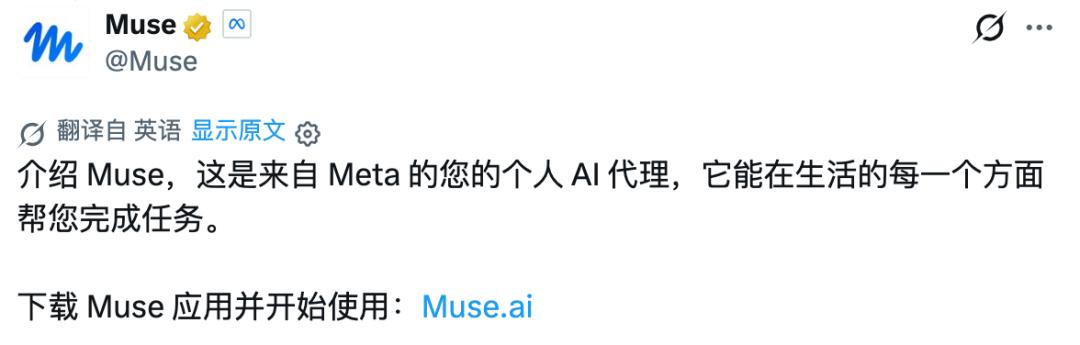
It is somewhat different from the AI assistants we are familiar with in the past, such as GPT and Doubao. Muse stays in the cloud all the time, has its own virtual computer and browser, and can remember your goals and habits. You can ask it to help you track prices, arrange schedules, and handle all kinds of trivial matters. Even if the App is closed, it can still keep working in the background.
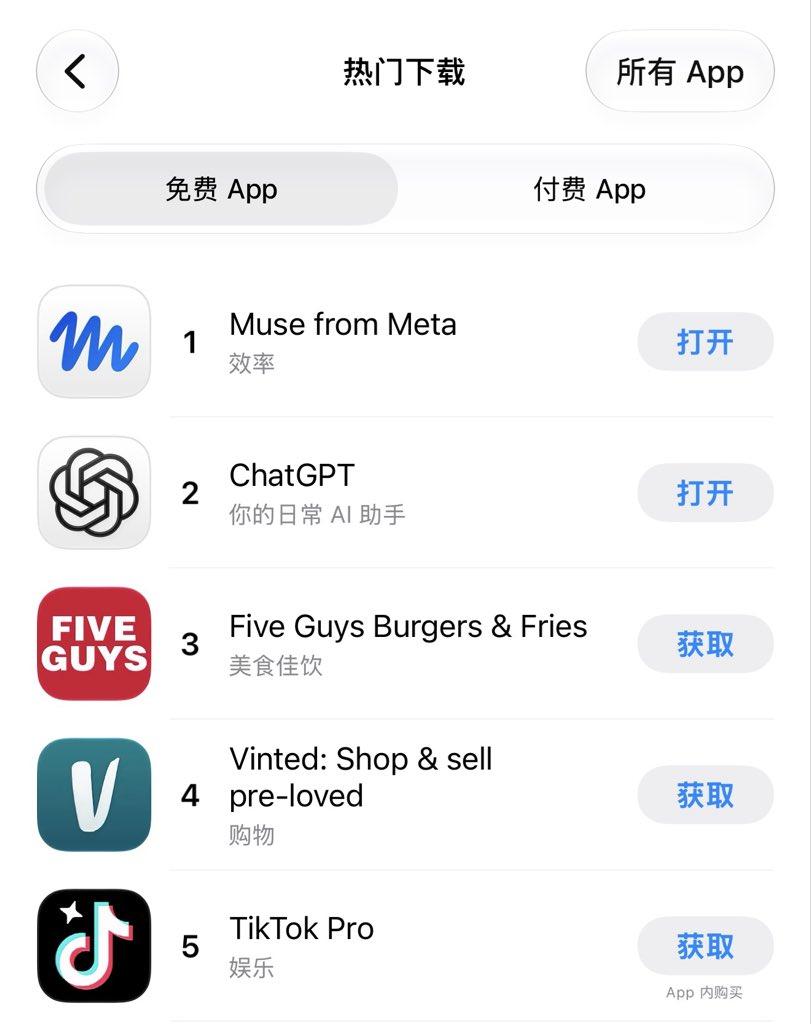
The market response is also quite staggering. Muse was launched on September 8. In less than three weeks, Sensor Tower estimates that its downloads have exceeded 3.4 million; around two weeks after launch, it has already topped the US app download chart.
What's more interesting is that it can also be directly integrated into WhatsApp. In the future, when you need AI, you don't necessarily have to open a dedicated App first, just send it a message like you would to a contact.
Meta positions it very directly: Personal AI Agent.
I saw a tweet on a social platform today and found that Tencent has quietly developed a product very similar to Muse, but this is not plagiarism, as it was launched even earlier than Muse.
It is called LightVela.
The more I research, the more I feel that this product can be completely understood as a "Chinese version of Muse".
01 Tencent has built a 7×24 hour online AI for you
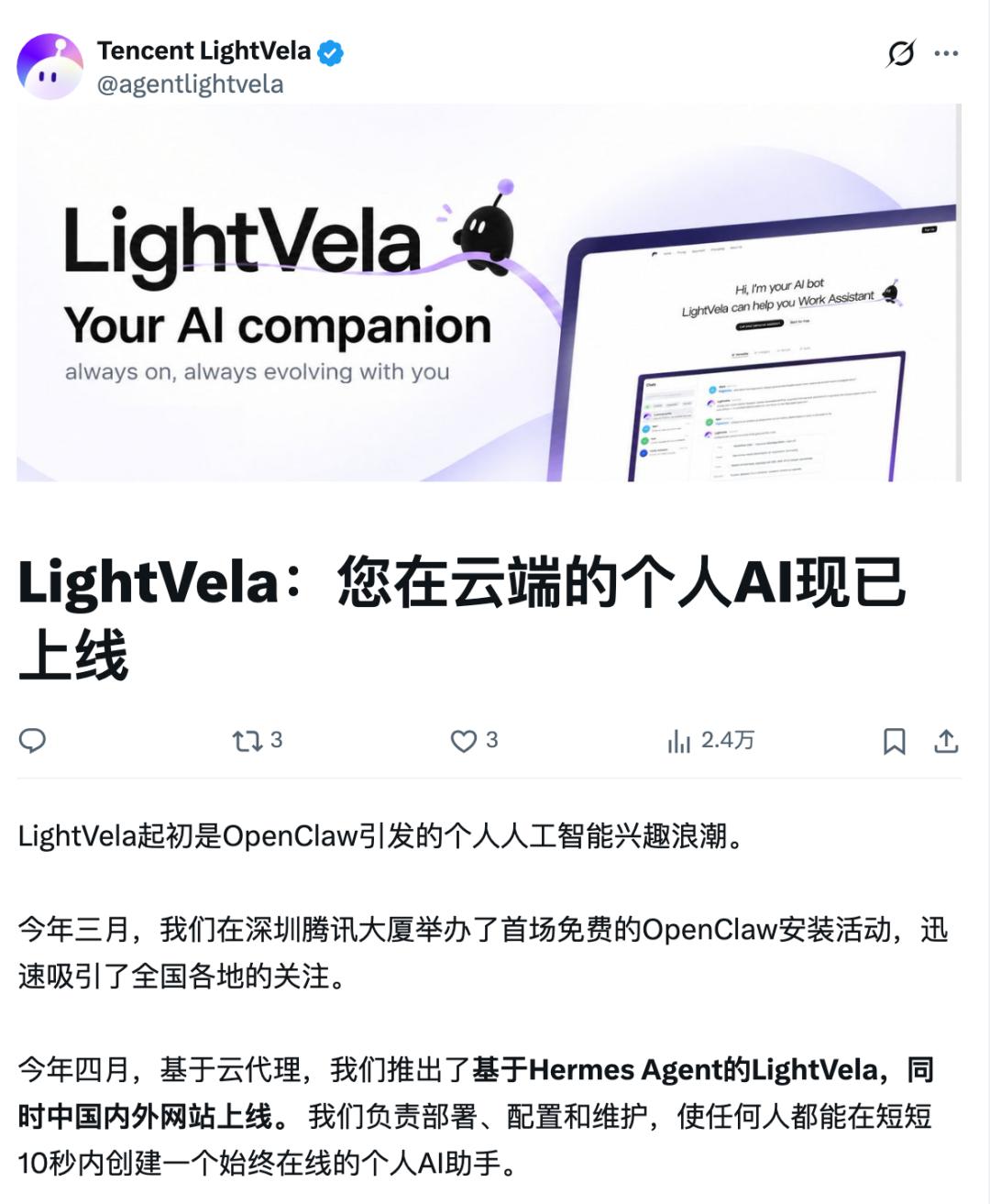
LightVela is a product developed by Tencent Cloud Lite team, and it currently hosts the open-source Hermes Agent.
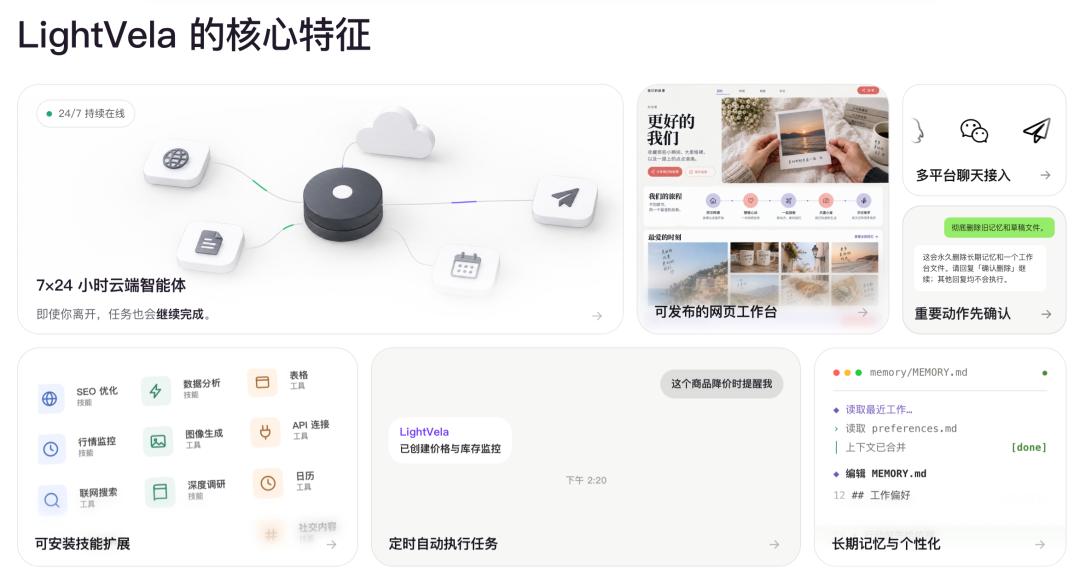
To put it simply, Tencent has deployed a dedicated AI for you in the cloud. It can stay online 7×24 hours, no need to keep your computer running all the time. You can configure the model, persona, and skills by yourself, and it also has long-term memory.
This is quite different from our usual habits of using GPT and Doubao. In the past, when we used AI, most of the time we only opened the App when we had something to do: ask a question, write a copy, look up information, and the conversation would almost end once the matter was resolved.
LightVela aims to build a different kind of relationship. This AI will always be there: you can ask it to record a project today, and follow up with questions tomorrow; you can ask it to help you organize work this month, and it will still remember what happened last month. You can also set up scheduled tasks, such as sorting out news every morning, summarizing project progress every Friday, or actively reminding you when a certain time comes.
LightVela has also made a specific comparison with ordinary AI Chatbots: traditional Chatbots are more centered on individual conversations, while it emphasizes a continuously existing Agent.
At this point, it is already very similar to Muse. Meta has equipped Muse with a continuously running Secure VM, which can operate in the background for a long time, has its own browser, can remember the things users care about, and can also take the initiative to send reminders to users.
One is called Muse, the other is called Hermes, but the final product forms they develop are getting closer and closer.
02 The part of LightVela that is most similar to Muse is that it integrates the Agent into WeChat
I find this feature particularly interesting.
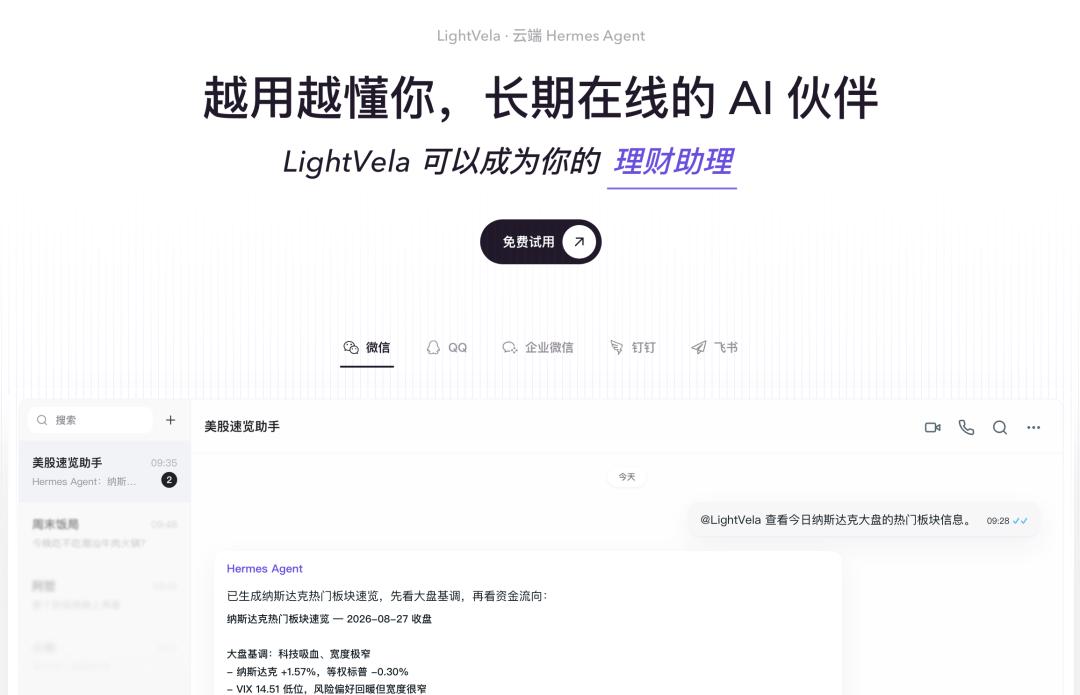
LightVela can be directly connected to WeChat. After configuration, you don't need to open the LightVela official website every day to access it, this Hermes Agent can appear directly in WeChat. In addition, it also supports QQ, WeCom, Feishu and DingTalk.
The WeChat entry in particular is very reminiscent of Muse's integration into WhatsApp.
You chatted with it about a project in WeChat in the morning, and switched to Feishu to continue the conversation in the afternoon, it can still follow up based on previous memories. You can also send images, files and voice messages in WeChat, and the Agent can also take the initiative to send you messages, such as reminders when the time comes.
This product form actually has great imagination space in China.
We are already used to having bosses, colleagues, friends and family in our contact list, and in the future, there may be an additional AI that never sleeps. If you suddenly remember something at 2 a.m., you can just send it a message: "Remind me to send the contract to Lao Wang tomorrow morning." Then put down your phone and go to sleep, and it will come to find you the next day.
This usage habit may be more natural than cultivating users to open a new AI App every day.
Muse chose WhatsApp, while LightVela chose WeChat, QQ, WeCom and Feishu. The ideas behind are actually very similar: Let AI enter the communication networks that users are already using.
If Personal Agent really becomes something that everyone uses every day in the future, I even think that "where it lives" may be as important as "how smart it is".
03 It is also different from Manus
When seeing "cloud-based Agent", many people may first think of Manus.
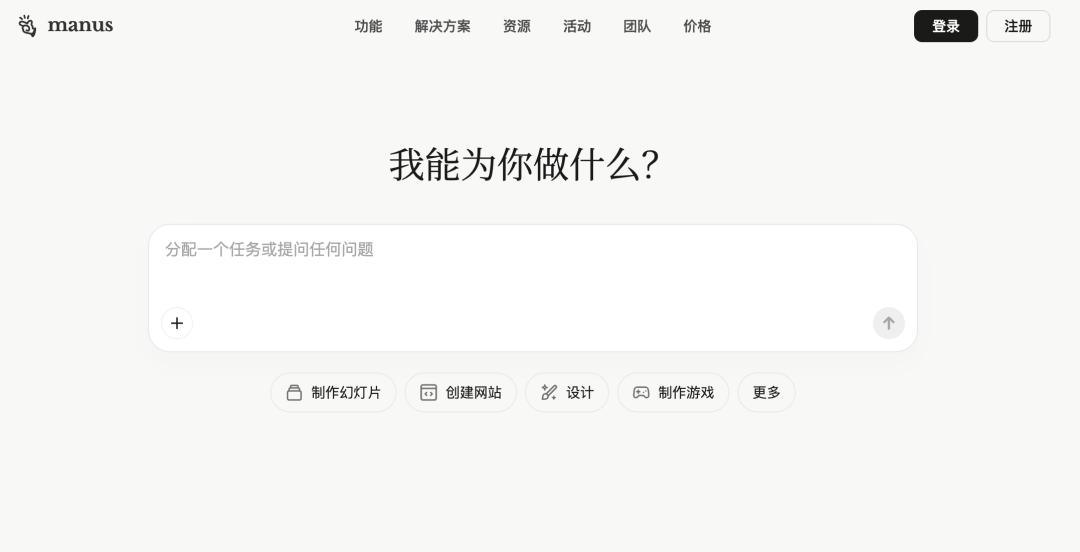
LightVela has also published a dedicated document explaining the difference between the two, and I think this difference is worth discussing.
Manus is better at letting you hand over a complete task. For example: "Help me research 30 competing products, and organize their prices, financing status and product features into a report." Then Manus starts to look up information, open web pages, sort out content, and finally gives you the result.
LightVela puts more emphasis on the long-residing Agent. You can ask it to record a project today, remind you tomorrow, and come back next week to ask "Where did we leave off last time", it will still be there.
Tencent's own document summarizes this difference very accurately: LightVela starts from "an Agent you will keep for a long time", while Manus starts from "a task".
To make an analogy, Manus is more like a highly capable outsourcing team: you hand over the work to it, and it is responsible for bringing back the results; LightVela and Muse are more like digital assistants that stay by your side for a long time, they are always there, and you can keep assigning tasks to them.
Of course, these two paths will most likely become more and more integrated in the future. Long-term Agents also need to perform complex tasks, and task-based Agents will also supplement memory and active services, but the focus of several products today is still different.
04 Tencent has taken a very "cloud vendor" route this time
There is another detail that is quite interesting: the Hermes Agent in LightVela is not built from scratch by Tencent.
Hermes Agent comes from Nous Research, which is an open-source Agent that supports long-term memory, scheduled tasks, Skills, browser, multi-platform message access, and can also connect to different large models.
What Tencent has done is very consistent with the identity of a cloud vendor: host this set of things, and hide the most troublesome parts in the background.
In the past, ordinary users who wanted to deploy Hermes might have to set up servers, environments, model APIs, Gateways, and process management by themselves. Many Agent projects on GitHub look very impressive in demos, but when ordinary users try to install them, they will be discouraged when they see Docker, Python, and API Key.
After LightVela is packaged, the process for users is much simpler: select a model, set a persona, install skills, connect to WeChat, and then start using it.
From this perspective, it is even a bit like an "AI hosting service". You don't need to maintain the server yourself, Tencent helps you run a long-term online Agent.
Moreover, the "brain" of this Agent can be replaced. You can connect to DeepSeek today, switch to Kimi tomorrow, and change to whichever model is more powerful the day after tomorrow. As long as the Agent's own long-term memory, skills and identity remain, users don't necessarily need to migrate along with the model.
I think this will become more and more important in the future.
05 Looking at the Yunqi Conference again, things are starting to be different
Originally, when I researched LightVela, I just thought Tencent had also made a product very similar to Muse.
But when I look at the recent moves at the Yunqi Conference, I suddenly feel that this may no longer be a coincidence between Tencent and Meta.
At the Yunqi Conference, Qwen clearly proposed to accelerate the development of Personal Agent, hoping to provide hundreds of millions of users with continuous and personalized intelligent services. After user authorization, Qwen will further connect to personal data such as health, sports, and financial holdings.
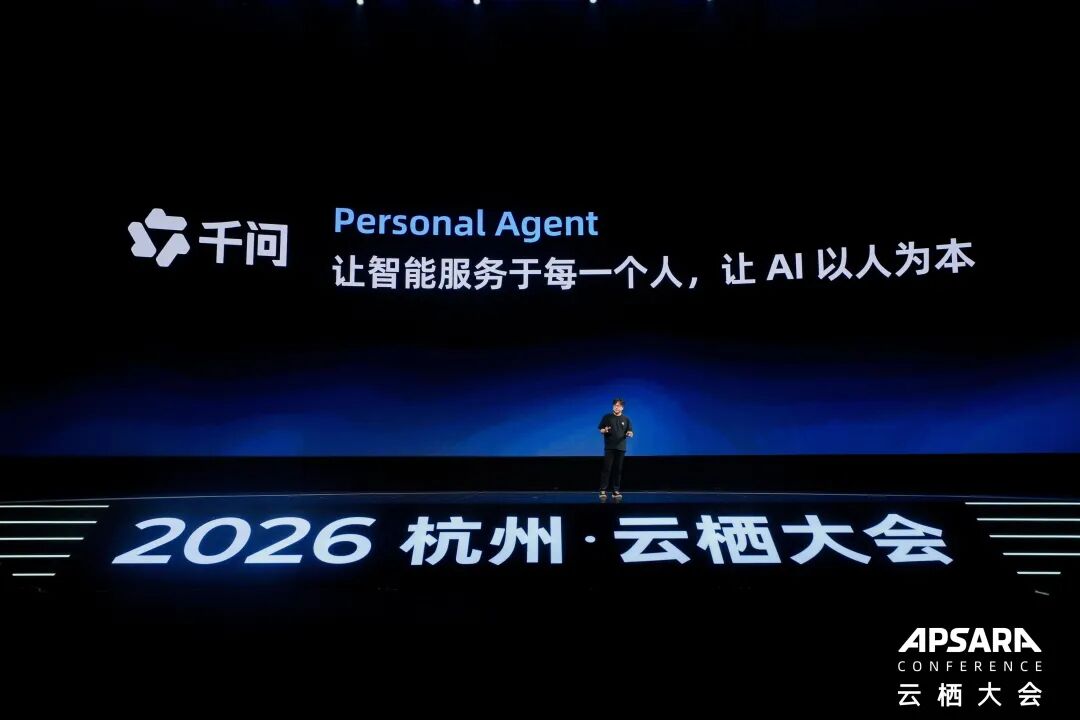
At the same conference, Chen Yusen, CEO of DingTalk, talked about another line: Enterprise Context. It enables enterprise Agents to understand the company's organizational relationships, knowledge, group chats, business data and workflows.
One is deeply exploring personal Context, the other is deeply exploring enterprise Context.
Looking overseas, Google is also strengthening Personal Intelligence this year, allowing Gemini to connect to personal data such as Gmail, Google Photos, and Search; Gemini Spark has even directly positioned itself as a "24/7 personal AI agent".
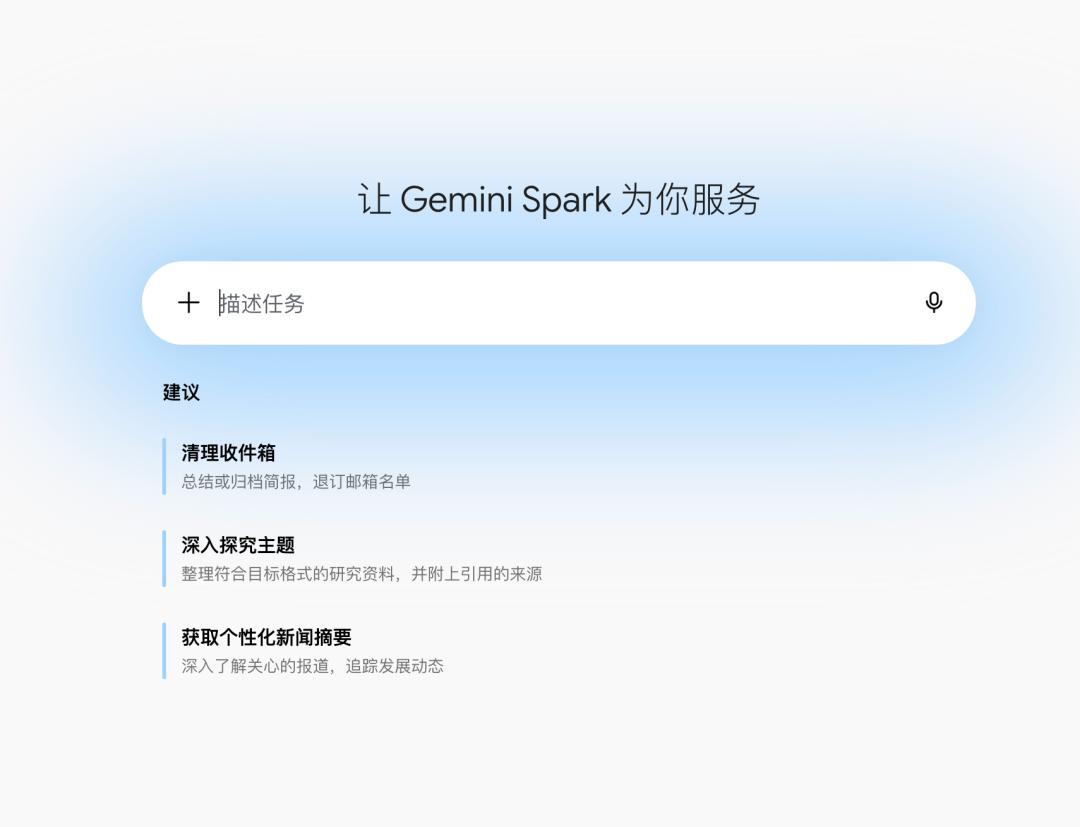
Meta has Muse, Google is developing Personal AI, Alibaba has clearly called for Personal Agent, and Tencent has already started to embed long-term Agents into WeChat.
Several major manufacturers are almost simultaneously moving towards the same direction.
At this point, looking back at LightVela, it feels different.
06 The next war among major tech companies may be "who will become your AI"
In the past two years, the large model industry has been most keen on comparing intelligence. Who has higher benchmark scores, who has longer context, who is better at writing code, and who has released the next-generation model.
After the emergence of Personal Agent, there is an obvious new dimension of competition:
Who can stay by the user's side for a long time.
A real Personal Agent will know more about you the longer you use it. It knows your work projects, your schedule, who you often contact, what you are paying attention to recently, and even remembers something you promised others three months ago that you have forgotten.
At that stage, the cost for users to switch AI is no longer just re-downloading an App.
What is really hard to move is Context.
This includes memories, history, data, contacts, preferences, and long-formed work and life habits.
The model is becoming more and more replaceable. You can use DeepSeek today, switch to Kimi tomorrow, and when a more powerful model comes out the day after tomorrow, you can just replace the "brain".
The model can be replaced, but the Agent that has been with you for a year or two may not be so easy to replace.
This is also why major manufacturers are naturally suitable for participating in this war.
Google has Gmail, Calendar, Photos, Search; Meta has WhatsApp, Instagram, Facebook, and smart glasses that will become more and more important in the future; Alibaba has Taobao, Alipay, Amap, Fliggy, DingTalk, covering consumption, travel, payment and work.
Tencent's resources are even more impressive.
It has WeChat.
Contacts, group chats, official accounts, mini-programs, payment, and WeCom, which almost cover a large part of the daily digital life of Chinese users.
So LightVela integrating the Agent into WeChat today may just be an interesting small product made by Tencent Cloud Lite. But if Personal Agent really becomes the next entry for AI competition, Tencent will sooner or later face a bigger question:
Where should Tencent's Personal Agent finally reside?
The answer may not be hard to guess at all.
WeChat.
In the past, everyone was competing to build a bigger AI App. Next, major manufacturers may start competing for another more difficult thing:
Who can become your AI.
Meta's Muse has proven with more than 3 million downloads in less than three weeks that ordinary users at least have strong curiosity and demand for this product form. Alibaba has just publicly proposed the Personal Agent concept, Google is also advancing in this direction, and on Tencent's side, a small product called LightVela has already embedded Hermes into WeChat.
It seems that this battle has only just begun.