QClaw Shutdown: Tencent does not raise shrimp, Tencent wants to be the pond owner
On September 24, 2026, Tencent announced that QClaw will cease operations on December 24, allowing users to migrate their data to WorkBuddy with a complimentary 1,000-point migration subsidy. From the thousand-person queue outside Tencent Building waiting to "get their lobsters" during the closed beta on March 9, to the service shutdown on Christmas Eve, this lobster product had a lifespan of less than 10 months.
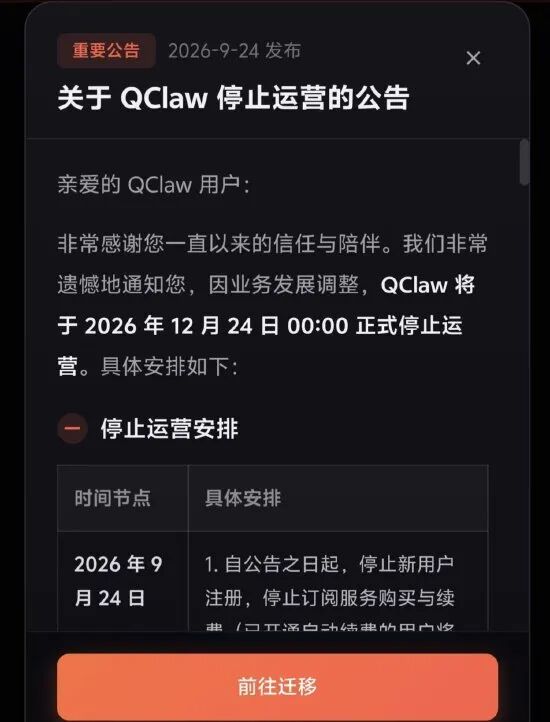
Industry players have already reviewed the internal competition mechanism, and gone over the three classic questions about user retention and monetization. None of these points are wrong, but they all stay at the product level. Dig one layer deeper into the structure, QClaw's shutdown notice reads more like a landing clearance notice: its short lifespan has brushed against all the hardest hidden reefs in this round of the Agent wave.
A Weekend Project Topped GitHub, Lobster Products From Tech Giants Were Only Fit For Ground Promotion
Let's start with a set of absurd contrasts.
OpenClaw is a weekend project by Austrian independent developer Peter Steinberger. This developer sold his company PSPDFKit for 100 million US dollars, and after retiring out of boredom, he spent one hour building the initial prototype, integrating Claude Code into WhatsApp. In March 2026, this project topped GitHub's all-time ranking with more than 248,000 stars, leaving Linux behind. On the other side, Chinese tech giants assembled elite teams, held project approval meetings, did encapsulation work, operated the products, and promoted their respective "lobster" products on a massive scale, only to fully retreat from the C-end market nine months later.
Value is deposited in the open source license and ecosystem layer. All C-end products built on top of it for encapsulation are essentially resellers of traffic. Shell products do not control either the model or the framework: the intelligence at the model level evolves month by month, the ecosystem at the framework level accumulates value compounded by star counts, and the shells sandwiched in between can only do three things: localize the interface, pre-install skills, and subsidize computing power. None of these three things build competitive moats, they only generate costs. What's more critical is Steinberger's own career move: in February 2026, he joined OpenAI to lead the next-generation personal agent project, and transferred the project to an independent foundation. Even the original author judged that the future of this framework lies in a more underlying position, and the encapsulation layer business was never written into the roadmap from the very beginning.
Shell products have no moats, and their accounts cannot be balanced, which are two sides of the same coin. The term "lobster farming" was coined by internet users, but it accidentally reveals the commercial essence of C-end Agents: lobsters need continuous feeding, and they eat more and more as they grow. In the traditional mobile internet era, the marginal cost of users approaches zero, and user scale is the most solid asset; Agents completely reverse this formula, every call consumes tokens, and the more active the users are, the more severe the loss will be. According to media reports, some heavy users burn 1 million tokens a day, while others spend nearly 20 US dollars to let the lobster crawl a single web page. For the first time, user scale has changed from an asset to a liability.
There is already an autopsy report for this phenomenon in the AI industry. Character.AI had a huge user base, but was eventually acquired by Google for 2.5 billion US dollars in a "reverse talent acquisition" deal: Google bought the team, and the remaining users became a burden no one wanted to take over. The standalone Sora app exceeded 1 million downloads in 5 days, but its 30-day retention rate was only 1%, with an average daily loss of about 1 million US dollars, and it was shut down in March 2026. The official statement from Marvis that "it is unrealistic to be completely free in the long run" is equivalent to the entire industry admitting this arithmetic fact: the accounts for free C-end Agents cannot be balanced, which has nothing to do with operational proficiency. Paid models also do not work: the time spent debugging AI automation is often longer than doing the work manually, and users' willingness to pay for "lobsters" is only limited to the novelty period. Data from Gartner is as cold as ice: only 6% of enterprises that tested Copilot have moved to large-scale deployment.
That's why QClaw's product manager left at the end of June, and the department was merged in July: on the surface it was a personnel change, but in essence it was a financial conclusion. Tech giants swarmed in, thinking they had seized a new entry point, but when the tide receded, they realized they had only done an expensive ground promotion for the open source ecosystem. The end of the lobster farming game was written on day one: whoever opens the service for free is working for cloud computing vendors.
The Rules of the Competition Game Have Changed: Products Are Only Probes, Who Owns The Pond Matters
Everyone knows the old story of Tencent's internal competition mechanism. Three teams competed to develop WeChat, and Zhang Xiaolong won by a one-week lead; PUBG Mobile beat Game for Peace by providing better experience and data. The book "The Biography of Tencent" states that none of the strategic products that determined the company's fate came from the top management's strategic decisions, they were all developed by edge teams. QClaw also followed this script: a 5-person team from Tencent PC Manager started the project with zero approval and zero budget, gained millions of registered users in one week, and QuestMobile recorded 2.259 million monthly active users.
But this time, the winning criteria of the competition have quietly changed. In the WeChat era, the competition focused on the product itself: whoever provided better experience and retained more users would win. This time, three teams ran on the same open source framework, and there was no generational gap in product experience, so the competition turned to another thing: who could find the commercial monetization exit first.
The answer has been revealed. WorkBuddy is backed by Tencent Cloud's CodeBuddy team, with 20 million monthly active users, targeting B-end office scenarios and developer monetization; Marvis takes the path of operating system-level assistants, targeting terminal entry points; QClaw had the best user data, but was the farthest from revenue, so it was eliminated first.
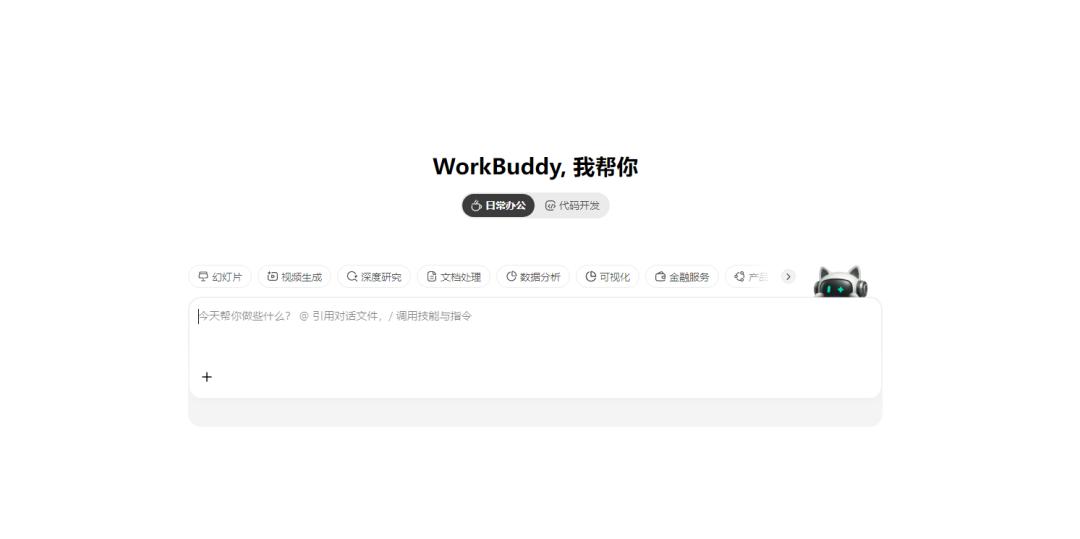
With this understanding, Ma Huateng's statement at the March earnings call makes real sense: we will not build the largest model ourselves, but build an open Agent ecosystem on top of existing models, allowing developers to grow their own lobsters on our soil, and AI investment will at least double. The key word is soil. What Tencent wants is far beyond a single hit App, it wants the landlord position in the Agent era. The life and death of lobsters do not matter, who owns the pond is what matters.
QClaw has completed its historical mission: it verified that the free C-end model is unfeasible at the lowest cost, finished the mass market education by the way, and guided users and data to WorkBuddy which has paid scenarios. This is not a failure of the competition mechanism, it is the alienation of the mechanism in the Agent era: products are no longer compared as products, they are only used as probes. Once the probe collects the required data, its mission is completed.
The Enlightenment Remains, The Lobsters Exit The Stage
To evaluate this craze that lasted less than a year, we cannot only count the gains and losses of QClaw as a single product.
The three days in March 2026 were a rare moment in China's AI history: thousands of people queued up outside Tencent Building to install the product, the on-site installation service for lobsters on Xianyu was priced at nearly 1,000 yuan, Mac mini devices were sold out, local governments in Shenzhen, Wuxi and Changshu released support policies, and national political advisors publicly discussed the product. Then came the equally intense backlash: the uninstallation wave came in about 45 days, there were safety accidents where installing Skills cleared the disk, lobsters in 3,000-person groups were reported to have leaked users' private data, the Ministry of Industry and Information Technology's vulnerability platform released safety alerts, the "100-yuan on-site lobster installation" business turned into "299-yuan remote uninstallation" business, and the lobster concept stocks fell collectively.
There was farce in it, but the enlightenment value is more real. Millions of users understood for the first time what local operation means, what skill plugins are, and what token costs are, and experienced the capability boundary and security boundary of AI agents for the first time. This kind of cognitive popularization usually takes a full product lifecycle of a generation to complete. Red envelope grabbing popularized mobile payment, Happy Farm popularized social games, and lobster farming popularized personal agents. The experiment ends, but the cognition remains. In 2025, 392 AI tools worldwide were shut down, and at least 25 well-known AI applications in China ceased operations, most of which died silently. QClaw is different: it died under the public gaze, which is its historical positioning.
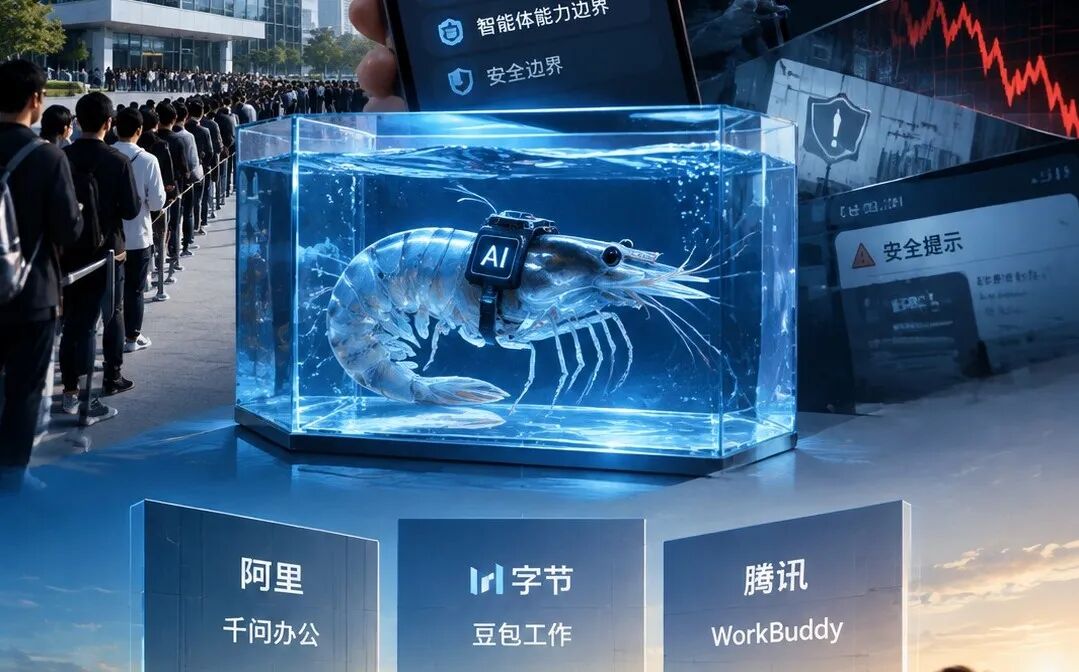
From a broader perspective, QClaw's shutdown is only part of the collective reorganization in the summer and autumn of 2026. From July to August, Alibaba merged multiple product lines into "Qianwen Office", ByteDance integrated related capabilities into Doubao and launched "Doubao Work", Tencent merged the QClaw team into the department that manages WorkBuddy. The three tech giants took the same action in the same time window: shifting from free trial and error to entry integration, marking the end of the wild growth period of C-end Agents. The subsequent competition will expand along three dimensions: in B-end paid scenarios, the product closest to enterprise budgets will survive longer; in the competition for ecological niches, open source will eat shells, and platforms will eat applications; every time the reasoning cost drops by an order of magnitude, a batch of products that could not balance their accounts before will be revived.
The rollercoaster experience of Manus is another mirror: at its peak, its invitation code was speculated to sell for 100,000 yuan, its ARR exceeded 100 million US dollars, Meta's 2 billion US dollar acquisition was blocked by the national development and reform commission's foreign investment security review, Tencent led the repurchase of the company, and now it is planning an IPO in Hong Kong. In the same track, products that have worked out the paid model have a completely different fate. The watershed of the industry is clear: Agents that can generate revenue are called products, Agents that cannot generate revenue are just traffic. The last lesson QClaw left to the industry can be summed up in one sentence: in the Agent era, user volume is a pile of pending bills, and revenue structure is the real asset.
Batches of lobsters will die, and the owners of the ponds are being determined. When the next mass craze arrives, more people will queue up, and more people will uninstall the products faster. Those who understand this game will see the pond owner's account books clearly before deciding whether to enter the market.
This article is from WeChat Official Account "Qidianpai", written by Li Zhe, authorized for release by 36Kr.