Alibaba's Steam Engine Era
By | Huahua
Many people may not know that the first batch of steam engines put into practical use during the Industrial Revolution had nothing to do with trains.
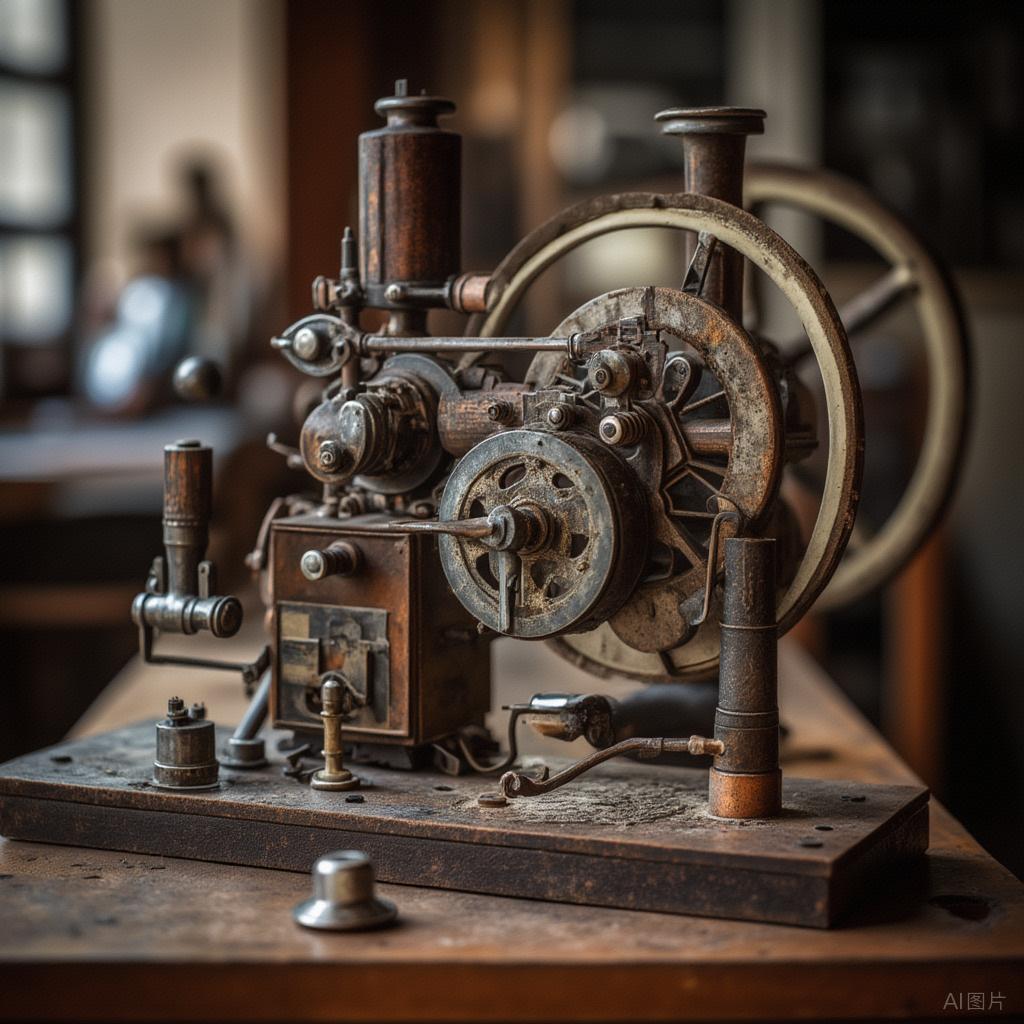
In 1712, British engineer Thomas Newcomen built an atmospheric steam engine that was stationed at coal mine entrances all year round to pump water. The thermal efficiency of this machine was only about 1%, and cartloads of coal were burned just to do the work that miners and horses had already been doing.
It could run mainly because coal mines had an abundant supply of coal, and the low fuel cost temporarily masked the efficiency problem.
From the perspective of that era, it was an expensive mining equipment, far from textile factories, steamships and railways.
More than 300 years later, Wu Yongming, CEO of Alibaba, placed today's AI Coding right next to the electric lights of 1882 at the Yunqi Conference: machines can write code, generate reports, and sort out meeting minutes, still undertaking the existing work that humans have long done, and the representative product of the machine intelligence era has not yet emerged.
Next, he tried to calculate the potential productivity of this yet-to-emerge production capacity. Today, the total amount of machine thinking is less than 3% of that of humans, and in the future it may reach more than 1000 times that of humans.
Alibaba has not announced the specific statistical caliber, and this number cannot be directly converted into Tokens, which is more like a strategic assumption about the market size.
1. Steam Engines Were Only Used for Water Pumping at the Very Beginning
When Newcomen's machine emerged, the main power sources in the UK were still water and wind.
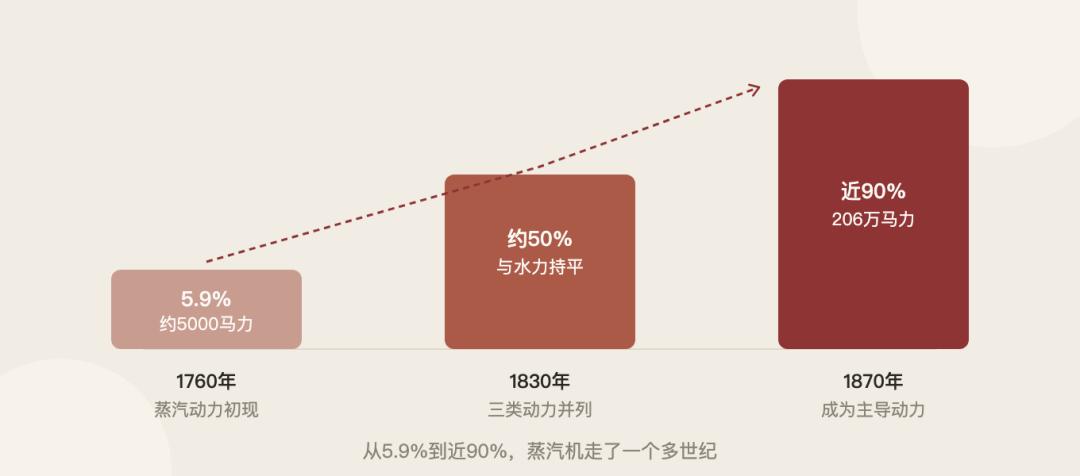
According to historical statistics cited by economic historian Nicholas Crafts, the installed steam power in the UK in 1760 was about 5,000 horsepower, accounting for only 5.9% of the total power of wind, water and steam.
It was not until 1830 that steam power was roughly on a par with hydropower; by 1870, this figure had reached 2.06 million horsepower, accounting for nearly 90% of the total of the three types of power.
It took the steam engine more than a century to grow from 5.9% to nearly 90% of the total power.
Later generations are used to associating steam engines, trains and the Industrial Revolution together, as if the train would pull out of the station the moment Watt tightened the last screw.
But history progressed much more slowly.
Early steam engines had low efficiency and narrow use cases. They were first used to pump water in coal mines, and later entered the textile and metallurgy industries. As factories were rebuilt around power, and railways and ports expanded the scope of use, this single piece of equipment in the mine gradually became the fundamental capability of industrial society.
Today's machine intelligence is also at the stage where the power source has emerged but the organizational mode has not yet changed.
AI Coding can shorten a project that originally takes eight hours to complete to two hours, but the number of projects, personnel scale and working hours are still constrained by the original boundaries.
Writing reports, making PPTs, and sorting out meeting minutes all follow the same logic: machines have increased the speed, but the total amount of tasks has not yet seen a change of order of magnitude.
In his speech, Wu Yongming described another kind of demand: millions of Agents conduct long-term research on rare diseases, or divide the construction of a Mars spacecraft into tens of millions of subtasks. Humans only need to assign the goal once, and the machine will continuously call tools, check results and arrange subsequent steps.
Thus, the computing demand extends from how many people use AI to how many machine tasks a single goal can generate.
2. Wu Yongming Found a "Horsepower" Metric for Machines
After Newcomen, Watt improved the steam engine.
In 1769, Watt obtained the patent for the independent condenser, which placed the steam condensation process outside the cylinder. According to data from the Science Museum in London, this improvement reduced coal consumption by about two-thirds.
In the 1780s, Watt solved the problem of rotational motion, enabling the steam engine to drive looms and other factory equipment.
The machine became more practical, but Watt still had to make mine owners and factory owners understand its value. Customers were familiar with how much work a horse could do in a day, but it was difficult for them to judge the work capacity of a steam engine.
Watt therefore converted the machine's output into "horsepower", using the most common power source in the old era to explain a strange new product.
"Horsepower" later became a physical unit, and initially also served as a sales tool.
"Total Machine Thinking Volume" plays a similar role.
It takes human thinking as a reference to mark the potential demand scale for a yet-to-mature machine productivity. Two experiments disclosed at the Yunqi Conference have left countable records for this direction.
Qwen3.8-Max built the training process, constructed data, designed experiments and located defects without human intervention, running continuously for more than a month and completing 33 rounds of effective iterations.
Another chip design experiment lasted for more than 60 hours, with the model calling EDA tools more than 10,000 times, eventually reducing the physical area of a chip bus module by 42%.
These results come from Alibaba and still require more external verification. But "33 rounds" and "10,000 calls" have already recorded a change: after humans set a goal, machines can continue to complete a large number of steps in the background.
Alibaba also announced that Qwen4 based on the new architecture has entered the training phase, and Qwen4.5 and Qwen5 are planned to be scaled up to 5 trillion to 10 trillion parameters. Parameters cannot be directly converted into productivity, and this plan points to the capability for complex tasks, continuous running time, and room for improvement based on feedback.
Tokens record the calls that have already occurred, while "Total Machine Thinking Volume" describes the scale to which Alibaba expects these calls can expand.
3. The Power Source Is Being Deployed First
Once a long task lasts for several hours, days or even months, it is difficult to complete it only by the model's own capability.
The task may be interrupted or go off track, so the system needs to save progress, resume operation, check permissions, and keep computing, storage and network in synergy.
T-Head unveiled the new generation of training and inference integrated AI chip Zhenwu V900 at the conference. The official claims that the performance of a single chip reaches 3 times that of the previous generation M890, and it is planned to be mass-produced and commercially released in the first quarter of 2027.
The conference also showcased server CPUs, interconnection chips, smart network interface cards and storage controllers. The upgraded super-node architecture can connect these components into a single cluster with a maximum scale of 500,000 cards.
The change behind this is very straightforward.
Alibaba has begun to shift its focus from developing a faster single AI chip to building a complete computing system.
When the model runs continuously, the CPU processes tasks, the network transmits data, and the storage is responsible for reading and writing. If any link fails to keep up, the expensive AI chip can only wait idly.
In addition to hardware, Alibaba Cloud's newly launched Agentic Cloud is responsible for the execution and management of long tasks. AgentCore manages failure retries, breakpoint recovery, identity permissions and operation audits, and Agent Sandbox provides an isolated environment.
What enterprises actually procure is a production environment that enables machines to run continuously, act according to permissions, and leave complete records.
This system needs to be constructed in advance.
In February 2025, Alibaba announced that it would invest at least 380 billion yuan in the construction of cloud computing and AI infrastructure in the next three years; at this Yunqi Conference, Wu Yongming further set the 2032 data center capacity target at 20GW.
Models, chips and cloud have been connected along the demands of long tasks. Now, these production capacities need to be absorbed by the machine tasks generated by enterprises every day.
4. The Electric Lights Are On, But Factories Haven't Transformed Yet
On September 4, 1882, Edison's Pearl Street Station was put into operation in New York, initially serving 82 customers and lighting only about 400 lamps. The electrical age that was later written into textbooks started with nothing but a small network in lower Manhattan.
Electric lights soon made people see the use of electricity, but the transformation of factories came much slower.
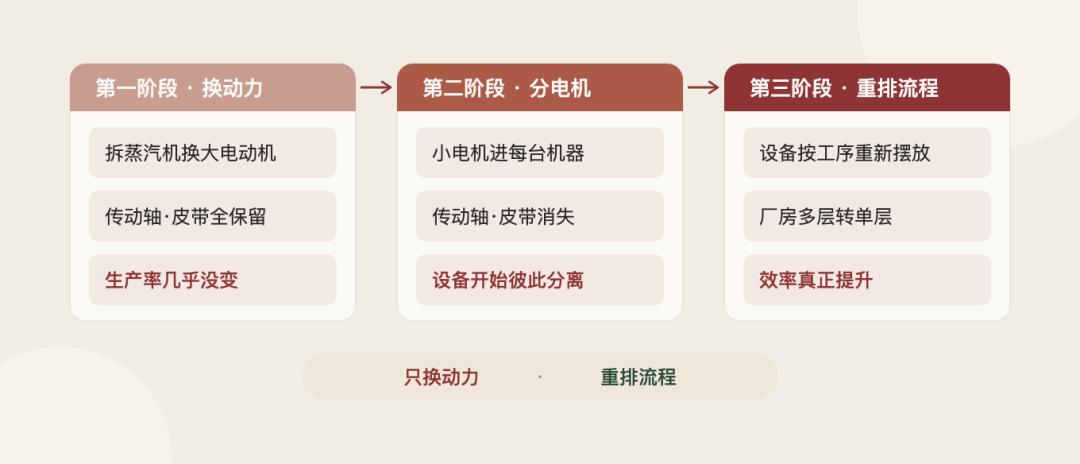
Economic historian Paul David recorded a period of history. In the early days after factories got access to electricity, the factory owners removed the central steam engine and replaced it with a large electric motor, while keeping all the transmission shafts, belts and factory layout on the ceiling completely unchanged.
The electric motor still drove the original production system to run, and the productivity barely improved.
After small electric motors were installed on every single machine, the central transmission shafts and belts gradually disappeared. The equipment could be rearranged according to the production sequence, and the factory buildings also shifted from multi-story structures to more flexible single-story layouts.
The efficiency improvement brought by electricity came from the rearrangement of the production process along with the power system.
When AI enters enterprises, it also encounters similar thresholds.
Many companies have already integrated AI into daily office work, but few allow it to access contract approval, customer accounts, R&D release and financial systems. These processes involve review, authorization, testing and responsibility confirmation.
Without data, tools and permissions connected, the model can only stay outside the business process to provide auxiliary support.
What Alibaba demonstrated at the Yunqi Conference is how a single task can run through all these links.
After a meeting ends, the QwenNote Eva desktop robot or QwenNote A2 voice recorder card captures the on-site content. DingTalk and MyContext then supplement the context from messages, documents and historical meeting records, and AgentCore subsequently manages execution permissions, progress and records.
Tasks can also be initiated from mobile phones. The Honor Magic9 series will become the first batch of models equipped with Qwen Intelligence. From a single sentence in the meeting room to specific actions in the enterprise system, Alibaba is trying to connect all the previously disconnected links.
What really determines how much work an Agent can do is no longer just the model parameters.
It needs to know what happened in the company, who the customers are, where the files are, which systems can be called, and which things must be confirmed by humans.
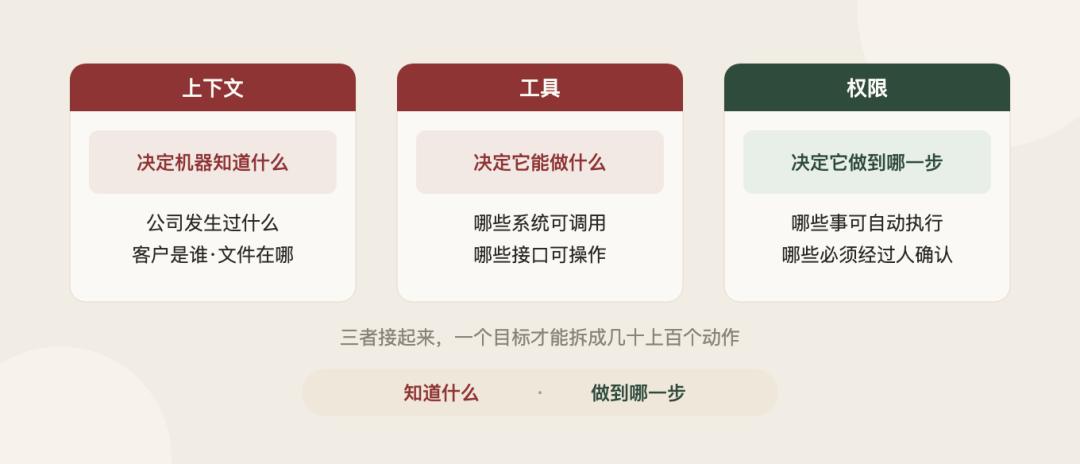
Context determines what the machine knows, tools determine what it can do, and permissions determine to what extent it can proceed.
When all these are connected, AI will begin to transform from a question-answering software to a productivity tool that can continuously execute tasks.
5. Machines Are Starting to Have Their Own "Working Hours"
When machines officially start working, what is missing is never just computing power.
After an Agent receives a task, it needs to know the company's information, who the customers are, what happened before, which systems can be operated, and who to confirm with if something goes wrong.
What enterprises provide to AI is also changing: from a single Prompt or a document, it has expanded to complete business context, and further to tools, permissions and execution environments.
Context determines what the machine knows, tools determine what it can do, and permissions determine to what extent it can proceed. When the three are connected, a single goal can be split into dozens or even hundreds of actions: looking up information, calling interfaces, writing files, running tests, waiting for feedback, and then moving on to the next step.
As a result, the workload of machines has begun to have the concept of "working hours".
A set of data disclosed by Ping An of China just provides a perspective: its daily average Token usage increased from about 30 billion to more than 300 billion in less than a year, and the computing power increased from 800PF to 1500PF. The computing power has less than doubled, but the Token usage has expanded tenfold.
This is only data from a single enterprise, but it demonstrates a growth path:
The growth of enterprise AI can be manifested as machines starting to undertake more and more steps in the same set of business processes.
Another set of data disclosed by Ping An is also very interesting: AI has been integrated into specific links such as customer service, healthcare and R&D, and more than 100 million AI services have been completed in less than half a year.
Machines have obtained a batch of business scenarios that continuously generate tasks.
This is exactly the difference between Agents and traditional AI tools.
Model capability determines whether the machine can do the work, enterprise context determines what work it knows to do, and tools and permissions determine whether it can continue to execute. As these links are gradually connected, enterprises have for the first time the opportunity to arrange a real "working hour sheet" for machines.
Alibaba's 20GW of computing power will eventually be applied to this scenario.
No matter how many GW the data center has, or how many chips the cluster is equipped with, it all boils down to a more simple question: how much work can actually be handed over to machines every day?
7. The Growth Unit Has Changed, And Companies Will Transform Too
If machines really become a new type of productivity, the first thing that may change is not products, but the internal organizational structure of the company.
After Wu Yongming took over as CEO