Zhang Xiaolong has started to replace Yuanbao with Xiaowei.
Today I saw a Citi research note stating that Tencent's "Xiaowei" is expected to become a very important consumer-grade AI Agent in China.
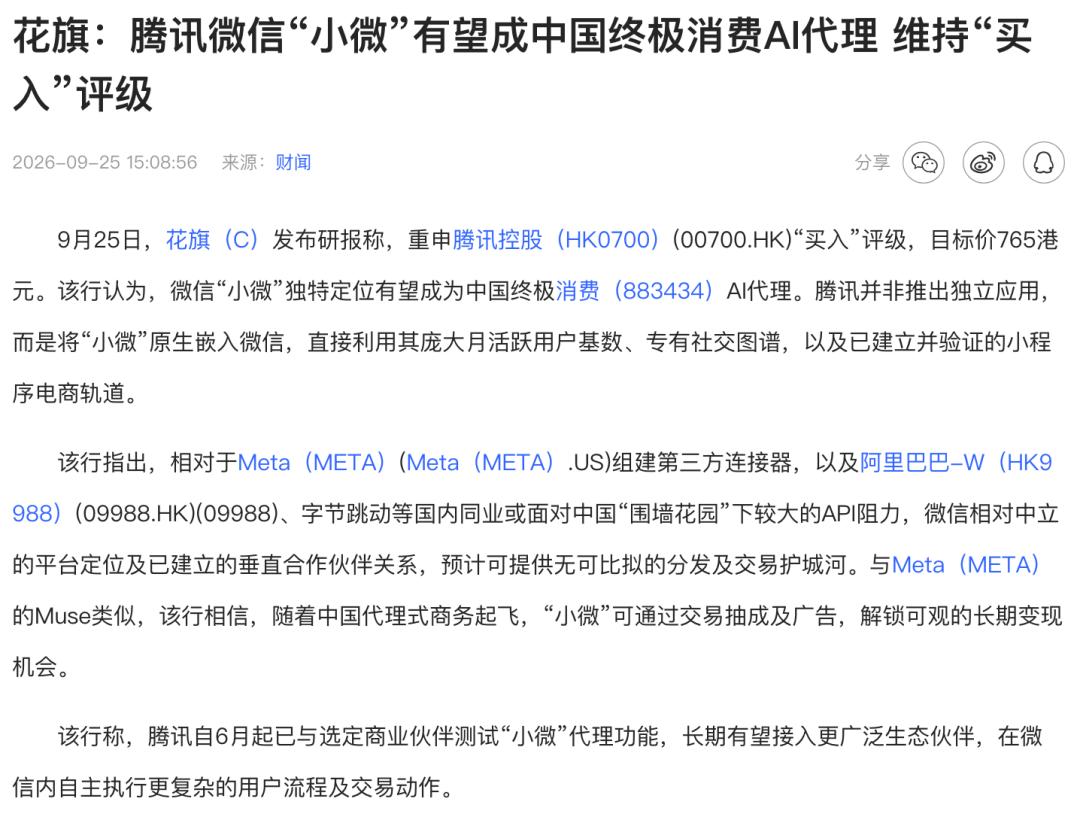
When I first saw this news, I didn't take it very seriously. The reasons why securities firms are optimistic about an AI product are nothing more than those familiar ones: WeChat has a huge user base, rich scenarios, a large number of mini-programs, and convenient payment functions.
But when I opened an article from my official account in the desktop version of WeChat in the evening, I suddenly noticed a detail.
Previously, it clearly showed "Yuanbao Summary" here, but now it has been changed to "Ask AI". After clicking in, what pops up is no longer Yuanbao, but "Xiaowei AI".
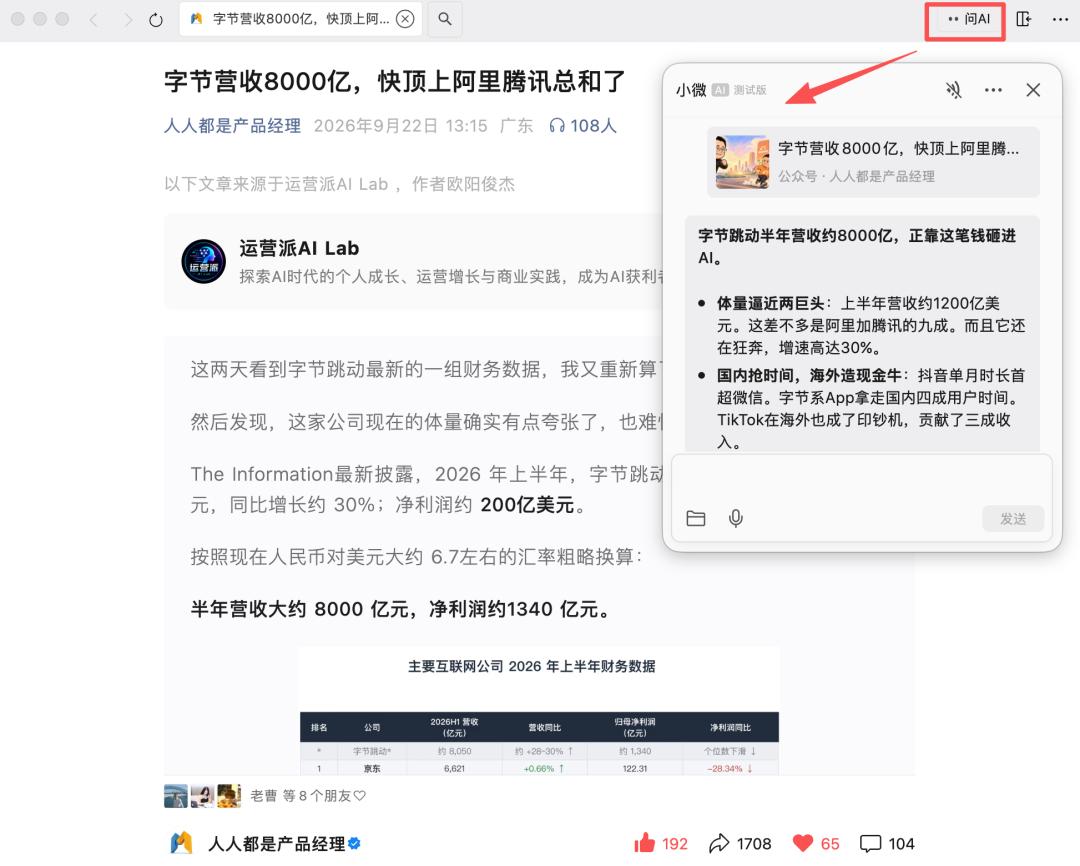
I checked further and found that this is not an accidental change unique to my version. In WeChat's tests over the past few months, the original "Yuanbao Summary" in the built-in browser has indeed been gradually replaced by "Ask AI", with Xiaowei integrated behind the function. Entries for Xiaowei have also begun to appear in chat messages, official account articles, Moments posts, photo editing, Scan, files, and some life services, though it is still in the testing phase and not everyone can experience it.
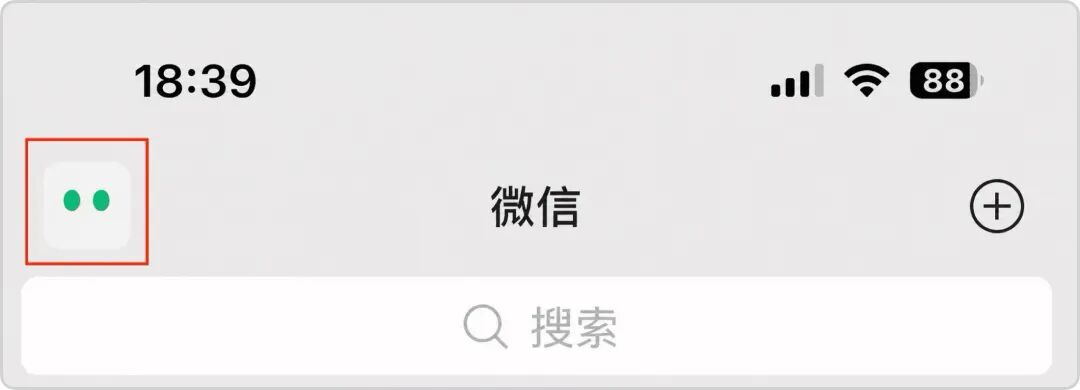
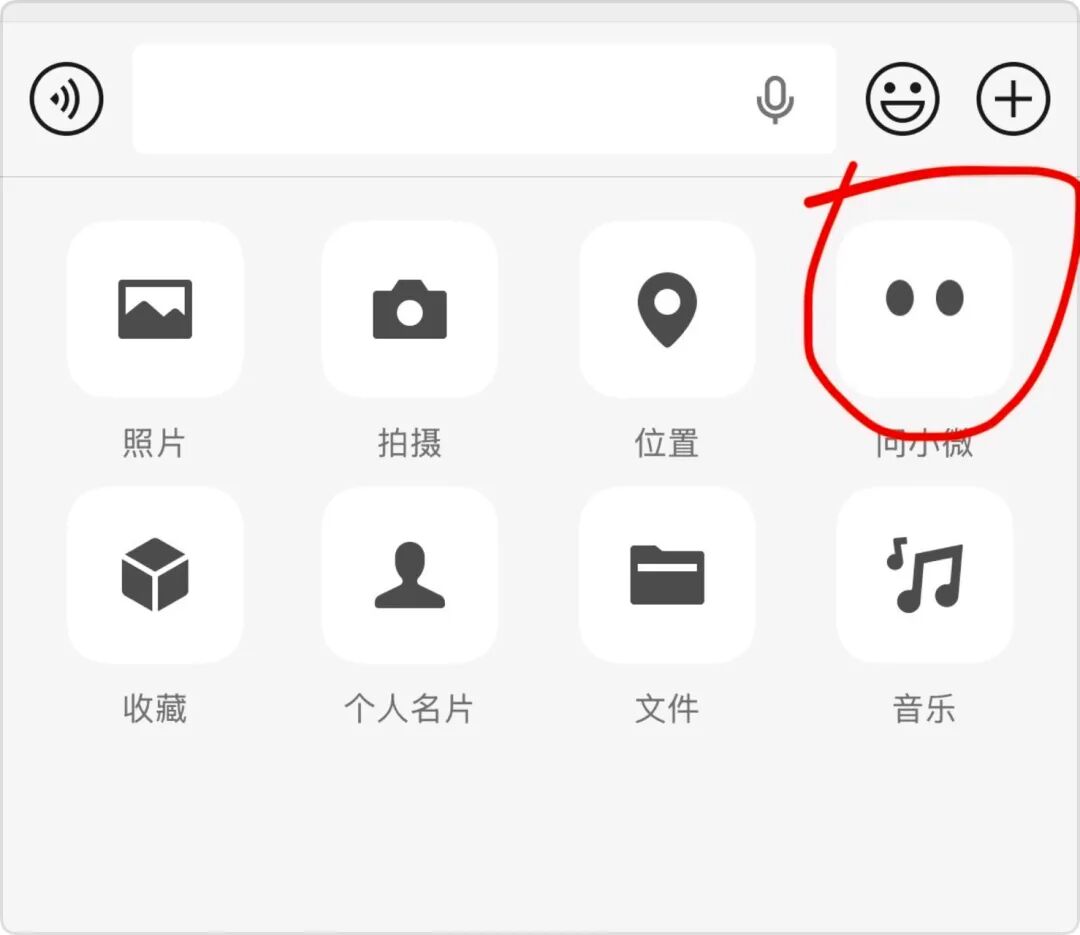
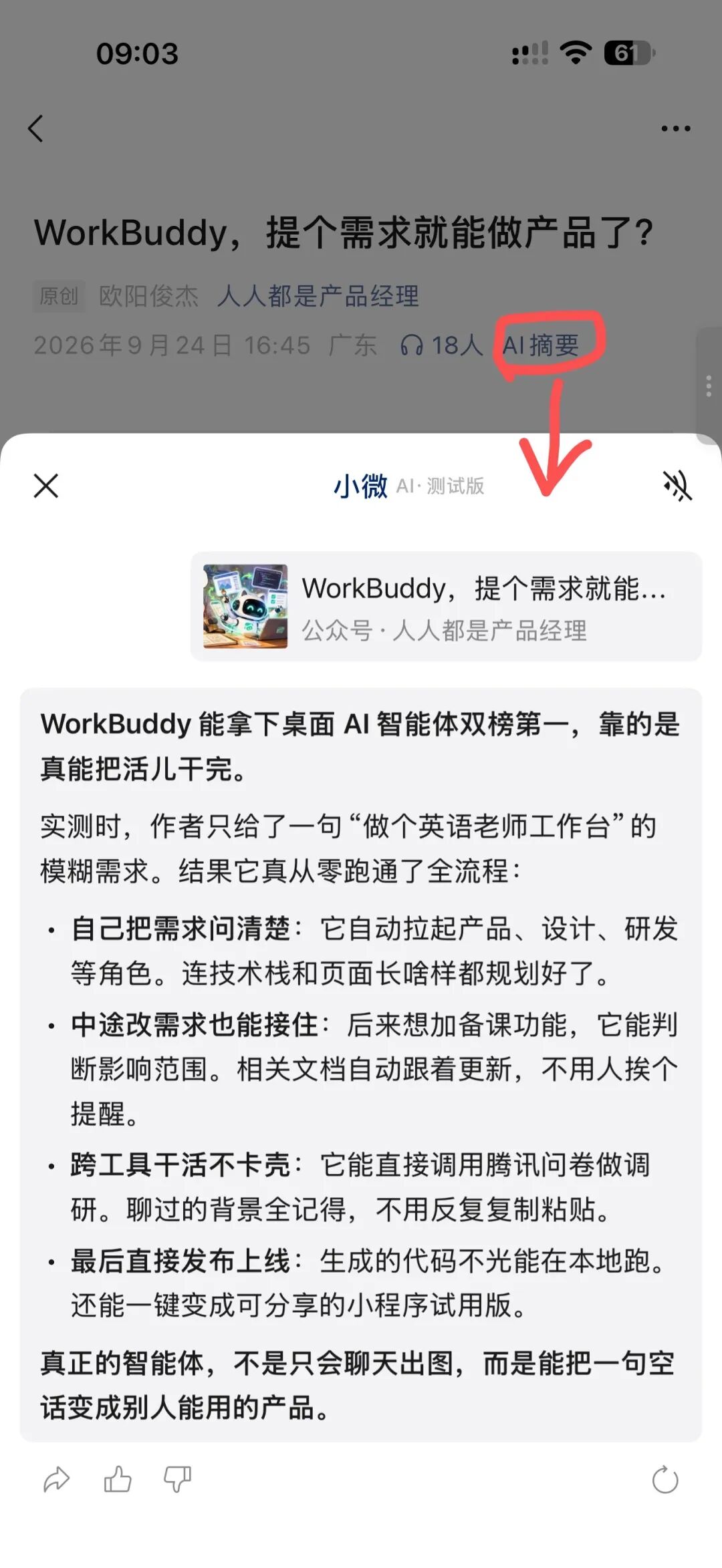
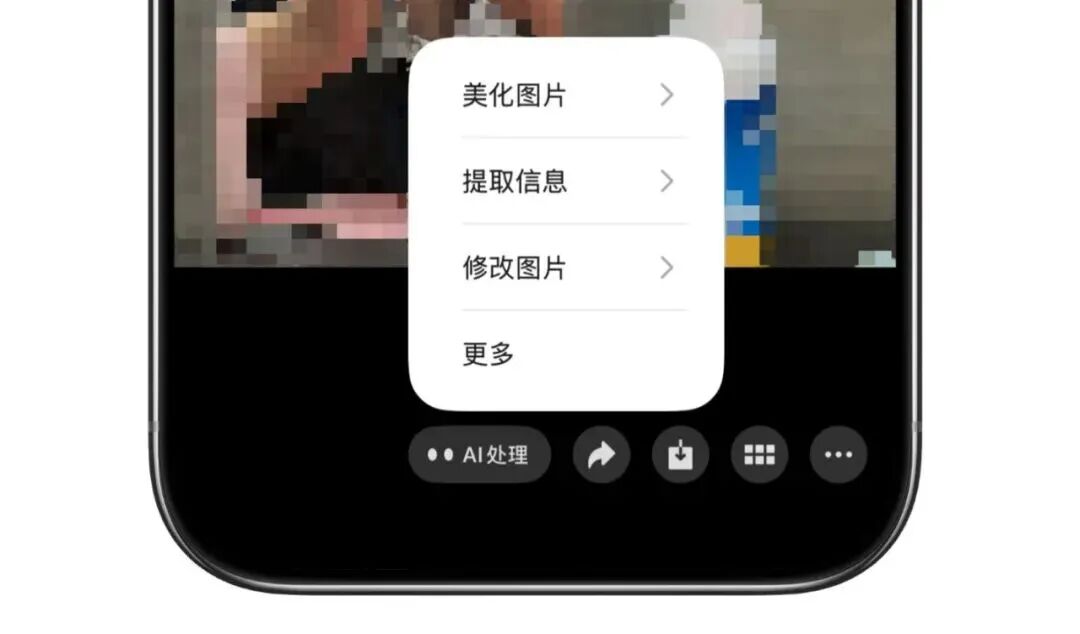
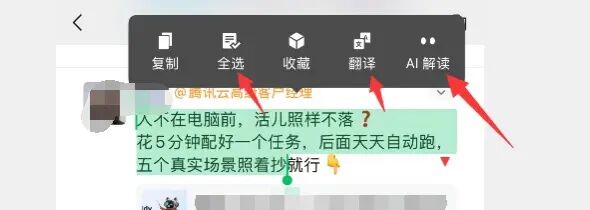
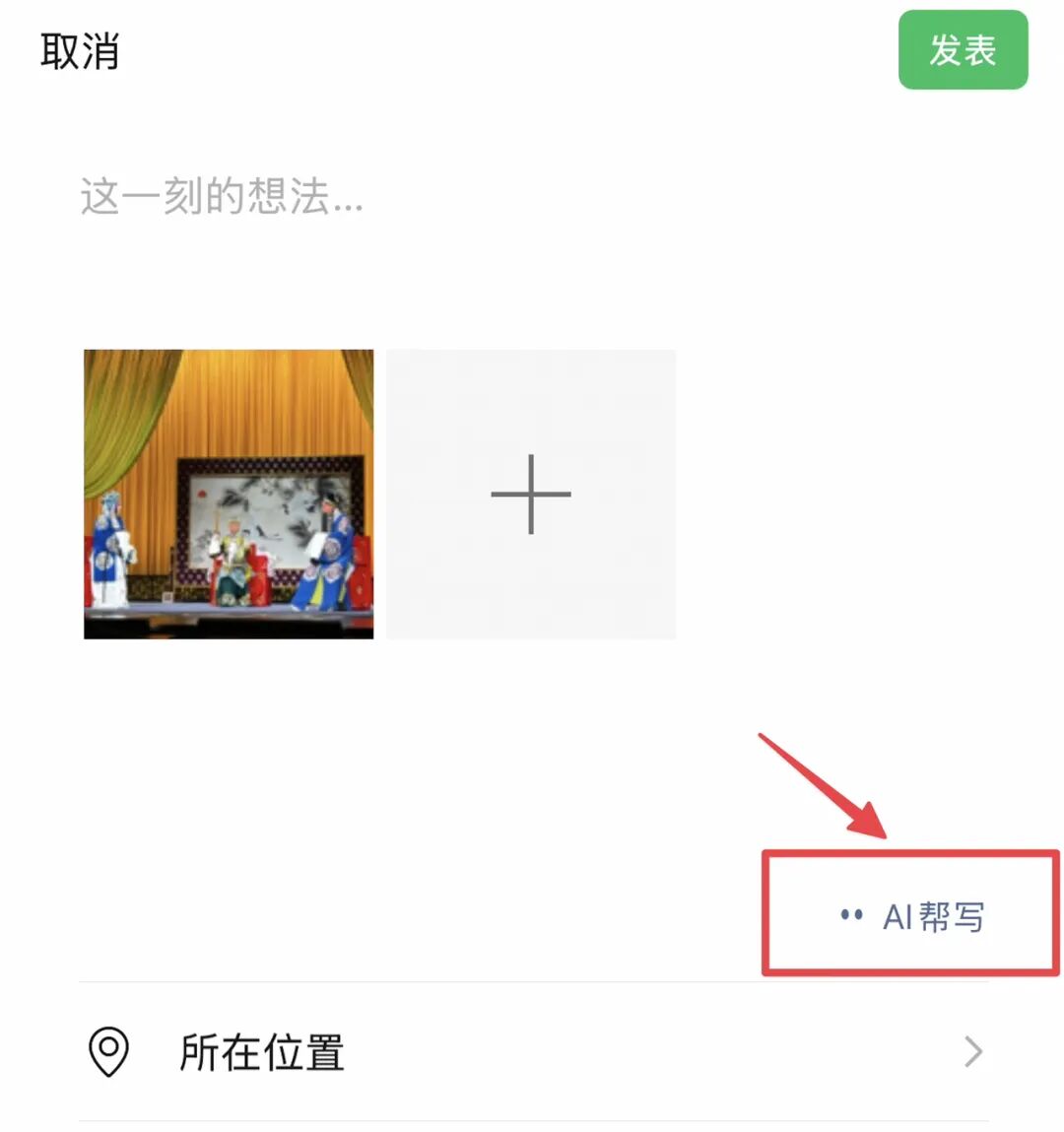
The above are some screenshots of Xiaowei's entry points
This matter immediately became interesting.
Citi just said today that Xiaowei may become China's "ultimate consumer AI agent", and on the other side, WeChat has started to replace the entry points originally assigned to Yuanbao with Xiaowei.
It is not difficult to find that Tencent's AI card table is rearranging its seats.
01. WeChat was previously diverting traffic to Yuanbao, but now it starts to develop its own AI
The logic behind Tencent's promotion of Yuanbao in the past is actually very easy to understand.
Tencent needed a self-developed general AI product, so it built Yuanbao; and WeChat is Tencent's largest traffic entry, so when users don't finish reading official account articles, the task can be handed over to "Yuanbao Summary", and many AI capabilities in WeChat can also divert traffic to Yuanbao.
To put it simply, WeChat is responsible for traffic, and Yuanbao is responsible for AI.
This is also the most natural strategy for many large manufacturers: first launch an independent AI App, and then find ways to connect the entry points of various Apps under the group to it.
But after Xiaowei came out, this relationship has obviously begun to change.
At least in the currently tested PC version of WeChat, the original "Yuanbao Summary" in the upper right corner of official account articles has been replaced with "Ask AI". After clicking, users are not directed to Yuanbao, but stay directly in WeChat to continue chatting with Xiaowei.
Don't underestimate this button.
Because it answers a very practical question:
In the future, will the AI in WeChat belong to "Yuanbao" or to "WeChat"?
Judging from these current actions, WeChat seems to have given its own answer.
02. This does not mean Yuanbao will be shut down, but its position in WeChat may be taken over by Xiaowei
We need to be rigorous here.
It is obviously too early to draw a conclusion directly that "Tencent is going to abandon Yuanbao". In Tencent's official financial report for the second quarter of this year, Yuanbao, WorkBuddy, CodeBuddy, Xiaowei and other products are still listed as the group's new AI products, and Yuanbao remains an important general AI product of Tencent.
What has really changed is the ownership of AI entry points within WeChat.
Yuanbao is more like an independent AI product developed by Tencent Group, competing head-to-head with products like Doubao and Qianwen. It requires users to open the Yuanbao App before asking questions, searching, and generating content.
Xiaowei is completely different.
Xiaowei was born directly inside WeChat.
Tencent clearly stated in its Q2 financial report that Xiaowei is an "in-WeChat AI agent", which is currently in a small-scale gray testing phase, and its underlying model is WeLM, which is specially customized for user privacy, WeChat scenarios and reasoning efficiency. In the same period, the combined monthly active users of WeChat and WeChat reached 1.439 billion.
This is a very delicate situation.
If WeChat only wanted to divert traffic to Yuanbao, there would be no need to develop Xiaowei at all, let alone customize WeLM exclusively for Xiaowei.
Now WeChat has not only developed Xiaowei, but also started to let Xiaowei take over the positions of "Summary", "Ask AI" and other functions that originally belonged to Yuanbao.
So a more accurate statement may be:
Yuanbao is still Tencent's AI, while Xiaowei is becoming WeChat's own AI.
These two positioning seem similar, but in fact they are very different.
03. Looking back at Citi's research note at this point, you can understand why it suddenly values Xiaowei so much
Citi maintained a target price of HK$765 for Tencent today, and one of the important reasons is that it believes Xiaowei has a very special product form.
Xiaowei does not have an independent App, but is embedded directly in WeChat. What Citi values is not just the 1.4 billion users, but the social relationships, mini-program ecosystem, merchants behind WeChat, and the transaction network that has been operating smoothly for many years. Citi even believes that compared with other AI assistants that need to continuously connect to third-party APIs, WeChat itself already has a very strong service and transaction foundation.
I think this judgment is quite interesting.
Now when people develop AI Agents, they often compare whose model is smarter, who can control the computer, and who can open more Apps.
But after the Agent actually starts working, the problem will quickly change from "is it smart" to:
Do you actually have available resources to call?
For example, I say to the AI: "Two people tonight, find a well-reviewed Cantonese restaurant nearby with a per capita cost of about 200 RMB, and make a reservation for me if there is a table available."
Understanding this sentence is no longer a difficult task for current large language models.
The difficulty lies in the subsequent steps.
It needs to know what restaurants are nearby, have access to map data and user reviews, confirm whether there are available seats, possibly obtain my mobile phone number, and finally create an order and complete the payment.
AI is not enough just to have a "brain", it also needs to have "hands".
And over the past decade or so, WeChat has accumulated a large number of these "hands".
Food delivery, taxi hailing, hotel booking, flight booking, hospital appointment registration, movie ticket purchase, mobile top-up, e-commerce, coffee ordering, government services... a large number of services have long been moved into WeChat through mini-programs.
In the past, we had to find the mini-programs ourselves and then click through the menus manually.
In the future, it is very likely to become:
You tell Xiaowei what you want to do, and it will find the corresponding mini-program to complete the task by itself.
04. Mini-programs may usher in a second platformization
This is also the part of Xiaowei that I think is most worth paying attention to.
In the recent tests of Xiaowei, it can already call some mini-programs to complete operations such as ordering food, hailing a taxi, and topping up mobile phone balance, and finally guide users to the confirmation and payment page. WeChat currently retains the user confirmation step, which is obviously to control the risks brought by the automatic execution of Agents.
Tencent's management has thought even further about this matter.
In the Q2 financial report and subsequent management communications, Tencent has clearly described a similar long-term direction: in the future, users will issue complex instructions through Agents like Xiaowei, mini-programs and merchants can also have their own Agents, and the two sides' Agents will interact directly to complete transactions.
Today's WeChat works in this way:
People find mini-programs.
In the future, it may become:
Xiaowei finds mini-programs for people.
Later on, it may even become:
User Agent directly interacts with Merchant Agent.
At that point, the role of mini-programs will change.
In the past, when we developed a mini-program, the first thing to consider was how to design the homepage, where to place the buttons, how to arrange the banners, and where to put the coupons, because the users are human beings.
Agents don't care about these.
It only needs to know: what capability to call to search for products, what capability to call to create an order, what capability to call to modify the delivery address.
So I think mini-programs are very likely to undergo a major transformation.
The first platformization was to move the capabilities of native Apps into WeChat, so that users don't need to download so many Apps.
The second one may be:
Gradually transform mini-programs from "pages for human operation" into "Skills for Agent invocation".
If this path is successfully implemented, the millions of mini-programs in WeChat will, in a sense, become a ready-made skill library for Xiaowei.
This may be far more valuable than simply training a more powerful large language model.
05. From this perspective, the relationship between Xiaowei and Yuanbao has become rather awkward
I am now very curious about how Tencent's internal team will finally handle the positioning of Xiaowei and Yuanbao.
Because from the perspective of product positioning, there is obvious overlap between the two.
If you ask a knowledge question, Xiaowei can answer it; if you read an official account article, Xiaowei can summarize it; if you send a file, Xiaowei can process it; furthermore, Xiaowei can also access WeChat chats, mini-programs, payment and various life services.
If all these capabilities are completed directly in WeChat, how many reasons do users have to jump out to the Yuanbao App specifically?
This does not mean that Yuanbao has no value.
Yuanbao can still act as a general AI App, support search, multi-modal interaction, and content creation, and compete for users who actively open AI Apps with Doubao and Qianwen.
But the problem is that the most valuable AI entry in China's Internet is probably never a certain independent AI App.
It is WeChat.
If articles, chats, files, Channels, search, mini-programs, and payments in WeChat are eventually connected by Xiaowei, then Xiaowei will face the real needs of more than a billion WeChat users every day.
Yuanbao still needs to find ways to get users to "open me".
Xiaowei doesn't even need to do that.
Users are already in WeChat.
This is the biggest difference between the two.
06. Tencent's most irreplicable AI product may really not be Yuanbao
So when I look at this Citi research note again, I think what they are targeting is not just "Xiaowei as a chatbot".
What they value is another thing:
WeChat is handing over its most valuable capabilities to Xiaowei.
Social relationships are accessible to it, official account content is accessible to it, Channels content can be searched by it, mini-programs can be called by it, merchants are all in