The Rise and Disappearance of Prompt Engineer, an Emerging Profession
In March 2023, Anthropic posted a job opening on its recruitment website for Prompt Engineer, and the position is no longer accepting applications.
The archived page still lists job requirements such as system prompts, model behavior, and product quality. The closure of recruitment certainly does not prove that this occupation has disappeared, but the name easily reminds people of the hype that surrounded it a few years ago.
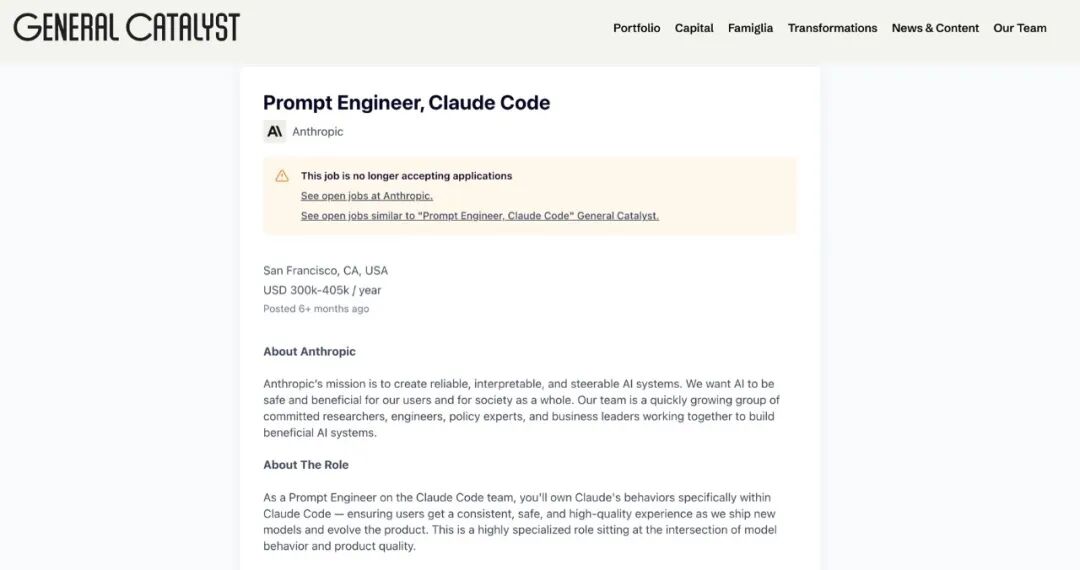
Back then, Anthropic offered an annual salary of more than 300,000 US dollars for the Prompt Engineer and Prompt Library Management positions.
A report from Time also introduced a practitioner who graduated with an English major and used to work as a copywriter. The combination of high salary and non-computer science background suddenly made many people realize that there seemed to be an extra path to enter the AI industry.
You don't have to spend years learning programming first. As long as you know better how to ask questions to AI, you can also get an enviable job. This kind of career imagination is especially attractive to ordinary people who worry about being replaced by AI.
Two years later, in a Microsoft survey covering 31,000 employees across 31 countries, this position ranked second from the bottom among the new positions the company plans to add in the next 12 to 18 months.
Its search popularity on Indeed surged from 2 times per million searches in January 2023 to 144 times in April of the same year, and then fell back to between 20 and 30 times.
It only took three years for the prompt engineer to go from an emerging position to being almost ignored.
Is it that this craft is no longer viable, or did we misunderstand its value from the very beginning?
01 The story of prompt engineers has long been staged in the computer industry
In the mid-20th century, "Computer" could also refer to an occupation.
People who sat at desks, held pens and paper, and performed repeated calculations were called Computers. Those research tasks that required a large amount of operations were often supported by a group of human calculators. They broke down complex tasks, calculated them one by one, and then handed over the results to researchers.
In the movie *Hidden Figures*, Dorothy led exactly such a team.
When Dorothy learned that NASA was going to install an IBM computer, she realized that the human computing team would no longer be needed. She went to the library to borrow a book about Fortran to teach herself, and after mastering it, she taught her colleagues in the west wing, and finally successfully started the machine and was promoted to head of the programming department.
In the same film, Katherine Johnson was told that her services were no longer needed during the launch preparation phase, and was reassigned back to the west wing computing department.

Similar changes also happened to telephone operators and typists. Some operations were handed over to machines, while some work was gradually completed by users themselves as tools became popular.
The situation of typists is particularly easy to understand. There is still a large amount of text to be input in the office, but when other employees can process documents on computers, the necessity of setting up a dedicated typing position is reduced.
These occupations share a common situation. Part of their value is built on things that machines cannot do for the time being and ordinary users cannot do for the time being. As these conditions change, the previously clear professional boundaries will also loosen.
02 How was the prompt engineer pushed to the peak?
In November 2022, ChatGPT based on the GPT-3.5 series was released. In March 2023, GPT-4 was launched. People began to find that as long as they typed in the input box, they could make AI write articles, organize materials, and generate solutions.
But being able to generate something is still a long way from being able to generate exactly what you need.
When asking AI to write a marketing plan, some people get a few paragraphs of general suggestions, while others get relatively complete analysis. The difference lies in whether the task is clearly stated, whether the materials are sufficient, whether examples are provided, and whether the output requirements are clear.
Therefore, asking questions itself has become a craft worthy of research.
The market quickly formed a set of popular circulating phrases, and many similar templates are like this: You are an expert in a certain field, you have such a background and knowledge reserve, now you need to give a certain solution based on certain problems and certain conditions.
In order to make AI answer like an expert, people first wrote a quite detailed expert job description. Some mass-produced prompt templates were even sold in large quantities.
This kind of exploration is indeed useful. Enterprises that want to use large models need someone to design instructions, prepare examples, and conduct repeated tests to adjust the inconsistent outputs to a usable level. Whoever figures out the characteristics of the model earlier can save a lot of trial and error time.
The problem is that the real demand was quickly magnified into a universal opportunity. The 2023 recruitment notice offering an annual salary of hundreds of thousands of US dollars became the most famous price tag in this industry.
Examples of people entering the industry without a technical background appeared in the market, and stories of successful career transitions across majors were repeatedly told. These stories work because they meet two psychological expectations at the same time: the threshold of new technologies does not seem that high, and there are indeed shortcuts outside the existing career paths.
But the real demand is not that large.
A study published in 2025 analyzed 20,662 relevant recruitment postings scraped from LinkedIn, among which there were only 72 prompt engineer positions. Although the data volume is not large, it reminds us that the actual scale of this occupation may be far less huge than imagined.
The popularity of this occupation ran ahead of its actual scale.
03 The fall of the prompt engineer
The collapse came faster than everyone expected, and the signal came from the model companies themselves. In May 2024, Anthropic launched the Prompt Generator.
When users describe the task they want to complete, Claude can assist in generating prompt templates. Some of the writing methods that originally required people to explore have become product features.
People are still learning how to translate their needs into instructions that AI can easily understand, while AI has already begun to help people do this layer of translation.
For AI products, this is actually a very natural path.
If every user has to learn role setting, background description, constraint conditions, and example organization first to get satisfactory results, the usage threshold will still remain very high. To reach more users, products need to take over as much of this preparatory work as possible.
The model's better understanding of natural language, the use of existing context, and the ability to ask follow-up questions when information is insufficient are all reducing the work that users have to complete in advance. Users do not have to write all requirements into a rigorous document at the first attempt, and can gradually clarify their needs in the communication process.
As AI becomes more and more able to understand people, the work of specially teaching people how to speak to AI can no longer maintain its original scarcity.
If the prompt generator reduces the trouble of writing prompts, then Skills further eliminates the need to repeatedly explain requirements.
In October 2025, Anthropic released Agent Skills, which organizes instructions, scripts and resources into reusable capability packs. In December of the same year, this mechanism further became an open standard.
On the day of release, developer Simon Willison commented that this may be more important than MCP, because the cost of writing and sharing a skill is extremely low.
The difference between the two is clearest in the reuse form. Prompts need to be maintained by people and re-entered every time; skills can be installed, version-controlled, shared, and automatically loaded when the corresponding scenario is hit. Prompts can only control the wording, while skills can come with scripts, templates, and reference documents to solidify a complete set of processes.
It didn't take long for people to find that many of the prompt requirements that needed repeated tuning in the past could be directly refined into a skill.
The behavioral changes brought about by the open ecosystem are even more thorough. When a large number of people upload their well-made skills to the public market, when a person encounters a certain demand, his first reaction will be to search the market for a mature solution that can be installed and used directly, instead of sitting down to write and tune prompts from scratch.
Hundreds of skills are actively used within Anthropic, and are categorized into nine major categories. This number shows that skills have evolved from personal tricks to regular engineering assets.
The demand for prompts has not disappeared, it has just changed its container. People who are good at writing prompts precipitate their experience into skills, while those who are not good at it directly install skills made by others. Both paths lead to the same result: the position of making a living exclusively by writing prompts is vacated.
04 When AI knows its users better and better
In a little over three years, the occupation of prompt engineer has gone from being invented and sought after to being barely mentioned.
Few occupations have experienced such huge prosperity and decline in such a short period of time. This seems to be a feature of the AI era: the speed of technological iteration is faster than the formation speed of an occupation.
To describe this speed in a joke, it is when it comes to AI, if you don't keep learning, you will no longer need to learn what you have learned.
The operation you laboriously learn today may be completed by AI itself tomorrow. It expresses the feeling of many people: chasing after tools to make up for lessons sometimes really feels like chasing a car that keeps accelerating.
Looking further ahead, the exit of prompts is inevitable.
The most natural way of human-AI interaction has always been natural language. In the past few years, prompts acted as a translation layer: people had to translate their intentions into a format that the model could understand, so that the model could give the desired answers. The reason why this intermediate layer exists is that the model does not understand humans well enough.
As AI continues to evolve and human-computer interaction memory continues to accumulate, it will know more and more about the person it is talking to. It will remember the style you asked for last time, remember the expressions you don't like, and remember the common sense of the industry you are in.
When an AI fully understands its master, the master does not need complex prompts, only a simple sentence in natural language, and the AI can give exactly what is needed.
This may be the final form of human-AI interaction after prompts disappear.
As machines understand humans more and more, humans no longer need to learn the way machines prefer to speak first.
This article is from the WeChat Official Account "Xunkong's Marketing Revelations", the author is Xunkong 2009, and it is released with authorization from 36Kr.