The real tough battle for AI is to be accountable for growth.
The past year has witnessed a tangible, visible shift in enterprise AI: it has evolved from a tool to a role, becoming a formal member of the workforce.
At Unilever, before a sales representative visits a restaurant to sell condiments, they will first run a full practice session with an AI sales employee.
When facing the head chef, they will practice how to discuss flavor profiles and dish presentation; when facing the restaurant owner, how to talk about cost control and business operation. The AI will simulate the entire conversation in advance by combining the restaurant's specific situation, product materials and past business knowledge, covering all possible customer questions and corresponding response strategies.
In the past, most of these judgment logics were stored in the minds of top-performing salespeople. Now, they are being systematically extracted and transformed into standardized processes that AI can learn and execute.
Similar changes are also taking place at enterprises including VOYAH, Bright Food and Pechoin, where AI employees are beginning to integrate deeply into the core business workflows of organizations.
Some AI employees focus on marketing, some on sales, and others participate in planning. They take on clear, well-defined tasks, and are even directly evaluated against metrics such as conversion rate, sales revenue and user retention. This is the fundamental difference that sets AI employees apart from traditional AI assistants. When AI starts to take responsibility for tangible business results, enterprises' requirements for it have also undergone essential changes.
The team that deployed these AI employees is Lynx, an enterprise-level Agent brand focused on growth under the Alibaba Cloud Intelligence Group. It builds truly deployable AI employees deeply integrated with work processes for enterprises on its self-developed platform AgentOne, covering all core operational links.
At this year's Apsara Conference in September, Lynx used the performance results of these AI employees to answer a profound industry question: if all sectors are already using AI to improve efficiency, why has the expected explosive growth not arrived in tandem?
01. What does a qualified AI employee look like?
The concept of "efficiency" has been the central theme in the AI narrative for three consecutive years. However, in his speech at this year's Apsara Conference, Peng Xinyu, Vice President of Alibaba Cloud Intelligence Group and CEO of Lynx, decided to shift the core theme to a new direction.
His judgment is: The AI revolution starts with efficiency, but ultimately leads to growth.
McKinsey's 2025 global survey shows that 88% of surveyed organizations have applied AI to at least one business function, while the proportion of enterprises that can attribute more than 5% of their EBIT (Earnings Before Interest and Taxes) to AI has remained at around 6% for two consecutive years. 80% of organizations have seen a substantial increase in individual productivity thanks to AI, but only 37% of enterprises have achieved corresponding EBIT growth from this improvement.
In his speech, Peng Xinyu referred to a powerful historical reference point: at the dawn of the Industrial Revolution, the efficiency per working hour of human beings increased by 26 times, but the explosion was in production capacity rather than profit.
In the early stage of every technological revolution, there is a cycle where efficiency gains come first and growth lags behind. However, efficiency is a process indicator, while growth is the ultimate result indicator. The real value of AI for enterprises lies in driving growth. The time saved by efficiency improvement needs to be reinvested into business operations, and then it can be converted into actual revenue for the enterprise.
In the AI era, the biggest obstacle to converting efficiency into growth is that enterprise-level AI has not truly penetrated into the processes of organizations. To connect AI to workflows and make the processes run smoothly, AI needs to change its identity: from a Q&A assistant at the workstation, to a formal employee embedded in the process.
So today, when the concept of digital employees has been around for more than a decade and the penetration rate of AI in enterprises is already sufficiently high, what exactly should a qualified AI employee be like?
In the past three years, the industry's criteria for measuring AI have focused on model capabilities: parameter scale, benchmark test scores, and conversation fluency. These standards are mostly used to define tools, describing the practical dimensions of tools, but cannot directly enable AI to participate in the improvement of business outcomes.
Peng Xinyu mentioned a "phone call" at the Apsara Conference. A small business owner in the rare earth industry with an annual revenue of about 200 million yuan and 20 salespeople asked straight away how much it would cost to deploy the latest large model.
When Peng Xinyu quoted a starting price at the multimillion-yuan level, the other party was stunned. He said what he needed was actually very simple: to help his 20 salespeople find more customers, improve conversion rates, and finally expand the team to 100 people. Peng Xinyu told him that what he needed was a sales-savvy dialogue assistant, which large general models cannot deliver.
In this environment that overemphasizes tools while being disconnected from actual business, Lynx has established a new set of assessment criteria for AI, with job requirements as the core dimension.
In other words, a qualified AI employee should be able to match a real job position, complete a full business process, and accept KPI assessments just like human employees.
From Lynx's perspective, the implementation of this set of assessment criteria mainly relies on the integration of three elements: Data for AI, Agent, and FDE.
Among them, Data is the flesh and memory: high-quality enterprise data is processed into AI-understandable semantics, forming long-term accumulated data assets; Agent is the body and skill, responsible for execution, decision-making, and delivery of results; FDE is the mentorship and job design module, which abstracts the tacit knowledge that originally only exists in employees' experience into processes that AI can execute in a standardized manner.
The condiment sales business of Unilever mentioned at the beginning is the result of the combined operation of these three elements. Why should two completely different sets of communication scripts be used when facing the head chef and the restaurant owner respectively? When a customer says "it's too expensive", do they really think the product is overpriced, or do they just fail to understand the product's value? When should we continue to promote the product, and when should we switch to another topic?
In the past, most of these judgments were stored in the minds of top-performing salespeople. When a salesperson leaves the company, this part of experience is very likely to be lost along with them.
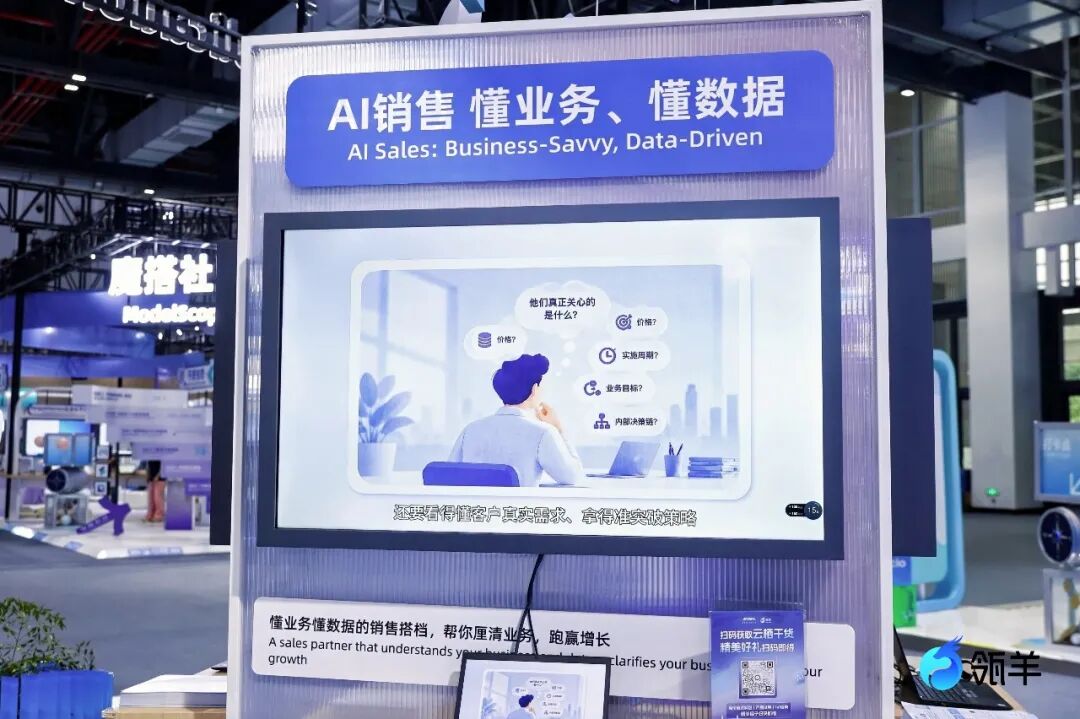
The task of FDE is to combine sales call recordings, category materials, consumer reviews and competitor information with Unilever's own business knowledge, to build a huge food knowledge engine. Based on this, the AI sales employee will generate a personalized practice script for each restaurant and the key person in charge, based on actual business information, covering customer background, communication paths, product recommendations, competitor comparison, and responses to common objections, all prepared in advance.
This system has a precipitatable closed loop, where every key piece of information and reasoning conclusion can be traced to its source and precipitated as reusable knowledge. As a result, individual experience is transformed into organizational capabilities that can be learned and reused.
At Unilever, data is first processed into structured knowledge, and then the knowledge is returned to the frontline sales scenarios. To make data serve AI, and make AI serve business growth, Lynx summarizes this entire chain into two core concepts:
Data for AI: build data into structured knowledge; AI for Business: enable knowledge to drive tangible growth.
02. Growth takes place at the frontline of business operations
Currently, AI applications in enterprises are scattered in different scenarios. Some are in dialogue boxes, only responsible for answering questions; some are embedded in office software to handle documents and workflows; others have integrated data and connected to core business systems.
Lynx divides these three types of AI usage into three layers, from shallow to deep: Chat (dialogue), Work (office), and Business (operation). The classification standard is the distance between AI and the enterprise's core data and business outcomes.
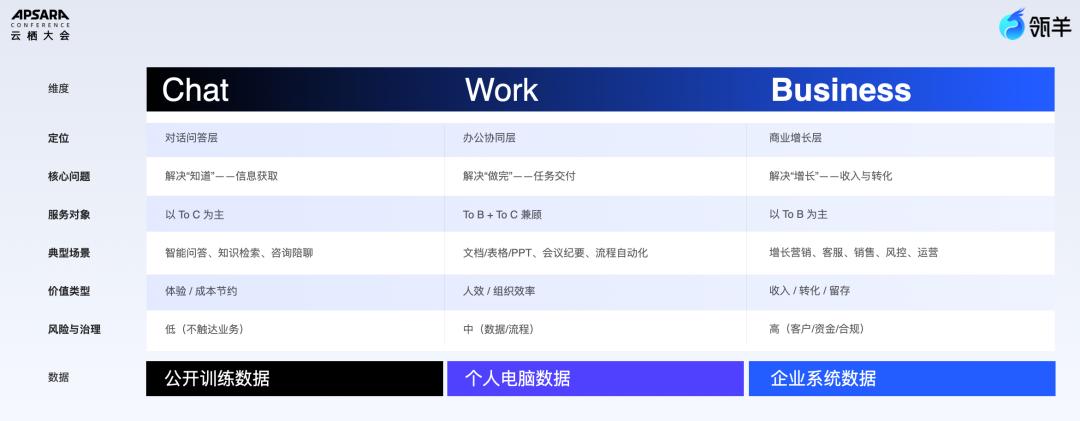
The Chat layer solves the problem of "whether we can get the information": the data of dialogue Q&A tools comes from the public domain, and its value is limited to improving experience and reducing costs. The Work layer solves the problem of "whether we can finish the task": office assistants handle documents, browsers and workflows, bringing value in the form of improved individual productivity and organizational efficiency. There is an endless stream of AI products in the industry corresponding to these two layers.
However, at the Business layer, which is closest to actual business operations, it is almost an uncharted territory. This layer focuses on solving growth problems, directly targeting revenue, conversion rate and user retention. The real growth of enterprises comes from this layer, and Lynx has maintained a unique position among all AI service providers because it has been rooted in this field since its establishment.
The rise in value corresponds to a simultaneous rise in investment and access thresholds. The deeper data penetrates into the core of enterprise operations, the more complex the issues of permission, risk and governance become, forming a huge gap between enterprise-level Agents and general-purpose Agents.
Based on Lynx's practical implementation experience, there are four steps to convert data into knowledge that Agents can understand: access and management, to obtain data in real time and accurately; processing and governance, to unify fields, calibers and business definitions; knowledge production, to convert the tacit knowledge in employees' experience into structured semantics and rules; service-oriented invocation, to enable Agents to access data and execute tasks through APIs and MCP.
The AI employee of VOYAH operates at the frontline of user marketing. In the lead pool of 20 million users, some have just viewed the vehicle configuration, some have consulted on financial policies, and some have taken test drives but have not responded for a long time. In the past, a push notification covering 7 vehicle models took 12 to 24 hours from audience selection to configuration and launch. After cooperating with Lynx, the team split the workflow into multiple marketing Agents for intelligent crowd targeting, user insight, solution planning, content generation, and canvas arrangement respectively, and the full launch can be completed within 3 hours. Data shows that VOYAH's user operation efficiency has increased by 3 times, the strategy click-through rate has increased by 15%, the activation rate of inactive existing leads has increased by 20%, and the conversion rate from lead to order has increased by 20%.
Feihe's AI employee operates at the channel frontline. With more than 2,600 distributors and about 67,000 retail outlets, in the past, it took 3 days to compile and generate a provincial-level operation report, and the processing window had already passed by the time problems were identified. Now regional managers can view the operation status of their jurisdiction on the same day, and the report generation time has been reduced to 1 hour.
Lynx summarizes this set of capabilities into three phrases: capable, reliable, and high-performing.
"Capable" means that AI employees are deeply integrated into the enterprise's business chain and industry knowledge, completing end-to-end full tasks from planning to execution, without requiring step-by-step manual instructions. "Reliable" means that all outputs are traceable and verifiable, supported by more than ten years of data governance accumulation and enterprise-level security architecture. "High-performing" means that the assessment of AI employees is directly tied to core business indicators such as GMV, ROI, order closing rate and input-output ratio, and the results are measured by actual business outcomes.
At the same time, the deployment of AI employees does not mean that human employees need to exit the workflow.
The experience of the VOYAH team is that parts involving brand guidelines, business compliance and strategic judgment still retain manual review. AI is responsible for high-frequency, repetitive execution and preliminary analysis, while human employees are responsible for controlling the general direction, checking risks, and adjusting the next round of operation strategies based on actual feedback. The time saved by the human operation team is invested in issues that require more human creativity and experiential decision-making, such as whether the strategy is reasonable and whether the content is close to user needs.
If we look at the global market, the entire enterprise AI field is generally moving in the same direction: shifting AI delivery from software seats to tangible business results.
Salesforce's Agentforce is billed by the number of resolved cases, with its ARR reaching 1.2 billion US dollars, a year-on-year increase of 205%. HubSpot positions its Agents as pay-per-performance products, with clear pricing for each resolved case and each valid lead. Microsoft has added usage-based billing on top of seat subscriptions, with built-in agent ROI tracking in its products. The deployment volume of ServiceNow's Agents has increased by about 9 times within 9 months.
Long before these global enterprise service giants, Lynx's AI employees have gone a step further, breaking the traditional settlement model based on software authorization or headcount, and adopting a settlement model based on actual business effects. For example, Lynx's AI customer service billing is directly linked to pre-sales conversion volume, after-sales service volume and user satisfaction. According to statistics, the payment cost of some enterprise customers has dropped to 50%-60% of the original level.
03. The second half starts with "taking up the post"
With the clear direction and industry consensus reached, the remaining question is at the execution level: who has the capability to deploy AI employees to the frontline of business operations.
Gartner predicts that by 2026, enterprises will abandon 60% of AI projects that lack AI-ready data support. In a concurrent survey of 1203 data management leaders, 63% of organizations are not sure whether they have correct data management practices. Data governance is the ticket to the future.
In China, Lynx has held the ticket of enterprise-level data governance for a long time, giving it a natural advantage in the field of AI-driven growth:
This company is derived from Alibaba's years of practice in serving enterprises, with more than ten years of enterprise-level data governance experience, processing the most complex commercial data in China, and the governance problems in transactions, marketing and supply chains have been repeatedly verified in this system. Centering on the four core operation scenarios of marketing, sales, customer service and operation, Lynx has developed a systematic Agent product line, as well as a professional FDE team, which is dedicated to bringing the methodology to the customer's site for implementation.
Backed by Alibaba Cloud is another layer of strong support. Behind Lynx's service chain are Alibaba Cloud and the Qwen large model as the infrastructure base. With the long-term support of Alibaba Cloud's global computing power and enterprise-level security architecture, the FDE team can complete the implementation of data governance without technical burdens.
The station recommendation service of Star Charge has been put into actual business operation. Users can describe their charging needs in one sentence in the Tongyi Qianwen App, the system will understand the constraints such as distance, available charging piles, fast charging and price, and return the optimal recommendation results. The station recommendation Agent responsible for this task does not belong to any of the four categories of marketing, sales, customer service and operation. Lynx calls this type of role that has no existing job number and is customized according to each customer's actual needs and scenarios as X-employee.
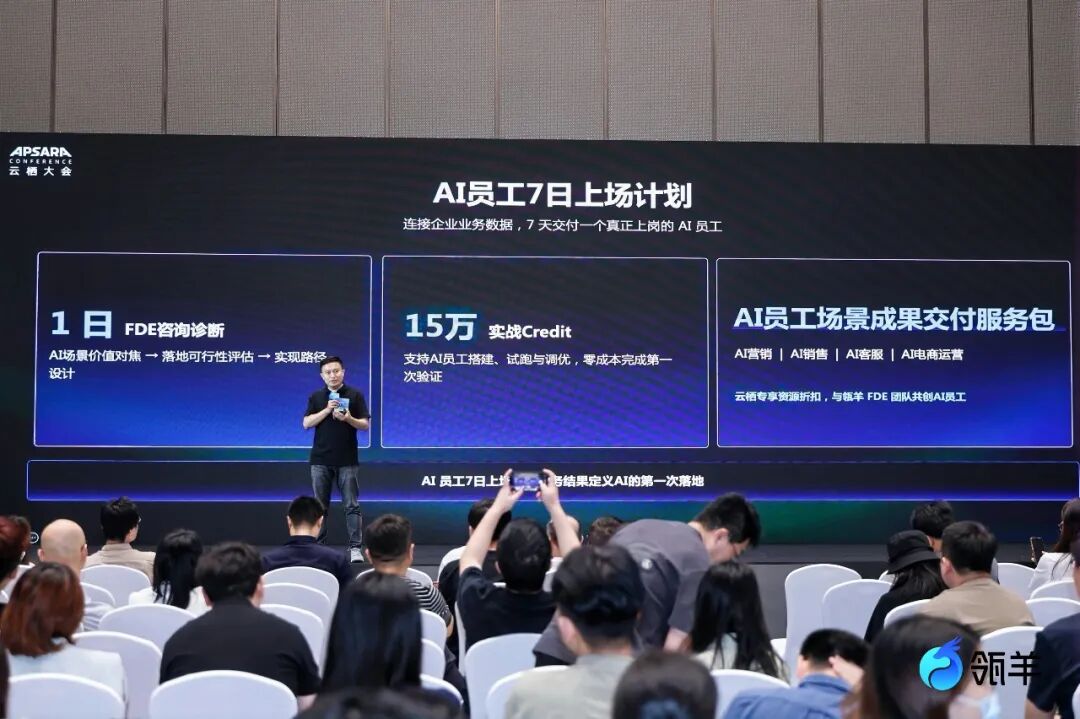
At the recently concluded Apsara Conference, in order to help more enterprises obtain tangible business results brought by AI, Lynx launched the "AI Employee 7-Day Deployment Plan": providing free 1-day FDE diagnosis, a credit resource package worth 150,000 yuan and other benefits. Enterprises can start from a clear business problem, and let AI employees be tested with real data and real tasks. At the end of the seven days, the enterprise will receive an "AI Employee Deployment Report", explaining whether the scenario is worthy of large-scale expansion, which data still needs to be governed, and what KPIs the AI employee should be responsible for after being officially deployed.
Previously, an enterprise with about 150 offline stores has already run through this path. The first round of practice completed the semantic sorting of more than 110 operation indicators, covering 5 business segments, and opened access to more than 50 accounts. Business questions that originally required manual table checking and repeated verification can now be directly queried in natural language.
In the past, when enterprises implemented AI, most of them only replaced bicycles with motor vehicles,