Chronicles of Getting Addicted to AI Dramas: From "What a Piece of Trash" to "Just One More Episode"
Not long ago, a trending topic went viral — #AIShortDramaAddiction#.
Before clicking in, kk thought it was just another marketing account fabricating topics, but after scrolling through several pages of comments, it found that the volume of discussion was far more staggering than expected.
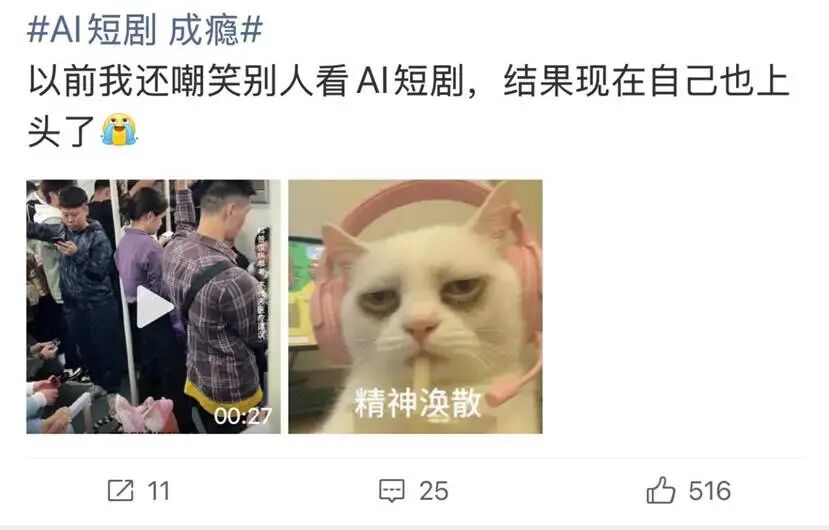
Some netizens said that the elderly in their family "watch 2 hours every night before going to bed, and 1 hour after waking up in the morning", some said "my parents can't stop watching", and others said "the elderly on the MRT and trains are all watching". What surprised kk even more is that it's not just the middle-aged and elderly groups: a 32-year-old man in Jiangsu said in a media interview that he has been addicted to AI short dramas for a month, wearing bone conduction earphones to watch during the 50-minute carpool ride home from work on weekdays, and can binge hundreds of episodes on rest days.
Out of curiosity, kk also binged several AI dramas at home last weekend. To be honest, the viewing experience is completely different from those AI videos made a few years ago.
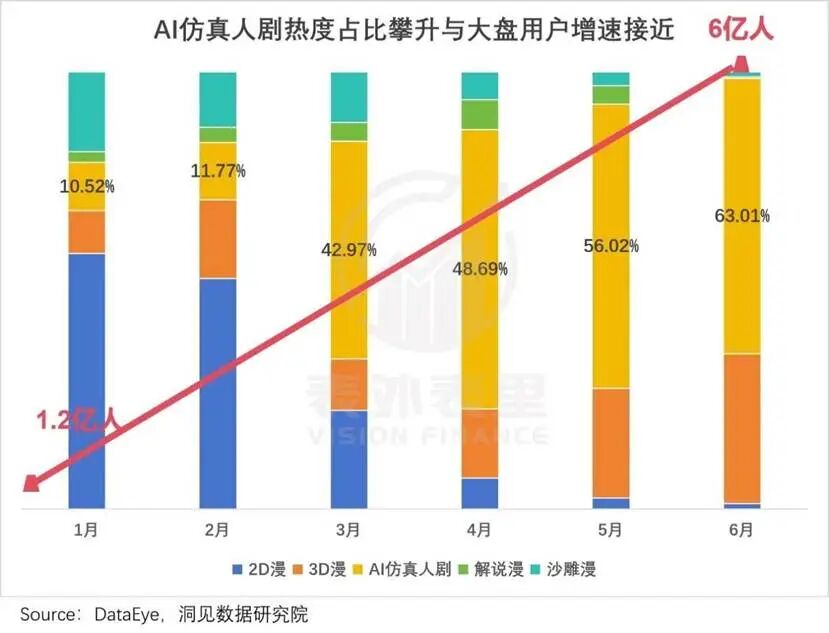
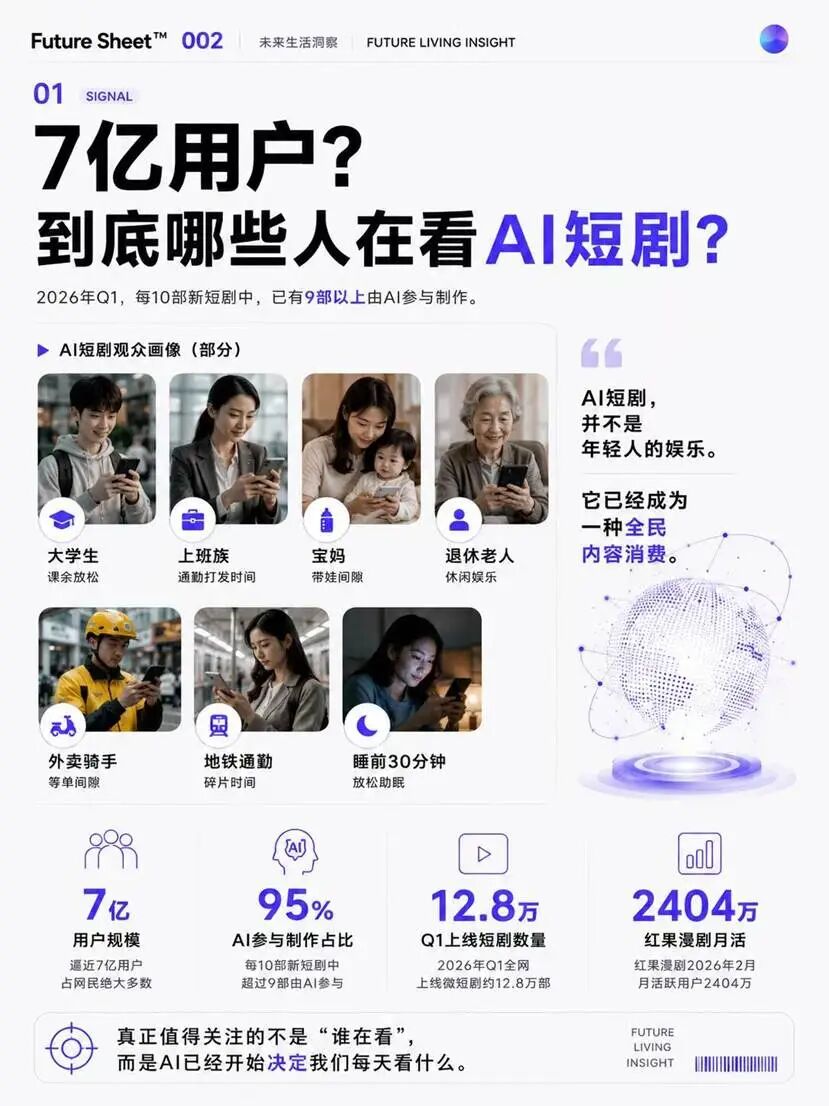
Data from Insight shows that the audience of AI hyper-realistic dramas has reached 600 million. The report released by DataEye also confirms this: from January to May this year, the market size of domestic AI dramas and manhua dramas exceeded 220 billion yuan, and the full-year figure is expected to hit 400 billion yuan, a year-on-year increase of 138%. In the first half of the year, more than 220,000 new AI dramas were launched across the entire network, with a brand new AI short drama going online every 36 seconds on average. This production capacity is staggering in any content industry.
But the numbers are only the result. What makes AI dramas so appealing that 600 million people are willing to spend time on them? What exactly are those viewers who can't stop binging consuming?
Are AI Dramas Really That Good?
Looking at the total hit chart of Hongguo Short Drama, 4 out of the top 5 titles are AI dramas.
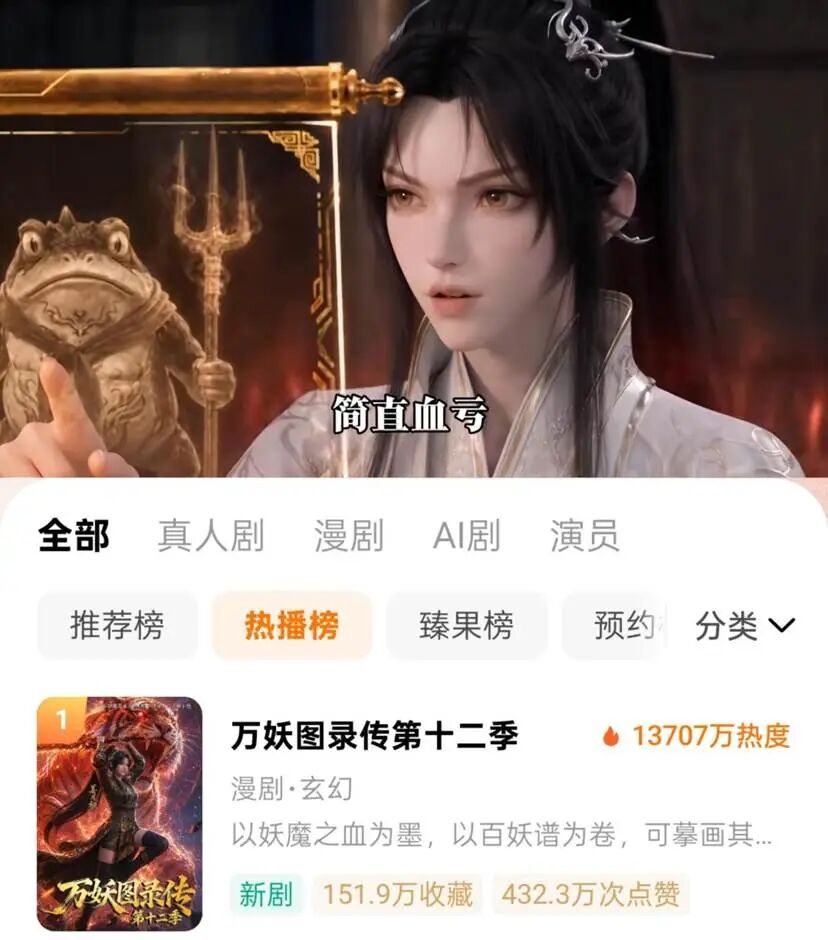
The 8th season of *Legend of the Ten Thousand Demons* firmly takes the first place on the manhua drama chart with 89.19 million popularity, and the total views of the entire series have exceeded 6.08 billion. The 3rd season of *The Youngest Junior Sister Doted on by the Whole Sword Sect* has a popularity of about 110 million, and the total views of the entire series have reached 3.4 billion. The series *We're All Reborn, Who's Still Pretending to Be a Rich Second Generation* has become a long-running hit of AI manhua dramas with 76.97 million popularity. The presence of live-action short dramas on this chart is being rapidly diluted.
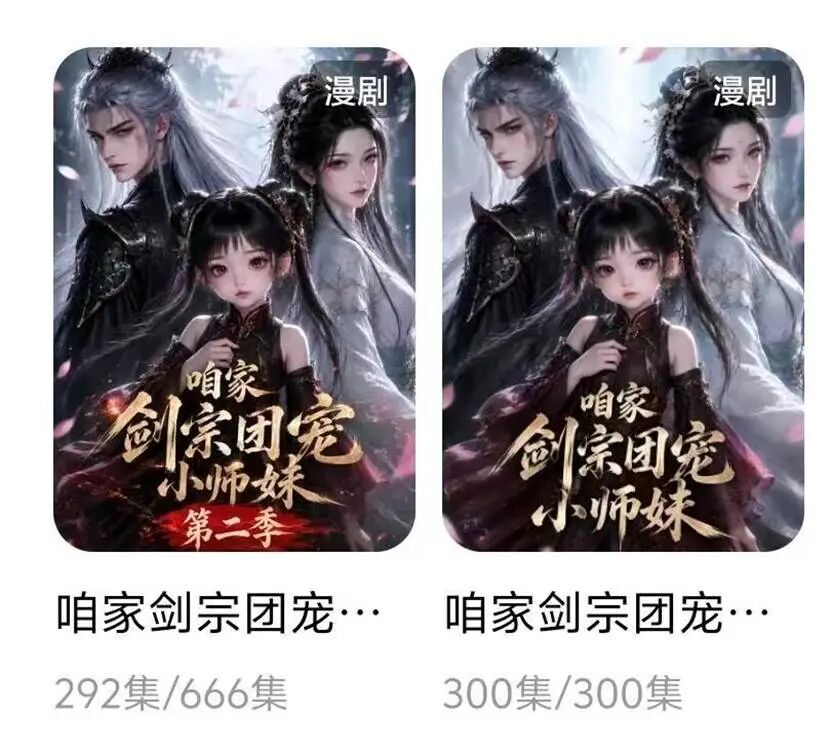
The first title kk clicked on was the 3rd season of *The Youngest Junior Sister Doted on by the Whole Sword Sect*. This drama is tagged with cute kids, cultivation, and another world, which is a typical hit formula of Hongguo. After actually watching it, the pace is indeed unmatched by live-action dramas: the background is fully explained within the first three minutes of the opening, and it immediately enters the loop of satisfying highlights where "the junior sister is bullied, and all the senior brothers stand up for her". There is no redundant setup, no complicated camera movement, the picture has bright colors, the character images are consistent, and although the special effects are not extremely fine, at least viewers can tell at a glance that a big move is being unleashed.
Then kk clicked on the 8th season of *Legend of the Ten Thousand Demons*. When this drama was launched last year, the popularity of Hongguo for the 7th season on its premiere day soared to 94.42 million, and shortly after the reservation for the 8th season opened, more than 3.73 million people were waiting for it. The story has a solid foundation, adapted from the novel *That Demon is Lord Jiang*, where the protagonist travels to the Tang Dynasty overrun by demons, awakens a demon-slaying system, and levels up while fighting monsters all the way. The action scenes clearly show the changes of moves and the layers of combat, instead of simply stacking pictures with light effects.
But as the story goes on, problems also emerge. The setting of "a man travels into a woman's body" could have explored deeper themes such as identity recognition and gender perception, but in the drama it is basically only used as a contrast for comedic effects. The growth of the protagonist is mostly the accumulation of combat power values, and there is rarely any wavering or reflection due to failure, friendship, or moral choices. This is a well-made satisfying drama with stable long-term narration, but it is still far from being a "great drama". It is satisfying enough, but you forget about it as soon as you finish watching.
30-year-old Ms. Chen is a loyal audience of AI manhua dramas. In May 2026, by chance, she came across an AI manhua drama adapted from a doomsday novel, and then she became completely addicted, falling in love with AI manhua dramas of the same genre. She recommended *The Hidden Ruins of Mountains and Seas* to kk, saying that this AI manhua drama gave her a sense of visual satisfaction.
After watching it, kk found that the production level of this drama really stands out in the environment where most AI manhua dramas are relatively rough. The story follows the blind protagonist Li Guanqi, whose elder sister was tortured to death by a wealthy family, and he climbs step by step from adversity to the peak. It is not a satisfying drama in the traditional sense: the protagonist has a cheat power but also suffers a lot, and the plot is quite inspiring. A Douban user commented "it no longer looks like an AI video", which in the current context is actually a very high compliment.

Of course, not all high-popularity works can stand careful scrutiny. The series *We're All Reborn, Who's Still Pretending to Be a Rich Second Generation* can hardly be called an artistic enjoyment, but it is indeed impossible to stop watching. The first episode ends with humiliation, the second with counterattack, the third with identity exposure, and the fourth sees the protagonist directly reach the peak of life. This "inability to stop" is not because it is so good, but because the whole drama has no redundant content. Each episode is like an emotional capsule that takes effect immediately after opening, and requires no digestion from the viewers.
The competitiveness of AI dramas is essentially a set of repeatedly verified emotional formulas. Tags such as cute kids, cultivation, counterattack, rebirth, and time travel precisely correspond to the preferences of specific audiences, and the pace is so precise that each episode has a clear emotional outlet. Viewers don't need to use their brains, don't need to understand complex character relationships, and just follow the rhythm. This "low threshold, high reward" form of entertainment is indeed very attractive to busy modern people.
Why Are AI Dramas So Addictive?
"After binging several AI dramas, you feel satisfied, but you still feel empty afterwards, as if you haven't watched anything." This is the common feeling of most people after finishing AI dramas.
A viewer working at a large internet company told kk that she watches AI dramas every night before bed, but never at other times, "because binging them wastes a lot of time". She knows very well that AI dramas waste time, but still opens them on time every day. This is not a problem of self-control, but that the consumption scenarios and product mechanisms of AI dramas naturally match certain demands.
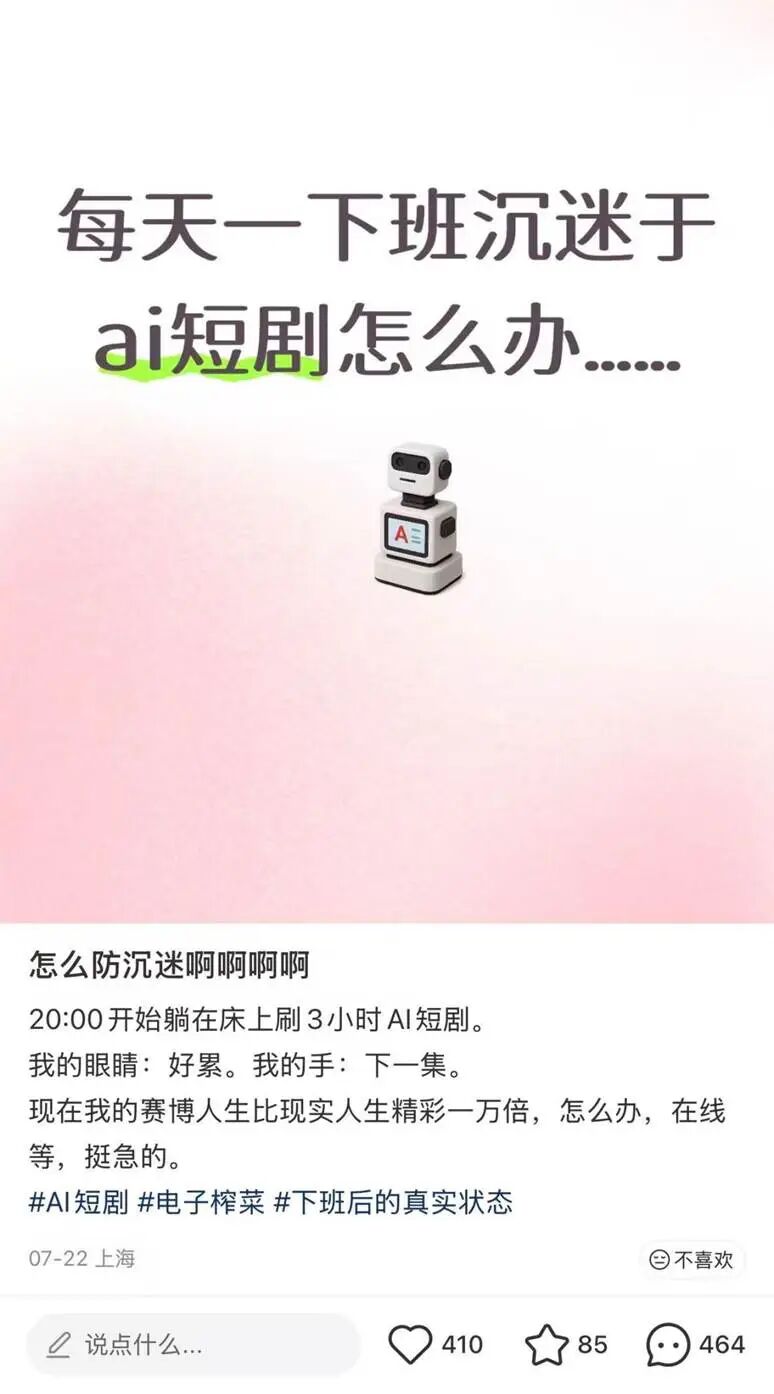
Short dramas themselves are famous for "hooks": each episode ends with a cliffhanger, forcing you to watch the next one. AI dramas take this mechanism to the extreme. Since there is no need for on-site shooting, they can be produced infinitely. After you finish watching one drama today, ten new dramas of the same theme will be launched tomorrow. This infinite supply, combined with the platform's recommendation mechanism, forms a cycle that is hard to break free from.
Viewers open an episode in fragmented scenarios such as before bed, during commuting, or while having meals, enter the conflict within 3 minutes, complete an emotional release in 5 minutes, and then automatically jump to the next episode. The whole process requires no thinking, no memorization, no social interaction, and provides pure emotional comfort.
Just like many short drama platforms provide the first 10 to 15 episodes for free, and require payment or watching ads to unlock subsequent episodes. At this point, the viewers are already invested in the plot, eager to know the ending, so the payment threshold becomes much easier to cross.
From the perspective of consumer psychology, AI dramas provide typical instant gratification. Live-action dramas need to lay out character relationships, leave space for actors to perform, and viewers need to invest a certain amount of attention to get into the plot. AI dramas have none of these burdens. They minimize all narrative costs and go straight to emotional release.
But the characteristic of emotional consumption is that the marginal utility decreases very quickly. After watching the same drama for the third time, you no longer feel anything, so new content needs to be continuously supplemented. This explains why the production of AI dramas needs to maintain such a high capacity: it is essentially an assembly line of emotional supply. Viewers are not consuming "stories", but consuming "emotions". The story is only the carrier of emotions, and the carrier itself does not matter. What matters is the efficiency of emotional release.
This leads to the fact that AI dramas are rarely regarded as social currency by viewers. Among the several viewers interviewed by kk, almost no one is willing to actively recommend AI dramas to their friends.
"Everyone has different levels of acceptance and different tastes, and there are not many well-made AI dramas, they are just for killing time, so there is no need to specially recommend them. The plots are designed to be satisfying for the sake of satisfaction, with no artistic value at all, not worth discussing with friends. If there is a good one, I will just watch it quietly, enjoy it quietly, and savor the happiness quietly."
This state of "quiet enjoyment" precisely illustrates the position of AI dramas in the hearts of viewers. However, this is not necessarily a bad thing. Entertainment products naturally have different levels and functions. Not all content needs to carry social value or artistic value. What AI dramas satisfy is to let people enjoy a period of brainless happy time when they are tired.
The employee of the large company said "I hope the plots can be more logical, and each episode can be a little longer", and the 50-year-old interviewee also expressed similar expectations in the interview. What they want is not only speed, but also quality. Speed is the entry point, and quality is the reason to retain people.
The only thing that needs to be guarded against is that the infinite expansion of AI dramas will eventually hit the ceiling of people's attention. A person only has 24 hours a day, and the time available for watching before bed is very limited. When all platforms are competing for this period of fragmented time, the "addiction" mechanism of AI dramas will change from an advantage to a burden.
At that time, the only thing that can retain people will be the quality of the content itself.
Can AI Dramas Reshape the Future of the Drama Industry?
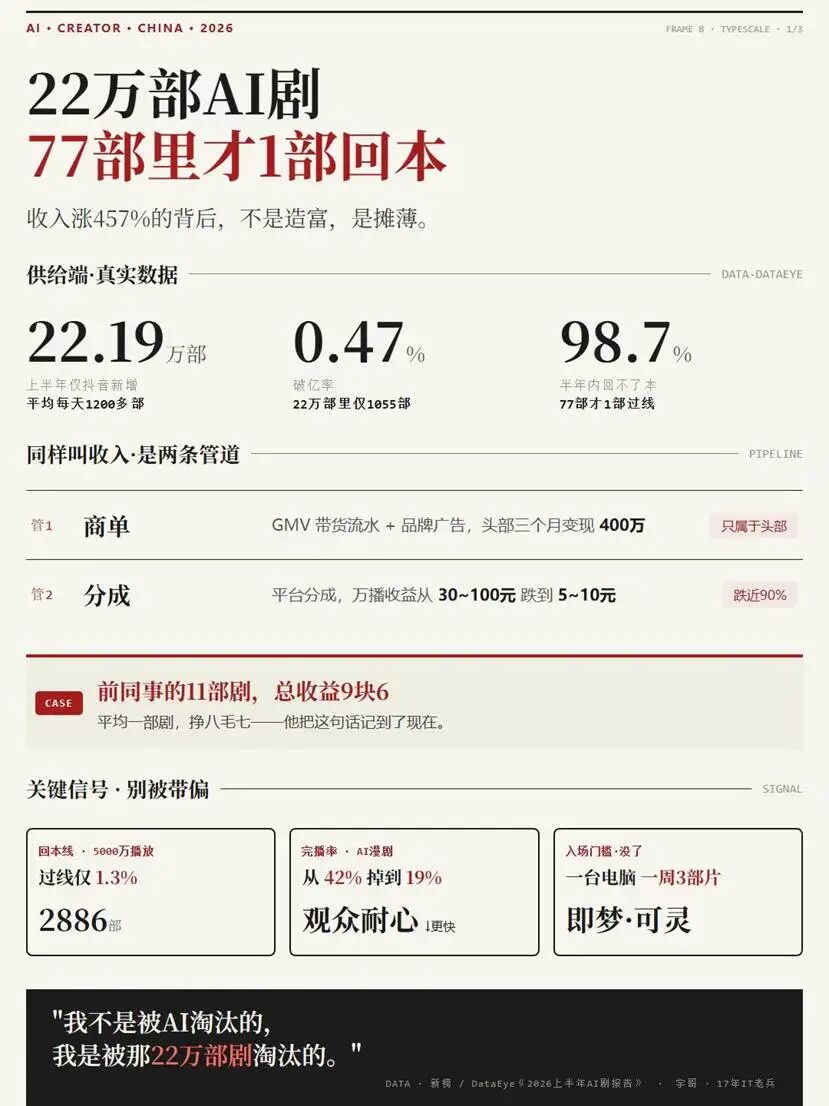
When it comes to the industry level, we have to mention a not-so-optimistic data: In the first half of the year, only 1055 AI short dramas had over 100 million views across the network, with a hit rate as low as 0.47%. In other words, more than 99% of AI dramas hardly attracted any attention after launch. Behind the skyrocketing production capacity of 220,000 new dramas is the reality that the vast majority of works are reduced to "digital cannon fodder".
This is not because the creators are not working hard. Ms. Chen mentioned that she often finds some well-made AI works on Douyin, but "there are rarely very well-made ones on Hongguo, probably because the base number is too large". When thousands of new dramas flood into the platform every day, the probability of good works being submerged is far greater than the probability of being discovered.
At the same time, the incentive policies of the platforms are also being adjusted. In the new regulations of July, the Douyin Copyright Center raised the revenue sharing coefficient of dynamic commentary manhua dramas from 1 to 10, and AI dramas with a popularity of over 50 million on Hongguo can get cash rewards, with a maximum of 200,000 yuan per drama.
These policies try to tilt resources towards high-quality content, but there is a natural tension between encouraging high-quality works and pursuing production capacity. High-quality works need time to polish, while production capacity requires continuous output. When the industry quotation drops from 5000 yuan per minute to several hundred yuan, the profit margin of production is extremely compressed, and it is difficult for creators to have the motivation to make carefully crafted works. The cost of pursuing efficiency is the sacrifice of the texture of the works.
As of the first half of the year, the number of active practitioners in the AI drama and manhua drama industry has exceeded 500,000. This industry is rapidly absorbing labor, and also rapidly generating a large amount of homogeneous content. Open any AI drama, and you can see similar character modeling, similar special effects styles, and