Kevin Kelly held a dialogue with China's emerging tech forces and put forward six judgments.
In 2026, AI is no longer a stranger to everyone. Large models have delivered sufficiently stunning results in the digital world, and technologies have further empowered intelligent entities to step into the real physical environment. For the AI industry, this is an industrial offensive that breaks through human limitations. For a broader audience, this is a new industrial revolution that is enough to subvert all historical experience.
However, on the forward path of AI, there are still many practical problems to be solved:
Is there a bubble in the AI industry?
Can embodied intelligence truly understand the physical world?
Will robots completely replace humans? Can they coexist with humans, and where is the boundary?
Can Token costs determine the winner of the AI track?
What attitude should we take towards the associated risks of AI?
On September 21, Kevin Kelly, founding editor of Wired magazine and a tech thinker, was a guest at 139 Chenyuan, Beijing, and had an in-depth dialogue of nearly 2 hours around AI with He Wang, Founder & CTO of Galbot, Qingsheng Zheng, Partner of HSG, Yaqiong Shi, Vice President of Jinqiu Fund, and Dagang Feng, CEO of 36Kr. Many practical issues such as the technical inflection point of the world model, cost game, human-robot collaboration boundary, risk governance, and technological optimism were discussed in this dialogue, leaving six clear judgments.
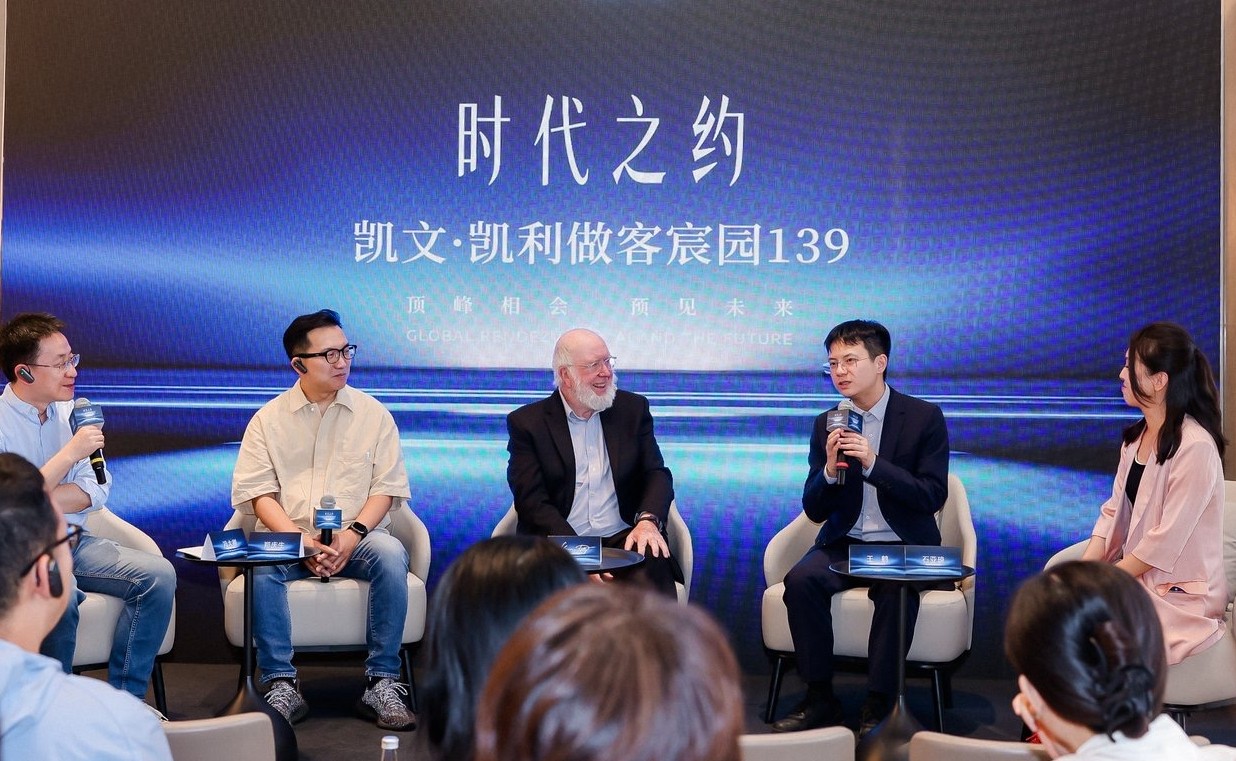
Event Site
Judgment 1: Embodied Intelligence has passed the AlphaGo Moment
In August 2026, at the World Humanoid Robot Games, a humanoid robot developed by China Galaxy General Robotics (Galbot) completed a fully autonomous remote-control-free tennis match. The robot ran all over the court, received and served, competed, stood up quickly on its own after falling, predicted the trajectory of the ball, and hit the ball accurately.
After the video of the robot playing tennis was released on social media, Andrew Kang, co-founder of Mechanism Capital, commented: Alpha Go for every sport is coming. Elon Musk also left a comment: The AlphaGo moment of embodied intelligence.
When He Wang, founder and CTO of Galbot who developed this robot, met Kevin Kelly face to face, the latter commented: "The most talked-about thing right now is the large language model that almost everyone uses, but the large language model itself knows very little about the real world. It is not trained in the real world, but trained based on text and textual data that describes the real world. Now people are starting to give AI a body, and use robots to connect AI to the physical world. But if you directly connect a large language model to a robot and let it act autonomously and cope with the environment in the real world, it will be very difficult. So our current goal is no longer just to create this kind of intelligence that "knows all the book knowledge", but to develop AI that understands the real world. Sometimes it is called a world model. Its training materials are no longer just texts from all over the world, but all physical laws, and massive amounts of data that describe how the real world works. This is the next major breakthrough, and the whole industry is moving in this direction."
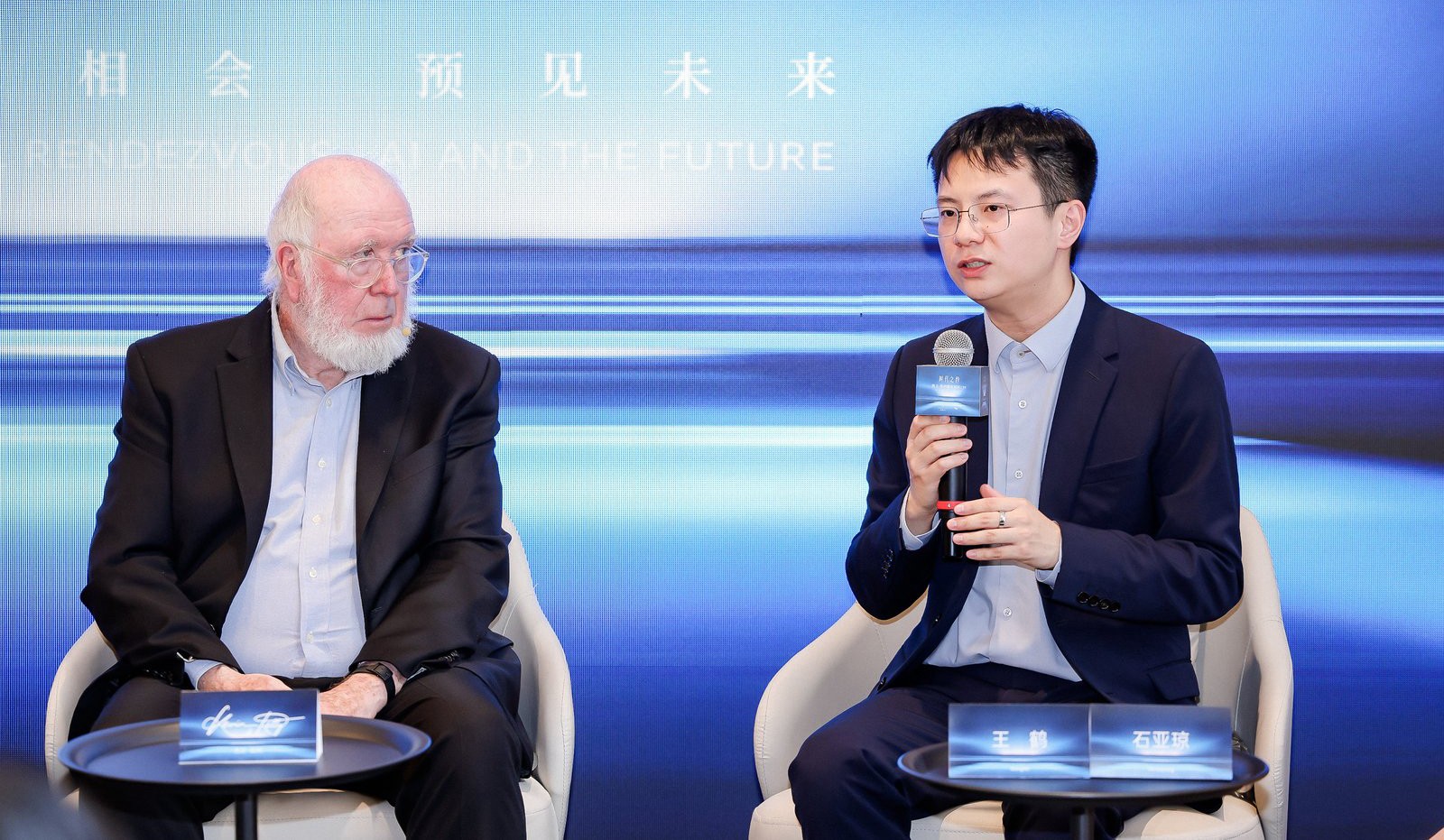
Event Site
From performing a single action to mastering a skill, how does AI complete its evolution?
He Wang revealed the underlying logic of Galbot's R&D: "We found that the brain of a mouse is very small, and the number of neurons is very small compared to us humans. But it has all the intelligence to find food and escape in the wild, and it does not need a brain as large as a human to survive. This intelligence is a different form from the knowledge intelligence behind the text model. On this path, we also hope to build a bionic brain system that can connect the cerebrum, cerebellum and pons step by step, which can not only make high-level judgments, but also perform low-level balance execution, so that our humanoid robot can truly have wisdom."
From a global perspective, Google VLA and OpenAI's world model represent two mainstream technical routes, but both have their own shortcomings. VLA training data must be bound to robot action labels, and massive public videos cannot be reused; the world model is good at environment prediction, but may not output action instructions that robots can execute directly.
To this end, Galbot proposed the World Action Model (WAM), trying to integrate the two paradigms. The model can not only predict the evolution of the environment, but also directly output robot action instructions. This technical route is called "the endgame technology of robots" by NVIDIA.
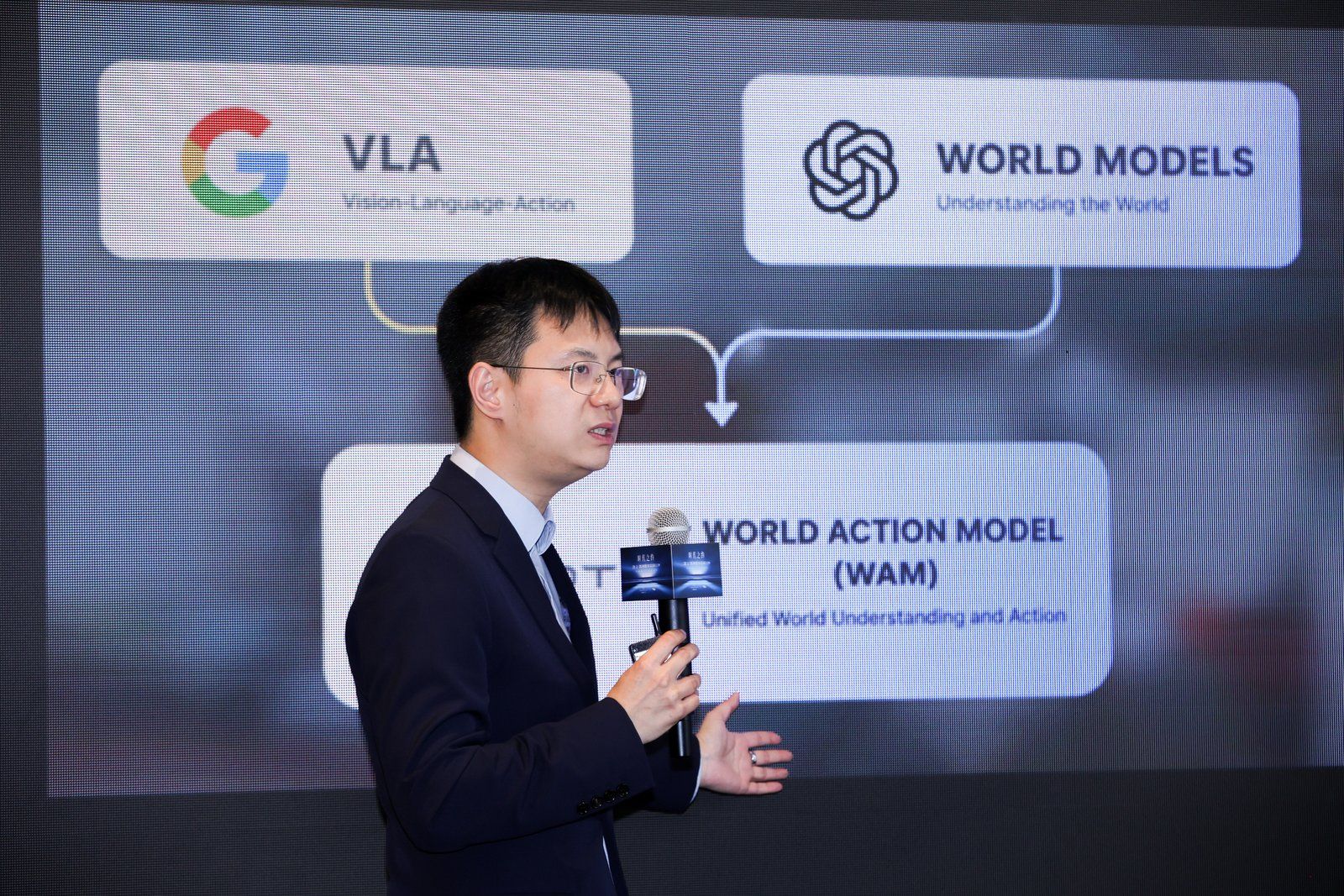
He Wang
He Wang said, "In the past, when robots danced, they needed to extract human trajectories in advance, put them on the robot, learn for the trajectories, and deploy them after debugging. Now our general cerebellum model can make our robot immediately dance the same dance in front of it after a human dances once. The intelligence behind the rapid imitation of street dance athletes' movements even surpasses human ability to master limb movements. Two years ago, this path was not very realistic. But today, it is the optimistic people in our industry, including Galbot, who have built the pyramid of embodied intelligence data, from Internet data to human data, to synthetic simulation data, to data collected by remote-controlled robots, to data returned from robot autonomous operations. This five-layer pyramid is continuously being scaled up to promote the robot's cerebrum and cerebellum to become more intelligent."
Facing these new breakthroughs, Kevin Kelly said: "I think the next big breakthrough will be about actually finally getting robots to work. What we have been working on, there's a huge impact it will have. So that's where some of the excitement goes.
Judgment 2: The underlying cognition of robots is completely different from that of humans
When robots break through the AlphaGo moment, become smarter and more capable, will they compete with humans for ecological niches?
Kevin Kelly reminds: "When we give AI a body, that is, a robot, we need to understand that they are different from us, they are not human." He calls robots "alien intelligence" or "heterogeneous intelligence".
He Wang explained the "underlying" difference between robots and humans: "Robot intelligence is very different from human intelligence with advanced thinking, judgment and reasoning logic. It is an intuitive intelligence. Most of human reasoning and thinking belong to the slow system in the brain, or system two. Human operations belong to the fast system in the brain, system one. The fast system requires a lot of practice to turn abilities into an innate, inadvertent subconscious reaction. It is a very different kind of intelligence from the large model that uses a very complex chain of thought."
In other words, the cognitive combination formed by AI is completely different from that of humans.
He Wang believes that robots will become as intelligent as humans, but "robots are essentially AI, not humans." AI will not pose a fundamental threat to human ecological niches. "Does it have the desire to reproduce? What can robots get from reproduction? It does not have our genes, and there is no mechanism to screen and keep its own genes. Personally, I think many things we imagine today take robots too much as humans, thinking that they will have the desire to replace humans. But I am quite optimistic about the future of robots. Under constraints, they will become human partners."
Kevin Kelly added that in the future, the world of robots will also be diversified. AI products will differentiate into a rich variety of categories, and different products will form differences in pricing, cost, response delay, and output capabilities. Eventually, the entire industry will evolve into a highly complex ecosystem. "In my opinion, this kind of intelligent carrier with physical entities is a low-cost and valuable resource. We will build a society where we work hand in hand with these 'aliens'. AI alone cannot solve all problems, but human + AI has huge room for imagination."
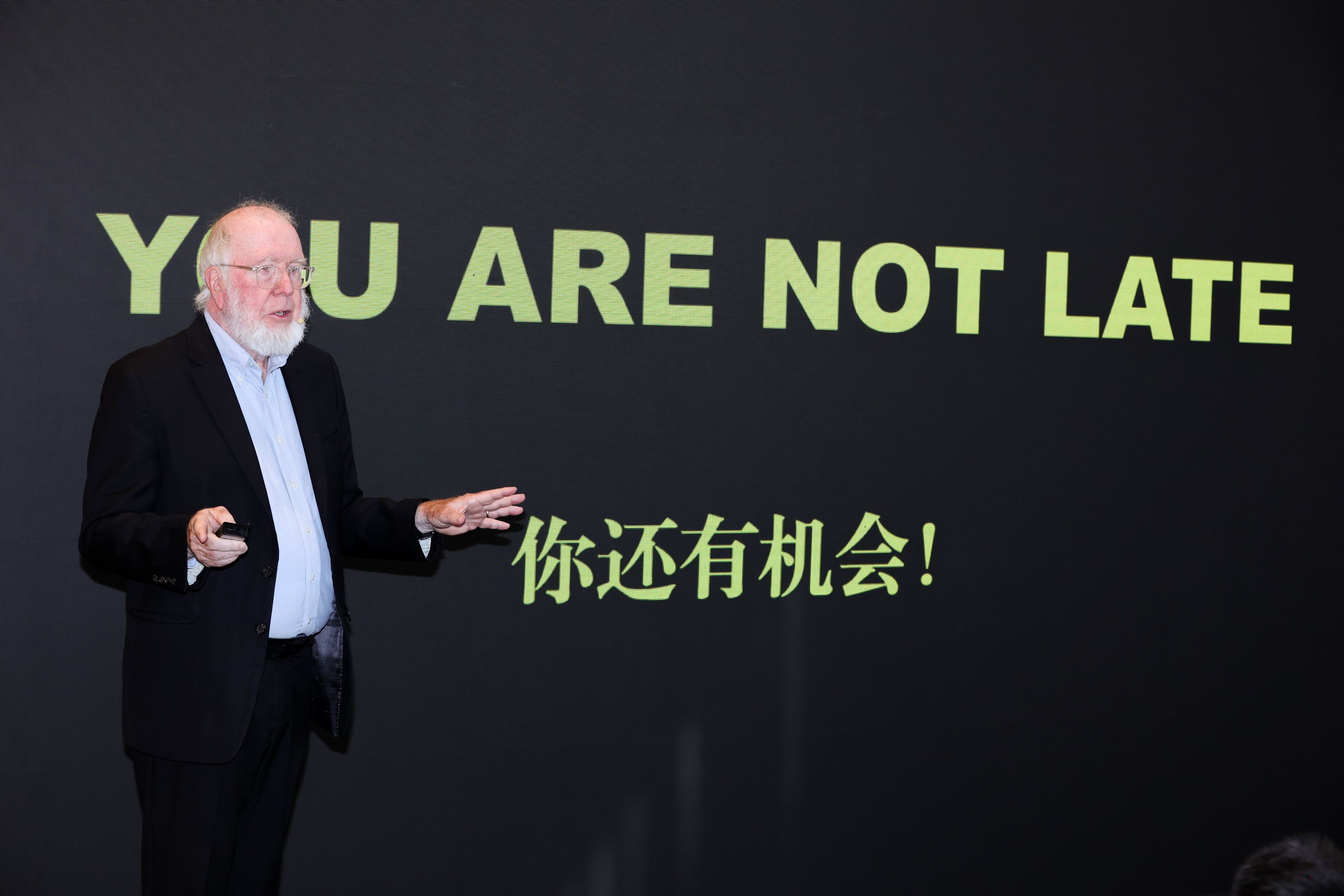
Kevin Kelly
Judgment 3: Token cost is reshaping the survival logic of the AI industry
For robots, optimistic people foresee huge imagination space brought by technological progress. However, there are still two barriers between the reality and the optimistic imagination of the future: First, from the cognitive generalization ability to the real completion of physical interaction in complex environments, robots still need to continue to prove that they know "how to do" and "can do it"; second, the rapid development of AI is currently supported by huge data and computing power investment, and it needs to be cheaper.
Kevin Kelly observed an obvious change in Silicon Valley: In the past, when engineers called models, they rarely accounted for Token costs. It was not until competitors could achieve similar effects at 1% of the cost that the entire industry suddenly woke up. Some complex reasoning tasks consume millions of Tokens at a single time, and computing power overhead will directly rewrite the product business model.
"We are entering an era of huge gaps, and costs will become increasingly critical." Kevin Kelly believes that in many scenarios, price is crucial.
Cost pressure has been transmitted to the venture capital market. Yaqiong Shi, Vice President of Jinqiu Fund, provided a set of industrial observations in the roundtable: Large models have greatly lowered the threshold for AI product prototype development, but the user acquisition threshold has risen sharply. From 2022 to 2026, AI applications have grown by about 17 times, and the customer acquisition cost of AI products has generally increased by more than 50%.
Who can take the lead in the competition? Technical capabilities, as well as first-mover advantages based on cost and scale, are very important. In the past, the industry spread the hypothesis of the Jeans Paradox: when the cost is reduced by ten times, the usage scale increases by ten times. But Yaqiong Shi believes that the reality is far more radical than the theory. The expansion of usage brought by AI is not a hundred times. In the code generation scenario, the per capita code output has seen a ten-thousand-fold increase. "This has brought many changes, allowing us to reassemble business logic in a coding way."

Yaqiong Shi
In the embodied robot track, the cost logic will change further. He Wang said that text large models can tolerate a certain reasoning delay, but humanoid robots and autonomous driving belong to strong real-time edge systems. Completely relying on cloud calls to Tokens is extremely risky. Exceeding the network and reasoning delay standards may cause robots to fall and cause operation accidents. Cloud-edge-end hybrid deployment will become an inevitable choice for the industry.
Judgment 4: AI creates a world without upper limits
Investors who have experienced the mobile Internet cycle tend to directly apply Internet experience to the AI track. Qingsheng Zheng, Partner of HSG, warned at the roundtable: this reference framework has failed.
In the mobile Internet era, there are hard constraints on industry growth, and the ceiling comes from the total human attention. The physical world changes slowly, and cities and production modes will not undergo subversive reconstruction for decades. No matter how iterative the Internet is, its essence is to distribute in the fixed human time pool, and there is a clear boundary for the total user duration.
But AI is breaking this set of growth logic, and it is creating a world without upper limits. Qingsheng Zheng compares AI to basic energy sources such as steam and electricity, but it is essentially different from all the energy revolutions in history.
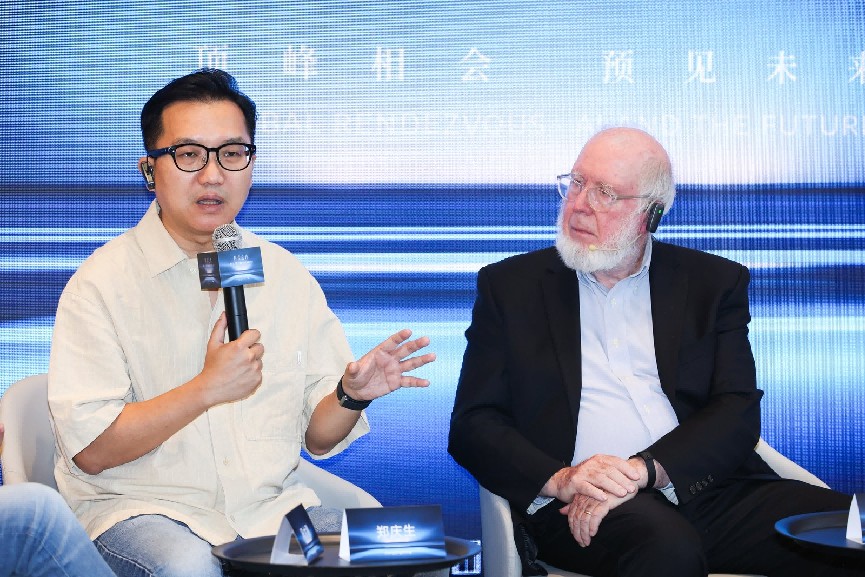
Qingsheng Zheng, Kevin Kelly
Traditional energy is constrained by mineral reserves, installed capacity, and transmission networks, and there is a clear physical upper limit for supply. The core raw materials of AI are computing power and data, which can theoretically continue to expand. We can schedule thousands of AI Agents to perform tasks in parallel at the same time.
"Oil and electricity have upper limits, but I don't think AI does." Qingsheng Zheng said that AI can not only act as the energy itself, but also create itself, with the ability of self-proliferation, which has never appeared before.
Judgment 5: Technical risks need to be digested by new technologies and systems together
With the increase in the shipment of humanoid robot hardware, the division of safety and responsibility has changed from theoretical discussion to an urgent practical issue in the industry.
He Wang took the deployed pharmacy robot as an example: in deterministic closed scenarios such as factories and pharmacies, the power and responsibility are relatively clear. Galbot has deployed nearly 100 robot pharmacy points in China, undertaking the work of taking medicine at night. To avoid the risk of wrong distribution of medicines, the team did not completely rely on the general reasoning of the large model, but added an additional deterministic verification program. The medicines must complete triple verification of text, image and barcode at the same time before they are allowed to be packaged and out of the warehouse. In the past year and a half, nearly a million boxes of medicines have been processed cumulatively, achieving zero wrong distribution. In such scenarios, if the robot failure causes losses, the responsible subject points to the manufacturer.
The family is a completely open and complex scenario, full of unpredictable interference factors, and the risk complexity has multiplied. The robot may knock over the water cup and cause a short circuit and fire, and the accident may even occur when no one is at home. The robot is still unable to independently handle the chain consequences brought by the accident, which is the core reason why the industry will not sell unattended humanoid robots to ordinary families at this stage.
Kevin Kelly believes that in the short term, AI companies must assume corresponding responsibilities, and can also support supporting insurance mechanisms. Conversely, AI companies that can survive must be companies that can handle the responsibility problem well.
But solving the problem does not mean not allowing problems to occur. He Wang proposed that absolute safety does not exist. Even today, there are still air crashes for airplanes, but it does not prevent it from becoming the mainstream long-distance travel tool. Humanoid robots will most likely follow a similar path. Allow trial and error within a controllable range, reduce the accident probability by continuously handling extreme cases, and solve problems by clarifying responsibilities, establishing mechanisms, and making technological progress. In some scenarios, it is necessary to allow robots to continuously touch things like children, continuously improve their learning ability, and converge the probability of problems.
Judgment 6: Optimists create the future
The whole dialogue