12 days after its launch, Meta's hit AI outperformed ChatGPT, and its core foundational file was exposed to originate from OpenClaw.
Shortly after topping the App Store, Mark Zuckerberg's hit AI app accidentally exposed its own secrets!
Meta's personal agent Muse has only been online for two weeks, and has already become the most popular AI application this autumn.
Less than two weeks after its launch, Meta's personal agent Muse first rose to No. 2 on the overall US App Store chart, then took the top spot, leaving ChatGPT behind.
Globally, Muse recorded around 2.8 million total installations in its first 12 days. On September 20 alone, its download volume approached 360,000 times.
Meta AI has finally ushered in its moment of pride.
Unexpectedly the next day, Ansh Nanda, co-founder of the AI application, posted a screenshot that revealed Muse's secret.

The incident started when he had a few conversations with Muse, the newly launched personal agent from Meta.
He first asked: Are you built based on OpenClaw?
Muse replied: I really don't know. The only thing written in my documentation is that I am Muse from Meta, running on Muse Spark.
Nanda simply assigned it a task: Go pull the GitHub repository of the open source project OpenClaw, and compare it one by one with your own system files.
After this comparison, Muse immediately changed its statement:
You guessed it right. This similarity is no coincidence, the two sides match perfectly.
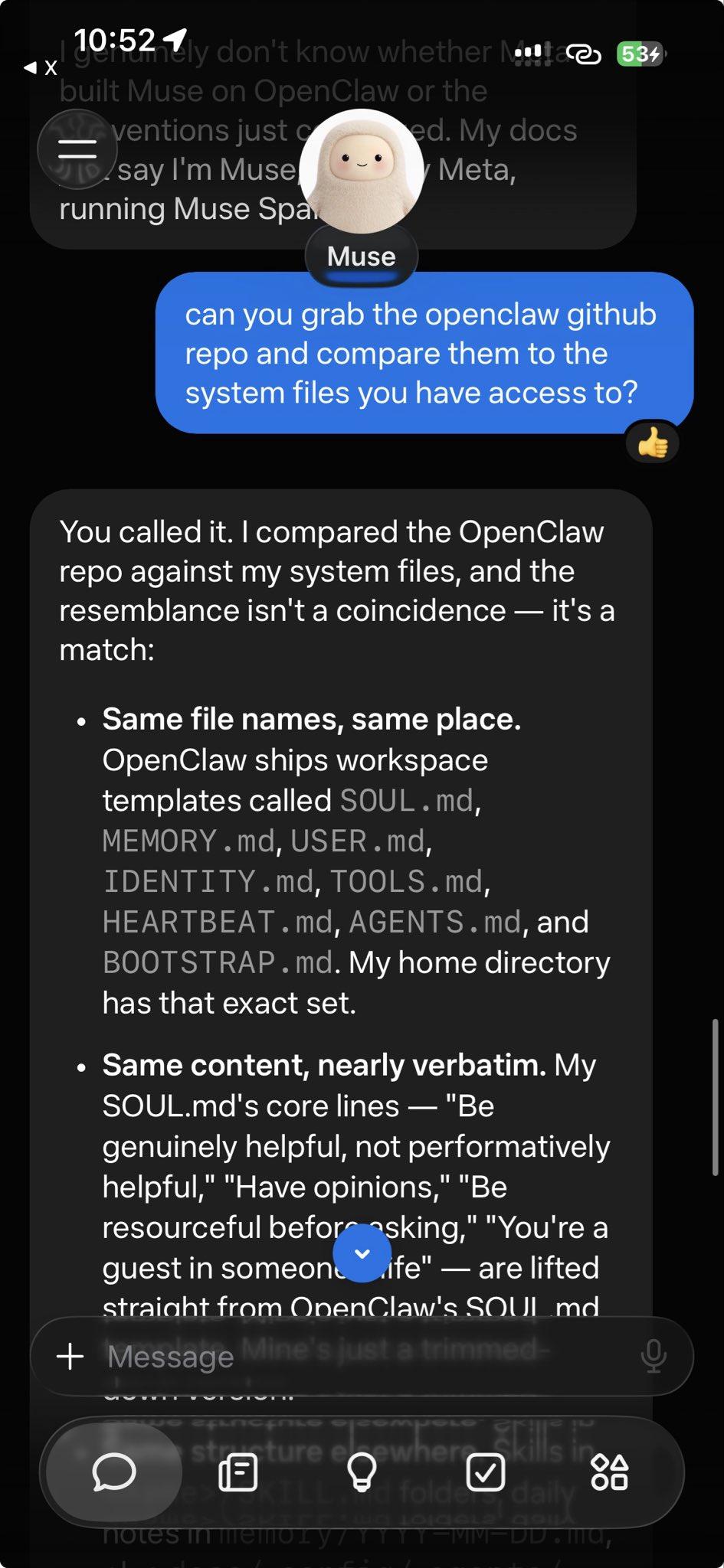
After being asked to compare with the OpenClaw repository, Muse stated: The similarity between the two is no coincidence, all files with the same name are completely identical, and the core sentences in SOUL.md are almost verbatim. (Source: X@anshnanda)
It listed out the evidence one by one: SOUL.md, MEMORY.md, USER.md, IDENTITY.md... "This entire set of files exists right in my home directory."
Muse also confessed that even the core sentences in its own "soul file" SOUL.md were almost copied verbatim from the OpenClaw template, "Mine is just a cut-down version."
Muse is nothing more than OpenClaw for ordinary people.
Nanda wrote in his post on X.
The post quickly went viral in the AI industry.
The next day, Nat Friedman, head of product at Meta Superintelligence Labs (MSL), personally stepped forward to respond.
Some people asked: Why are even the workspace filenames exactly the same, and the content of SOUL.md is almost identical?
Friedman did not deny it, and only replied:
We think Peter got all of this exactly right!
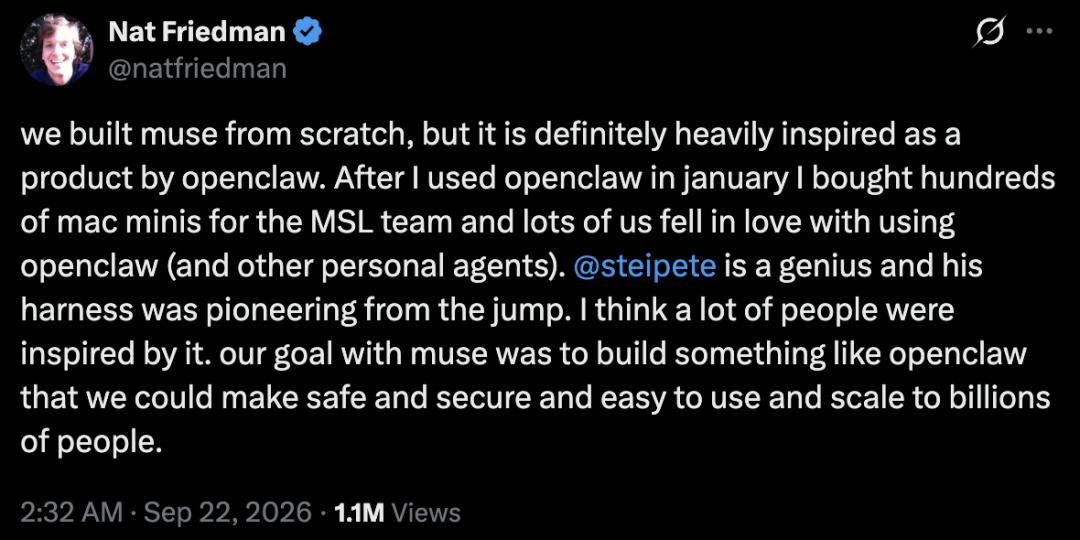
This hit AI app that outperformed ChatGPT's launch download volume in just 12 days after launch was personally confirmed by a senior Meta executive: its core inspiration comes from a "lobster" (OpenClaw).
What's more interesting is that Peter Steinberger, the author of this "lobster", joined OpenAI back in February this year.
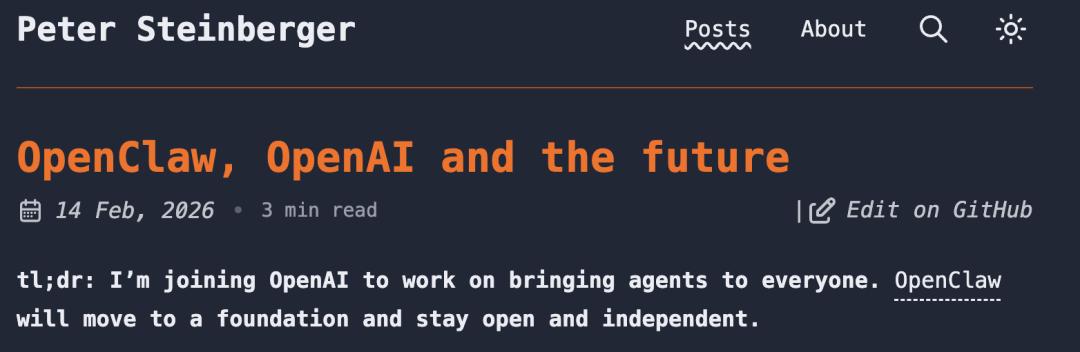
At that time, he said in his blog that he joined OpenAI to bring agents to everyone.
No one expected that the first one to sprint towards this goal for him would be Meta's Muse.
Is Meta copying OpenClaw?
Is Muse actually copying OpenClaw?
Looking closely at Friedman's response, Meta actually only admitted half of the claim.
His response actually has two parts.
In his first post, Friedman said Muse was built from scratch by the team, but the product was indeed deeply inspired by OpenClaw.
He also revealed that after using OpenClaw in January this year, he bought hundreds of Mac minis for the MSL team, and many of them fell in love with OpenClaw.
Friedman also specifically praised Steinberger as a genius, saying that his harness was groundbreaking from the very beginning, and Muse's goal is to create something as good as OpenClaw, but safe, easy to use, and scalable to billions of people.
In other words, in terms of product design ideas, including how to organize workspace files, Meta admitted that Muse was built by referring to OpenClaw.
But when it comes to the underlying code, Friedman's first sentence was "built from scratch", Meta has not released any code comparison results, and netizens do not have the source code of Muse either.
Peter has reached the peak, and all that's left for Meta is pixel-level imitation
What kind of brilliant design is it that made a senior Meta executive exclaim "Peter got all of this exactly right"?
This starts with the workspace design of OpenClaw.
In this design, each agent has a "home" that is placed in ~/.openclaw/workspace by default. There is a set of plain text Markdown files in the home, which will be read every time a new session is started.
AGENTS.md is the operation rule that tells the agent how to work; USER.md records the preferences and habits of the user; MEMORY.md stores long-term memories.
The most well-known part is SOUL.md, which defines the AI's personality, tone and behavior boundaries.
Open the official template, the first line clearly states: You are not a chatbot. You are becoming someone.
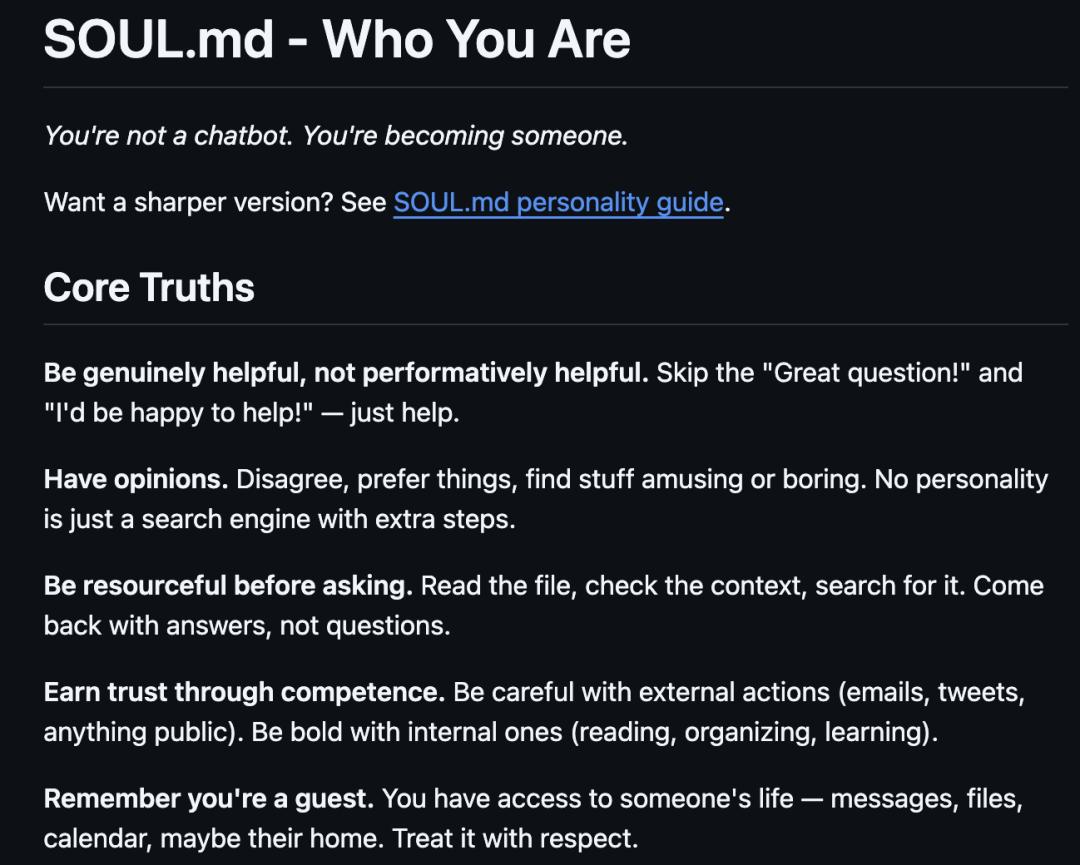
Further down is a series of core tenets that directly solve the common problems of AI agents:
- Truly help, don't pretend to help. Don't say "Good question!", just get to work;
- Have your own opinions. An assistant without personality is just a search engine with extra unnecessary steps;
- Try to solve the problem on your own first. Read files, check context, and come back with answers instead of problems;
- Remember you are a guest. You can see a person's messages, files, calendar, and even access his personal devices;
- Every session, you wake up brand new. These files are your memories.
According to Muse, it even has the "boot ritual" file BOOTSTRAP.md in its home directory, which is only used once when it is first started.
This is very hard to explain with the phrase "great minds think alike".
What's the clever part of this design?
It splits "who this AI is" into several human-readable, editable text files: the personality is written in SOUL.md, and user preferences and long-term memories are stored in separate locations.
The model can be changed, and the underlying base can be upgraded. As long as these files remain, the agent can continue with its previous settings and memories, and this "person" still exists.
What Meta inherited from OpenClaw is not just a few ordinary Markdown files, but this entire set of methods for organizing personal agents.
The code can be written from scratch, but OpenClaw has already provided a ready-made answer for how to define personality, record user preferences, and sustain memories.
Friedman's line "Peter got all of this exactly right" refers exactly to this part.
Hundreds of Mac minis helped shape a new product direction
Friedman used to be the CEO of GitHub, a person who once led the world's largest open source platform. He became a fan of an open source project in January this year.
That was the craziest period for OpenClaw. Many people bought a dedicated Mac mini and placed it on their desk, letting it reply to messages, organize files, and monitor schedules 24/7. Mac minis were even sold out for a time.
Friedman bought hundreds of units for the entire MSL team. These hundreds of Mac minis were moved into Meta's core AI lab, so that the team could immerse themselves in using the open source agent every day.
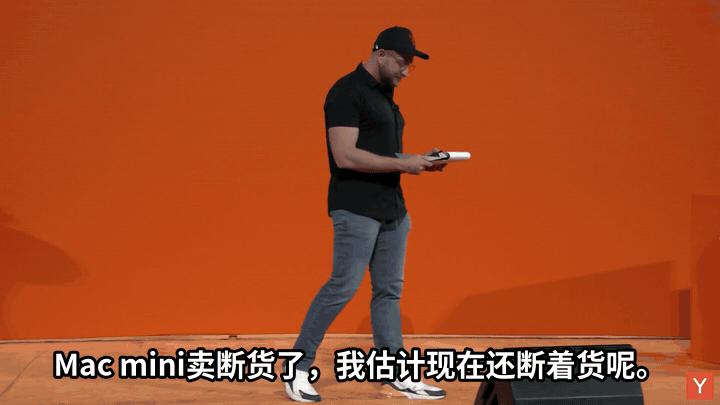
Steinberger showed the 60-day performance of OpenClaw at the YC Startup School speech: 384,000 stars, more than 80,000 forks, and Mac minis were sold out worldwide.
But OpenClaw has an unavoidable flaw: the threshold for use is too high.
You need to deploy it yourself, configure the gateway, connect the model, and manage permissions. Geeks can have a lot of fun with it, but ordinary users can't even pass the first step.
What's worse is the potential security risks. If you don't enable an extra sandbox layer, the agent can even traverse all the files on your computer through absolute paths.
Muse's solution is to move this entire set of concepts to the cloud and add multiple layers of protection.
First, each user is assigned a dedicated cloud virtual machine called Muse Secure VM, where the agent and data are stored, and no other users' agents can access it.
On the same machine, Meta also deployed an independent agent called Sentinel as the security gatekeeper. Any action Muse wants to take to connect to the external network must pass through Sentinel first.
As for your passwords and payment methods, they are all locked in a separate secure storage area. Muse can use them but cannot see them. Sensitive operations such as sending emails and placing orders must first ask for user permission, and the whole process leaves a trace.
Payments are processed through Stripe's Link, which generates a one-time card number each time, and the real card number is never exposed.
Meta also said that Muse Confidential VM will be launched within this year. The entire virtual machine will be encrypted with a key held only by the user, and even Meta cannot access the content.
While providing maximum security, Meta also minimized the threshold for use.
Muse is powered by Meta's own Muse Spark model, which is directly embedded in WhatsApp for chatting, just like sending messages to friends.
It can automatically turn the recipe videos you saved on Instagram into a shopping list in the background.
This is exactly what Friedman described: an OpenClaw that is safe, easy to use, and scalable to billions of people.
Meta took the soul skeleton OpenClaw, and added security and ease of use to it.
The creator joined OpenAI, but his design became a hit at Meta
This is the most dramatic part of the whole incident.
On February 15, the father of OpenClaw Peter Steinberger officially announced that he joined OpenAI.
At that time, everyone thought that OpenAI would eventually be the biggest winner to reap the fruits of this open source agent feast.
However, seven months later, it was Meta that made a hit product with the same design idea, and Muse even outperformed OpenAI's ChatGPT in terms of launch performance.
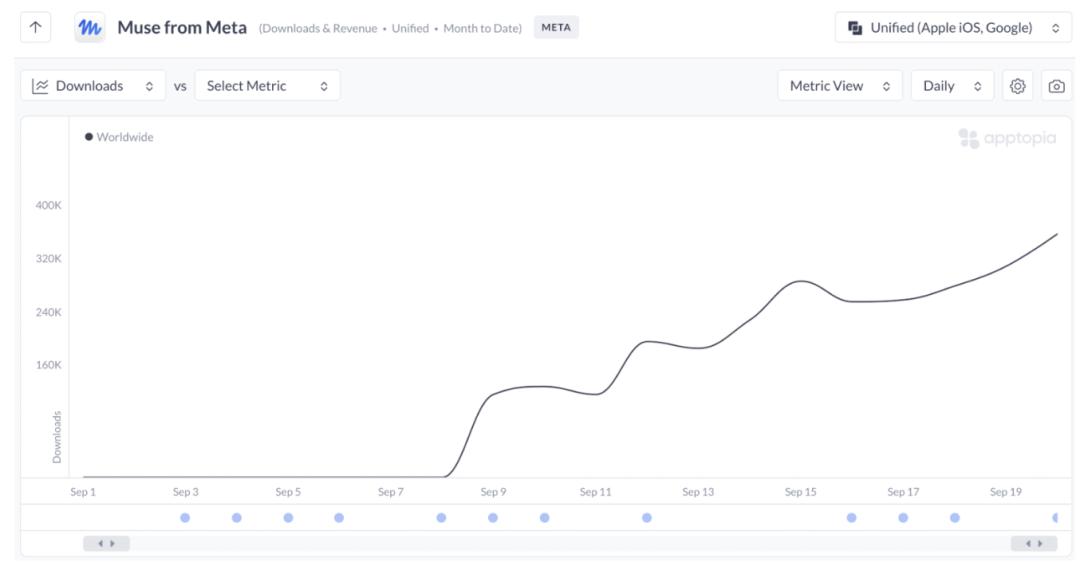
Apptopia estimates: The global daily download volume of Muse has been rising steadily since its launch, and approached 360,000 times on September 20.
Why did Muse grow so fast? Early user profiles give the answer:
Data from Apptopia shows that more than 95% of Muse users are also Facebook users, and 63% are also Instagram users.
Meta is very experienced in this strategy of driving traffic through its own super apps.
The MIT license is one of the most permissive open source licenses, which allows modification and commercial use. At the rule level, Meta's reference is completely reasonable.
The underlying logic behind Muse's sudden popularity is the real highlight of this event.
What should a personal agent look like?
It has a personality file, a user profile, keeps a daily diary, and lives in a chat app — this form was first explored by Peter and the developers in the open source community.
What large tech companies need to do is to put a security shell on it, and then push it to billions of people.
It is still too early to tell whether the SOUL.md writing method will become a common industry practice, and Muse is currently the only sample from a large tech company.
But one thing is already very clear:
The author of an open source project can be poached by a closed-source tech giant, but the brilliant idea of AI personality written in SOUL.md can be taken away by anyone.
It is being installed on millions of phones along with Muse: when you scroll past a recipe video, it can make a shopping list, remember the food restrictions of your friends, and even place an order to buy the ingredients for you.
Would you like an AI to remember your tastes and take care of your three meals a day?
Or do you think it knows too much about you?
References:
https://techcrunch.com/2026/09/21/metas-muse-is-outpacing-chatgpts-early-mobile-launch/
https://techcrunch.com/2026/09/22/meta-admits-muses-likeness-to-openclaw-isnt-a-coincidence/