Just now, ChatGPT has gained the ability to "speak and get things done".
You may no longer need a keyboard for work in the future.
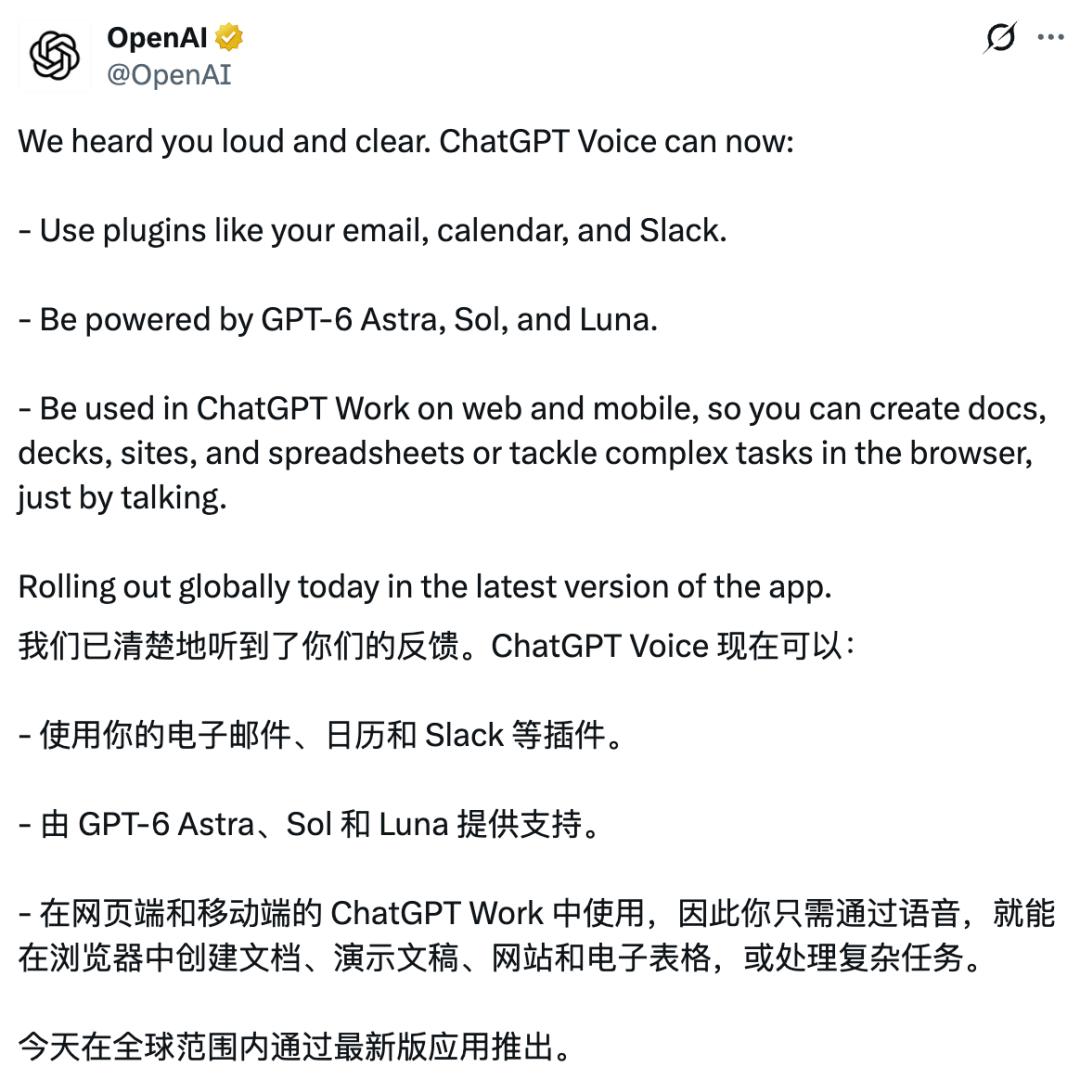
Just today, OpenAI dropped a bombshell.
ChatGPT's voice mode, which used to only talk, can take practical actions from this moment on!
Check emails, reschedule meetings, make PPTs, build websites, and even write letters to get back duplicate subscription fees you were overcharged. You only need to speak up.
The pace of the AI industry this week is incredibly fast.
The day before, Anthropic just released Claude Opus 5.5, and about 90 minutes later, OpenAI launched GPT-6 Sol and Luna, cutting the calling price directly in half.
While everyone was still calculating the cost, OpenAI immediately integrated the entire GPT-6 family into the voice function.
The new version of the App is rolled out globally starting from the same day.
Some netizens commented below: I've been wanting this feature since last month.

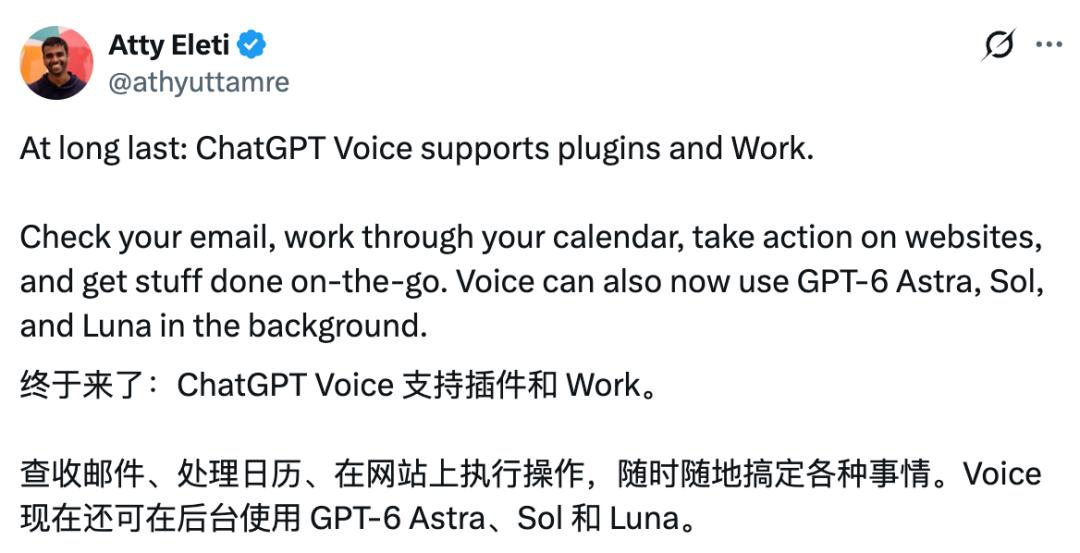
Atty Eleti, Head of ChatGPT Voice, posted three words when reposting: At long last. We've finally got it.
Capable of independent operation, upgraded with new model, and fully adapted to office scenarios
A closer look reveals that ChatGPT Voice has more than just a new model this time.
New capabilities: Plugins are now integrated into the voice mode. Users have been looking forward to this for a long time. The previous Voice function was only a chatterbox that could talk to you for an hour, but if you asked what time the meeting would be tomorrow, it could do nothing to help.
Upgraded core: The three models of the GPT-6 family are all deployed in the background.
Astra, the most powerful one, is best at operating computers and handling complex multi-step tasks; Sol is in the middle, responsible for reasoning; Luna runs the fastest with the lowest cost.
The dedicated GPT-Live model for real-time voice chat still handles your real-time conversations, while the GPT-6 models process complex tasks in the background.
Free users can also use these features: plugins are available in voice mode, and the Luna model can be used on the desktop side.
Fully adapted to office scenarios: Voice function is connected to ChatGPT Work.
Work is the Agent launched by OpenAI in July.
Just give a command on your phone, and it will create spreadsheets, make PPTs, build websites, or even run operations on the browser on its own; after you hang up the call, the unfinished tasks will be converted to text and continue to be processed.
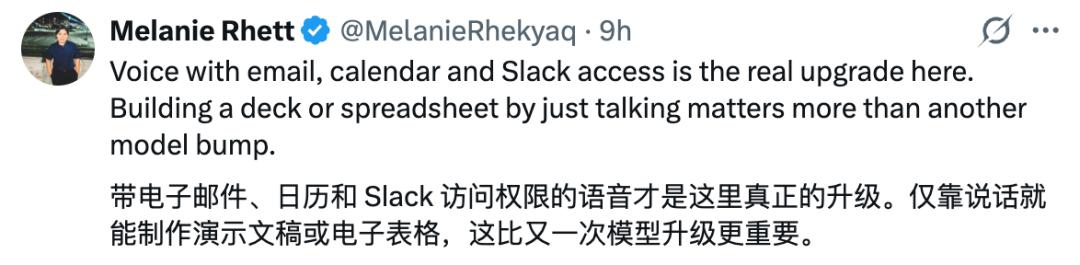
A netizen's comment is very to the point: No matter how much the model version number increases, it is not as good as letting it actually access your emails, calendars and Slack, and generate a PPT as soon as you speak. That's a real upgrade.
Now that we've covered all the features, who does OpenAI want to target as users? The answer is hidden in its promotional video.
The protagonists of the promotional video are a group of elderly women
This ChatGPT Voice promotional video is only 125 seconds long, and you can hardly see anyone writing code from start to finish.
Most of the protagonists are elderly women: some are kneading dough in the kitchen with their phones placed on the countertop; some are shaping pottery with their hands covered in mud; others are sitting in a beauty salon with hair curlers on their heads.
All of them have their hands occupied, so they can just speak to operate.
The demonstration is also very down-to-earth.
ChatGPT finds that a magazine has charged you twice, cancels the duplicate subscription, and writes an email to apply for a refund. Then another user asks it to build an online store for selling pottery, and it even sets up the checkout page.
In the past, you would have to switch between three different apps for the whole process, and go through countless emails until you get dizzy.
Now, it's just a matter of one sentence.
Of course, there are still some problems for sure.
The first one is approval. According to the rules of the help center, for sensitive operations such as sending emails, you need to click confirm on the screen in person, and a verbal "yes" does not count.
I totally agree with this rule. If the voice misrecognizes a name, the email may be sent to the wrong recipient's inbox.
The second one is the usage limit. Plus members only have 3 hours of voice usage within 24 hours, while the $200 Pro tier has unlimited duration. When you give commands in Work, the voice duration is counted on one hand, and the task usage is counted on the other, both are deducted at the same time.
The competition for user entrance has reached the voice interaction field
It is obvious to see what OpenAI is trying to do.
In the past, to use AI, you had to learn to type to ask questions, and then copy and paste the answers one by one after getting them.
What OpenAI wants now is that you just say a casual sentence, and it will run between emails, calendars, spreadsheets and web pages on its own.
Three weeks ago, when GPT-6 Astra was released, everyone focused on its 98% score in top-level math tests, and the sentence from OpenAI President Brockman that "Welcome to the AGI era".
This time OpenAI is thinking about another thing: now that the model is so smart, can people who are too lazy to type directly assign tasks to it?
OpenAI is not the only one competing for this entrance.
Ten days ago, the new Siri integrated with Gemini was launched along with iOS 27. OpenAI said in July that more than 150 million people are using voice or dictation to interact with ChatGPT, but its own hardware will not be available on the market until next year at the earliest.
At the moment, the mobile phone is the device closest to your mouth.
The elderly women in the video probably will never open Codex in their life, nor figure out how many tiers GPT-6 has. But they know how to speak.
Reference: https://x.com/OpenAI/status/2102808325742322002
This article is from WeChat official account AI Era, author: ASI Revelation; editor: Solomon, published by 36Kr with authorization.