Tesla's third-generation robot is suspected of being accidentally leaked.
Tesla's third-generation humanoid robot Optimus, which has not yet been officially released, is suspected to have first revealed its outline in its own mobile app.
On September 23, media outlets including Tesla North and Drive Tesla reported that a set of robot images marked with "gen3" appeared in the installation package of Tesla's Android app. The robot in the images adopts a gold and black color scheme, with some of the previously exposed mechanical structures covered, and the appearance changes at the hips and legs are particularly noticeable.
The exposed content this time is the rendered images inside the application. As of September 24, Tesla has not confirmed whether these images correspond to the final hardware design of the third-generation Optimus, nor has it made a public statement on this discovery.
According to Drive Tesla, the relevant images were first shared by the X platform account Whole Mars Catalog, and the original post was later deleted. With reposts from other accounts and developers' verification of the installation package, the source of this set of images has gradually become clear: they come from the Android application resources publicly distributed by Tesla.
Ming, a developer who has long tracked Tesla's software updates, said he independently confirmed three relevant images in the 4.60.5-4573 version. The file names contain marks such as close-up, full body and inactive state respectively, and all names include "gen3". Among them, the full-body image is named "robot_home_full_body_gen3.png", and this naming has become the direct basis for the outside world to associate the images with the third-generation Optimus.
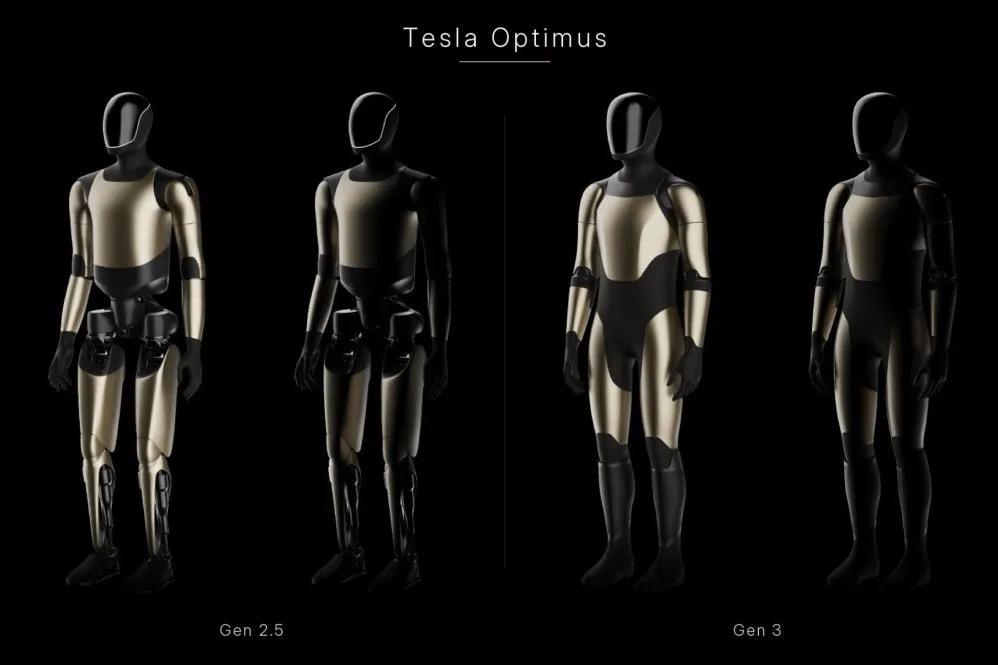
These images have actually existed in the App for some time. After comparing multiple historical versions, Humanoids Daily, a robotics media, found that the resources marked with "gen3" first appeared in the version released on August 27, and higher-resolution images were updated on September 5. The set of images did not change again in the version of September 22.
Judging from the public comparison images, the new design inherits the overall outline of Optimus, but the body is more fully covered. Additional covering structures are added to the hips, more black outer covers appear on the knees and calves, and some of the connecting rods and mechanical components that were more prominent in the previous gold-colored version are covered. The surface of the torso also looks more cohesive.
This makes the new design visually closer to a fully encapsulated product. However, the changes presented by the images are mainly concentrated on the exterior: how the actuators under the shields are arranged, how heavy objects the robot can carry, and how precise operations its hands can perform cannot be judged from the rendered images.
Humanoids Daily also pointed out that the relevant files are located in the "assets/mock" directory of the application. This means they may still be used for interface development or placeholder display. The fact that the resources are packaged into the App proves that Tesla has used this set of materials in its software, but it is not enough to confirm when the robot control functions will be opened to users.
The reason why the third-generation Optimus has attracted widespread attention is related to the mass production positioning that Tesla has set for it.
In the Q4 2025 performance materials released in January this year, Tesla defined Gen 3 as the first Optimus designed for large-scale production. The company stated at the time that this version will be significantly upgraded compared to the 2.5 generation, including the adoption of a new hand design, and it is planned to be officially unveiled in the first quarter of 2026.
The hand is precisely the development priority that Elon Musk has repeatedly emphasized. At the earnings call on October 22, 2025, he said that to enable robots to perform general-purpose tasks, hands with human-level dexterity are required. From the perspective of electromechanical design, the hands and forearms of Optimus are even more difficult to develop than the rest of the body. He described the new hand design as "an amazing engineering achievement", and said that even after production starts, the hardware design will continue to iterate.
Musk gave a more specific description of the capabilities at the earnings call on January 28. He called Optimus 3 a "very capable robot" that will be able to learn tasks by observing human behaviors. According to his vision, people can demonstrate on site, give verbal instructions, or provide a video to let the robot learn and perform the corresponding work.
However, the release schedule in the first quarter was not fulfilled. At the end of March, Musk responded to the progress on X, saying that Optimus 3 was already able to walk around, but some final improvements were needed before public display. At that time, he did not give a new specific release date.
At the Q1 earnings call in April, Musk explained another consideration for delaying the display: competitors will analyze every frame of the content released by Tesla and imitate the designs in it as much as possible, so the company hopes to announce new technologies when it is closer to production. Since then, the long-awaited full official release has not arrived, and this exposure of images in the App has provided new clues about the appearance.
At the same time, Tesla has planned a large-scale manufacturing space for the robot. The company disclosed in the Q1 2026 performance materials that the original Model S and Model X production lines at the Fremont factory will be replaced by Optimus production lines with a designed annual capacity of 1 million units; the Texas Gigafactory is also preparing for subsequent production lines, with a long-term planned annual capacity of 10 million units.
These two figures reflect the production line planning, and cannot be regarded as the actual output that has been achieved. Tesla also clearly stated in the same document that the installed capacity is not the same as the actual production speed, and factors such as equipment operation and parts supply will affect the output.
Musk has also reminded that the ramp-up of Optimus' production will take longer. He said at the earnings call in January that this robot requires the establishment of a brand new supply chain, and the manufacturing progress will be constrained by the slowest link. Therefore, the process from starting production to expanding output will be longer than that of products that can reuse part of the mature supply chain.
For the third-generation Optimus, the appearance, functions and manufacturing progress still need to be verified separately. This exposure supplements the appearance information, but does not provide the selling price, delivery arrangement or the actual operation data of the new generation robot. At the official debut, Tesla still needs to demonstrate the upgraded hands and the overall performance of the whole machine, as well as how this robot designed for mass production will enter real work scenarios.
This article is from the WeChat official account "Core Smart Headline", author: Time, editor: Mark, published with authorization from 36Kr.