Domestic open-source models are becoming a new business for Silicon Valley cloud vendors.
On September 18, Amazon Web Services officially announced that its large language model service platform Bedrock has officially hosted Kimi K3. It is not a new thing for domestic models to be launched on overseas cloud platforms. However, as an open-source model, Kimi is indeed the only one that has made American cloud manufacturers willing to "pay" for its services.
Not only Amazon, but also Microsoft and Google, the other two major cloud vendors in the United States, are negotiating cooperation with Kimi. In addition, as we know, Zhipu AI and MiniMax are also seeking cooperation with overseas cloud vendors, hoping to accelerate the promotion of overseas enterprises to use cheap and easy-to-use AI models.
This also means that domestic open-source models targeting overseas developers and entrepreneurs have the opportunity to enter large overseas enterprise customers and share the dividends of enterprise AI. Amazon Web Services also previously said that in addition to hosting K3, the two sides will jointly build industry solutions to solve the business and personalized integration problems in the last mile of enterprise AI.
The specific cooperation method has not been publicly disclosed for the time being. However, the "Moon Landing Project" released by Moonshot AI on September 10 has made it clear that in solving the last-mile problem of enterprises, Kimi and its integration partners will jointly build an FDE (Forward Deployed Engineer) team to go deep into the customer site.
However, Kimi is only responsible for the model capabilities, and all other parts are handed over to partners. This open ecosystem approach is different from the model manufacturer self-built FDE model that was popular in Silicon Valley before. In the past ten weeks, many giants in Silicon Valley, including Anthropic, OpenAI, and Microsoft, have invested nearly 100 billion US dollars in total to form FDE teams to promote the implementation of enterprise-level AI on site.
The originally undervalued position has suddenly become very popular. Anthropic even offers an annual package of 780,000 US dollars to seize the dividends of enterprise AI implementation.
In the process of seizing the implementation of enterprise-level AI, why has K3 suddenly become so popular? Why have cloud vendors that were deeply bound to Anthropic or OpenAI models in the past turned around to support a Chinese open-source model?
01
K3 tore a gap in the market
Throughout July and August, the AI circle in Silicon Valley was permeated with a subtle emotion.
On August 22, Rauch, CEO of Vercel AI, an AI model routing company, posted a post on X: "This may be a record-breaking day for the token call volume of open-source models." In just two months, the token usage of open-source models has soared from less than 30% to more than 60%, surpassing closed-source models.
Rauch also hinted that this may just be the beginning. Because enterprise-level AI adoption is still in its early stage, when operating frameworks (harnesses), command-line tools (CLI), integrated development environments (IDE), software development kits (SDK) and other tools are all adapted to the model transformation, the switching cost will decrease, and the cost advantage of open source will be released at an accelerated pace.
Vercel AI is mainly targeted at developers, start-ups and technical teams. Although the change in their token consumption cannot be equated with the whole industry, it seems to send a signal that the explosive growth of open-source models has already begun. Especially when the performance of open-source models gradually approaches that of closed-source models, it may break the entry card position built by cutting-edge models.
The most concerned among open-source models are still domestic models. According to the data from Hugging Face's 2026 Spring Report, Chinese open-source models account for as high as 41% of total downloads. The data of developers voting with their feet shows that Kimi K3 had 2.01 million downloads in August, GLM-5.3 had 970,000 downloads, and DeepSeek V4Pro had 560,000 downloads.
Kimi K3 was officially launched and open-sourced on July 16, with a 1 million token context window and native visual capabilities. It is also the world's first open-source 3T-level model.
A number of independent evaluations such as Artificial Analysis have included K3 in the world's first echelon, and only three closed-source flagship models, Claude Opus 5, Claude Fable 5 and GPT-5.6 Sol, are ranked ahead of it. In the actual test of front-end development (Code Arena) on Arena, K3 topped the list with a 76% winning rate, surpassing closed-source products.
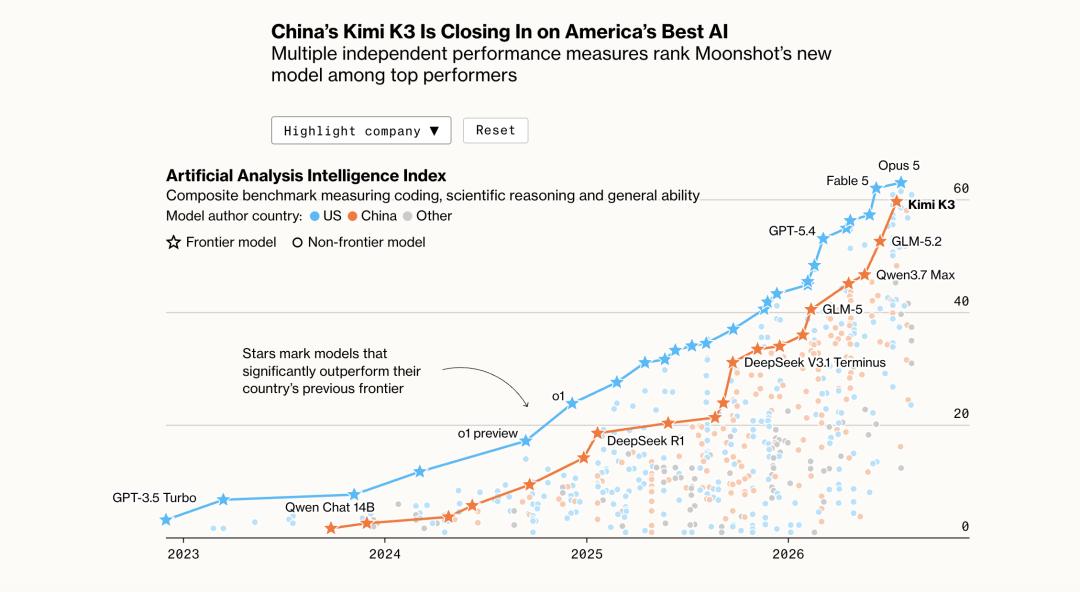
Photo / Bloomberg
The shock brought by K3 is not limited to approaching the performance of closed-source models with lower cost advantages. Some entrepreneurs have begun to do post-training, fine-tuning, and build various vertical models based on K3's open-source model. Cursor, the world's most expensive AI Coding tool, released its programming model Composer 2 in March this year, which was post-trained based on Kimi K2.5. Harvey, a Silicon Valley legal AI company with a valuation of 15.5 billion US dollars, post-trained its first self-developed model Harvey Tenet based on K3.
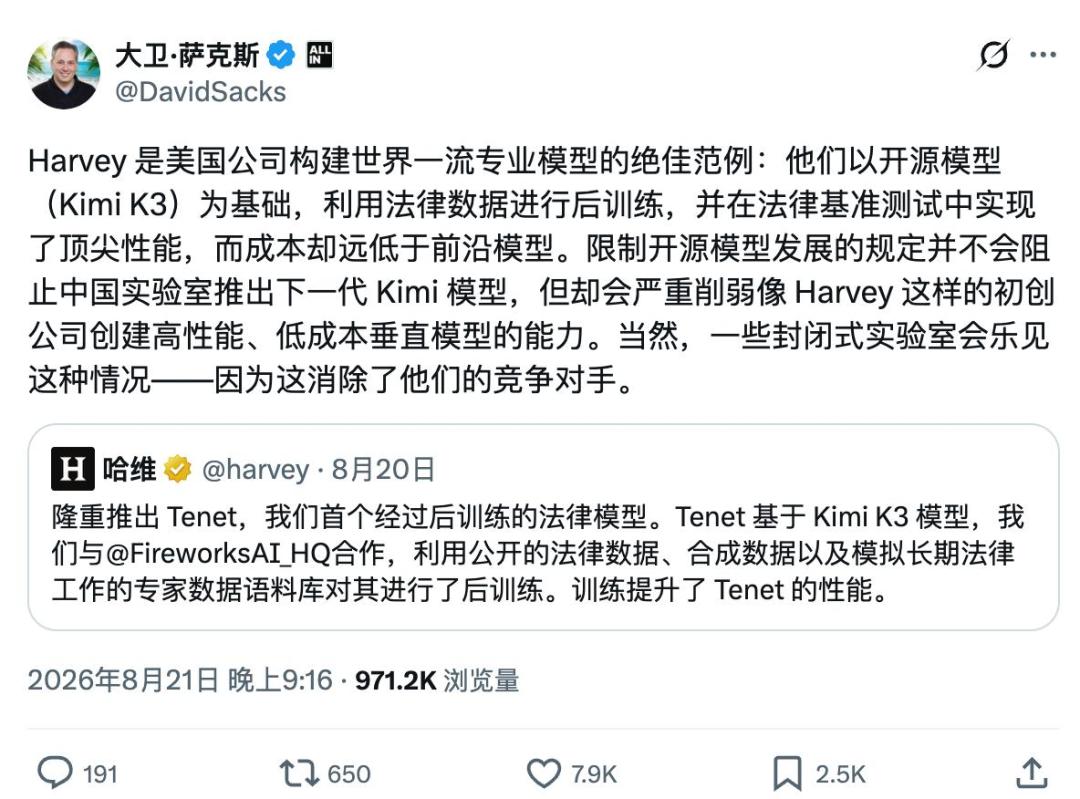
Investors in Silicon Valley have stated one after another that open-source models such as K3 are conducive to the ability of start-ups to build high-performance, low-cost vertical models.
Gavin Baker, an American tech investor, said, "Kimi K3 may be an important inflection point for AI. It is a potential negative for Anthropic and OpenAI, but a net positive for almost all other companies in the world."
Open-source models have actually lowered the entry threshold for vertical models. Entrepreneurs do not need to spend huge sums of money on pre-training from scratch. They only need to download and deploy the open-source model, combine their own professional advantages, and quickly launch high-performance vertical models with the help of post-training. This is why the developer community and entrepreneurs love open-source models so much.
02
Cloud vendors and model manufacturers have their own considerations
Although K3 has intensified the long-standing debate on open-source models and closed-source models in the United States, even in Silicon Valley, some entrepreneurs support open source. Less than 10 days after K3 was launched, Jensen Huang posted his first post on X in his life, publicly supporting open source.
He also initiated a joint letter, forcing public opinion to take sides. Finally, 230 technology companies signed jointly, including not only super-large cloud vendors such as Microsoft, Amazon, and Google, but also dozens of infrastructure companies in AI computing power cloud, reasoning cloud, edge cloud, storage, computing power and other fields.
This means that in the camp of open-source models, almost all cloud vendors and service providers have chosen open-source models. Why does the entire computing power ecosystem rarely stand on the open-source side? Because only when competition is maintained at the model layer, chips and clouds will not be priced by a single buyer.
For a long time in the past, giants such as cloud vendors were tightly bound to closed-source model manufacturers. Amazon was deeply bound to Anthropic, Microsoft was deeply bound to OpenAI, and Google was deeply bound to self-developed models and Anthropic.
However, since the beginning of this year, model manufacturers have become more and more powerful. On the one hand, closed-source model companies with pricing power have begun to break the exclusive cooperation with cloud businesses and put their businesses into more clouds. On the other hand, they have set up their own deployment teams to do delivery, all of which are breaking the original interest pattern of deep binding between cloud vendors and closed-source models.
In February this year, OpenAI also received a $500 billion investment from Amazon, and Amazon had previously been an important investor in Anthropic. What's more interesting is that Amazon and Google Cloud are also cloud service channels for models such as Anthropic at the same time. In other words, AI giants are both investors in terms of capital and partners in infrastructure and model services, and their competition and cooperation are intertwining.
The pricing power of model companies in AI has already had an impact on enterprises in the short term. In the first half of 2026, Anthropic's gross profit margin soared from 38% to more than 70%, and it took the lead in achieving profitability. But when the earnings season came, many technology companies found that after the models were billed by tokens, the company's costs rose sharply.
Uber spent its full-year budget in the first quarter. On June 30, after seeing the bill, senior Microsoft executives began to restrict thousands of internal engineers from using the Claude model.
A more long-term concern is that after the previously deep-bound relationship is unbound, different cloud vendors can sell the same model, there is no differentiation, they can only lower prices each other, and profits are absorbed by the model layer. If closed-source models master pricing power for a long time, and start to vertically integrate and build their own FDE teams, do delivery, cloud and computing power by themselves, cloud vendors may become pipelines that are bypassed.
Gavin Baker, founder of a top Silicon Valley venture capital firm, put forward a relatively sharp judgment: "If only 2-3 closed-source model manufacturers hold 90% of the reasoning gross profit, their downward vertical integration will swallow chips, electricity, cloud and software." In his view, open source models can increase competition and reduce the profit margin of top models, which will benefit all industries.
In this context, cloud vendors must find a new way out so as not to fall into a passive position. On September 18, Amazon's model open platform officially hosted Kimi K3 and shared revenue with Moonshot AI in accordance with the open source agreement. This is the first time that a Chinese AI company has reached a revenue sharing agreement with an American cloud vendor.
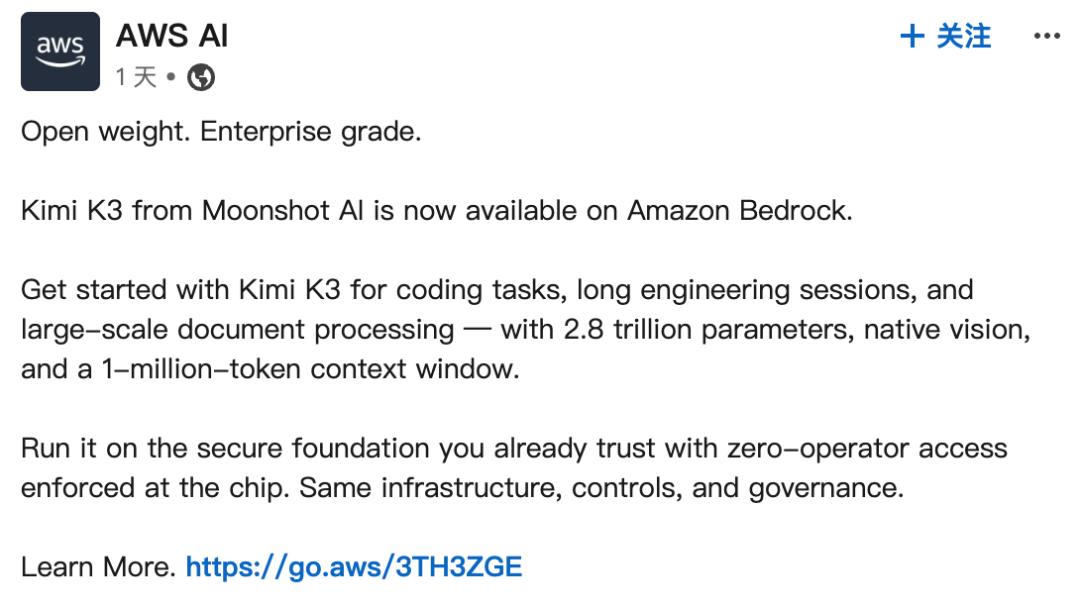
Not only Amazon, but also Microsoft Azure and Google Cloud are negotiating hosting cooperation with Kimi. According to Reuters, Kimi may get a 30% share from the cooperation.
To some extent, the official announcement of this cooperation may change the trend of the AI industry. It practically solves the long-standing problem of how open-source models can make money, and makes the open-weight models free from geopolitical restrictions, becoming a product that can be safely purchased, deployed and paid for by any overseas enterprise for the first time.
03
A lighter and more open ecosystem
If the dispute between open source and closed source is about how model capabilities can be commercialized, then Kimi, as a representative of open-source models, is showing another possibility: the model itself can also obtain commercial revenue through an open ecosystem.
In the "last mile" of AI implementation, Kimi did not build its own FDE team like some overseas closed-source model manufacturers, but continued the path of open ecosystem, leaving model delivery, deployment and industry adaptation to cloud vendors, developers and partners.
In the "Moon Landing Project" released by Kimi on September 10, Kimi made it clear that it only focuses on model intelligence and product performance, allowing partners to complete the last mile of delivery. At present, it has cooperated with third-party service providers such as Chinasoft International, Kingsoft Cloud, Teamsun, Yakang Co., Ltd. and AsiaInfo.
This is in the same line as its strategy on cloud vendors: light assets, ecological orientation, and leave the heavy part to others. Moonshot AI did not choose to raise hundreds or even thousands of on-site teams by itself, but only provides model capabilities and Agent base, and leaves the rest of the work requiring manpower, industry experience and customer relationships to partners.
This is the opposite direction to OpenAI and Anthropic. In May this year, OpenAI and Anthropic announced the establishment of joint ventures with a number of financial institutions on almost the same day to form FDE teams. Among them, OpenAI's deployment company had an initial financing of 4 billion US dollars, and the company's valuation was directly pulled to 10 billion US dollars. Through the acquisition of the British AI consulting company Tomoro, it recruited 150 experienced deployment experts at one time.
When emphasizing its strategic positioning, OpenAI even changed its tone and said that from day one, it has been a company focusing on models and deployment, and did not mention C-end applications at all. Anthropic's deployment company is not to be outdone, and its deployment company has raised 1.2 billion US dollars in financing.
This FDE arms race of overseas models is essentially because the difference in model capabilities is narrowing. They want to deeply bind customer business processes through FDE to build a moat. Because the core value of the AI industry has shifted from the model capability itself to who can take the lead in entering enterprises and create value.
When models become infrastructure, the models themselves no longer have pricing power, and the AI value chain will also shift to downstream applications synchronously. Whoever can truly enter the customer's business process, understand the customer's industry pain points, and be responsible for the final result can win in the downstream track.
The two overseas closed-source giants, which have been pushed by capital to a valuation close to one trillion US dollars, are naturally unwilling to only play the role of infrastructure. Moving down to downstream applications for vertical integration to obtain greater value returns may be their optimal solution at present.
But this is not completely without risk. From a cutting-edge technology company to an in-depth service provider, these are two completely different logics. The latter tests how to understand enterprises and customers better, connect the data systems and processes scattered in various places of the enterprise. What they sell is no longer pure technical capabilities, but also need to know what kind of business changes AI technology can bring.
Even Palantir, the company that pioneered the FDE model, groped for more than ten years to achieve real profitability. Most service providers will initially underestimate various organizational and heavy investment challenges faced by on-site service customers.
In a study released by NANDA at the Massachusetts Institute of Technology, 95% of AI implementation projects did not bring real benefits to the company. The reason for the failure is that although general-purpose models get high scores in professional fields, they usually get stuck in organizational processes and various independent systems separated from each other inside the enterprise when actually processing enterprise business.
For independent model manufacturers such as Kimi and DeepSeek, it is unrealistic to build their own FDE deployment teams when neither capital nor computing power can compete with overseas giants. Choosing to cooperate with third parties can not only allow the company to focus more on AGI, but also benefit from ecological expansion together with partners.
The capital market reacted quickly to this. On July 20, Chinasoft International officially announced that it had signed a "Moon Landing Project" token sharing and joint innovation cooperation agreement with Moonshot AI. On the same day, its share price rose by 23%, and once rose by more than 37% during the trading session, with the trading volume expanding to about 15 times of the usual level; after AsiaInfo announced the signing on August 25, it once rose by 25.4% during the trading session the next day.
In fact, no matter it is closed source or open source, integrating upstream and downstream or opening up the ecosystem, the final outcome may not be a simple either-or choice. Apple uses the closed-source IOS system to vertically integrate upstream and downstream to obtain maximum profits, while Google's Android system relies on an open ecosystem to occupy the largest market share.
In any case, a trend has become clearer and clearer: before the large-scale outbreak of AI applications, cloud platforms, model manufacturers and service providers are all expanding, even building their own FDE teams to compete for the last mile of AI implementation.
Under such competition, it is hard to say that a single AI enterprise can eat the entire industrial chain. Unlike the past when a few platform companies such as Apple dominated an era, the AI industrial chain is longer and has more participants. It is far from conclusive how much share each can occupy in it.
This article is from the WeChat official account "White Wh