AI new materials company raises tens of millions of yuan in angel round financing, and has established partnerships with leading players in the solid-state battery and chemical industries | 36Kr Exclusive

Source / Enterprise
This article contains approximately 3700 words, with an estimated reading time of 8 minutes
Author | Ou Xue
Editor | Yuan Silai
Hard Krypton learned that SOG Intelligence (Shanghai) Technology Co., Ltd., an AI for Materials company (hereinafter referred to as "SOG Intelligence"), has recently completed a multi-million-yuan angel round of financing. This round was led by Fosun Chuangfu, with Nantong Industrial Control Siyuan Artificial Intelligence Pilot Fund, Yunqi Capital, and Zhongying Venture Capital participating as follow-on investors, and old shareholders including Zizhu Sci-Tech Investment making additional investments. The funds will be mainly used for continuous R&D and iteration of automated R&D pipelines for new materials, laboratory construction, expansion of R&D teams and introduction of industrial talents, so as to promote the independent controllability of domestic high-end materials.
Founded in 2025, SOG Intelligence is a hard technology company focused on driving new material R&D by integrating original AI computing engines and other convergent technologies. The company targets the key challenges of new material design under national strategic needs, and builds a cross-scale R&D chain through the closed loop of atomic large model for materials, high-performance simulation, and dry-wet experiments, so as to promote the localization breakthrough of core technologies and the independent controllability of key materials.
Xu Zhenli, founder and chief scientist, is a distinguished professor at Shanghai Jiao Tong University, director of the Artificial Intelligence New Materials Research Center, and a recipient of the National Science Fund for Distinguished Young Scholars. The core team has interdisciplinary backgrounds in mathematics, artificial intelligence and materials. The company has formed an R&D team of more than 30 people, with four R&D centers under its jurisdiction covering AI algorithms, applied technology, agents and quantum computing. The advisory board covers AI algorithms, material R&D and industrial resources, forming a dual-engine architecture of "basic research + industrial implementation".
Why is AI needed for new material R&D?
Hard Krypton understands that traditional material R&D relies on the trial-and-error method. It often takes decades for a new material to go from laboratory discovery to product implementation, with high R&D costs and opaque mechanisms. Against the background that industries such as new energy and fine chemical industry are accelerating their evolution to higher generations, the existing material supply can no longer meet the continuously upgrading requirements for next-generation high-performance materials, and there is an obvious gap in the independent support capacity of key materials.
However, there are also challenges in using AI to accelerate material R&D. The interaction between atoms is easy to calculate at close range, but difficult to calculate at long range. Traditional AI models rely on "message passing" to transmit layer by layer, which is slow in calculation, high in cost, and ineffective when applied to other materials. The breakthrough of SOG Intelligence is to solve this problem from the underlying algorithm.
The technical system of SOG Intelligence revolves around three original algorithms:
SOGNet solves the problem of "accurate calculation". Traditional models can only observe close-range information, while SOGNet can directly learn the correlation of distant atoms in Fourier space, and adaptively learn the attenuation characteristics of different distances. Relevant research was published in Phys. Rev. Lett. (2025) and recommended by the editors.
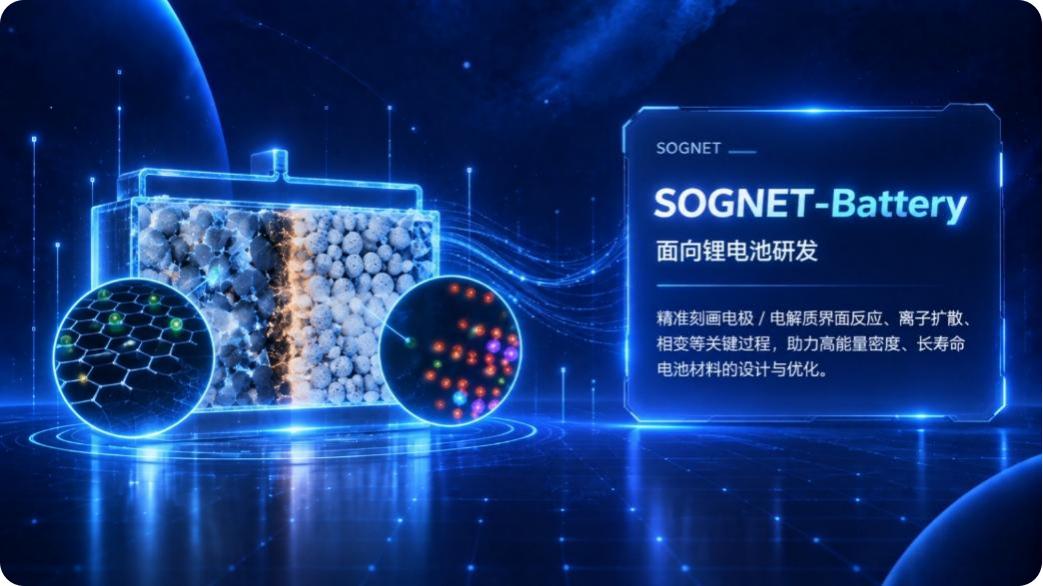
Large atomic model for materials built based on SOGNet (Source / Enterprise)
The random batching algorithm solves the problem of "fast calculation". The parallel efficiency of traditional algorithms on ten thousand cores is only 20%-30%, while the random batching algorithm can achieve more than 95%, increasing the calculation speed by dozens to a hundred times, making large-scale material simulation possible. This work won the first prize of Shanghai Natural Science Award.

NanoTitan Ultra, a dedicated simulator for new materials (Source / Enterprise)
The R2D multi-field coupling model solves the problem of "authentic calculation". Traditional electrochemical modeling relies on the homogeneity assumption, while the R2D model breaks through this framework and can accurately capture the multi-physical field coupling evolution process of battery materials during charge-discharge cycles, including ion transport, interfacial reaction, stress evolution and failure mechanism.
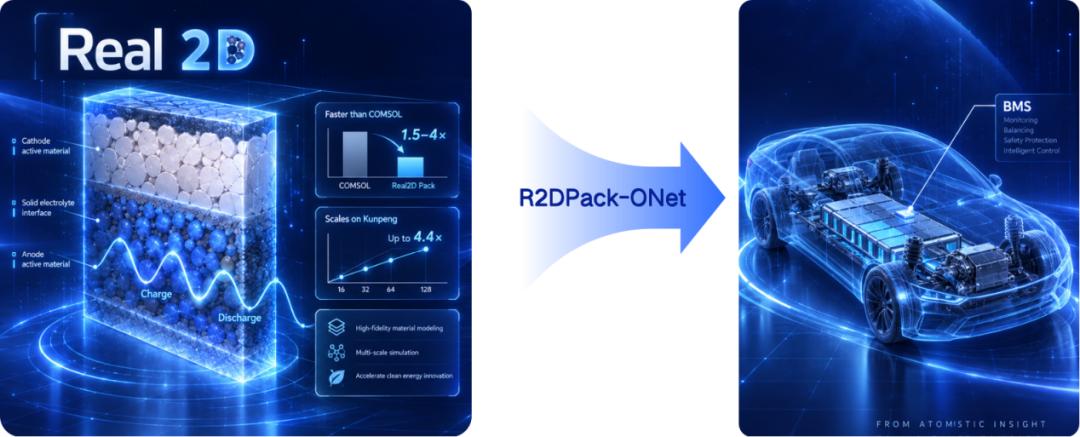
R2DPack, the next-generation battery automated simulation software, and R2DPack-ONet, the AI proxy model (Source / Enterprise)
Based on these algorithms, SOG Intelligence has formed a self-developed product matrix that covers the full chain of material design, computational verification, industrial simulation and independent R&D: the SOGNet atomic large model for vertical fields such as lithium battery and polymer, the high-performance simulator NanoTitan, the material device simulation platform R2DPack, and the self-developed autonomous agent SOG Omni.
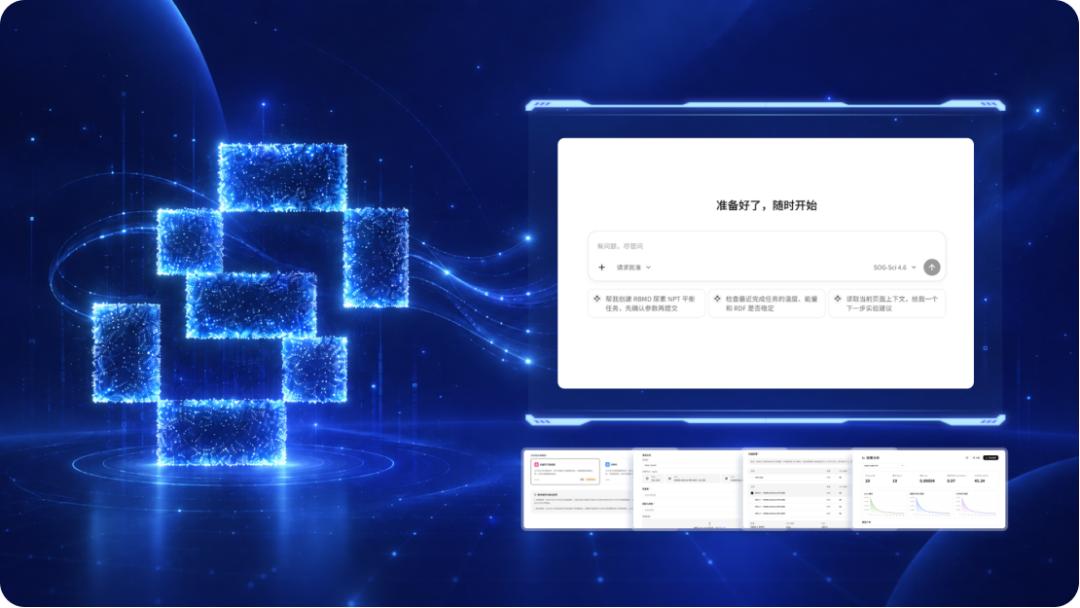
SOG Omni, the autonomous agent for material R&D (Source / Enterprise)
Among them, the SOGNET-Battery, the vertical domain model for lithium battery materials, is the core product for the lithium battery field. Lithium battery materials involve complex processes such as ion migration, interface evolution and coating stability, and it is difficult for traditional models to balance accuracy and efficiency at the same time. The idea of SOGNET-Battery is to train the model with professionally screened and independently generated lithium battery data, so that the model "can see accurately at close range, see clearly at long range, and still calculate quickly even when the system is scaled up".
In terms of measured performance, on six types of lithium battery materials, SOGNET-Battery with a smaller parameter scale achieves higher accuracy than general potential function models with larger parameters. More importantly, its migration ability: only a small amount of data fine-tuning is needed on the new system to achieve rapid adaptation. Taking the Li-Li₆PS₅Cl system as an example, with only 359 configurations for fine-tuning, the atomic force error is reduced by about 68%, and the energy error is reduced by about 83%. In terms of inference speed, SOGNET-Battery is more than 80% faster than the general model, and the same computing power can process more atomic configurations.
At present, the company has precipitated the above core technologies and products into a reusable automated pipeline for material design, forming continuous iteration capability. In the process of cell design for a solid-state battery enterprise, the team used R2DPack to carry out cell-level multi-physical field simulation, coupled material parameters, interface characteristics and cell structure, realized rapid prediction and design optimization of cell performance, significantly reduced the dependence of traditional cell design on repeated experimental verification, accelerated the R&D iteration of solid-state battery cells, and realized millisecond-level response under the same computing power condition of mainstream vehicle chips to meet the real-time computing demand of vehicles, laying a foundation for lightweight deployment and real-time prediction on mainstream vehicle chips of hundreds of thousands of new energy vehicles.
For the intelligent discovery and rapid screening of polymer materials of a listed chemical enterprise, the team used SOG Omni to recommend candidate formulas that meet the enterprise's needs, and then the multi-scale computing engine carried out accurate prediction and screening, and the relevant results have entered the wet experiment verification stage.
In addition, SOG Intelligence has also begun to lay out in the field of new material design that meets major national strategic needs, including rare earth permanent magnet materials and radiation shielding materials; it has co-built artificial intelligence R&D and application systems with leading enterprises and research institutes to help realize the independent controllability of key strategic materials.
In terms of future planning, the goal of SOG Intelligence is to achieve breakthroughs in high-value new material design capabilities through independent and controllable product technologies. In terms of products, the company plans to build a full-process automated simulation platform in the fields of lithium battery and chemical polymers, starting from the agent, recommending materials through AI, then carrying out large-scale calculation, simulation and screening, and finally simulating at the device level to complete the whole process; at the same time, it will launch automated calculation and screening platforms in fields such as polymers and chemical industry.
The following is an excerpt of the conversation between Hard Krypton and Xu Zhenli, founder and chief scientist of the company (edited):
Hard Krypton: What is the core technical barrier of SOG Intelligence?
Xu Zhenli: Our core barrier is original algorithm. SOGNet solves the bottleneck of long-range interaction potential function, the random batching algorithm breaks through the bottleneck of micro-scale computing scalability, and the R2D multi-field coupling model realizes high-fidelity calculation.
These three algorithms are not simple engineering optimizations, but original breakthroughs starting from the underlying mathematics. Based on these original algorithms, SOG Intelligence has opened up a complete closed loop of data-model-simulation-experiment.
Hard Krypton: The competition in the AI for Materials track is becoming increasingly fierce, how does SOG Intelligence respond to it?
Xu Zhenli: There are numerous subdivisions in the material field, with different technical routes and abundant commercial opportunities. Our advantages lie in algorithm efficiency and accuracy. In the future, all competitors will focus on computing power utilization. With the same input of computing power, higher algorithm efficiency and accuracy will lead to stronger prediction capabilities.
In addition, we provide software and hardware integrated products to further give play to the effect of collaborative acceleration of algorithms and hardware, and fully adapt to the local deployment needs of material enterprises. We are also building pipelines, starting from the agent, recommending materials through generative artificial intelligence, then carrying out large-scale calculation, simulation, emulation and screening, and finally simulating at the device level to complete the whole automated process.
Hard Krypton: What is the company's future commercialization path?
Xu Zhenli: We have two levels of arrangements. First, we take joint R&D at the proof-of-concept stage as the starting point of cooperation, take the lead in verifying technical feasibility in high-value material directions, and then expand in depth. Second, we deepen strategic cooperation, anchor the high-value key material track, focus on subdivisions such as photoresist and semiconductor packaging adhesive materials, and comprehensively promote the molecular design, formula development and production line implementation of new materials.
Investor's View:
Fosun Chuangfu: As an important direction of deep integration of artificial intelligence and advanced materials, AI for Materials has the strategic value of subverting the traditional material R&D paradigm.
We are very optimistic about SOG Intelligence, which lies in its complete technical strength covering "underlying algorithm - computing power platform - industrial application". Relying on the top interdisciplinary team of computational mathematics, artificial intelligence and material engineering led by founder Xu Zhenli, the company has formed original technologies such as SOG-Net Gaussian and neural network, RBMD random batching molecular simulation around core problems such as accurate simulation of long-range interfaces of materials, and explored a productization route of software and hardware collaboration. We believe that this capability of starting from the underlying core technology and further extending to industrial scenarios is an important foundation for AI for Materials enterprises to form long-term competitive barriers. The company has shown clear application value in key industrial fields such as lithium battery, rare earth permanent magnet and semiconductor, and is in a critical transition period from technological breakthrough to large-scale industrial implementation.
In the future, we look forward to working with SOG Intelligence to promote the deep integration of AI and material science, support the company to continuously strengthen core technologies, expand industrial applications, promote the further realization of independent controllability of domestic material development infrastructure, and grow into a benchmark hard technology enterprise with long-term influence in the AI for Materials field.
Yunqi Capital: AI for Materials is a key direction of AI for Science that we have been continuously focusing on. SOG Intelligence reconstructs the material R&D paradigm with original algorithms. The interdisciplinary team led by Professor Xu Zhenli has jointly built an artificial intelligence new materials research center with Shanghai Jiao Tong University, and has realized implementation and application in the R&D system of leading battery enterprises. We expect the company to continuously transform original algorithms into industrially reusable R&D tools, so that AI for Materials can truly enter the critical transition period from laboratory breakthrough to production line implementation.
Nantong Investment Management: We are optimistic about the reshaping of the material R&D paradigm brought by the deep integration of AI and physical computing, and also optimistic about the potential of SOG Intelligence to move from underlying algorithm innovation to industrial application. The key to intelligent material design is to balance the prediction accuracy of complex systems and the computational efficiency of large-scale simulation. Focusing on these two core capabilities, SOG Intelligence has formed a distinctive technical layout: SOG-Net characterizes long-range interactions through learnable Gaussian sum representation, which compensates for the deficiency of short-range machine learning potential in describing long-range effects, and provides more complete physical modeling capabilities for complex material systems. The random batching algorithm reduces the computational overhead of interaction through random sampling, and is engineered in the RBMD molecular dynamics platform to improve the efficiency and scalability of large-scale simulation. The two form a synergy from modeling accuracy and computing efficiency respectively, providing support for material screening, performance prediction and mechanism research. Relying on the team's accumulation in the fields of applied mathematics, machine learning and high-performance computing, as well as continuous exploration in scenarios such as batteries, advanced alloys and semiconductors, we expect SOG Intelligence to transform the advantages of original algorithms into reusable R&D tools and industry solutions, helping industrial customers shorten R&D cycles, reduce trial-and-error costs, and promote the implementation of AI-driven material innovation.
Zhongying Venture Capital: Professor Xu Zhenli is a recipient of the National Science Fund for Distinguished Young Scholars, who has been deeply engaged in interdisciplinary fields for more than 20 years with far-reaching academic influence. He has formed an interdisciplinary team with backgrounds in applied mathematics, AI, chemistry and materials, with profound accumulation in operator learning, machine learning potential and large-scale molecular simulation. In particular, the team has achieved underlying breakthroughs with the SOG-Net long-range potential function, and opened up a closed loop path from micro to macro. This "algorithm + engineering" capability is the scarcest barrier in the AI for Science track. We expect SOG Intelligence to continuously transform technological breakthroughs into scalable products and become an important promoter of the paradigm transformation of new material R&D.
Zizhu Sci-Tech Investment: SOG Intelligence is a hard technology project that we focus on laying out in the AI+ material track. AI-enabled new material R&D has become a national strategic direction, and high-performance material simulation platforms are an important base for the breakthrough of the domestic new material industry. SOG Intelligence is a representative project of joint achievement transformation between Shanghai Jiao Tong University and Zizhu. The team has gradually realized the implementation and transformation of cutting-edge computational science algorithms to AI-enabled industries. The company directly targets the industry pain points of insufficient simulation accuracy and low large-scale computing efficiency in domestic material R&D,