Company A and Company O can no longer sit still.
Large models have finished competing on parameter sizes and now start to compete on pricing. This time, the two companies leading the price cuts are the ones that least lack customers.
On September 22 US time, Anthropic released Claude Opus 5.5. About an hour and a half later, OpenAI launched GPT-6 Sol and GPT-6 Luna.
Both have positioned low pricing as a core selling point. The prices of GPT-6 Sol per million input and output tokens have been reduced to $2 and $10 respectively, half of that of the previous generation GPT-5.6 Sol. OpenAI stated that the new pricing is long-term, not a promotional price or a launch-only discount. The input price of Luna has dropped from $0.2 to $0.1, and the output price from $1.2 to $0.5, with a maximum cut of 58%. The input and output prices of Opus 5.5 have been reduced to $4 and $20 respectively, 20% lower than that of Opus 5.
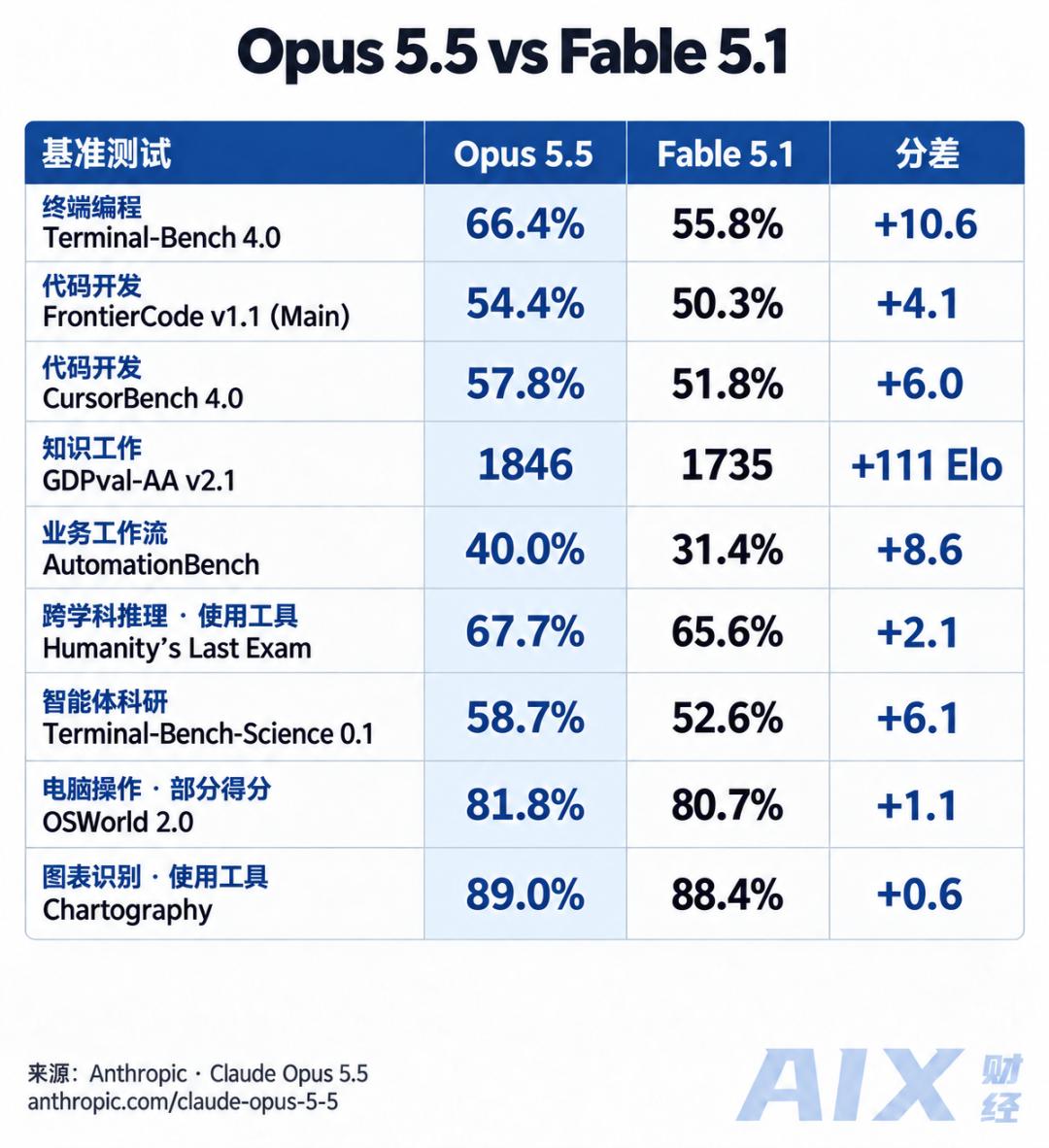
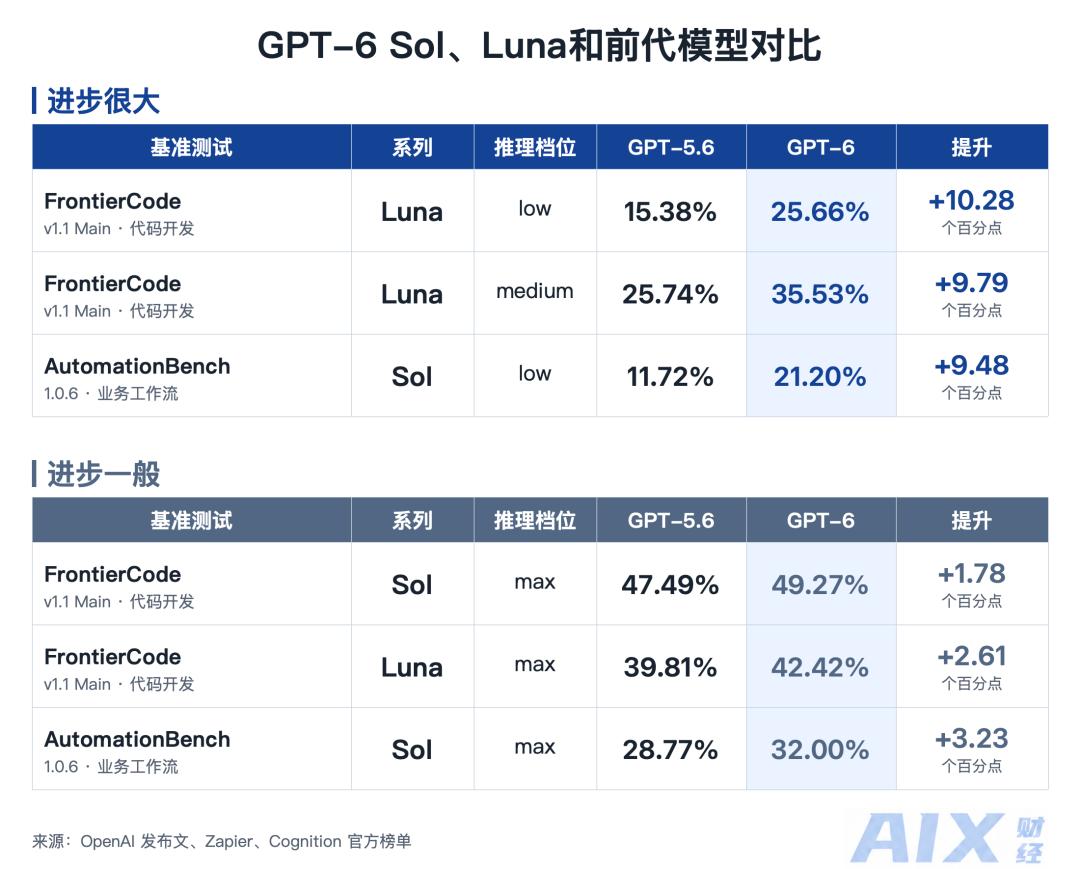
Pure price cuts are not enough, as low-cost models are starting to take over tasks previously reserved for high-priced models. According to the benchmark tests released by the two companies, Sol can achieve the performance of high-priced models at lower costs in some tasks; Opus 5.5 outperforms Fable 5.1 in multiple tests.
The savings go far beyond unit prices. OpenAI has optimized its caching mechanism to reduce redundant computation of models. Opus 5.5 uses fewer tokens to complete tasks, and combined with the price cut, the overall cost of typical tasks is about 40% lower than that of Opus 5. For users, the same budget can now support more work.
One is an AI company with a trillion-dollar valuation and the largest user base, and the other is a model vendor with the highest paid adoption rate among US enterprises. Neither of the two lacks customers willing to pay premium prices, so why did they voluntarily cut prices on the same day? Price cuts can drive up usage, but can they keep the two leading sustainably?
01. High-priced models are no longer the default option
Judging from the performance of the new models this time, both companies are enabling users to obtain capabilities that used to come at a much higher cost for less money.
Anthropic's Opus 5.5 has been mainly improved in programming, AI agents, computer usage, mathematical and scientific reasoning, and other scenarios. It performs better in development tasks that require continuous execution, and its performance in sorting out materials, analyzing information and generating reports has also been enhanced. In the 9 benchmark tests announced by Anthropic, Opus 5.5 outperforms Fable 5.1 released three weeks earlier, but its price is only 40% of Fable 5.1's. Anthropic also notes that the actual performance gap between the two in real-world use is smaller than what the benchmark scores indicate.
OpenAI's GPT-6 Sol and Luna bring the capabilities of flagship models to lower-tier, more affordable products. The two models adopt the same training method as GPT-6 Astra, extending Astra's capabilities in professional work, programming, and computer usage to the more accessible product lines. Sol produces roughly half as many factual errors as its predecessor, and its performance in programming and computer usage tests is close to or on par with higher-priced models.
Why are the new models not priced higher?
First, look at the product lines of the two companies themselves. Fable is Anthropic's most expensive product line, designed for complex, long-running tasks, but it has not been well received by enterprises. Data from Ramp, an enterprise expense management platform, shows that one month after the launch of Fable 5, it only accounted for 6% of the total tokens purchased by enterprises from Anthropic.
This is tantamount to acknowledging that most work tasks do not require paying for the top-tier model. For users, if a task can be completed well with Opus, there is no need to pay extra for Fable. For Fable to keep selling at premium prices, it has to prove that it is worth the price difference for the most challenging subset of tasks.
OpenAI has adopted a tiered product strategy, using models of different tiers to handle tasks of varying difficulty levels. Astra retains the positioning as the model with the highest capabilities, while Sol and Luna handle a wider range of daily tasks. For example, for the same programming task, complex solutions can be assigned to Astra, while clearly specified code modifications and batch checks can be handled by other lower-tier models.
In this way, the top-tier model only needs to be called in a small number of scenarios. What Sol and Luna are targeting is the far larger volume of recurring daily calls. This type of task does not have high single-value, but is highly price-sensitive. Only when the cost is reduced, will enterprises be willing to integrate them into their daily workflows and use them in the long run.
Then look at the market, where enterprises are becoming increasingly cost-conscious when spending on AI.
Ramp's September report shows that according to the data it tracks, the effective price per million tokens has dropped from $1.15 in March this year to $0.68, a 41% decrease in half a year. The growth in usage is mainly driven by standard models such as GPT-5.6 Terra and Claude Sonnet. The share of token calls for cutting-edge models including Opus, Fable and Sol has fallen back from a peak of about 53% in August to 45%.
Ramp also mentioned that some enterprises have set standard models as the default option within their companies. The performance of these models is sufficiently good, and their costs are even lower.
This means that enterprises will not increase their budgets just because new models have stronger capabilities. Model vendors need to show their customers that the same amount of money can complete more work, or the same task can be done at lower cost. In this case, the upgrades of new models will more easily translate into actual purchases and usage.
Greater pressure comes from the financial perspective.
The revenue of both companies is growing rapidly. According to public reports, OpenAI's annualized revenue exceeded $40 billion in August, roughly twice the level at the end of last year. Anthropic's annualized revenue reached $65 billion at the end of July, and some media reports expect it to exceed $100 billion this year. The valuations of both companies have exceeded $1 trillion, and both have filed for IPO confidentially with the U.S. Securities and Exchange Commission.
At the same time, OpenAI is still making large losses. In the second quarter of 2026, its operating loss increased from $9.3 billion to $12.3 billion. Although Anthropic has achieved positive adjusted operating profit for the first time, to justify its trillion-dollar valuation, it also relies on sustained high growth.
The two companies are betting that this round of price cuts will drive usage growth faster than the decline in unit prices.
OpenAI has already reaped benefits from its previous generation of products. Data released by OpenRouter shows that during the discount period from July 27 to August 14, the average daily token usage of GPT-5.6 Luna reached 13.8 times that before the promotion, and Terra reached 5.6 times. About three quarters of the newly gained usage share of the two models came from other vendors. This shows that price cuts did attract a portion of users to switch models.
Anthropic is in a slightly better position, and its priority is to tap incremental value from its existing enterprise customers. Among the US enterprise samples counted by Ramp in August, Anthropic's paid adoption rate was 43.8%, higher than OpenAI's 39.8%. Its growth can also come from existing customers: getting enterprises that previously only had part of their employees using Claude to deploy the tool across more departments and business lines. By simultaneously improving performance and reducing costs, Opus 5.5 is designed to boost user retention and expand deployment scale.
02. How long can the leading edge last?
Price cuts can attract users, but whether users will stay depends on whether the models perform well in actual work, and whether they can continuously save time and costs.
The pressure facing OpenAI and Anthropic is that more and more models are becoming capable of handling these tasks.
In the open-source community, Kimi K3 from Moonshot AI has already demonstrated strong competitiveness. When it was released in July this year, it scored 57 points in the Artificial Analysis General Intelligence Index, ranking third overall and first among open-source models. It also took the first place in the Arena front-end programming ranking, surpassing Fable 5 and GPT-5.6 Sol, marking the first time an open-source model has topped that list.
However, the competition between open-source and closed-source models goes far beyond benchmark scores.
Source / pexels
The advantage of open-source models lies in controllability. With publicly available weights, enterprises can run the models on their own servers, so data never leaves their internal systems; the same model is offered by multiple inference service providers, so enterprises will not be locked into a single vendor, and pricing is more transparent.
In the closed-source camp, Grok and Muse Spark are also attracting users to try them out.
After SpaceX acquired Cursor, the Grok series models have maintained high-frequency updates. Cursor holds a large volume of data on interactions between developers, code and tools, which can provide valuable support for model training. The latest Grok 4.7 scored 9 points higher than its predecessor in the Artificial Analysis Programming Agent Evaluation, surpassing GPT-5.6 Sol. The continuously upgraded models, combined with Cursor's existing user base of developers, have given Grok the confidence to compete for the programming business market.
Meta has narrowed the gap through continuous updates. Muse Spark 1.3, released in September, is its fourth update to the Muse Spark model within five months. The publicly available version matches GPT-5.6 Sol in the Artificial Analysis General Intelligence score, and the cost for average tasks is even lower. This performance is regarded by the industry as Meta's official entry into the cutting-edge model camp.
For customers, there are far more comparable options now. As long as competitors can handle a part of their tasks, they will have the opportunity to take a share of the AI budget.
OpenAI and Anthropic still have two major chips in hand: the accumulated base of enterprise customers, and the delivery quality for complex tasks.
First, look at the enterprise customer base. Ramp's September report shows that enterprises using open-source platforms only account for 6.4% of all AI-paying enterprises, while the paid adoption rate of both Anthropic and OpenAI stands at around 40%. These open-source platforms also provide closed-source models, so the actual adoption rate of pure open-source models is even lower. At least for now, the catch-up of open-source models has not significantly shaken the customer base of the two companies.
Price cuts can help the two companies retain these customers. When services work smoothly and costs are reduced, enterprises will naturally have less incentive to switch vendors. However, having a solid customer base only raises the switching threshold, and the final decision of enterprises to stay or leave still depends on actual performance.
The other chip is the delivery quality for complex tasks. When processing large volumes of documents and modifying complex code, models not only need to generate answers, but also fully execute the requirements and deliver tangible results. As long as high-end models can perform these tasks more stably and efficiently, they still have room for premium pricing.
To maintain their business, the two companies need to do two things well at the same time: retain daily calls with low-cost models, and secure complex tasks with the delivery quality of high-end models. The former can be achieved through price cuts, while the latter can only be realized by continuously improving model capabilities.
Moving forward, two types of players have greater potential to capture more market share.
The first category is large tech companies that hold enterprise entry points, such as Google. It has a large user base of office and cloud service customers, and Gemini Enterprise can connect to tools and data including Google Workspace, Microsoft 365, and Jira. Enterprises can integrate AI into their existing documents, emails and project workflows.
The advantage of this type of vendor is that customers already work on their service platforms, so their models are likely to be purchased by enterprises as long as they can meet daily work needs and support easy integration.
The second category is open-source vendors including DeepSeek, Alibaba, Zhipu AI, and Moonshot AI.
They can target two types of customers. One type has high call volume and is highly price-sensitive, focusing on long-term cost control; the other type hopes to run models internally in a controllable environment, prioritizing data security and flexible deployment options.
In the past, open-source vendors had to overcome two major barriers to win these customers: deployment complexity and trust issues. Now cloud service providers are helping them make up for this shortcoming. The recent partnership between Moonshot AI and Amazon Web Services is a proven path. On September 18, Amazon Web Services integrated Kimi K3 into its large model service platform Bedrock, so that enterprises do not need to deploy the model themselves, and can directly call the model via AWS, while leveraging the platform's existing access control, encryption and audit mechanisms.
The significance of this move is that Bedrock itself is also a key sales channel for Claude to serve enterprise customers. Open-source models are now competing directly with Claude on the premise of the same security standards and procurement processes.
On one side are large tech companies with enterprise entry points, and on the other side are open-source vendors entering the enterprise market via cloud platforms. Price cuts can narrow the price gap, but to retain enterprise AI budgets, the two companies still need to continuously deliver better performance in the work scenarios that customers value most.
For the two soon-to-go-public companies, the answer to this question will eventually be reflected in the valuations the public market gives them.
This article is from the WeChat official account "AIX Finance", author: Lei Jing, editor: Wei Jia, published with authorization from 36Kr.