On the eve of the Personal Agent battle, Qwen submitted an assignment first.
By Wang Yi
Cover Source: René Magritte, La Décalcomanie

What does it truly mean to understand a person?
This is the question that Zheng Sishou, product lead of the Alibaba Qwen App, has been thinking about most frequently recently.
A common example Zheng Sishou shares with his team comes from the healthcare scenario. "If we only roughly categorize users' symptoms as periodic or chronic diseases, we may miss a huge amount of information," he said. "A person who visits the hospital 10 times a year and a person who only visits once a year will lead the AI to draw completely different conclusions based on these contexts — 10 hospital visits almost indicate that there are major problems with his physical condition. Such understanding cannot be exhausted through simple strategies."
A year ago, issues like this had not yet come into the view of the Qwen team. The turning point came with the rapid maturity of the Agentic architecture in 2026, which made Agent the most important AI theme and enabled AI to gain the ability to remember each individual user.
This is also the six-month period for Qwen to evolve from LLM Chat to the Agentic architecture. The Qwen team has abstracted the high-frequency scenarios that users use most often — the original advantageous fields such as college entrance examination, healthcare, and work, have now been expanded to more than 20 scenarios including finance, providing different Agent services.
"The more we do, the harder it gets, and the more interesting we find it, with huge space and great value," Zheng Sishou said. It is precisely this complexity that makes him see the underdeveloped potential of Personal Agent.
This has brought a strong sense of urgency to the Qwen team — in the 10 months of this year, the demand for complex personal tasks from users on Qwen has increased by 5 times. Zheng Sishou estimates that if this wave of opportunities can be seized in the next few months, this number may rise by another one to two orders of magnitude.
The most notable impact of the rapid development of Agent is the significant improvement in user interaction rounds and retention. At present, the average number of conversation rounds for users in Qwen products has reached 5 to 8.
The increase in conversation rounds comes, on the one hand, from the leap in model capabilities, which gives Agent more sufficient intelligence to align with users' true intentions; on the other hand, by using users' medium and long-term context and profile portraits, more than 60% of the questions have received better responses.
This number is still growing. The most profound feeling of the Qwen team in the process of exploring Personal Agent in recent months is: personal needs are not equal to simple needs. Behind seemingly simple questions, intentions vary widely — to meet these needs, it is necessary not only to handle complex tasks, but also to understand a specific individual.
"Human communication is inherently a process of gradually opening up and delving deeper into details, which requires more sufficient intelligence to align with users' intentions and inherent goals," Zheng Sishou added.
In the Chinese market, where the mobile internet is more developed and local life services are more mature, Chinese manufacturers have taken several steps ahead on this path.
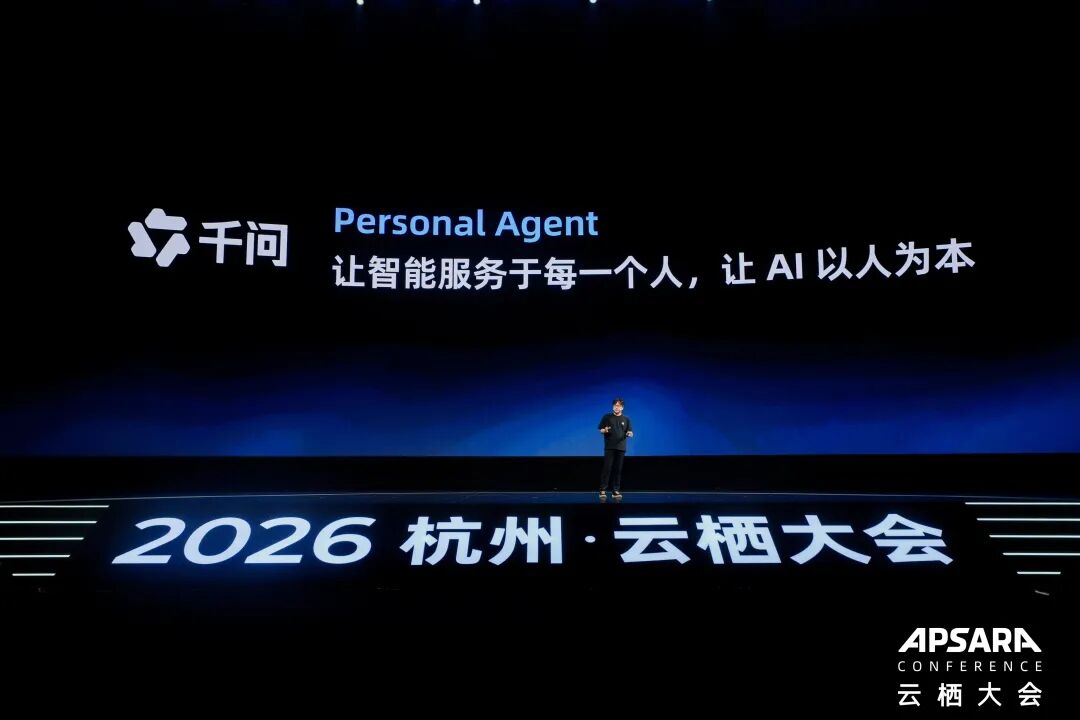
On September 22, 2026, Alibaba released a brand new Qwen product strategy at the Yunqi Conference, officially announcing the acceleration of evolution to Personal Agent, precipitating a broader personal context on its own products, and expanding service fields to more than 20 with the help of ecological cooperation.
All these actions point to the same goal: organize different capabilities into continuous AI services around the goal of serving one person.
"We hope to build Qwen into your Personal Agent," Zheng Sishou said. A detail that the Qwen team pays close attention to is that in the past, when people talked about Qwen, they often used the expression "use Qwen", but this is not the ultimate goal of Qwen. "What we want to achieve more is — users perceive us as 'my Qwen'."
01. "Today, more than 95% of AI demands are still at the level of advanced search"
Looking back to the beginning of 2026 when OpenClaw became popular, Agent brought unprecedented new opportunities to the AI application market. In the past two years, the industry focused on super AI applications; while this year, attention has returned to foundational models. The underlying reason is that the improvement of model capabilities can still open up new product space and bring growth and business cycles, with Agent and video being two examples.
Agent enables model capabilities to enter specific long-term tasks. When the large model is combined with Harness, AI can continuously form memories and advance tasks, instead of just providing one-off answers. But action capability is only the first step. More importantly, after being orchestrated by the Agent mechanism, the same model can understand and handle problems more completely, bringing users a direct perception — the model becomes smarter and more human-like.
But today, most users cannot feel this kind of intelligence yet.
"Among users' AI demands now, more than 95% treat AI as an advanced search tool," Zheng Sishou's perception is that many users are not clear about which complex problems can be handed over to AI, and there is still a huge gap between supply and demand.
Conversely, this precisely means that more than 95% of Agent capabilities have not yet been tapped.
A typical example is college entrance examination volunteer application, a scenario that the Qwen team has been working on for nearly 10 years. In the past, Qwen's college entrance examination volunteer application function was more like a probability engine — users input information such as scores and subject selections, and the system screened out a probabilistically optimal solution across the country.
However, after reconstructing LLM Chat into the Agentic architecture, Qwen added a new personal context layer, which provides the most critical part of personalized understanding.
With the same score, in the past application results, the results provided by AI may not differ much; but now, even with the same score, AI will consider more dimensions: some users value the tier of the school, some prefer to stay in their hometown, taking into account peers, resources and the industrial environment for future employment.
The most intuitive change is that AI can understand — where one can go and where one is suitable to go are two completely different questions.
The action capability of Agent has changed the interaction process of the product, enabling more active access to user context — in the latest version of the college entrance examination volunteer Agent, Qwen will organize the two-week period from score release to application into a calendar, telling users what they need to learn and what to complete according to time nodes, and adjust the suggestions and plans for volunteer application accordingly based on users' feedback.
This draws a clear line with the previous Chatbot era.
"The difficulty of Personal Agent has been greatly underestimated in the past," Zheng Sishou said. This is because what AI needs to do is no longer limited to one recommendation, but runs through the entire decision-making process, which is essentially about the understanding of people.
A person's identity, situation and goals are constantly changing — they used to be students, now they are employees; they used to be children, now they may become parents.
Zheng Sishou sums up the core point of building a good Personal Agent as "accumulating the full-domain, lifelong context of the individual". Personal Agent needs to accumulate this context for a long time to understand what users need at the moment, without having to ask from scratch every time.
Having figured this out, the Qwen team is promoting the construction of the personal context system around three dimensions:
First, the Qwen team has built a general context, which is constructed around users' identities and life stages — occupation, family roles, and the time scenarios they are in are constantly changing. The task of the general context is to extract users' stage characteristics and unique needs in dynamics, and understand users' long-term goals and inherent personalities;
Furthermore, according to users' needs in work and life, Qwen will build domain-level context, precipitate information from multiple scenarios, and call it across scenarios, so that health, finance, life and learning are no longer isolated needs. For example, a child's education plan will affect family finance, and health status is intertwined with exercise habits.
In order to understand users better, the current volume of context is far from sufficient. This also explains why Qwen has built such a rich terminal ecosystem — in addition to the APP and PC, at this year's Yunqi Conference, Qwen also announced that it will launch brand new AI glasses and AI earphones, all of which are aimed at increasing the continuous understanding of the same person, and providing different AI services centered on this.
02. Personal Agent may be the super application in the AI era
Today, the global AI industry is forming a new consensus: the competition in the Agent era is essentially the competition for context.
Personal Agent is the latest bet of major tech companies. On September 8, Meta released its Personal Agent "Muse", focusing on helping users shop online, buy movie tickets, arrange schedules, send emails, make payments and make reservations, which instantly ignited the market. As of September 21, Muse has ranked first on both the US App Store and Google Play free charts, and Meta's stock price surged 11.4% in response.
Instinct, which works closely with OpenAI, and Grok's AI assistant have also flocked to this track one after another. At the same time, according to leaks, OpenAI is also internally developing a personal-oriented Agent — AEON.
According to Meta executive Nat Friedman, the goal of Muse is to "create a product similar to OpenClaw, but safe, reliable, easy to use and scalable to billions of people".
This vision is not original to Muse. OpenAI began to test Agent capabilities such as AI shopping as early as 2025, but it did not make much waves. The reason why Muse became a hit is that it is the first truly usable Personal Agent product after OpenClaw went viral — it not only provides services, but also combines users' personal schedules, emails and calendars, making ordinary users feel for the first time that "AI knows me well when handling affairs".
But Muse's path cannot be copied as it is in China. How many services browsers can support and what capabilities platforms are willing to open will affect the execution mode of Agent. A large number of domestic life services are concentrated in mobile Apps, with relatively independent accounts, data and transaction processes. For Personal Agent to cross these boundaries, more in-depth ecological cooperation is required.
In comparison, Qwen's starting point is that it has already connected a number of real life services. From ordering food, hailing a ride, to introducing more partners on the open platform, it has accumulated not only service entrances, but also experience in understanding demands, invoking capabilities, and promoting performance.
The next step for Qwen is to make different services collaborate around the same person's context, and advance from "being able to complete one thing" to "continuously doing things for one person".
This will gradually evolve into a service-oriented Agent Loop. The physical condition expressed by users in the healthcare scenario can become a reference for travel arrangements; family education plans may also affect financial judgments. Services still have their own professional divisions, but the understanding of users needs to cross scenarios and continue to update with personal status.
The architectural change that Qwen is promoting is precisely to reorganize these capabilities: the general Harness undertakes planning, tool invocation and task advancement, domain-level Agents in healthcare, learning, work and other fields provide professional capabilities, and the unified Personal Context enables them to better understand the same person's goals and preferences when executing tasks.
However, this does not mean the disappearance of "vertical categories". On the contrary, professional data, tools and services still determine how deeply tasks can be completed. The change is that users do not need to find and organize these capabilities one by one by themselves, but the Personal Agent understands the needs, invokes them on demand, and connects the help from different fields into a continuous service process.
Having diverse context is only the first step. To promote Personal Agent to the market better, this will be a complex system engineering that links cloud, models and Agent services.
Alibaba's determination in models, computing power and ecology has provided conditions for Qwen to pursue the Personal Agent entrance: more than 380 billion yuan of investment in cloud and AI infrastructure in three years, as well as the Qwen series model family of multiple sizes, which can adapt to the capability requirements of various Agents, coupled with the real demands accumulated from AI shopping during the Spring Festival and the open platform — these are all visible advantages on the table.
"But no necessary step can be skipped." Zheng Sishou believes that computing power, model foundation and even offline ecology are only "relatively good entry conditions", which can hardly be said to be decisive factors; and accessing services does not mean that the context is connected — the scenarios inside Qwen have not been fully connected, let alone the data in the entire Alibaba ecology.
"Even if you have a user's 10-year shopping data, without accurate understanding, the services you provide to the user will be wrong."
In response to this, the Qwen team did not choose to launch a large general Agent that takes care of everything, but started from the high-frequency scenarios where users have already built trust, and promoted two main lines in parallel: upgrading the main Chat to Agentic Chat to adapt to high-concurrency and medium-low complexity problems; at the same time, building domain-level Agents in rigid-demand scenarios such as learning and healthcare, so as to balance effectiveness, speed and large-scale service costs, which is mainly solved by building the Harness layer.
For partners inside and outside Alibaba, what Qwen needs to do has also changed: it is more about working with partners to jointly define the capabilities and feedback mechanisms that Agent can invoke, rather than jointly developing a "product".
What is rather counter-intuitive is that the manpower ratio of the Qwen product team has also changed significantly.
This will lead to a new round of reshuffling in the software service market. Zheng Sishou said that the "boundary problem between major manufacturers and partners" that has been frequently discussed in the past is no longer a problem — after the launch of Qwen App, more than 400 scenario functions have been accessed. However, the full-time staff responsible for App docking and construction accounts for less than 2% of the total manpower. The largest number of personnel are concentrated in Harness, memory, tools and services in various fields.
To a certain extent, the current pursuit of the upper limit of model intelligence is only one aspect of the AI battle, every battle is a joint operation of heavy regiments to charge forward; but to compete for a system-level entrance like Personal Agent, it is more like a protracted war, gradually building its own fortress, on the premise of crossing App boundaries and truly "continuing to get things done".
"The future competition is not only about who can complete more tasks, but also about who can continuously coordinate capabilities around the same person and continue services across different devices," Zheng Sishou said.