Muse is a smash hit: Is this a genuine inflection point for Meta, or just a false climax?
Since its launch in the US region on September 8, Meta's new product has been available for more than two weeks. Dolphin Research previously released a brief review (see Longbridge App). As user evaluations keep increasing, its popularity has remained unabated in recent days. Even today, Muse still ranks No.1 on the free app download chart for iOS US Store.
This has directly driven the boom in Muse's backend industrial chain, front-end business ecosystem and the stock prices of related mapped targets. Today, Dolphin Research will conduct an in-depth discussion on the product side first, and the sorting out of changes in the backend industrial chain is coming soon.
I. The popularity of Muse is not unexpected
2C Agent is an AI application track that never lacks attention. However, compared with the thriving 2B Agent which has achieved impressive paid revenue, the commercialization model of lifestyle-focused 2C Agent has never achieved a real breakthrough.
Therefore, in the past six months, major tech giants have quietly adjusted their direction for 2C Agent, and focused internal resource priorities on the workflow scenarios for C-end users. The progress of general lifestyle 2C agents has been visibly slowed down due to commercialization constraints.
Only Meta has been consistently emphasizing the importance of developing personal AI life assistants. The management has mentioned the concept of "everyone has an AI assistant" on earnings calls for at least two years. Muse is a core project built by the company's core team over a long period with the highest internal resource priority, and it is also a key product layout of Meta this year.
Of course, this is also a direction that Meta, which lacks productivity scenarios itself, has to bet on. Otherwise, the new 100-million-user-level entry — ChatGPT — will seize users' attention, which will cause long-term damage to Meta's own social ecosystem.
Then why can Muse achieve instant success? What are its advantages?
1. Cognition Rewriting: Chat Q&A type vs. Active task type
As a task-oriented personal AI assistant, Muse is fundamentally different from users' product cognition of ChatGPT in its underlying design. Although ChatGPT can also perform some tasks, and can execute more long-task workflows with Codex, most users still habitually classify ChatGPT as a chatbot in non-work scenarios, with interactions limited to question and answer forms.
However, the life assistant positioning of Muse does not position itself as a Chatbot from the very beginning. In its promotional introduction, Muse illustrates its functions and positioning with different tasks that it can complete.
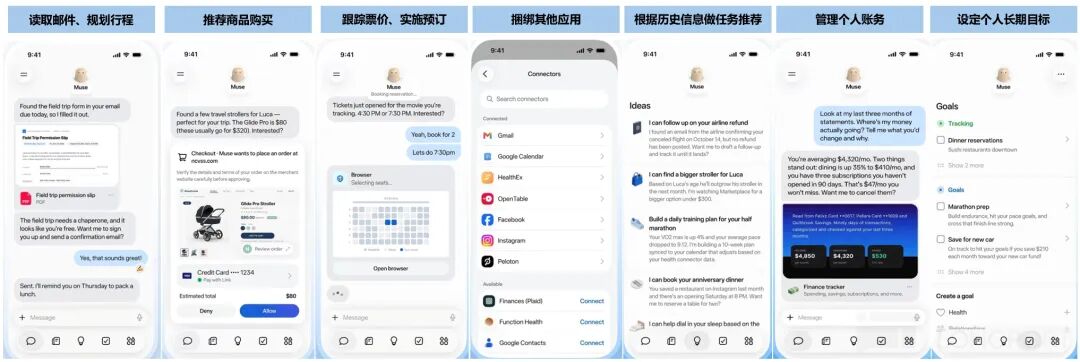
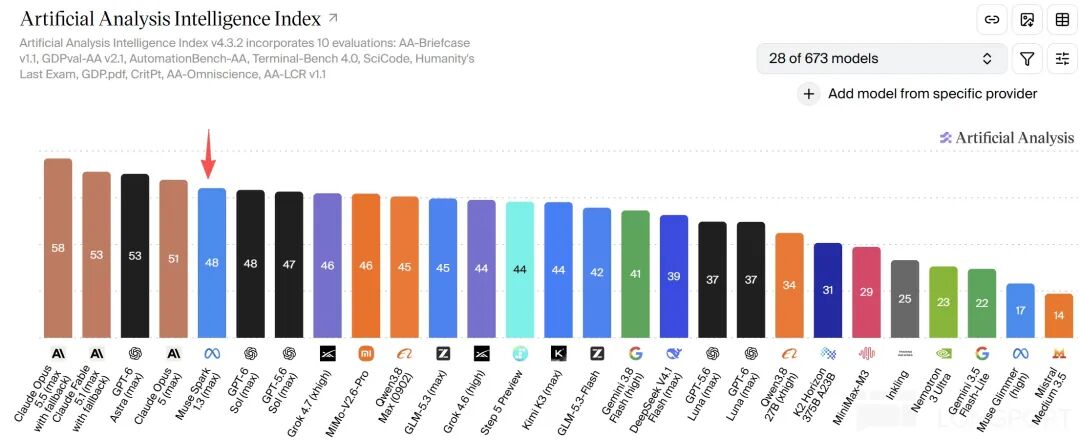
However, for the underlying large model, Muse still uses the public Muse Spark large model for support, and has not carried out lightweight processing such as model-specific tuning and parameter simplification. At present, the intelligence score of Muse Spark 1.3 ranks in the global first tier, which to a certain extent guarantees the capabilities of complex instruction understanding, cross-platform operation and multi-scenario adaptation, and underpins the product experience.
2. Balance between user data memory and privacy security
Speaking of task-oriented AI assistants, before Muse was launched, there were already several similar products in North America that were under testing or fully launched. Typical examples are Instinct and Grok bot.
Instinct is developed by a startup, released in February and still in invitation-only testing, which has led to a sharp rise in its valuation in the primary market. However, compared with Muse developed by large companies, Instinct has a relatively bold style, and is not so cautious about user privacy security with a larger authorization scope. Users may feel it is "smarter" during experience, but the platform has not adopted comprehensive protection measures for risks brought by AI autonomous decision-making.
Grok bot was launched in August, which is also an AI robot that handles tasks for users. Users can authorize Grok bot to access Gmail, Google Calendar, Notion, Figma, or other software such as financial tools and AI code assistants to execute tasks.
However, compared with Muse, Grok bot is more of a workflow-focused AI assistant, which may not show significant differentiation from the currently well-known Openclaw-like platforms.
Detailed comparison of other indicators can refer to the figure below:

Dolphin Research believes that Muse's greater advantage may lie in its "years of accumulation of user data", and it has achieved a middle balance between the utilization of these data and "user privacy protection".
(1) User data accumulation
With exclusive user social data and ecological advantages, Muse has three substantial differences from other products.
a. Long-term memory: Muse has the ability to remember long-term context, and tasks continue to advance even after users close the App. In its functional sections, Goals is responsible for tracking long-term objectives, and Artifacts precipitates results into reusable itineraries, checklists and dashboards;
b. Real account connection: Muse connects to Gmail, Calendar, OpenTable, Spotify, Amazon, as well as Meta's own IG, WhatsApp and Marketplace through three methods: built-in connectors, official APIs and browser operations;
Especially by connecting to its own social accounts, Muse has relatively high read permissions. After user authorization, it can directly read public or semi-public data such as Instagram posts, fan data and comments. It also supports reading WhatsApp chat records and message content, automatically sorting out users' social messages, extracting to-do items and summarizing important information.
c. Active recommendation: Based on real account connection and long-term context memory, Muse can actively put forward task suggestions according to the calendar, conversations and connected accounts, forming the prototype of a progressive Agent, and also reserving space for future advertising monetization.
(2) User privacy protection
Privacy security and risk control system are the core links where AI applications may cause problems. For Meta, a large company, the compliant use of user privacy data is very easy to become the target of product criticism.
Mark Zuckerberg claimed in the middle of the year that the development progress of the AI assistant was behind schedule, and it was postponed to September launch precisely because of the need to solve the problem of AI authorization risk control. At present, Muse is only launched in the US region, which is very likely to continuously optimize privacy protection and AI authorization issues.
To balance functional experience and privacy security, Muse's isolation and protection of user privacy are mainly reflected in two aspects:
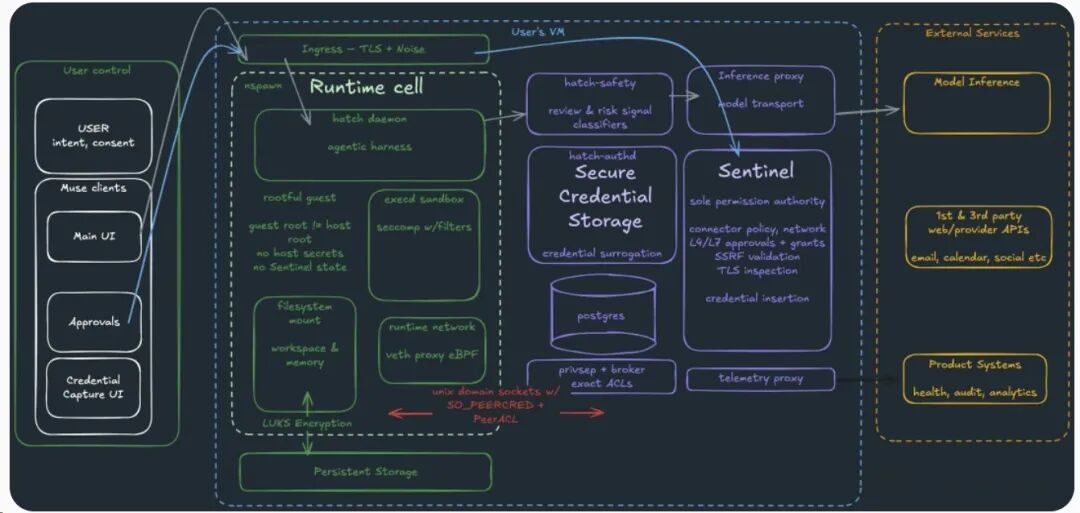
a. Isolated storage: Muse provides each user with an independent exclusive Secure VM (Secure Virtual Machine). The Sentinel agent guards all external actions, and the platform sets up an exclusive secure storage partition to strictly separate the data accessible to the model from users' core private data (such as account passwords and payment credentials).
All data interaction and function calls of third-party platforms are transmitted through encrypted secure APIs to avoid exposing sensitive data to the large model.
b. Layered authorization: The real account data reading mentioned above requires user authorization. For accounts in Meta's own ecosystem, it provides users with layered authorization functions. For example, users can separately turn off the Instagram direct message reading permission, only authorize the reading of public post content, and can also separately turn off the WhatsApp message reading permission.
The figure below is the security architecture diagram disclosed by Meta.
(1) Gray line process: A normal instruction goes from the Main UI to the user's virtual machine VM. The hatch daemon (Agent ontology) calls the external large model for reasoning, and then evaluates the risk score through hatch safety (risk control review). All actions and network requests of the Agent in the VM are directed by the eBPF agent to Sentinel for inspection.
(2) Blue line process: When encountering sensitive actions such as payment, Sentinel will intercept it and push it to Approvals on the user control interface. After the user approves, Sentinel issues permission and obtains payment credentials such as passwords from the Secure Credential Storage vault.
The Agent does not see the user's password and card number in the whole process, but the setting of a resident virtual machine for each user will increase component costs.
II. How much incremental value can Muse bring to Meta?
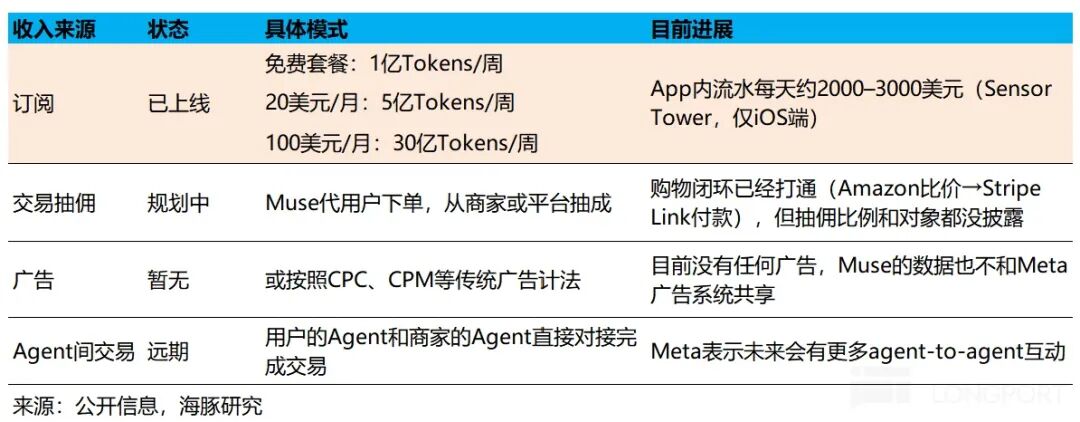
At present, Muse is mainly in public beta for US users aged 18 and above. It adopts a tiered pricing model based on Token consumption demand with no function restrictions. In addition, it is expected that Muse will later charge a certain commission on the transaction value of merchants, and give full play to its strengths in advertising display.
1. Subscription: Hard to be optimistic in the short term
Although the first batch of users gave positive feedback and the subscription habit in North America is stable, Dolphin Research still believes that the direct monetization (payment) of C-end users needs to be treated cautiously in the short term:
According to Sensor Tower data (only counting the iOS end), Muse currently has nearly 250,000 DAUs, with a daily revenue of 2000-3000 US dollars per day. Although the current data is only from a partial test, we can roughly perceive the payment situation:
Calculated based on an average of 2000 US dollars per day for two weeks and the lowest paid package of 20 US dollars per month, the number of paying users is 1500. Assuming that the iOS end accounts for 1/3 of the total paying users, the total number of paying users across all ends is 4500. With an average of 150,000 DAUs in the past two weeks, the payment rate is only 3%.
However, considering that the package is calculated at the minimum standard and the iOS payment proportion is generally more than 1/3, the actual payment rate is significantly lower. At the same time, by comparison, ChatGPT covers more relatively complex production scenario demands, and its payment rate is only 5% under the high stickiness feature of 1 billion weekly active users.
Therefore, Dolphin Research still suggests not to be overly optimistic about the contribution of subscription payment. We estimate that most users will stay at the free tier (100 million Tokens per week). Even under a very optimistic assumption in the final state, with 3 billion users, 80% penetration rate, 2% payment rate (the monthly active user payment rate is lower than the daily active user payment rate), and an average ARPPU of 20 US dollars per month, the annual new revenue will be 11.5 billion US dollars. For Meta's current revenue base of 250 billion US dollars, the increment is only 5%.
This figure does not include the underlying costs, including computing power costs and exclusive virtual machine component costs. Therefore, the final profit contribution brought by subscription is very limited.
2. E-commerce: How to break through ecological restrictions?
According to actual tests, e-commerce shopping is a relatively mature scenario that has the potential to expand commercial space (other high-frequency usage scenarios at the top of the list are mainly productivity-focused scenarios such as accounting processing, document processing and tax filing), which mainly relies on the integration of Muse with Meta's existing products and business ecosystem.
In addition to Muse, Meta currently also provides Meta Business Agent and Meta Business Agent Platform.
Meta Business Agent is an "AI shop assistant" that can be called at any time, which is activated by direct subscription payment. The AI shop assistant can perform general functions such as answering questions, recommending products, booking services and screening potential customers, and is more suitable for small, medium and individual merchants. In Q2 2026, more than 1 million small and medium-sized enterprises used Meta Business Agent through WhatsApp and Messenger every week.
Meta Business Agent Platform is an API-based enterprise-level development platform. Large enterprises can customize AI shop assistants according to their own businesses, and then connect to their own systems. The target large enterprise customers need to have certain IT configuration capabilities.
Therefore, the C-end Muse and the B-end oriented Business Agent can be connected, so that the Agent (AI assistant) on the Muse end can connect with the Agent (AI shop assistant) on the merchant end, thus forming a complete e-commerce service chain from product discovery to transaction completion.
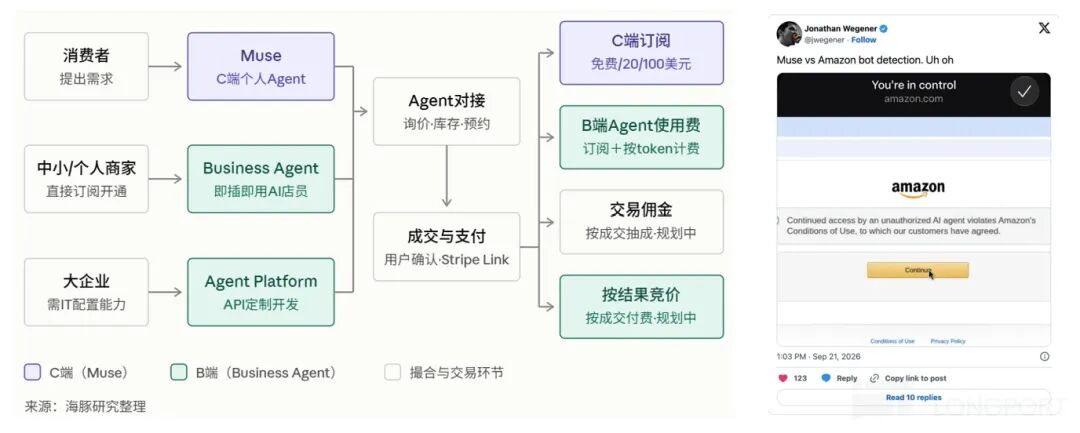
However, there is an obvious loophole in the above commercialization process:
Since Meta does not have its own e-commerce platform, a three-party closed-loop ecosystem can be formed if users have clear shopping targets and the merchants are independent site merchants. But if the merchants are settled on e-commerce platforms, this becomes a four-party ecosystem. Whether Muse is allowed to perform access and payment actions depends on whether the e-commerce platforms acquiesce to such operations.
Theoretically, Muse's shopping experience intercepts users' operations such as search, browsing and order placement on e-commerce platforms, which will directly affect the advertising revenue of e-commerce platforms.
Therefore, on September 20, Amazon announced that it would block Muse, which means Muse cannot perform operations such as browsing for price comparison and making payments on Amazon, and a violation warning window will pop up on the user end (as shown in the figure above). It is worth mentioning that not only Muse, Amazon has similar restrictions on the shopping Agents of OpenAI and Perplexity.
However, small and medium-sized e-commerce platforms, especially those with a high proportion of self-operated businesses, are more inclined to join Muse, as they essentially value the super App traffic of Meta. The e-commerce platforms that have joined at present are Shopify and Etsy, which are platforms with their own inventory and engaged in 1P business, so they are essentially the first large merchants. Meta has a very strong subjective willingness to import all social traffic to Muse, which is undoubtedly a considerable dividend for Shopify.
This loophole mainly affects the transaction commission commission or advertising effect in the above four business models, but has not much impact on the call of B-end Agent.
If mapped to the Chinese market, Tencent's WeChat ecosystem can be regarded as a perfect benchmark that has such private domain data and a relatively large public domain business ecosystem without the trouble of ecological restrictions (Muse - WeChat Mini Agent, independent site merchants - WeChat Mini Store, Shopify - Mini Program). However, in terms of cross-service privacy authorization, Tencent may not be so aggressive in the short term.
At the same time, there are also considerations on the cost side (according to survey information, when Muse simply executes tasks, the cost per user may be as high as 50 US dollars per month). Multiple considerations also make the current Mini Agent experience not "smooth" enough.
3. The incremental