OpenAI acquires Glass for over 300 million US dollars, how will the visual perception of AI-native hardware change?
OpenAI has acquired Glass Imaging (hereinafter referred to as Glass) in a deal valued at over 300 million US dollars. The neural ISP developed by Glass uses AI to improve the image quality of small cameras, making it possible for lenses and camera modules to be made smaller and thinner.
Prior to the acquisition, Glass had raised a total of approximately 31.5 million US dollars in financing from investors including GV, Insight Partners, Future Ventures, etc. Its most recent round was a 20 million US dollars Series A financing in May 2025, led by Insight Partners.
OpenAI previously acquired io, a co-founded company of Jony Ive, to develop its own AI-native hardware. The acquisition of Glass now is likely based on the logic of reconstructing the way AI-native hardware captures information from the physical world.
The Entrepreneur Who Spun Out of the iPhone Portrait Mode Project
Both of Glass's co-founders participated in the development of the iPhone portrait mode.
Ziv Attar (CEO, founder) founded LinX Imaging in 2011, focusing on dual-camera stereo vision and fusing black-and-white and color images to improve low-light image quality. In 2015, LinX was acquired by Apple, where he later led multiple computational photography projects, including the portrait mode launched with iPhone 7 Plus.
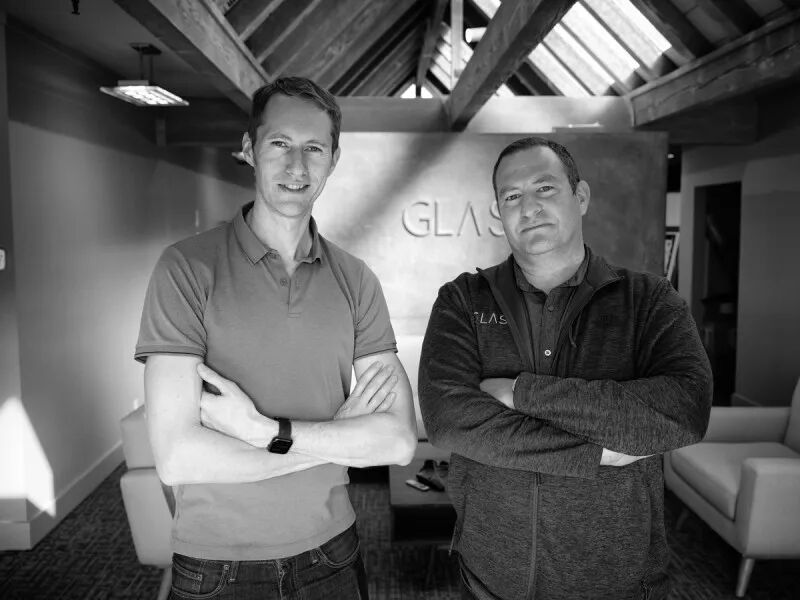
Glass's two co-founders, Image source: Glass Imaging
The other co-founder Tom Bishop (CTO) studied inverse imaging during his doctorate and postdoctoral periods, covering deblurring, super-resolution and depth estimation. From 2013 to 2018, he developed the core technology of portrait mode at Apple, and later led a team at a startup to research automatic photo editing and large-scale image recognition.
Portrait mode uses depth information and computation to simulate the background blur effect of large cameras. At Glass, the two founders continue to address the physical limitations of small cameras, applying neural networks to more underlying imaging processes and attempting to reshape lens design.
Neural ISP: Redesign Small Cameras With AI
Glass's product is a neural ISP (Neural Image Signal Processor) named Glass AI, which is essentially an end-to-end neural network trained for specific cameras. It can not only improve the image quality of existing cameras, but also leave more design space for smaller and thinner camera modules.
The miniaturization of cameras has always been accompanied by compromises in image quality. As lenses become smaller, it is more difficult to correct optical aberrations; limited by sensor size, noise tends to appear in low-light environments. Given a fixed sensor area, increasing the number of pixels will make each individual pixel smaller, and the same optical blur will cover more pixels. If you open the aperture to reduce the impact of diffraction on details, lens aberration may be aggravated. Therefore, as the pixel count increases, the details in photos may not be improved synchronously.
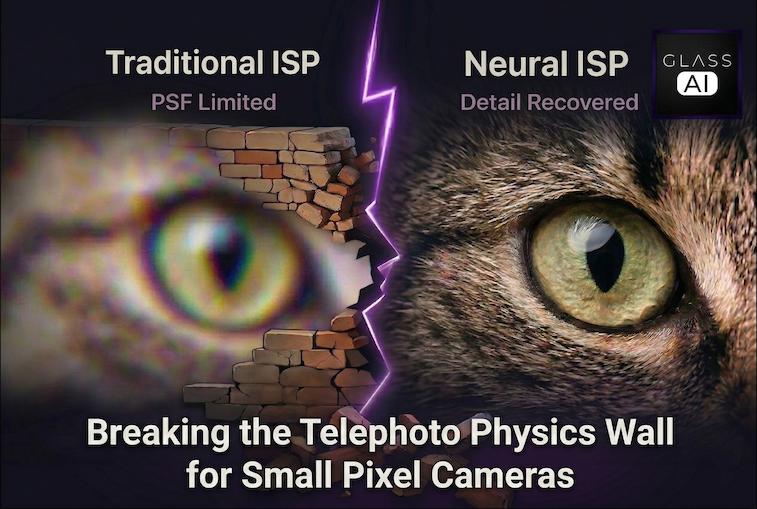
Mobile phone cameras first record unprocessed raw data (RAW), which is processed by the Image Signal Processor (ISP) before becoming the photos we see. Traditional ISPs are usually implemented by dedicated circuits integrated in the main chip of mobile phones, which process color interpolation, noise reduction, sharpening and other tasks separately. However, blur and noise exist at the same time. If the blur characteristics of the lens are not fully considered during noise reduction, the texture may be erased together with noise, and subsequent sharpening can hardly restore the lost details.
Glass AI delegates the main image reconstruction work to a neural network, which directly processes RAW data and completes color interpolation, noise reduction, aberration correction and detail recovery jointly. It can also align and fuse burst shot data, recover more information using the slight displacement between frames, and finally output RGB images for device manufacturers to perform subsequent processing such as color, tone and compression adjustment.

The training process of Glass AI
The ability to correct part of the optical defects allows corresponding compromises in camera hardware design. Manufacturers can try simpler and thinner lens structures, and leave the resulting aberrations that can be effectively corrected to the neural network for processing. On the premise of meeting imaging requirements, camera modules can be made smaller in size and lighter in weight. The AI and optical co-design mentioned by Glass refers to optimizing lenses and algorithms together from the design stage.
This capability relies on a full understanding of specific hardware. Glass trains the neural ISP for specific combinations of lenses and sensors: the main camera and telephoto camera of the same mobile phone need to be trained with exclusive models respectively; if the hardware is replaced, re-measurement and training for adaptation are required, while the same hardware can share the same model.
Glass has built an automated lab for this purpose, to measure the performance of target cameras under different lighting, object distance and focusing conditions, covering different positions of the frame and the lens shift caused by image stabilization, to master the unique blur, chromatic aberration and noise patterns of the hardware for model training.
According to the two founders, automated data collection and model training each take from several hours to one or two days, reducing the workload of manual measurement and tuning.
In a publicly disclosed simulation study on small-pixel cameras, the team generated RAW images based on the physical characteristics of lenses and sensors, and paired them with reference images in the simulation to train the neural ISP to jointly correct imaging defects such as optical blur and noise. The study demonstrated the reconstruction effect of the model on these simulated cameras. The trained network can complete the main reconstruction work from RAW to RGB in one go; Glass can also optimize the model for the device's NPU, so that images are processed locally on the device when being captured.
In January 2026, Glass demonstrated comparison results on Apple mobile phones: processed by Glass AI, the 12-megapixel telephoto camera of iPhone 16 Pro delivered detail performance in some high-magnification zoom scenarios that is close to or even exceeds the native 48-megapixel telephoto output of iPhone 17 Pro.
At the 2025 Snapdragon Technology Summit, Glass also demonstrated 4K video enhancement at 20x and higher magnifications on a reference device equipped with Snapdragon 8 Elite Gen 5. The neural ISP runs on Qualcomm Hexagon NPU, which improves noise, detail and picture stability of videos in real time.
OpenAI Acquiring Glass: From Taking Good Photos to Understanding the Physical World
Glass will most likely be used for visual perception in OpenAI's own hardware. In 2025, OpenAI acquired the team of io co-founded by Jony Ive, and started to develop new devices. Its consumer device division is also recruiting camera engineers, positioning the camera system as a key perception component, whose work covers the whole process from sensor access, raw image acquisition to mass production.
If AI devices are designed to be portable, their size and weight must be controlled, but side-end computing, sensors and communication all require power supply, and the battery cannot be too small. In the limited body of the device, every component is competing for space.
If Glass can help reduce the size of camera modules, it will free up space for batteries and other components, or reduce the overall weight of the device.
Glass used to focus on "how to make mobile phones take better photos". In the hands of OpenAI, its technology may be used to enable AI-native hardware to better perceive the physical world.
Mobile phone photos are mainly for people to view, so clarity, color and portrait effects will affect user evaluation. AI-native hardware, on the other hand, needs to read text, identify objects and understand what the user is doing from frames. A small section of text erased during noise reduction may affect the model's understanding of the entire frame. When the imaging system processes details, it needs to take subsequent recognition tasks into consideration.
It is conceivable that OpenAI will design cameras based on the information that the model needs to obtain: how to select lenses and sensors, which details must be retained, how to balance noise reduction and information loss in low-light environments, and finally evaluate the entire solution based on the performance of actual perception tasks. If the recognition effect is not ideal, adjustments can be made along the imaging process.
This direction can be called "AI-native visual perception camera". It designs optical acquisition, image reconstruction and model understanding in an integrated way. Glass can provide the underlying imaging capabilities in this process, and how its technology will be integrated with OpenAI's model after the acquisition will determine how much perceptual improvement it can bring to AI hardware.
With improved perception capabilities, the interaction between humans and AI may also change. Currently when using AI, in most cases users still need to describe the situation clearly, upload images and then ask questions. If the device can reliably understand the surrounding environment and the ongoing activities of the user, such background information can be automatically obtained by the device. When a user says "how do I do this", the AI may know exactly what "this" refers to, and give a response that is directly related to what the user is doing.
Going one step further, when perception is integrated with memory, reasoning and task execution, AI-native hardware can provide help at the right time. It needs to know which step the task has reached, what changes are worth reminding, and when it should stay quiet. The product form, interaction mode and service content of hardware can all be redesigned around this capability.
This opens up new product space for entrepreneurs. More reliable perception is expected to enable existing AI hardware to enter more usage scenarios, and make product ideas that were previously hard to implement due to the device's inability to see and understand the environment clearly become feasible. The technological improvement starting from underlying imaging may eventually give rise to new categories of AI-native hardware.
This article is from the WeChat Official Account "Alpha Startup" (ID: alphastartups), author: Discovering Extraordinary Entrepreneurs, published with authorization from 36Kr.