Jev vs Decitron: Both are decision-making AIs, why are they not the same thing?
Recently, a new model named Jev has suddenly gone viral.
It is developed by TypeSafe AI. This team with OpenAI background did not continue to compete in generation and reasoning, but changed direction: to let AI make judgments directly.
They even wrote their slogan explicitly: Decisions, not strings.
The skyrocketing popularity of Jev has made "Decision" a buzzword in the AI circle again.
But if we look back a few months, we will find that this trend did not emerge out of nowhere today.
Before Jev drew widespread attention, a "Decision AI" track had already emerged in China. In June this year, Zhongke Wenge (previously called "the first stock of decision-making large models" by some media) released the general decision-making large model Decitron Decision Machine, trying to integrate world models, multi-agent deduction, game theory and solving into a unified decision-making framework.
So here comes the question: both talking about "Decision AI", are Jev and Decitron essentially the same thing?
The answer is no. Both Jev and Decitron focus on Decision, but their understanding of "decision-making" is quite different.
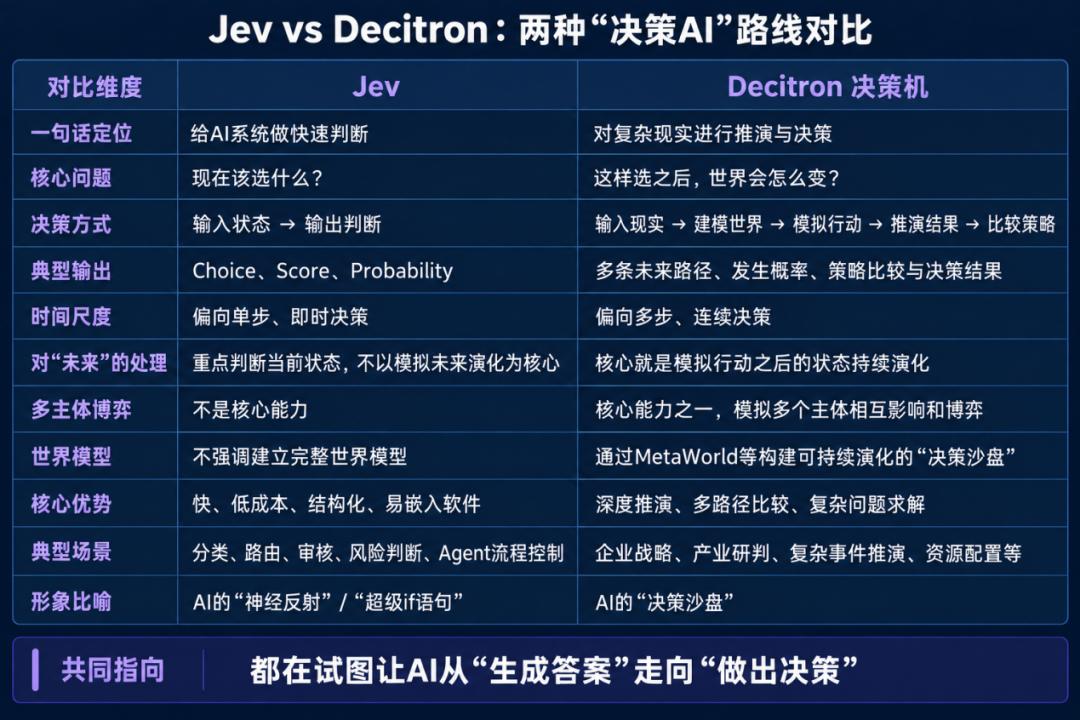
Jev turns decision-making into an instantaneous judgment, while Decitron turns decision-making into a deduction of the future.
One solves the problem of "what to choose right now", and the other solves "what will happen next after the choice is made".
Why are they worth comparing together?
At first glance, the two are far apart.
Jev emphasizes rapid judgment, mainly serving software and Agents; Decitron emphasizes complex world deduction, targeting strategic, industrial and complex system decision-making scenarios.
But if we take a broader perspective, we will find that they are actually working on the same thing, that is, both are rethinking: can the output of AI be more than just a piece of text?
The default output of traditional large models is a string of text.
When you ask a question, it generates an answer, and then a human or program decides what to do next.
Jev is very straightforward on this point: no text, just decisions. It turns AI outputs into Choice, Score, Probability, results that software can execute directly.
AI is no longer just "answering you", but begins to directly participate in program branching and actions. Decitron reaches the same core question from a different path.
What it focuses on is not generating an "analysis of the future", but splitting the real world into states, subjects, actions and results, then comparing different paths through multi-agent deduction, game and solving.
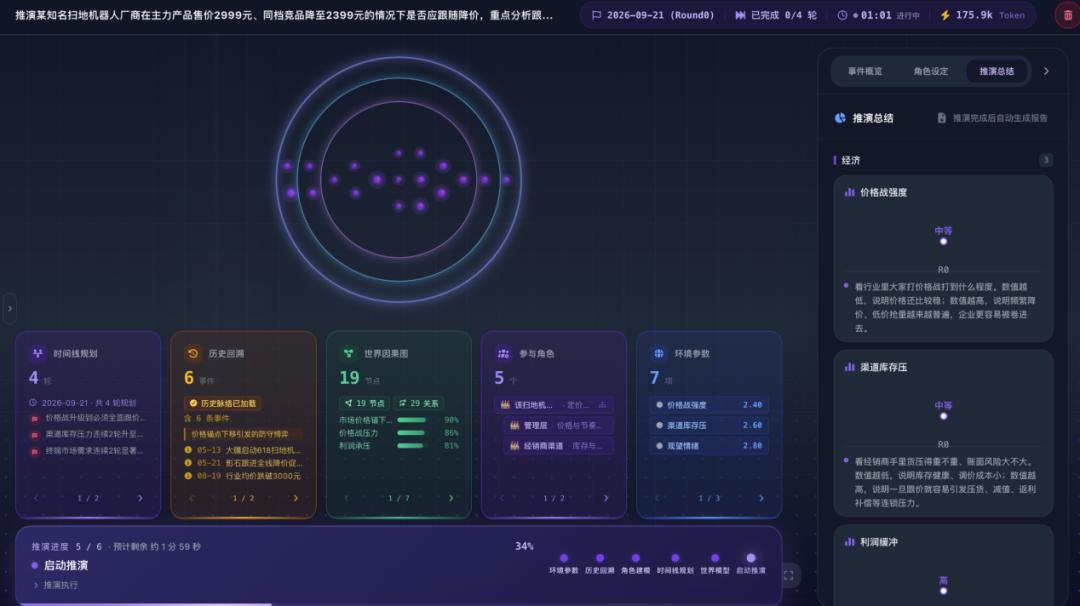
Therefore, the first real common point of Jev and Decitron is: both are trying to make AI output move further from "generating content" to "supporting judgment and action".
The second common point is that both emphasize that uncertainty should be explicitly quantified.
Jev tells the system: I choose A, but the confidence level is only 72%.
What Decitron focuses on is another kind of uncertainty: under the changes of different subjects, actions and environments, which paths the future may evolve along.
One quantifies the uncertainty of the current judgment, and the other deals with the uncertainty of future evolution.
The underlying logic is consistent: AI cannot only give conclusions, but also tell you how credible the conclusions are.
More importantly, both of them are trying to turn "decision-making" into an independent AI computing paradigm.
The logic of Jev is: input state → output judgment; the logic of Decitron is: input reality → world modeling → action simulation → result deduction → strategy comparison.
One compresses decision-making into an extremely short time, and the other expands decision-making into multiple future worlds.
Jev: Compress Decision-making into a Single Judgment
What Jev aims to solve are the judgment questions that require immediate answers: A or B? How high is the risk? Should we transfer to manual processing? Which process should be taken next?
For example, a customer service system receives a request: "My credit card has been charged twice."
Traditional large models may first generate a paragraph of analysis. But Jev prefers to output directly: Billing: 96%; Fraud: 3%; Other: 1%.
Then the program proceeds to the next step immediately.
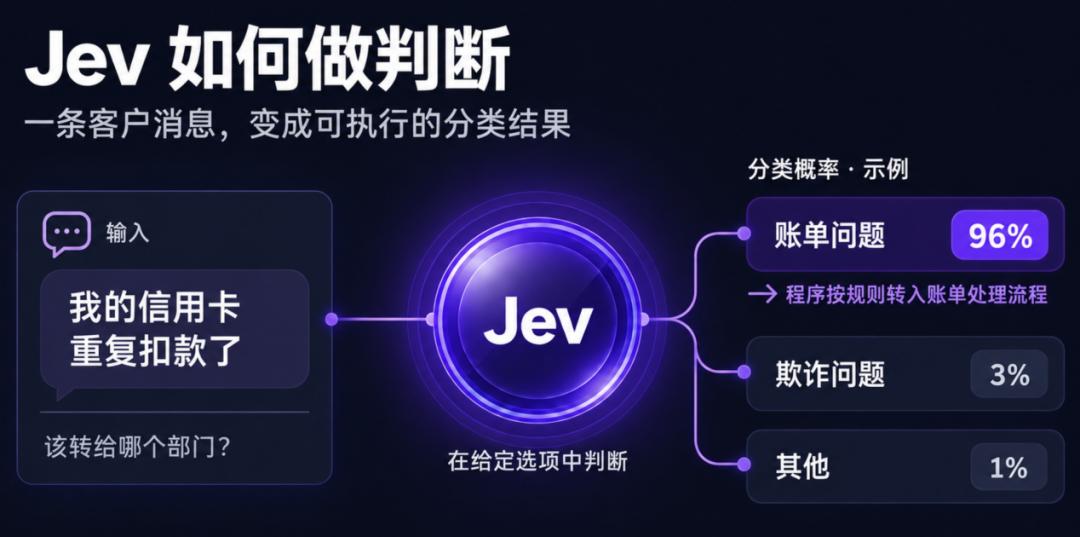
So from an engineering perspective, Jev has done a very interesting thing: it upgrades the if/else in traditional software to an AI version of if/else.
In the past, programmers needed to hardcode in advance: if A happens, execute B. Now it can be changed to: if AI judges that the probability of A happening exceeds 80%, execute B.
This also determines Jev's core goals: fast, low-cost, stable, and capable of being directly embedded into software.
Decitron: Expand Decision-making into a Deduction Process
But some decisions are not "multiple-choice questions" at all.
Should an enterprise expand its production capacity? If it does, will competitors cut their prices? If competitors cut prices, will the market pattern change? If policies, raw material costs and market demand change at the same time, will the original choice still be valid?
In such scenarios, the "A or B" framework is no longer sufficient.
Because in the real world: your choice will change the world; after the world changes, other parties will make new choices accordingly.
This is exactly the problem Decitron is trying to solve.
It does not only focus on "what to choose right now", but further models: State → Action → Outcome.
That is, what is the current state of the world? What actions will different participants take? What will the world become after these actions? Then the next round of iteration starts.
Enterprises take actions, competitors respond; competitors respond, the market changes; the market changes, all parties make new decisions again.
Decision-making is no longer a single point, but a continuously growing timeline.
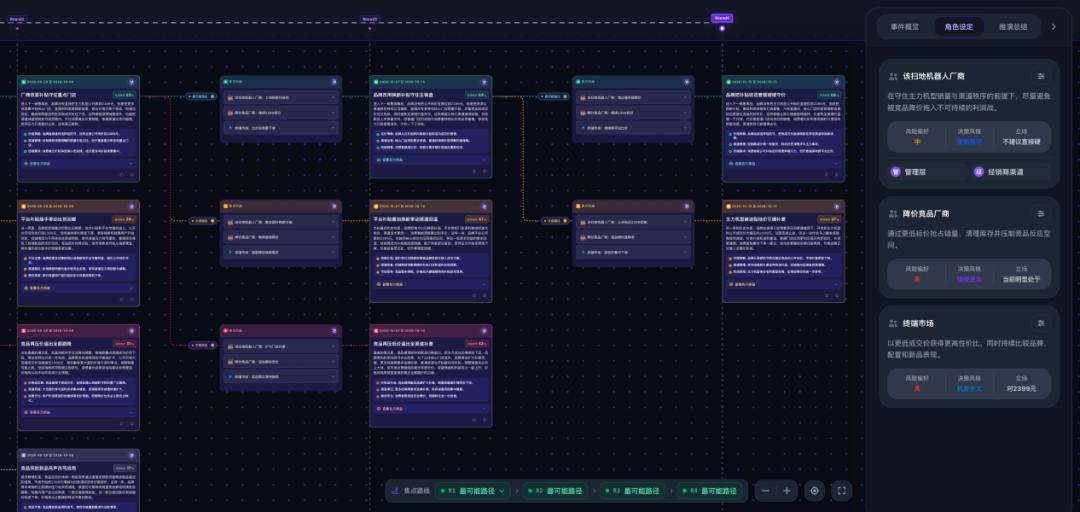
Therefore, Decitron introduces world models, multi-agent deduction, game theory and solving modules.
To put it simply, the world model is responsible for building a "sand table"; the multi-agent system is responsible for placing different participants into it; game theory and solving modules are responsible for calculating where different choices may lead the world.
The real watershed lies in the different understandings of "decision-making" between the two:
Jev turns decision-making into a current instant judgment, while Decitron expands decision-making into a deduction of the future.
From Generation to Decision, AI is Shifting Its Battlefield
Why did Jev become popular right at this moment?
Because a trend is emerging in the AI industry: generative AI solves "how to answer", while decision AI starts to solve "how to choose".
In June this year, Zhongke Wenge released Decitron, formally bringing the "general decision-making large model" to the public eye; a few months later, Jev quickly gained attention with the slogan "Decisions, not strings".
Jev makes "judgment" faster and cost-effective enough to be integrated into the daily workflows of software and Agents; Decitron targets more complex decision-making problems, and compares the possible outcomes of different choices through world modeling, multi-agent deduction and solving.
One handles "how to choose now", and the other handles "what will happen after the choice is made".
But the two together at least illustrate one thing: when "generation capability" has gradually become the basic capability of AI, the industry has begun to focus on "decision-making capability".
The next competition may not only lie in "how well AI can speak", but also in whether AI "can make the right choices" when the world is constantly changing.
*This article is republished with authorization from QbitAI, and the views expressed are solely those of the original author.
This article is from WeChat official account "QbitAI", author: Yunzhong, 36Kr is publishing it with authorization.