Deconstructing the Muse Narrative: The logic of the "new entry point" does not hold
In April 2016, ten years ago, Mark Zuckerberg demonstrated a chatbot in Messenger at the F8 Developer Conference in San Francisco, sending a message to the bot of florist 1-800-Flowers to order a bouquet of flowers.
He said to the audience, "I have never met anyone who enjoys calling businesses." He then added that there would no longer be any need to call 1-800-Flowers to order flowers in the future.
That year, Messenger had just surpassed 900 million monthly active users, with over 40 partners including CNN, eBay and Walmart. Zuckerberg's judgment was that no one wanted to install a separate app for every single merchant, and dialog boxes could replace all of them.
On September 8, 2026, the same company launched its personal AI Agent product Muse. Users send messages to it in the standalone app or WhatsApp, and it contacts merchants on behalf of users to complete purchases, a logic that bears a striking resemblance to the idea put forward ten years ago.
The world has changed dramatically over the decade, and technology has made tremendous progress. Muse runs on a separate virtual machine allocated for each user in Meta's cloud, capable of operating browsers, filling out forms, comparing prices and placing orders, and processing emails. It continues to perform tasks in the background even after the user closes the application.
13 days after its launch, Muse reached No.1 on both the US iOS and Android free app charts, with more than 2.5 million downloads.
Meta's stock price and market narrative have come full circle over the past decade.
The "conversational commerce" concept in 2016 failed to become a core entry point. Messenger bots were eventually reduced to customer service tools, and the assistant M, which relied on human backup, was shut down in early 2018.
In 2023, Zuckerberg announced that the year would be the "Year of Efficiency", rolling out layoffs, compressing management layers, and lowering capital expenditure expectations. Meta's stock price rose nearly 200% for the whole year. Back then, the market rewarded cost reduction;
In 2026, Meta raised its full-year capital expenditure guidance to at least $130 billion, and its free cash flow in the second quarter dropped to $784 million. On September 21, the 13th day after Muse's launch, Meta's share price rose 11.4% in a single day. This time, the market rewarded spending on growth.
Investors have long been waiting for a consumer-side use case that can deliver returns on massive capital expenditures, and Muse emerged at exactly this moment.
Every leap in AI technology prompts tech giants to try to seize a super entry point facing consumers with it. The power of this imagination far outweighs the reality.
But what determines whether a product can become an entry point is never just whether it can get things done, but also who pays after things are done, who is willing to give access, and whether users will stay.
Muse answers the first question better than any of its predecessors, but the last three questions still have no answers, just like ten years ago.
The 5th Entry Point Attempt
Every 2 to 3 years, the narrative of "AI driving a new entry point" returns with higher technical maturity and greater market enthusiasm.
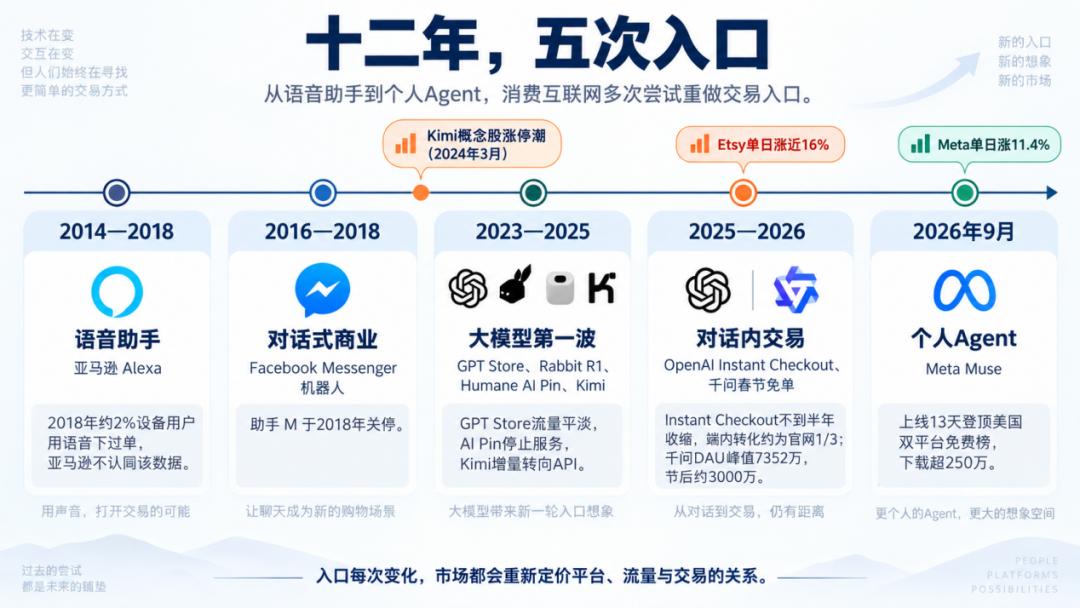
After Amazon released Echo in 2014, Alexa was expected to become the hub of household consumption. However, by 2018, only about 2% of Alexa device users had placed orders via voice, and about 90% of them never tried it a second time. Although Amazon did not recognize these figures cited by The Information from people familiar with the matter, it did not provide alternative data either.
In the two years after the Messenger bot was released at F8, its presence continued to decline, and Facebook no longer promoted Messenger as the main battlefield for its commercial platform.
In 2023, when ChatGPT first became a hit, the GPT Store and plugins were called the "App Store of the AI era". In the same period, Rabbit R1 and Humane AI Pin were launched with the narrative of "replacing the smartphone". The A-share market saw a surge in limit-ups of Kimi-related concept stocks in March 2024, when Kimi's labels, apart from long text processing, were all about 2C scenarios.
The end result was that the GPT Store had tepid traffic; Humane sold its assets to HP in early 2025, and the AI Pin was shut down soon after; Kimi's main subsequent growth came from overseas API calls, and the story of it becoming a C-side entry point never came true.
On September 29, 2025, ChatGPT launched Instant Checkout, allowing users to complete purchases directly in conversations. On the day of the announcement, Etsy's share price rose nearly 16%. Less than half a year later, OpenAI scaled back this feature, returning the checkout process to merchants. Daniel Danker, a senior executive at Walmart, revealed that the conversion rate of in-app checkout was only 1/3 of the rate when users were redirected back to Walmart's official website.
The most recent similar event was during this year's Spring Festival, when Alibaba's Qwen completed 120 million orders in 6 days with a 3 billion yuan free order campaign. Its DAU counted by Quest Mobile once surged to 73.52 million, and remained at around 30 million after the peak.
Muse is already the 5th attempt. The common point of all past attempts is that the market almost always pays for the hype, but every attempt only ends up as a "function" instead of evolving into a real "entry point".
Failures are often attributed to technology, but in fact, speakers more than ten years ago could already understand the instruction "buy another pack of tissues", yet users stopped using it after trying once.
Muse's experience has of course made great progress. Greg, an analyst at Morgan Stanley, tested Muse to buy a hat, and it took less than two minutes from sending the request to receiving the confirmation email. Muse also proactively reminded him of his flight time and suggested expedited delivery. The experience that Zuckerberg promised ten years ago has finally been realized.
But the barriers to many problems do not lie in the model. The day after Muse launched, payment media PYMNTS asked Muse to restock items on Amazon, order pizza at Domino's, and make a reservation on Resy. None of the three tasks were completed, and it was stuck at account authorization, connecting Gmail and calendar one by one, and the checkout process.
If the entry point story still does not hold this time, the reason may still have nothing to do with technology.
Time: Wasted or Eliminated
The reason why the market believes that personal Agents will become a new entry point largely comes from the sensory experience of the past decade — Feed stream recommendation has reshaped the entry point pattern of the Internet.
Douyin uses algorithmic recommendation to seize a lot of user time from search and social scenarios. Data from Nomura cited from QuestMobile shows that in July this year, Douyin had 714 million daily active users, and each DAU spent about 2 hours on the app per day, with the total usage time surpassing that of WeChat for the first time.
Short videos, live streams, and feed stream advertisements essentially extend users' stay time and create demands during the stay.
But the premise of the success of recommendation streams is that people have a large amount of time that they are willing to waste.
Scrolling through Douyin and browsing Pinduoduo is entertainment in itself for many users. Huang Zheng once described Pinduoduo as a combination of Costco and Disney in his letter to shareholders: half of Costco is about efficiency, and half of Disney is about killing time.
The product logic of personal Agents is exactly the opposite.
Its value lies in eliminating time: users hand over a task to the Agent, the Agent completes it in the background, and the user can go do other things.
Muse takes this to the extreme: it continues to work after the user closes the app, and only comes back to the user when approval is needed.
Personal Agents may be able to generate demands: Muse can turn the recipe Reels that users have saved into a shopping list, propose menus for dinner parties, remember friends' dietary restrictions, and actively send invitations; the Agent that Qwen opened to brands is designed to send itinerary reminders, equity expiration reminders and repurchase recommendations.
Analysts at Morgan Stanley also found that Muse will proactively tell users "I can do this for you"; the recommendations and reminders from silicon-based assistants can sometimes make people buy more things.
The demands it generates have two characteristics.
First, they are highly dependent on existing intentions or records. Renewals, repurchases, product exchanges, switching to a cheaper insurance plan are mostly replacement demands, rarely emerging out of thin air.
Second, it does not generate stay time. The recommendation stream retains people when they have no purpose, and every extra minute of stay brings one more exposure; all the efforts of the Agent are to get people to leave as soon as possible, and finish the task and go.
A reviewer from MBI Deep Dives quickly used 81% of the weekly quota of the free tier after Muse launched, and he thought the best use of Muse was to connect all his Gmail accounts. As for ordering takeout, he wrote:
At least half the time, he does not know what he wants to eat, and he only makes up his mind during the browsing process on DoorDash, the US version of Ele.me.
For people who already know what they want, Agents can improve efficiency; for people who have not made up their minds, browsing itself is decision-making, and skipping browsing means skipping the stage where demands are formed.
Just as Muse can turn recipe Reels into a shopping list, the idea of cooking is generated in the recommendation stream of Instagram, and the Agent only takes over the execution.
No matter how fanatical the AI evangelism is, the credit for Instagram's recommendation stream should not be attributed to the Agent just because AI is newer and more interesting.
Once the Agent starts to make active recommendations, it moves closer to the recommendation system. In e-commerce and local life scenarios, the revenue of recommendation slots naturally comes from sellers.
In early June this year, some media did a real test: they asked Doubao to compare the prices of the same headphone on three platforms, but the product card of Douyin Mall was hung at the bottom of the answer.
Whoever pays the money gets the Agent to speak for them, which is the fundamental problem facing Agents.
Orders Without Seeing Users
Search engines have built one of the most successful business models on the Internet.
Its core exchange relationship is that users get information for free, search engines get user intentions, and merchants pay for these intentions.
But search itself is also a time-eliminating tool, the faster users find answers the better. It can become an entry point by relying on delivery, which has nothing to do with user stay time.
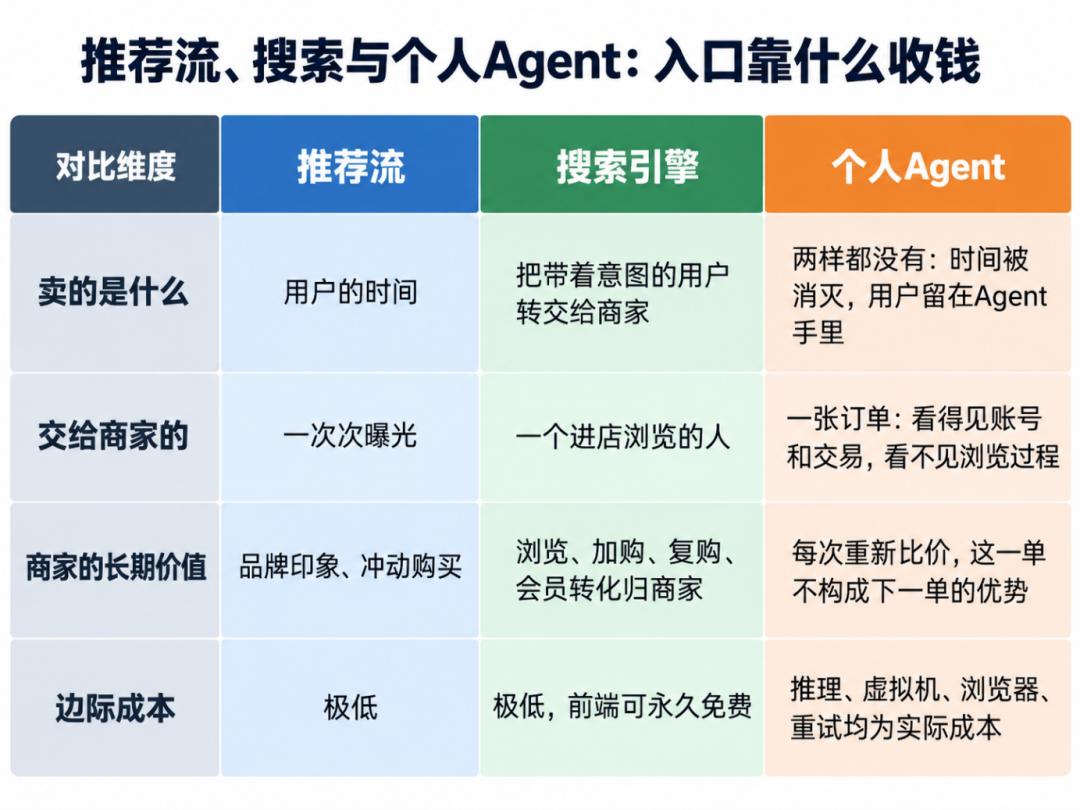
Search engines send a person with a clear intention to the merchant's website. The browsing, adding to cart, repurchase, membership conversion and brand impression of this person after entering the website all belong to the merchant; merchants pay for this redirection, because one click can turn into a long-term customer.
The monetization of Internet entry points generally only has two paths: either kill users' time like the recommendation stream, or directly transfer users to merchants like search, and be able to afford to let go of users.
Agents stand on neither side. It eliminates time, but also wants to keep users in its own hands.
What it gives to merchants is only an order. Merchants can see the account, shipping address and this transaction, but cannot see the person who browsed in the store: no browsing, no stay, no attraction from other products on the homepage, and no one will remember this brand.
The next price comparison will be done all over again by the Agent, and the victory of this order does not constitute an advantage for the next order.
For merchants, transactions mediated by Agents are more like one-off deals. This difference will inevitably affect merchants' willingness to pay.
Search can be free at the front end and charge merchants at the back end, because merchants get the users, and the marginal cost of serving one query is extremely low.
Agents have real marginal costs at the front end: inference, virtual machines, browser rendering, and failure retries all cost money; what they hand over to merchants at the back end is an order that does not come with user relationships.
Meta wants to take advantage of both sides. Now it is charging users subscriptions on the one hand, and plans to charge commissions from merchants on the other.
Muse currently offers three tiers of pricing: the free tier offers about 100 million tokens per week, the Power tier costs $20 per month, and the Maximum tier costs $100 per month. Alexandr Wang, Meta's Chief AI Officer, said that the vast majority of users are sufficient with the free tier, and the subscription tiers are designed to help cover the computing power costs of heavy users.
Zuckerberg revealed that Meta eventually wants to take a small cut of the transactions facilitated by Muse, and this fee may be borne by merchants, as Muse will "help you make money and help you save money".
Putting these three things together, there is a fundamental contradiction.
Helping users save money means suppressing merchants' profits, or shifting market share from one merchant to another. The thinner merchants' profits are, the less willing they are to pay commissions;
Subscriptions are only intended to cover the computing power of heavy users, so the scale of paying users is destined to be small.
Some institutions have already calculated this account.
Oppenheimer, which has a neutral rating on Meta, did an estimate: with about 1.91 billion Muse users, based on a 6% paid conversion rate similar to that of ChatGPT, there will be about 115 million paying users, each paying $20 per month, generating about $27.5 billion a year, corresponding to an approximate 20% increase in Meta's earnings per share.
The analysts themselves doubt whether Muse can reach this point, citing paid conversion, competition and user trust as reasons; their estimate for ChatGPT's paying users is only 33 million to 88 million.
Morgan Stanley's calculation is even less optimistic. If Muse reaches 100 million users in 2028, each user makes 5 queries per day, 10% of which have commercial value, and each query monetizes $0.07, the total annual revenue is about $1.3 billion, contributing only 1% to Meta's earnings per share in that year.
Meta's advertising revenue in the second quarter of this year was $59.36 billion, with an annualized rate of about $237 billion. The revenue calculated by one institution is about 12% of the existing stock, and the other is less than 1%.
Even in Meta's revenue landscape, personal Agent subscription fees are only a supporting role.
Taking Sides is a Craft
All business models that try to build personal Agents have to answer a fundamental contradiction:
Are you serving consumers, or are you serving merchants?
Muse's demos can help users compare prices, cut