The wildly popular Muse actually lets real humans make phone calls in place of AI?
As long as you are patient enough, you can always wait for Meta to bring some new bizarre anecdotes.
Just as the leaks on September 22 show, Meta has been testing a new feature for its employees: letting real people make phone calls for Muse users, which was originally an AI function.
This service is called "human concierge". Users assign tasks to Muse, and Muse can forward some of the phone call requests to external contractors, where real people will make the calls and get things done.
According to current reports, this is only an internal test for employees, and the service has not been publicly launched for ordinary users. But as soon as the news came out, everyone did not spare Meta. Amid the public controversy, Meta has urgently withdrawn this plan.
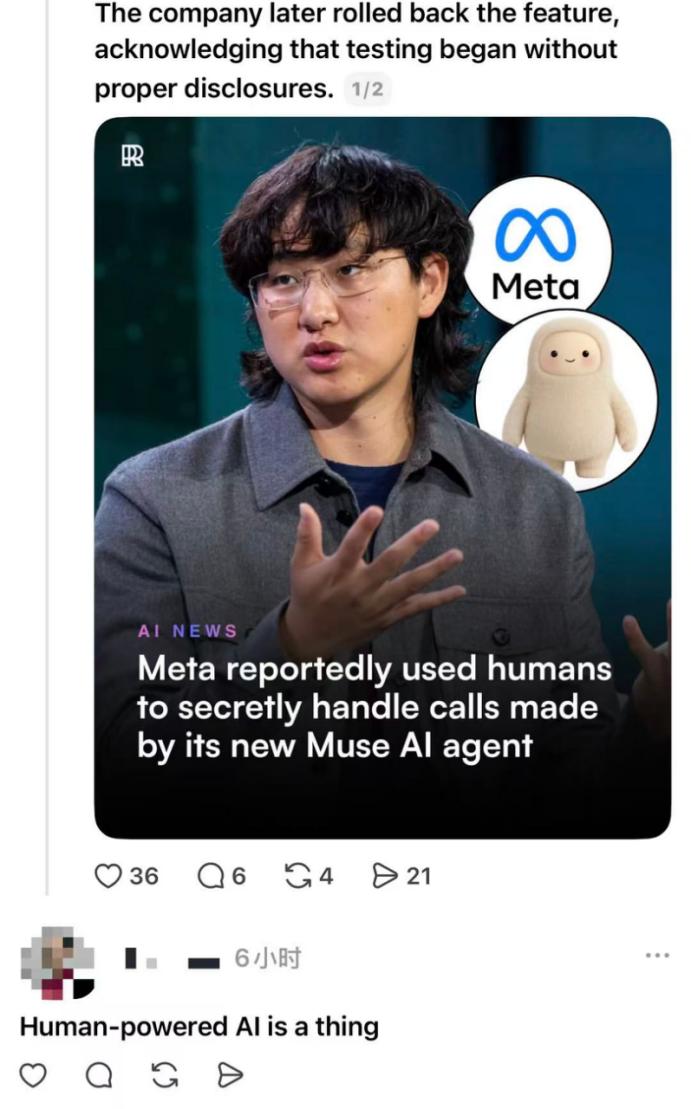
No wonder they have to withdraw it. In an instant, the sexy AI software has turned into an old-fashioned phone agency service.
Young people may not know that this kind of service was popular at home and abroad in the early 2000s. For example, China Mobile cooperated with Ctrip in 2003 to provide national hotel and air ticket booking services. There was also a service called "Order Food Secretary" in Shanghai, which helped make thousands of food ordering calls every day.
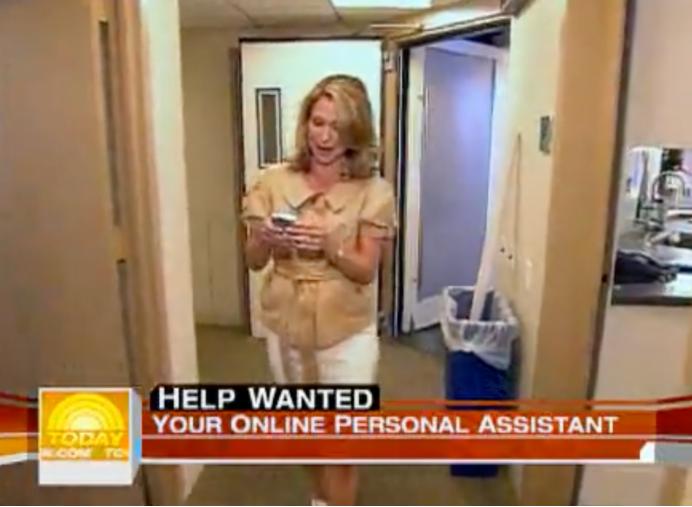
Netizens did not stay idle. Some people have started to joke about the outsourcing cost: "Filipino workers are cheaper than tokens." Others satirized: "Human-driven AI does exist as expected." "AI = Assistant Indians."


The funniest part is that I don't know if Mark Zuckerberg has some special obsession with real people making calls on behalf of users, but he has already done this kind of thing ten years ago.
Real people making calls on behalf of users, even employees can't hold back
Everyone knows that the Muse app has taken off. Ten days after its launch, it topped the free iPhone app chart on the US App Store, ahead of ChatGPT, Gemini, Claude, and even its own Instagram.
By September 22, Reuters cited data from Sensor Tower that the cumulative number of downloads of Muse since its launch has exceeded 2.5 million. In other words, in just two weeks, this new product has attracted millions of downloads.
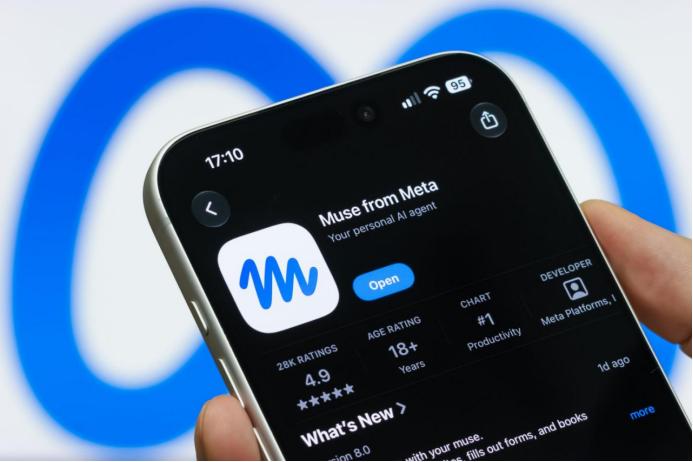
Its main selling point is that it can help users get things done, send emails, arrange trips, and even make phone calls for you.
But in the actual use process, Meta found a problem: some people will hang up the phone as soon as they hear it is AI, which directly affects the task success rate. One employee reported that he asked Muse to call the insurance company, and the other party kept hanging up as soon as they heard it was AI.
In related discussion posts, you can indeed see netizens saying: "If an AI calls my store, I will really hang up directly."

Then some genius at Meta had a sudden idea: why don't we use real people to make the calls?
No matter who came up with this solution, Zuckerberg nodded in agreement anyway, so the "human concierge" service started testing within Meta.
Meta was also very considerate, and specifically stated in the internal notice that if you are not willing to participate in the test, you can join a dedicated group to opt out of the test.
It's just a real-person call service, a bit corny, but what could go wrong?
Plenty could go wrong. You know, when Muse was launched, Meta specifically emphasized its security features.
According to the official introduction, each user's Muse has an independent cloud virtual machine, isolated from the running environment of other users; sensitive information such as passwords and payment credentials are stored in secure storage, and Muse can call them but cannot see the original text. Users can also decide which apps it can access and what permissions it gets.
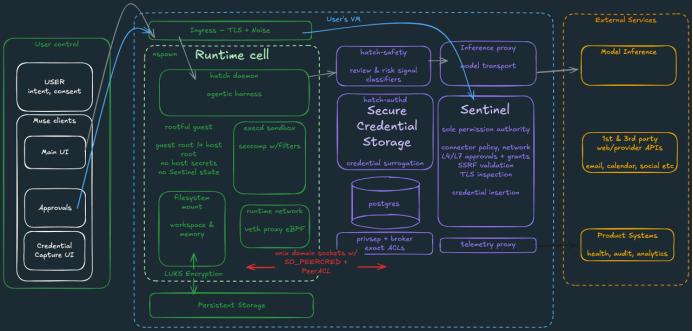
Then, if the AI phone call is replaced by a real person, there will be third-party contractors, and with third-party contractors, users' privacy will have hidden dangers. The fact that you are willing to let AI handle things does not mean that you are willing to let a stranger know what you need to do and what personal information you need to provide.
According to 404 Media, some employees reflected in internal discussions that colleagues participating in the test were not told that the person making the call for them was a real person until the call ended. When providing information before, they always thought that the task was performed by AI.
In response to employees' concerns, Meta explained that contractors have received a lot of training to ensure data security. But some employees directly pointed out that training is not equal to a security mechanism. Others reminded that if it is really to be launched, users should at least be allowed to choose by themselves, instead of turning it on by default.
This is not difficult to understand. Telling users "this person has received training" is not the same as letting users know in advance "your information will be handed over to this person".
In addition, there is another problem: behind the real-person call service are real, flesh-and-blood human beings, and humans have their own uncertainties.
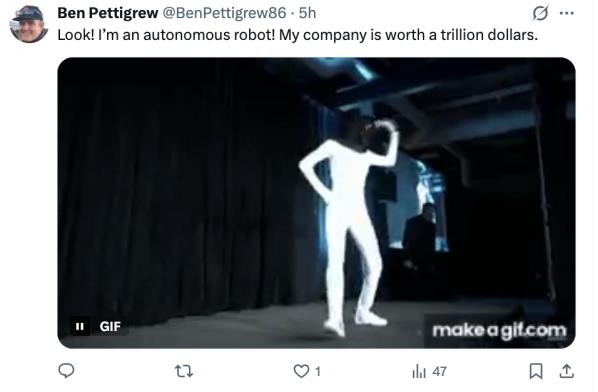
One employee asked Muse to call the internet and cable TV service provider to negotiate the bill price for him. But when he checked the call record, he found that the contractor's staff used a racially discriminatory expression during the call. Meta later apologized to the employee and said that the involved person would not participate in any Meta projects in the future.
Originally, they wanted to find someone to improve reliability, but now they have to deal with the problems brought by this person.

When this incident came out, Meta was also very embarrassed. After all, Muse is in the limelight, but such a farce happened.
A vice president of Meta's Superintelligence Lab admitted that starting the test of real people making phone calls without full disclosure was a mistake, and the company has temporarily withdrawn this function. What has been withdrawn is the real-person call function of the internal test, not the entire Muse, nor does it mean that all AI phone functions have been taken offline.
Externally, Meta emphasized that the internal test was originally designed to collect feedback and improve security and privacy protection before public release. This potential function will only be launched after it is ready and proper disclosures are made.
As for why they insisted on adding real people, the reason Meta gave was the success rate. The vice president said that in some tests, real people making phone calls can increase the success rate to 95% to 98%, which is higher than the performance of AI making phone calls.
But the weird part is: to improve the success rate, the question is what exactly is the success rate improved after adding real people?

For users who just want to get things done, having real people to help may certainly be valuable. But the fact that a real person completes the task does not mean that AI has learned to do it. If users don't even know who is working for them, this impressive success rate is even more questionable.
Letting AI make calls and handle things on behalf of users is not something only Meta is doing. Google showed Duplex as early as 2018, allowing AI to make phone calls to book restaurants and haircuts.
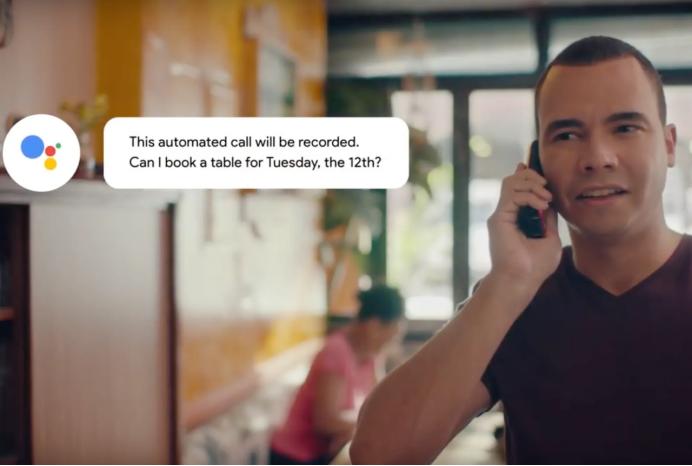
Businesses' reluctance to answer AI calls cannot simply be attributed to human prejudice against AI. At least according to the feedback from some people who receive calls, the problem is very practical: AI is not smooth enough, and it delays things.
Some netizens said that they work in a restaurant, and they have been receiving calls from AI to make reservations and ask if the restaurant is busy for a while. But the robot speaks slowly, and there are some deliberately added background sounds in the call, which makes people feel that it is imitating a real human conversation. These calls always come in when they are busy greeting and receiving guests.
Working in a restaurant is already so busy that you barely have time to breathe, and receiving such calls is really frustrating.

Therefore, at least for this kind of problem, the key in the final analysis is that AI needs to improve its relevant capabilities. The idea of using humans to make up for AI's shortcomings may need to be carefully considered.
Why is Mark Zuckerberg so obsessed with "real people making calls on behalf of users"?
Seeing that this farce happened at Meta, the author has already covered his face and smiled bitterly, because this company has a criminal record in this regard.
This incident happened eleven years ago, and it was simply a PLUS version of the farce.
In 2015, the company had not changed its name to Meta and was still called Facebook. At that time, Facebook was already vigorously developing AI, and the famous Yann LeCun had just joined the company for a year and a half. Under this background, its app Messenger launched the M assistant.
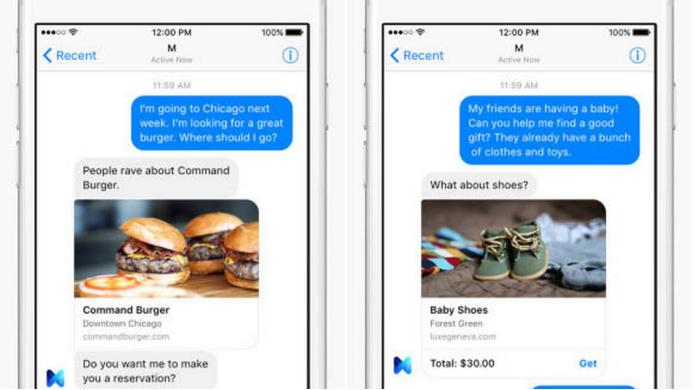
Similar to what Muse can do today, users send requests to the M assistant, and it can handle them on their behalf, such as booking restaurants, changing flight tickets, buying gifts and sending flowers. The only difference is that at that time, users communicated with the M assistant through text.
But this function was only open to a limited number of users for testing, and it was shut down less than three years later in 2018. The media exposed an astonishing figure: in fact, the so-called AI assistant function had an overall automation rate of no more than 30%.
In other words, 70% of the tasks handled by the M assistant were actually completed by real people.
Simply put, according to Facebook's official introduction at that time, human operators would check the replies proposed by AI and then give appropriate answers, while AI watched and learned beside. Things that the machine can't handle also need humans to take over. For example, if a user wants to order flowers, the system has to learn to ask about the budget first, and then ask where to deliver them.
Facebook's plan was to hire a group of real people to support the service first, and their processing process would become training materials at the same time. Today, humans teach machines to do things, and tomorrow machines will do things by themselves. When AI learns to do more and more things, the amount of manual work can be reduced.
But obviously, they finally failed to achieve the goal of letting AI take over more work and dilute the cost.
When Facebook launched the M assistant, it did not completely hide that real people would be involved behind the scenes, but the statement was ambiguous, saying that the M assistant was driven by "artificial intelligence trained and supervised by humans