GPT-6 Sol/Luna Release: Permanent 50% Price Cut, OpenAI Locks the Price War Firmly on the Cost Curve
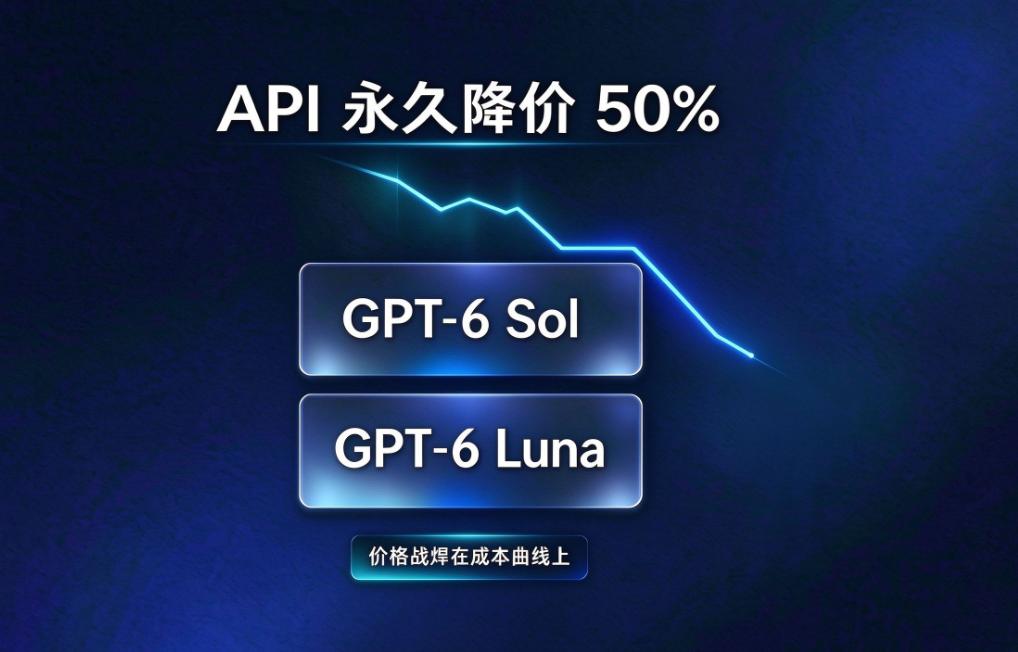
The large model price war has now targeted the "permanent" positioning.
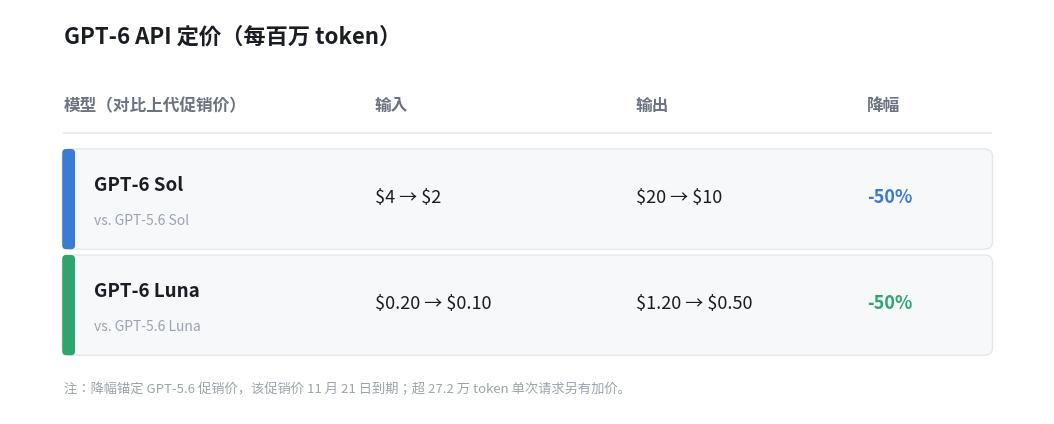
Yesterday, OpenAI released GPT-6 Sol and GPT-6 Luna. According to official statements, compared with the promotional price of GPT-5.6, the API price is further reduced by 50% — and this is a permanent pricing policy, no limited-time gimmicks. The input price of Sol is $2 per million tokens, and the output price is $10, while Luna is directly priced at $0.1 for input and $0.5 for output.
On the same morning, Anthropic just launched Opus 5.5. 90 minutes later, OpenAI completely disrupted the market rhythm.
OpenAI released GPT-6 Sol/Luna, with a permanent 50% cut in API prices, and Luna's $0.1 input price sets the lowest price point for frontier models. Its peak score has a slight drop, and the comparison targets avoid the Opus 5.5 released on the same day — the price cut is real, and the tricks in official statements also need to be examined clearly.
What Are the Two Models
What can be confirmed from public information is that this release transfers part of the progress of GPT-6 Astra in programming, professional work, fact accuracy and computer operation to two faster and cheaper models.
The specifications are as follows: Sol is oriented to complex programming and Agent workflows, while Luna focuses on high-frequency and low-cost tasks. Both support 1.05 million token context, maximum 128,000 output, and the inference intensity can be adjusted in 6 gears. The API model names are gpt-6-sol and gpt-6-luna respectively.
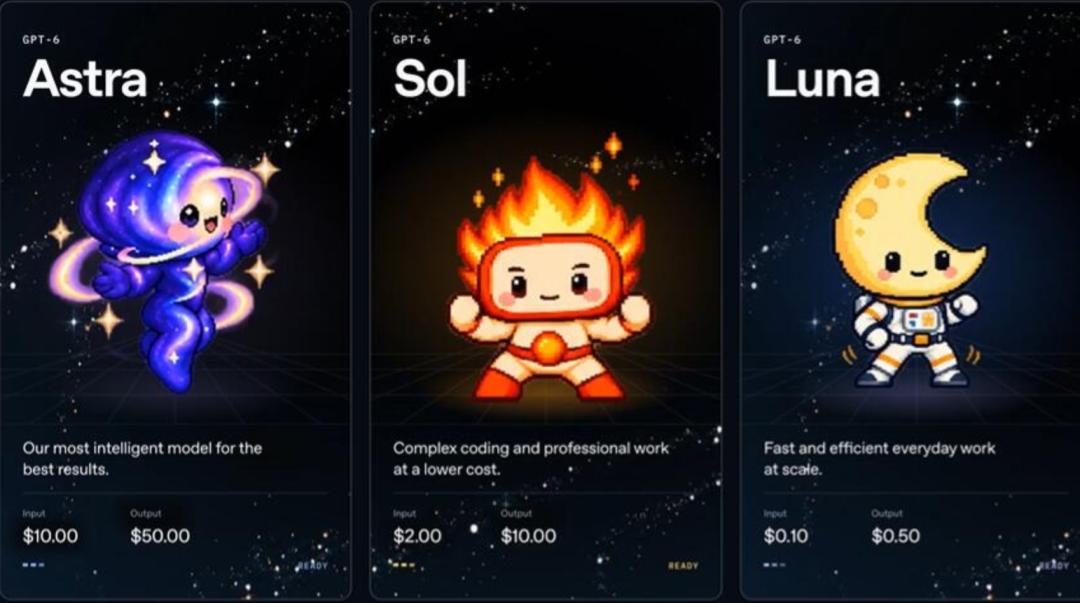
According to internal test data, Sol's factual error rate is about half of the previous generation; Sol reaches a maximum of 68.8% in DeepSWE 1.1, and Luna reaches 66.6%. In the official cost comparison, the single-task cost of Sol on AutomationBench is $0.27, with a higher score than Opus 5 and the cost is only 9% of Opus 5's; Luna's DeepSWE performance is close to the mid-range level of Opus 5 and Fable 5, and the single-task cost is 93% and 96% lower respectively.
Availability: Plus, Pro, Business, Enterprise, and Edu users can access the two models on ChatGPT Work and Codex, and the APIs are opened simultaneously; Free and Go users can use Luna on desktop applications. The regular chat interface has not been connected yet.
Mechanism: Trading Scores for Cost, How the Curve Shifts
The core change of this upgrade can be illustrated clearly with one graph.
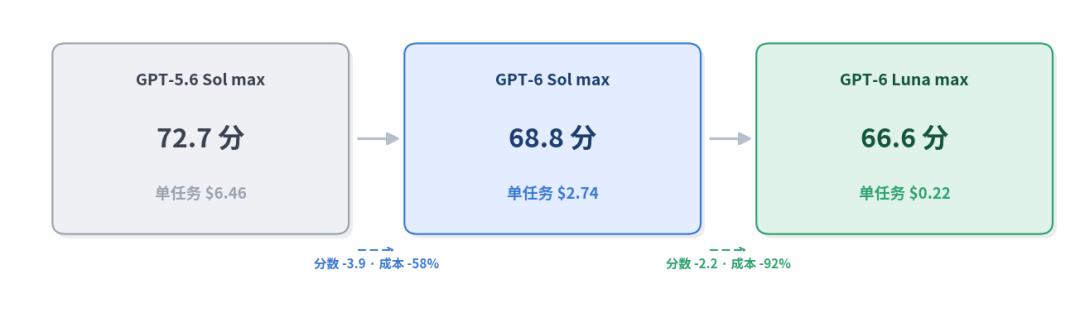
Break down the data: On DeepSWE v1.1, Sol's highest score is 68.8%, lower than the previous generation Sol's 72.7% and also lower than Opus 5's 73.7%; the OSWorld 2.0 computer operation score also drops back to 60.5% from the previous generation's 65.7%. The peak score is reduced, but the entire cost curve shifts to the left — the number of tasks that can be run with the same budget is multiplied by two or three times, and the price for the same score range is much lower.
This trade-off points to a clear judgment: for teams that run thousands of Agent calls every day, the single-task cost is more important than the peak score. OpenAI shifts the overall cost-performance curve to the left, gives up the peak score market, and captures the mass market with large shipment volume.
Luna is the sharpest product in this strategy: the $0.1 input price is the floor price of all frontier-level models, and free users can use it on the desktop side.
Why Right Now
The release density itself speaks for the problem. On September 21, xAI released Grok 4.7 with an input price of $2; on September 22, Anthropic released Opus 5.5; 90 minutes later, OpenAI's Sol also set its input price at $2.
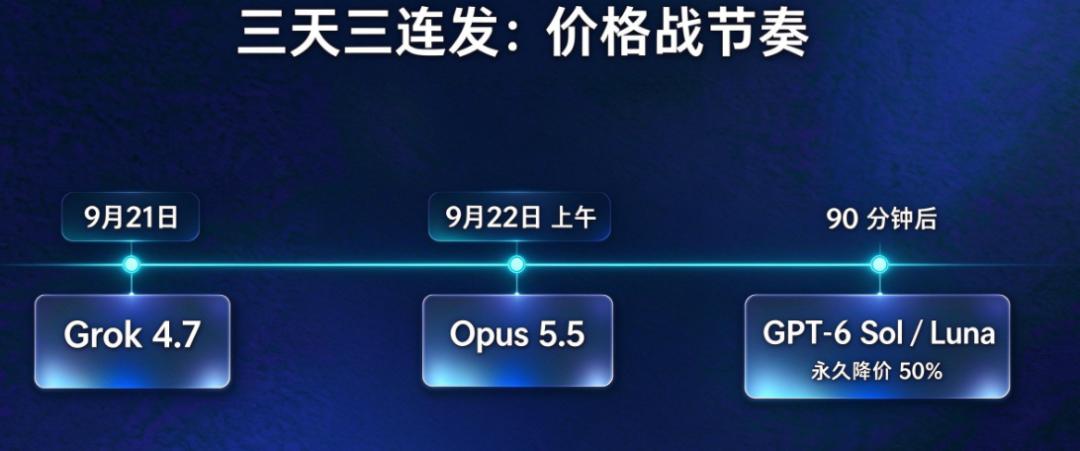
A reasonable deduction is that the price war has moved from the stage of "benefiting users through cost reduction" to the stage of "positioning pricing": whoever occupies the default option in developers' minds will win the second half of the competition. The official explicitly stated "permanent pricing" to the media, which completely blocks the possibility of returning to higher prices after promotion — this is a long-term positioning move.
Another observation point: The GPT-6 series currently does not have the mid-range Terra model. Either it will be released later, or OpenAI judges that the bipolar structure of "flagship Astra + high-volume Sol/Luna" is already sufficient.
Boundaries and Deduction
Several issues in the official statements need to be clarified.
Regarding comparison targets: Opus 5.5 released on the same day outperforms Sol on two benchmarks with the same caliber from both companies — 40.0% vs 33.2% on AutomationBench, 54.4% vs 49.3% on FrontierCode 1.1 — but OpenAI's official comparison chart only includes Opus 5 and Fable 5, and the official explanation is that "Fable 5 is used as a substitute when there is no sub-item data".
Regarding the benchmark of price reduction: The anchor of "50% price reduction" is the promotional price of GPT-5.6, which will expire on November 21 and will rise back to the original price at that time; if compared with the original price, the actual price reduction is 60%. There is also a hidden clause: if a single request exceeds 272,000 tokens, the input price will be doubled, and the output price will be multiplied by 1.5.
Regarding actual measurement: Third-party tests ran the same set of construction tasks on three GPT-6 models, Astra got full marks, Sol ranked second, and Luna ranked third, the order is consistent with the price; the low-cost model is 2 to 6 times faster, but the finished results all have visible flaws. All the numbers on the ranking lists are based on the manufacturers' self-test calibers, and there is no third-party cross-manufacturer horizontal evaluation result with the same caliber yet.
Conclusion
In terms of credibility, the facts on the ground are clear: the APIs are already open, the pricing is permanent, and the free desktop version is available. What remains questionable is the capability narrative — the peak score drops back, and the comparison targets are selectively selected, so the word "upgrade" does not hold in the peak dimension.
The industry signal of this release lies in the pricing structure: three weeks ago, Astra pushed the capability ceiling, and now Sol and Luna break the price floor. One product family covers all budget levels from enterprise-level inference to high-frequency document processing. The actual impact on developers is very direct: the selection standard shifts from the unit price per token to the single-task cost.
There are two observation points in the next round: the third-party horizontal evaluation results of Opus 5.5 and GPT-6 Sol with the same caliber, and whether the mid-range Terra model will be added to the product line. The second half of the price war has just made its first move.
This article is from the WeChat official account "AI Contrarian", and is authorized for release by 36Kr.