Outperforming ChatGPT, what can Meta's Muse do?
Less than two weeks after its launch, it topped the US iOS free app chart, with both downloads and daily active users exceeding the levels of ChatGPT in the same period. Muse, the personal AI agent released by Meta on September 8, has become the most eye-catching product in the global AI industry recently. Mark Zuckerberg, CEO of Meta, defines it as "a personal agent that can understand users' goals and complete tasks for users around the clock", noting that this is the first step toward "personal superintelligence".
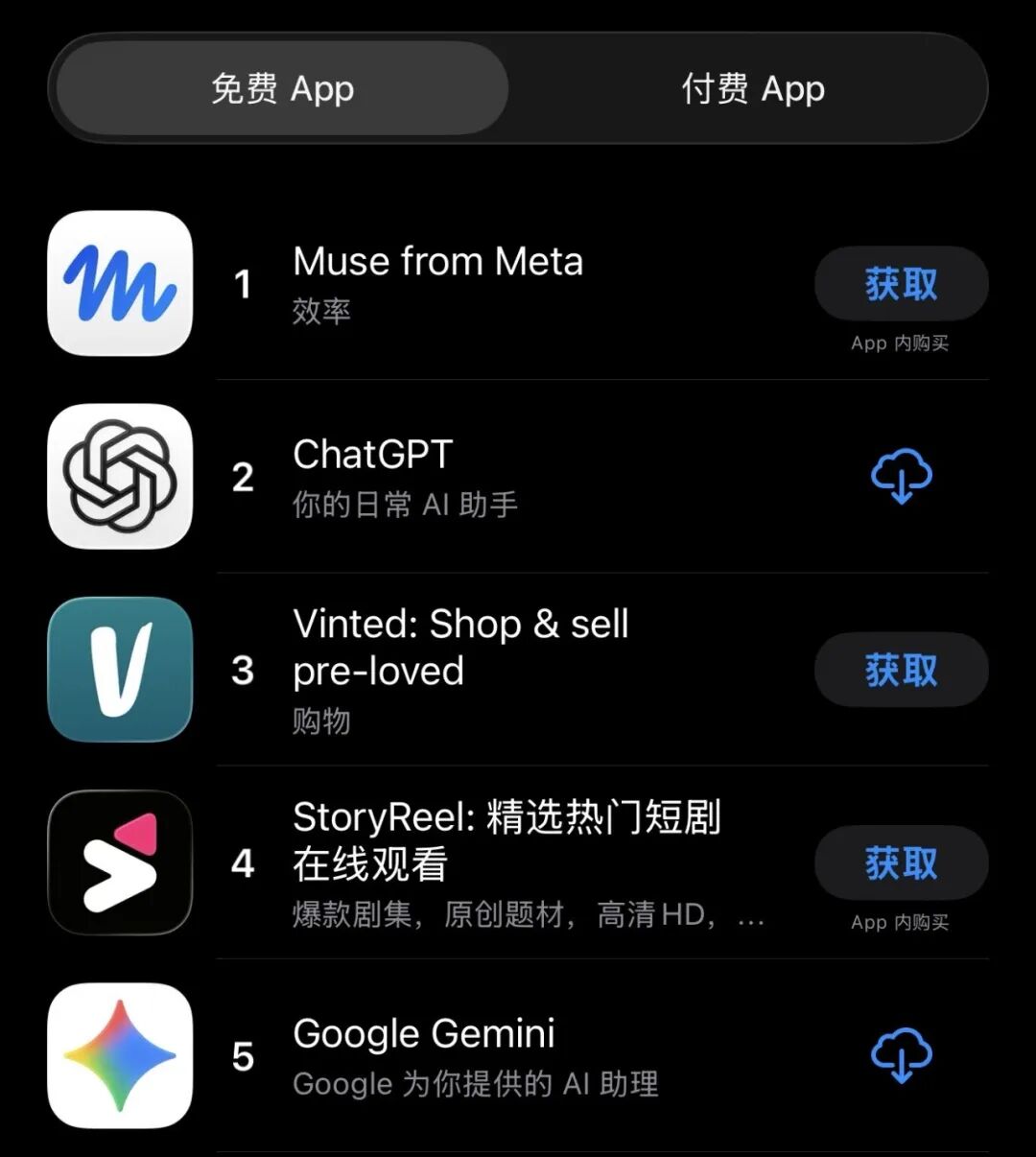
Muse tops the US iOS free app chart Image source: Jiemian News
What exactly can Muse do? Different from the traditional chatbot's "one question, one answer" mode, Meta positions it as a "personal AI agent": users do not need to issue instructions step by step, they only need to state their goals, and Muse will independently break down tasks, open web pages, fill in forms and call external applications for execution. In other words, Muse's function has shifted from "giving answers" to "getting things done".
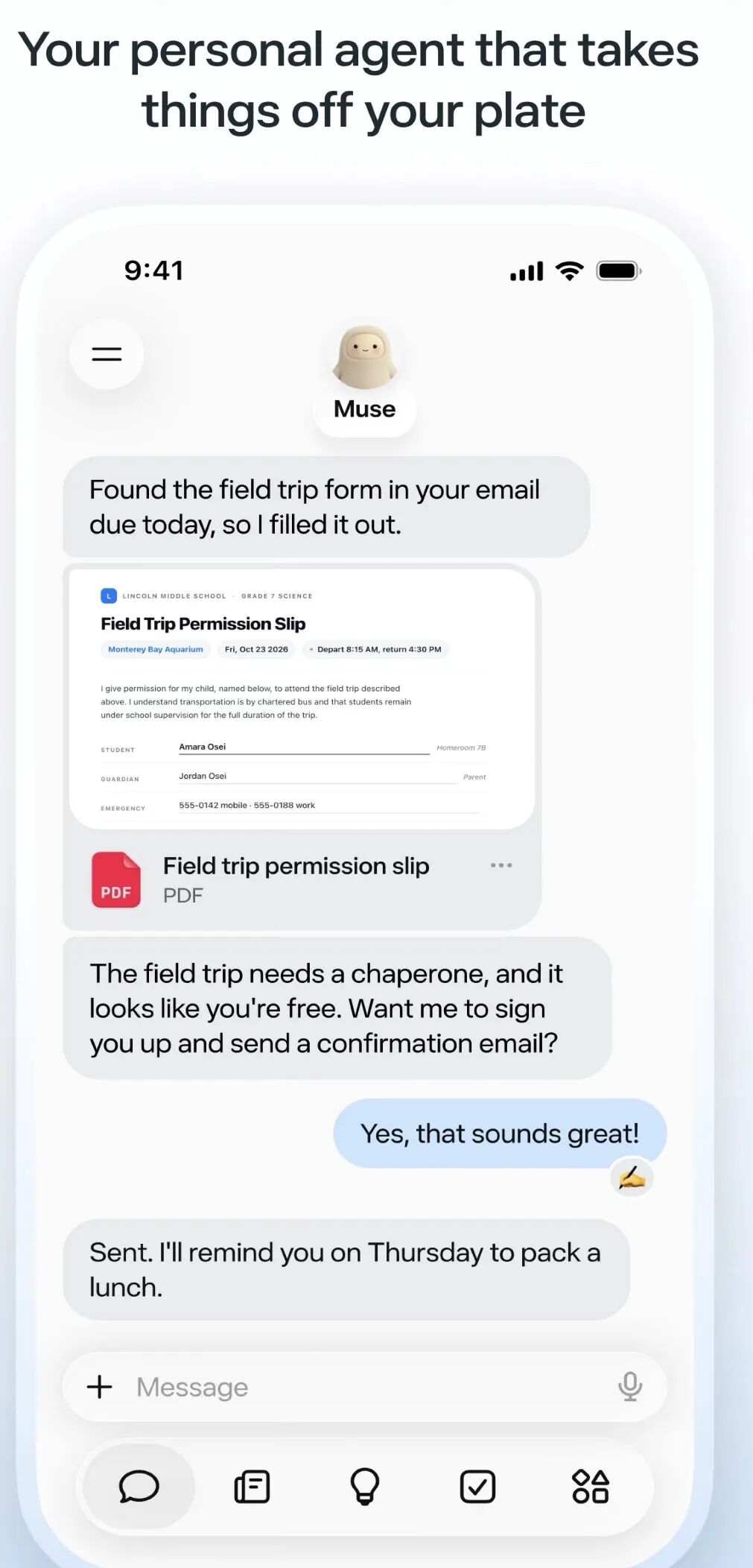
Muse helps users fill out forms and arrange follow-up plans
According to the official introduction, it can write and send emails, arrange schedules, book travel and restaurants, place online shopping orders, fill out web forms on behalf of users, and even participate in bill negotiations and assist in selling cars; for long-term goals such as fitness and entrepreneurship, it can first make plans and then continuously track progress. For example, for the goal of "selling your old car at a higher price within four weeks", Muse can check market conditions, list the car on trading platforms, reply to buyers, and coordinate viewing times; in travel scenarios, it can search for flights and hotels, fill in forms, plan itineraries according to budget and complete reservations; in daily office scenarios, it can organize mailboxes, draft and send emails, make meeting outlines, fill in reimbursement or registration forms; in family scenarios, it can convert users' collected recipes into shopping lists, generate dinner party menus and send invitations based on the dietary restrictions of relatives and friends.
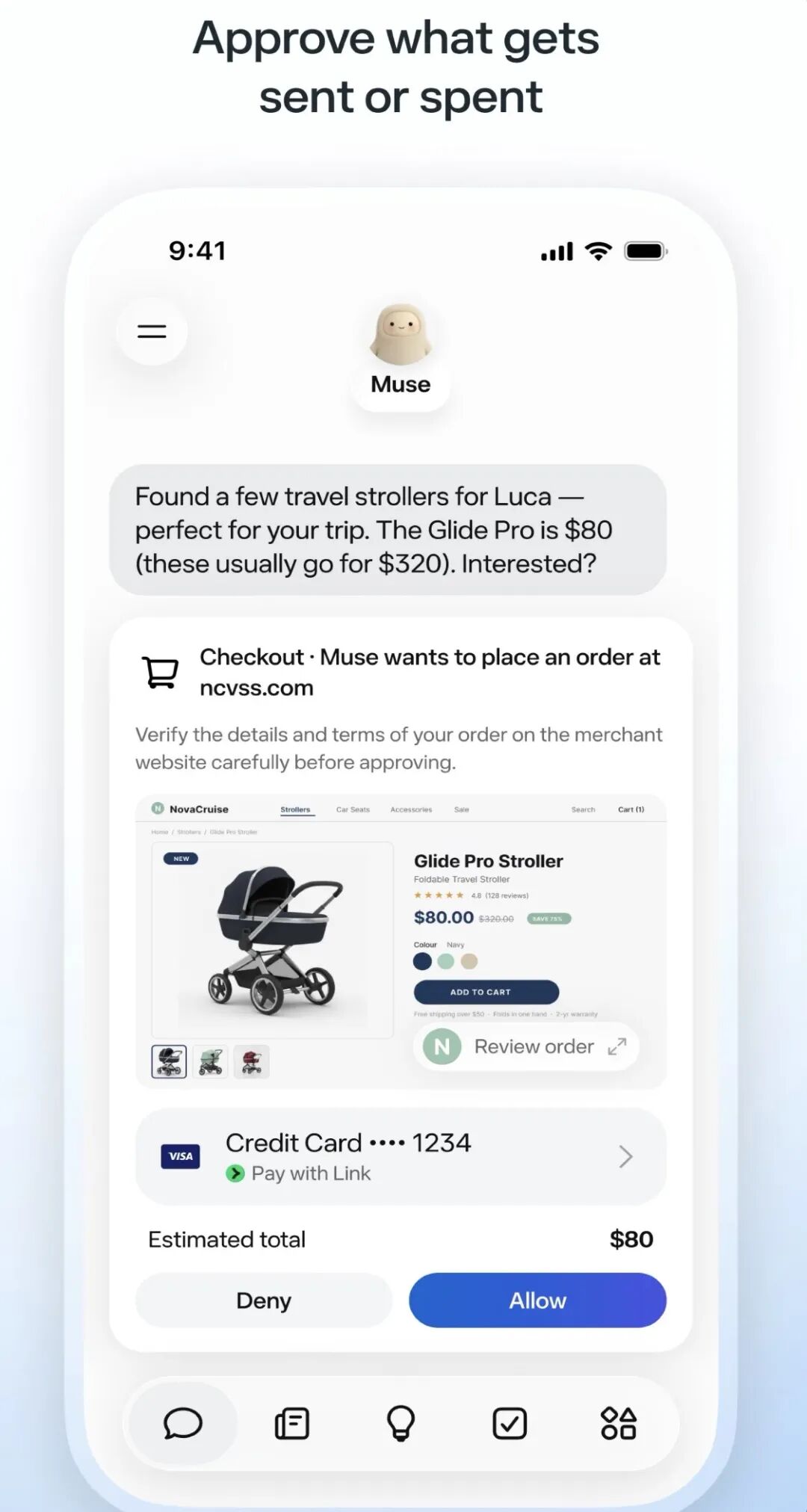
Muse shopping demonstration
Especially in the shopping and payment process, Muse generates a one-time card number through Stripe Link, and eligible orders enjoy purchase protection services covering loss, price reduction and return, with Shop Pay and 1Password to be connected later. Unlike assistants that only answer questions, each user of Muse has an independent virtual machine located in Meta's cloud. Even if the application is closed, Muse can continue to execute tasks in the background until the task changes or sensitive operations requiring authorization occur, and then return to confirm with the user.
In terms of pricing, Muse offers a free version with a free quota of about 100 million Tokens per week in the early launch stage, and two subscription tiers of $20 and $100 per month respectively. It is open to users aged 18 and above, and only available in the United States and Canada. At present, in addition to the standalone app, it also has a web version, and will be integrated into Meta's AI glasses in the future.
At the beginning of its launch, Muse performed very impressively. Data from Sensor Tower shows that Muse recorded 730,000 downloads about 5 days after its launch; Apptopia data shows that its cumulative downloads in the United States and Canada reached 2.8 million in the first 12 days of launch. According to the same statistical standard, the iOS downloads in the same period were about 1.8 million, higher than the 1.3 million of ChatGPT in the same period, while Claude and Grok only had about 400,000 and 200,000 downloads respectively in the same window. In terms of daily active users, Muse's US mobile daily active users are about 642,000, far exceeding the 231,000 of ChatGPT in the same period. Even when comparing only the iOS platform, Muse still leads the performance of ChatGPT in its launch period with about 359,000 daily active users.
The day after Muse was released, Meta's stock price closed up 6.55%; on September 21, it even soared 11.43% in a single day to $741.24, once touching $753 during the trading session, hitting a new high in more than 7 months. Its market value has increased by more than 200 billion US dollars cumulatively since the release, and the stock price has risen by more than 20% cumulatively. Wells Fargo raised Meta's target price from $640 to $796 that day; Jefferies raised it to $875, and estimated that if Muse attracts 1 billion users by the end of 2027 with a paid conversion rate of no less than 3%, its annualized revenue can reach 10.8 billion US dollars.
Analysts believe that Muse's top ranking and daily active user data convince the market that Meta can convert its social user base of about 4 billion into distribution advantages for AI assistants; if the transaction agent operates smoothly in the future, it can also draw commissions from reservations, shopping and B2B access. Muse has the potential to become "the most widely used consumer-grade AI application after ChatGPT".
At present, competition in the consumer-grade AI sector is becoming increasingly fierce. ChatGPT's monthly active users have exceeded 1 billion, and Google's Gemini also reached 1 billion monthly active users in August this year. After consumer-grade AI shifted from "chatting" to "getting work done", OpenAI, Google and Anthropic have all bet on agents that can perform tasks independently, and Meta is also trying to open up a consumer-level entry with Muse to bring AI agents to ordinary users. Whether Muse can grow from a "phenomenal start" to the "personal superintelligence" mentioned by Zuckerberg remains to be verified by time. After all, Meta's own products such as Vibes once became a hit at the beginning, and then faded into obscurity for various reasons.
For ordinary users, the most worth trying low-risk "semi-automatic" tasks of Muse at present include organizing inboxes, drafting travel plans, generating shopping lists, tracking prices, and reminding schedules; for high-risk tasks such as sending emails and making payments on behalf of users, single authorization and small amount limits should be set first. It is still unknown whether Muse can truly pass the two checkpoints of "reliably completing tasks" and "winning user trust". However, the previous popularity at least proves that the inflection point for personal AI agents to move from demos to mass consumption is approaching.
This article is from the WeChat Official Account "Jiemian News", author: Li Kefeng, published with authorization from 36Kr.