Alibaba's Chen Yusen: 100 Days in His New Mandate: Changes, Hardware and Context
Be the first to set off amid the thriving chaos of the industry.
From the official announcement of taking over as CEO of DingTalk on June 11 to the public speech at the Yunqi Conference on September 22, Chen Yusen, born in 1992, has spent 100 days "taking up the mission at a critical moment".
The changes in these 100 days were carried out in full swing: first, the organizational adjustment of DingTalk in June; then the internal competition at Alibaba ended in July, and the three product lines of QoderWork, Wukong and MuleRun were merged into Qianwen Office, which is under the unified charge of Chen Yusen; after that, Qianwen Office officially launched public beta in August, deeply embedded in DingTalk to compete with Tencent WorkBuddy and ByteDance Doubao Work.
The Qianwen Office special session at the Yunqi Conference on September 22 attracted extremely high attention, which was Chen Yusen's first public appearance 100 days after taking office. He presented a relaxed demeanor, and the microphone in his hand was hung with the mascot of Qianwen Office - a little green octopus. He said that he hopes we can also have the well-deserved relaxing moments in our work in the future.
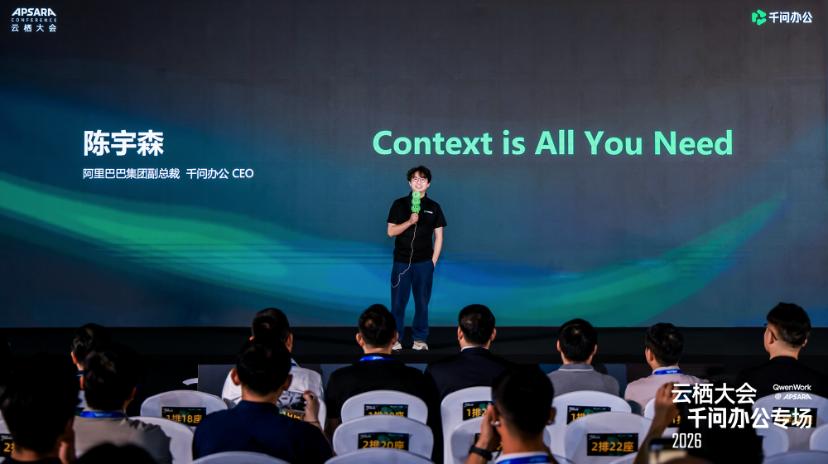
The title of Chen Yusen's speech is "Context is All You Need". "Context" in the office scenario specifically refers to the massive amount of documents, emails, meeting records and chat history of enterprises in daily work, which can be explained in plain language: Context is everything.
"Qianwen Office is an enterprise-level Agent product", Chen Yusen said, hoping that in the eyes of everyone, Qianwen Office will be an enterprise-level Agent product that understands business, supports collaboration and is trustworthy.
One of the core releases of Chen Yusen is "Enterprise Context", a product for enterprise context data management, which structurally connects the data previously called "tacit knowledge" such as enterprise documents, meetings and group chats, compresses it layer by layer, and extracts it for Agent use on demand. Based on the enterprise context product and the Agent hosting capability of Qianwen Office, Qianwen Office can help enterprises build digital employees that understand their business.
Another highlight is AI stepping into the physical world. Chen Yusen released the Agent hardware QwenNote A2. Compared with the previous DingTalk voice recorder card A1, the core of A2 is to record information in various scenarios anytime and anywhere through speech-to-text transcription, and users can also call Qianwen Office to perform tasks via voice. To protect user privacy, A2 does not retain the original audio, and the transcription content only retains text and meeting minutes.
"We serve a large number of customers who use Feishu and WeCom for internal communication, which will be a particularly important core of Qianwen Office in the future. Whether it is Qianwen Office or Enterprise Context, we must adhere to the principle: openness, and more openness." Chen Yusen's speech won applause from the scene.
At the Yunqi Conference, Shu Junliang, Vice President of Qianwen Office, was interviewed by the media. Shu Junliang was the former CTO of Alibaba's MuleRun. After taking over DingTalk with Chen Yusen, he was in charge of the new Wukong team, and now he is also the head of product and R&D of Qianwen Office.
The following is a selection of dialogues, which has been edited:
Blue Hole Business: Qianwen Office has been online for two months. Looking back, what are the key node changes? What is the real race point for Agent office?
Shu Junliang: We also discussed internally before, and there is a very interesting word that can describe the current development state of the entire AI Agent industry - "thriving chaos".
Everyone feels full of energy, this track is very promising, and AI Agent is very fresh and interesting. Many enterprises are willing to embrace AI Agent, but they have not thought clearly about what kind of AI they need.
In such a market competition state, there is bound to be some chaos. It is the same as starting a business in the past: no matter how far the ship can sail, you have to set off first. Even if it is a broken boat, you can repair it while sailing, but the important thing is to start first.
From this perspective, we have done a pretty good job in the past two months. We set off relatively early, we are among the major manufacturers that completed integration relatively early, we launched the product at the first time, won the first wave of reputation in the market, and today we can still launch new features at a very high frequency. From this perspective, I am quite satisfied.
I don't think the real race point in the competition among major manufacturers has arrived yet. The underlying technology and changes in user demands are developing rapidly. If we have to find a race point now, it may be the choice of enterprise customers: how many top large customers have chosen you, and how many small and medium-sized merchants have chosen you. The choice of customers is always the first priority, rather than how much exposure you have today.
1. Talking about hardware: Hardware is the bridge connecting the digital world and the physical world
Question: You released hardware like QwenNote A2 today. What consensus has the industry reached on the linkage between AI office products and hardware?
Shu Junliang: The consensus on this matter is just like the sentence we repeatedly emphasized during Yusen's speech today - "Context is All You Need". As the AI Agent industry develops to the present, many technologies have gradually converged. The core point that determines whether an Agent can well understand a person, understand an industry and complete tasks lies in how much context you provide for its reasoning process.
From this point of view, we believe that hardware is a very good entry for incremental context collection. In the past, we developed this kind of products to solve the context problem at the computer and software levels, such as documents. In fact, current AI hardware is becoming more and more mature, and hardware is the bridge connecting the digital world and the physical world. Through such hardware, such as the Qwen A2 released today, it can convert daily conversations into text context that Agent can understand and precipitate.
In the future, we will have more cooperation with hardware, such as glasses and a series of other hardware, which can convert more information in the physical world into context available for Agent.
Question: In addition to Note, you also released a desktop robot Eva. What consensus has been reached on developing desktop robots?
Shu Junliang: On the one hand, hardware solves the source of context; on the other hand, not only desktop robots, Qwen A2 also has a function - it can wake up the Agent through hardware. I think this may be another consensus, at least we think so: in what scenarios can I wake up this Agent is a very important thing for user experience.
Usually when we want to use Agent, we have to open the computer or mobile phone, which is not so smooth and convenient. Suppose I have a hardware placed in front of the computer, I just need to say "Hi, Eva" to it, and it can receive my instruction.
We have also connected the entire data link with Qianwen Office, so it can help me complete the task on Qianwen Office. This is a very user-friendly and imaginative experience for users.
Question: What is your hardware layout and planning? What other hardware products will be launched later? Will you compete with external manufacturers?
Shu Junliang: At present, there is not much competition. The direction of our internal hardware development is relatively focused, with clear goals. But for products like A2, there are competitors in the market.
But it is impossible for us to develop all hardware products. For us, we will definitely adhere to the direction of self-research + ecological expansion. We have two major exploration directions for hardware: one direction is that hardware will be our entry to collect more context and present more interactive interfaces. As long as a hardware can provide us with different context and present different interactive interfaces for users, we are very willing to cooperate with it; the other direction is to explore the possibility of edge-side model deployment, which is also the area that may produce major highlights from the second half of this year to the first half of next year.
For example, the Qwen3.8 Flash model, which is used daily in Qianwen Office, is already very small in size, so small that we can run it on hardware with 128G unified memory.
2. Talking about the relationship with DingTalk: Traditional software and AI software will find their own positions
Question: What is the long-term relationship between Qianwen Office and DingTalk?
Shu Junliang: Traditional software still has its value of existence, and its value of existence is very large in the short and medium term. For example, DingTalk has precipitated a large amount of business information assets and customer logic. If I force all DingTalk users to switch their work interface to Qianwen Office just because there is a new product, it is unreasonable for customers, and customers will not recognize it. For us, whether it is DingTalk or Qianwen Office, the first priority is to serve customers well.
In the long run, all kinds of traditional software may become data base and context base - they precipitate data and solidified, non-generalizable business processes, which we will solve within the scope of traditional software. This is also beneficial, because it is not very economical to rely on AI to solve all processes within an enterprise - we know that AI has hallucinations and AI consumes Tokens.
In this way, both traditional software and AI software can find their own positions and give play to their respective advantages: traditional software runs fast, is cheap and very stable; AI software has strong generalization ability and supports natural language interaction. The two sides will form such a cooperative relationship.
Question: How do Qianwen Office and DingTalk cooperate? Will Qianwen Office become a new entry? How to make enterprise organizations truly root in Qianwen Office just like DingTalk and Feishu?
Shu Junliang: From the software level, which one is the entry depends entirely on the development of the times and the needs of customers. The reason why we add collaborative capabilities similar to traditional collaboration software in Qianwen Office today is that we have heard such demands from customers - they hope to have a certain degree of collaborative capabilities in this AI product of Qianwen Office. This is completely from the user's perspective.
We are also doing a lot of integration of Qianwen Office capabilities within DingTalk: when users process documents in DingTalk, we will provide summary and polishing capabilities based on Qianwen Office in the background; when users hold meetings in DingTalk, they can invite a Qianwen Office robot to help them take notes, do real-time translation and a series of other things.
The current trend we see is that the two sides are carrying out two-way integration: on the one hand, traditional software needs to add AI capabilities, on the other hand, AI software needs to add capabilities of traditional SaaS that are more closely connected with business. This does not conflict, because we are essentially one team, with only two products - one is the past product, the other is the new product. It may eventually become one product driven by user demands, or the two products may continue to develop and find their own positioning, both possibilities exist.
For all the functions released today, we no longer emphasize that we are a personal Agent. The personal Agent has basically completed the task of improving efficiency, and there may be further improvement with the improvement of model capabilities, but I think the functional difference is not big. One point that everyone agrees on is that the real AI capability can exert value and generate productivity value only inside enterprises.
Question: What new cognition and insights have you gained on user demands in the AI office scenario?
Shu Junliang: My entire methodology comes from customers. First, identify what are the common demands, and then identify what can be made into common functions.
Customers are stratified. Small and medium-sized customers pay more attention to whether the product is cost-effective and easy to use; but large and medium-sized customers care whether it is safe, controllable and can be deeply customized. These are two completely different paths.
For large enterprise customers, we will directly hand over the capabilities to the customers, even to their own departments or employees, because they have technical reserves and can do scenario customization for their own enterprises; but more often, for small and medium-sized customers, we will choose to cooperate with ecological partners to make customized Qianwen Office products. It is not our goal to persuade all customers to migrate to Qianwen Office.
We now observe that customers are very willing to stay in the old collaboration scenarios - that's no problem, if users have demands, we will meet them.
3. Talking about context interconnection: Context belongs to the enterprise entity, not to a certain Agent
Question: Will context become the core competitive point of AI office products in the future?
Shu Junliang: I think it definitely will. Not only for office, but for any Agent, context is a crucial part in the future.
We are clearly aware of two contradictions now: the first is the problem of data source. The data source in the personal field is relatively more difficult: personal data is currently scattered in various APPs - WeChat, Taobao, Meituan, there are a lot of data related to you personally. Whether we can get the data in these platforms depends on whether these companies open permissions to individuals. At present, we have not seen this opening trend.
But on the contrary, the situation inside enterprises is different. The difficulty in enterprises is that the amount of data is too large, and there are many contradictions between the nature of data and the chronological order of data. In the enterprise field, how we process these data and how we abstract them, especially how much scope our abstraction algorithm can cover - whether it can only cover DingTalk today, or can cover both DingTalk and Feishu, or can cover all kinds of other software - is actually decisive. This part also involves many technical details: underlying computing power, model capabilities. This is also a difficult problem, but it seems to have a solution.
Question: Does Enterprise Context have a mechanism to help enterprises extract these entity attributes from unstructured data? What is the future plan?
Shu Junliang: What we really want to do is that this structured data must be AI-friendly, and can be used out of the box by Agent. Suppose it is a graph - of course what we are talking about today is not as simple as a graph - you are exploring on the graph, there are edges between graphs, and there are edges between two entities. What we really want to achieve is this kind of abstraction, which can not only abstract structured data, but also abstract unstructured data.
Suppose an enterprise comes today, and a set of algorithms takes 10 days and costs 1 million yuan to abstract its enterprise context; but now we have a solution that only costs 5,000 yuan and takes 3 days to complete the work. For enterprises, the former is definitely not feasible, and the latter is a very good solution.
From this perspective, it reflects the advantage of Alibaba Group in the full-stack AI layout - it has not only chips, but also models. For example, a customer who runs a milk tea business has a large number of videos to process in its enterprise context. When processing thousands or even hundreds of thousands of video clips, the standard large language model cannot handle it, and a multi-modal model with very strong understanding capability, such as our Qwen3.8 Omni Flash, is required to process it quickly and at low cost. The existence of such a model makes this scenario possible from impossible.
As the supply and capability of underlying models continue to increase, we can process more and more non-standard and unstructured data inside enterprises. The more data we process and the wider the coverage, the more complete the enterprise context will be. I think this is the difficult part we have observed in this process, where we can build technical barriers.
Question: We have been talking about context today, and Qianwen Office has also expanded its context coverage. But when we use Qianwen Office and Qwen, the two products are still not in a unified context?
Shu Junliang: The dimension should not be to interconnect the context between software such as Qwen, Feishu and Qianwen Office, because the context actually follows its subject - whether it is my personal context or the context of this enterprise - this is decoupled from the Agent you finally use. The context of an enterprise must belong to this enterprise, not to the Agent product of Qianwen Office that is currently in use.
What we provide is the infrastructure of enterprise-level context, which belongs to the enterprise itself. Gaining the trust of enterprises is in line with business logic: my enterprise context must be precipitated on my own side, and I have my own infrastructure. Large enterprises will not only use an AI product, they will also develop some AI products by themselves. Can these AI products not get benefits from my context? This is the data infrastructure in the new era, which is the same as the database, except that it has not been standardized like the database yet.
Question: Will there be levels like L2 and L3 in the autonomous driving field in the AI office industry, and at what level can AI