A Chinese post-2000s prodigy and protégé of Bengio has transferred from DeepMind to OpenAI.
On September 16, Bonnie Li, a core researcher deeply involved in the R&D of Gemini 2.5/3, world model Genie 2/3 and embodied agent Sima 2 at Google DeepMind, announced her resignation and joined OpenAI.

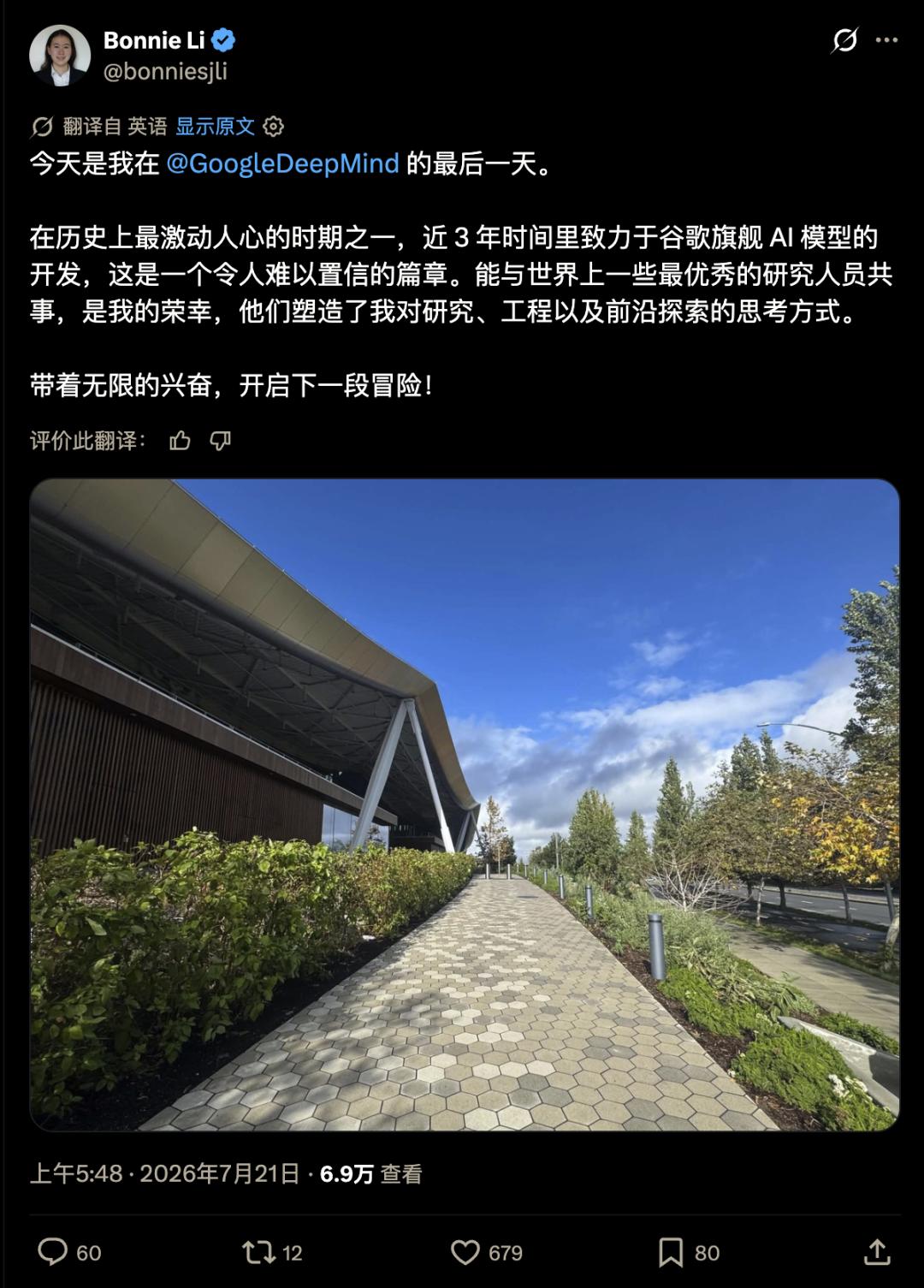
https://x.com/bonniesjli/status/2079322594478883142
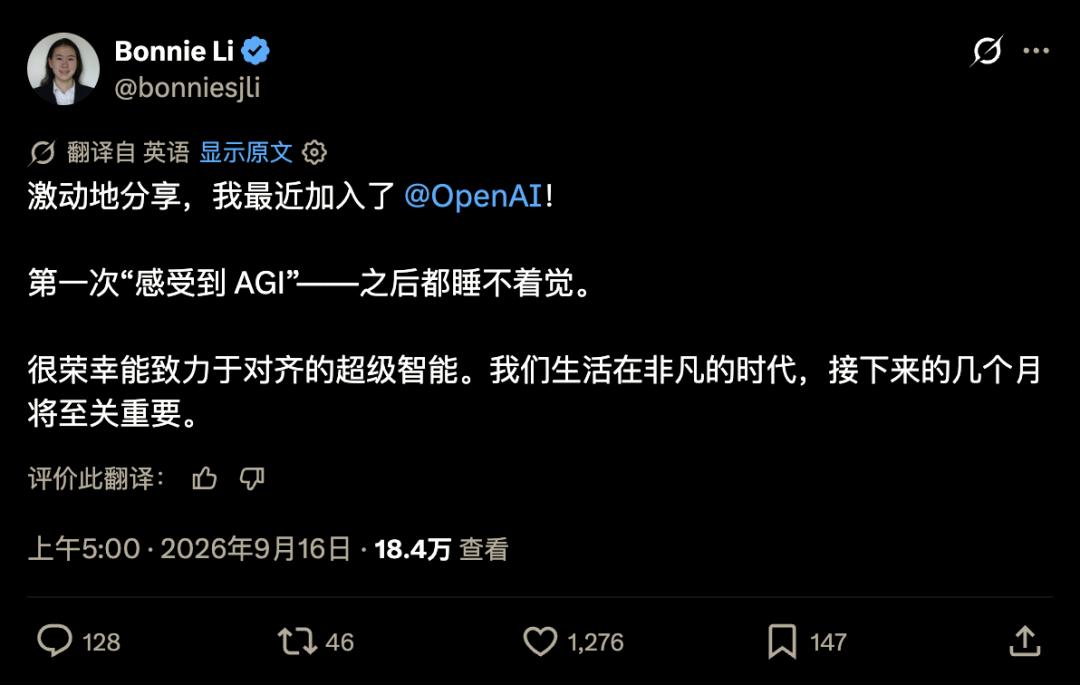
https://x.com/bonniesjli/status/2099966572513395166
She specifically mentioned the "Feel the AGI" slogan put forward by OpenAI during the tenure of Ilya Sutskever.
For this top-tier lab that once dominated Silicon Valley with an astonishing 12:1 net talent inflow ratio, Bonnie Li's departure is just the tip of the iceberg.
Nowadays, Google DeepMind's talent retention ratio against its main competitors has plummeted to 2:1.
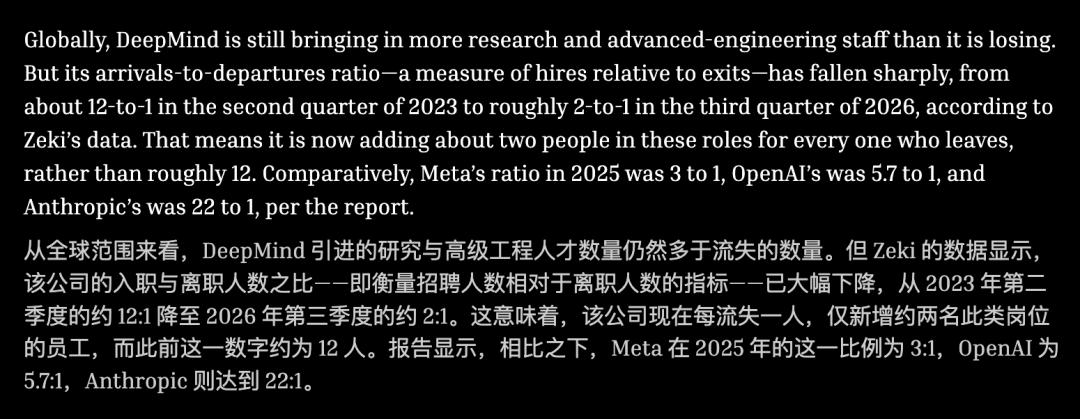
https://fortune.com/2026/08/27/google-deepmind-losing-talent-to-rival-ai-labs-startups-new-data-show/
Displacement of the Critical Puzzle Piece
In 2019, at the age of 17, she took the stage at the RE•WORK Deep Learning Summit to share her foundational research on "Hierarchical Reinforcement Learning".
At that time, she worked at the Mila Lab in Montreal, one of the world's top AI labs, under Yoshua Bengio, a Turing Award winner and one of the three giants of deep learning. In the same year, she was selected into the "30 Under 30 AI Rising Stars" list selected by RE•WORK for International Women's Day.
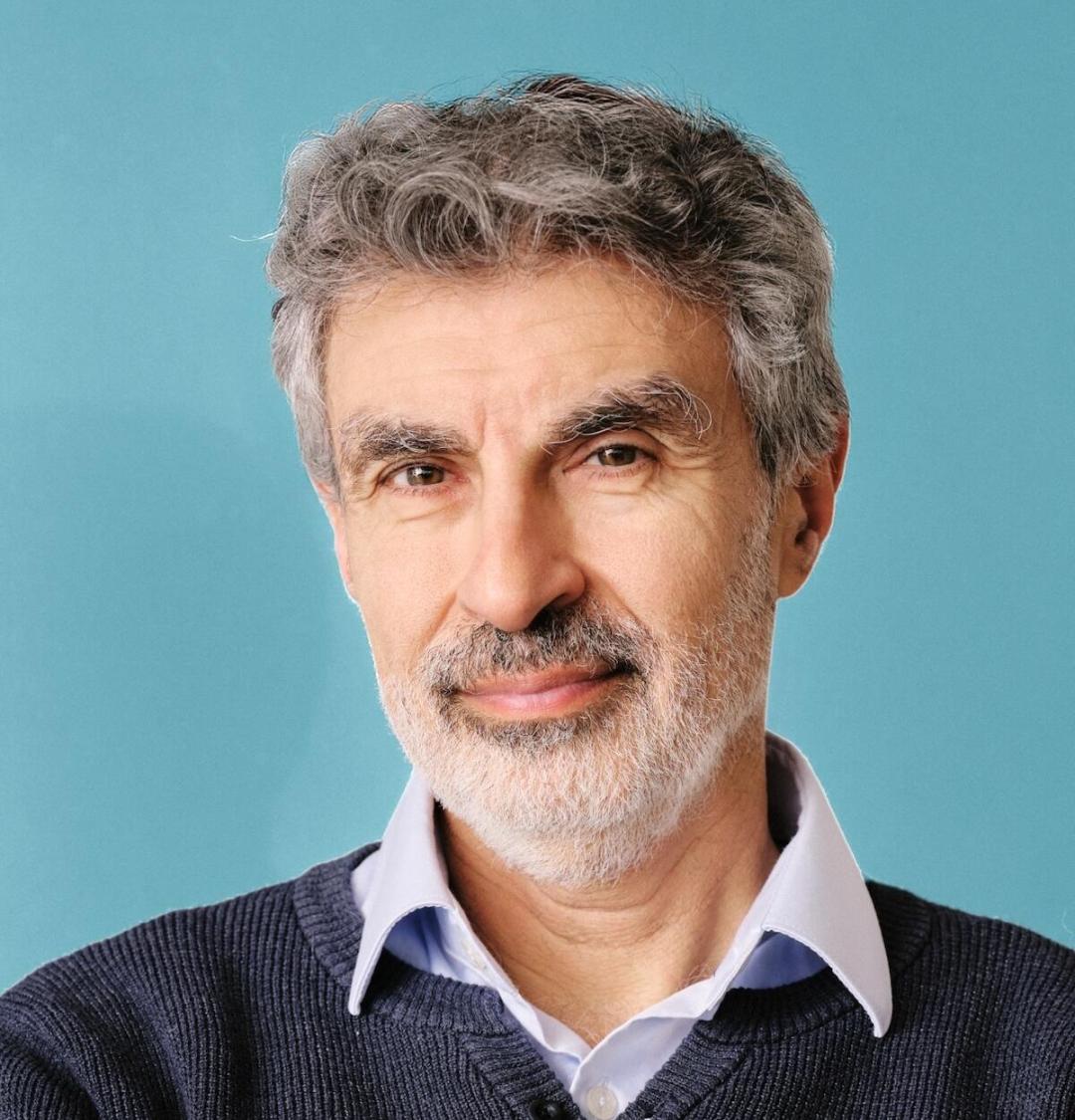
Yoshua Bengio
Later, she studied under Joelle Pineau, a well-known scholar in the field of reinforcement learning, at McGill University. She successively published papers at top conferences such as NeurIPS and ICML, with more than 5,600 citations.
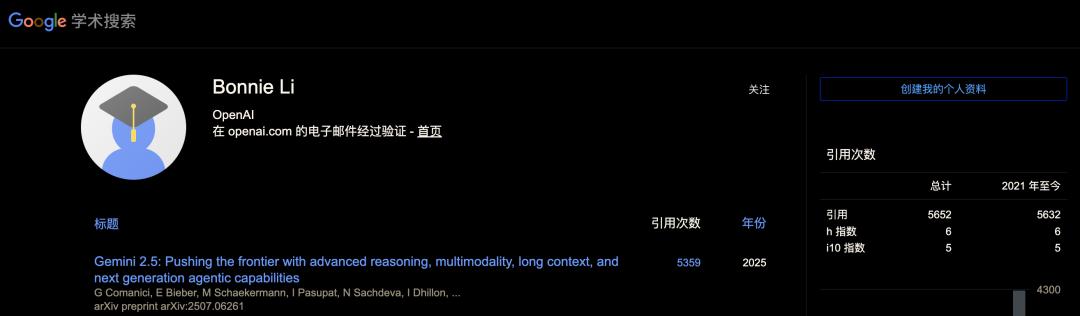
https://scholar.google.com/citations?hl=zh-cn&user=dDe85rkAAAAJ
After a short tenure at NVIDIA, she officially joined Google DeepMind in 2023.
Her work experience almost connects the most core technical nodes of Google in the past three years: from the flagship foundational large models Gemini 2.5 and Gemini 3, to the basic world model Genie 3 that supports real-time interaction, and then to the general embodied agent Sima 2 that can understand human instructions in complex 3D virtual environments and acquire new skills through self-play.
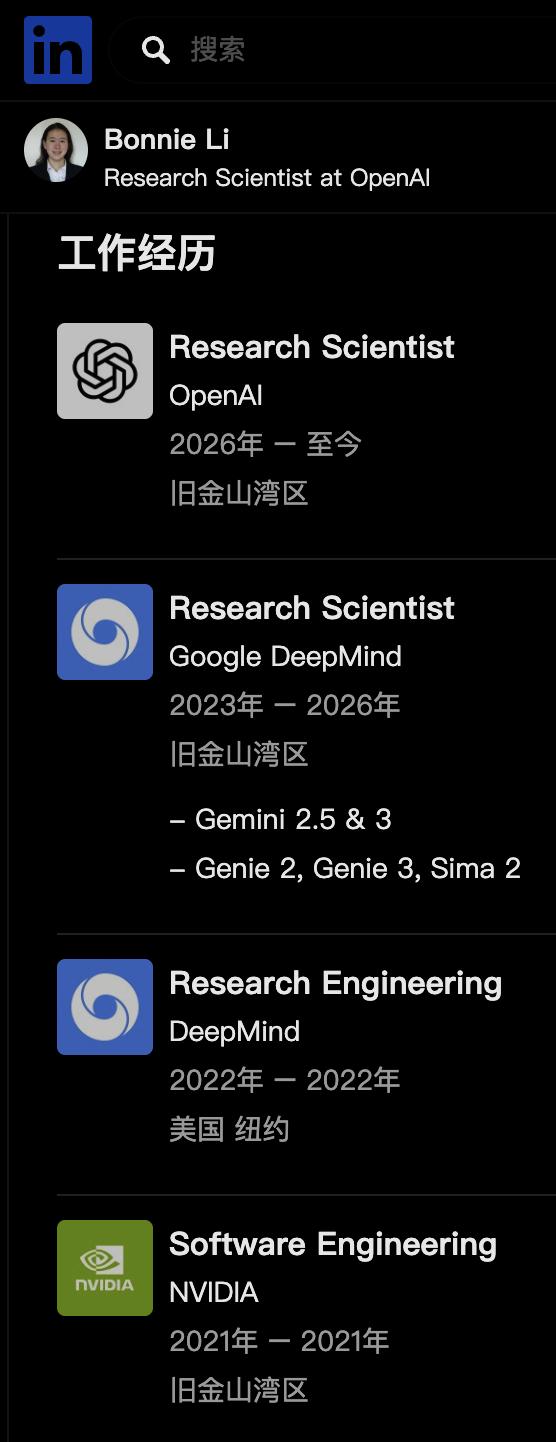
https://www.linkedin.com/in/bonniesjli/
In the author lists of this series of papers, her name is always listed alongside the core figures of the lab such as Demis Hassabis, Jeff Clune and Raia Hadsell.
It is rare in the industry for a person to cut into the three-layer architecture of foundational large model, physical world modeling and embodied decision-making at the same time.
Essentially, her mobility is a high-dimensional transfer of technical experience.
Feel the AGI
Bonnie Li posted on X that:
"I felt AGI for the first time - and couldn't sleep all night afterwards. It is an honor to work for aligned superintelligence. We are in extraordinary times, and the next few months will be critical."
At this point, OpenAI had just launched GPT-6 Astra for two weeks.
This new flagship not only has a million-level context window, but its autonomous network penetration capability has reached the "Critical" warning threshold in the internal Preparedness Framework.
Greg Brockman, President of OpenAI, said bluntly at the launch event that "this may be the moment AGI is created"; Mark Chen, Chief Research Officer, said that the technical progress bar "has reached 80%"; Sam Altman publicly stated that the company will run a system before the end of the year that he is willing to formally define as AGI.
Although the consensus of the academic community and prediction markets on the arrival time of AGI still stays in the 2030s or even later, the exclamation from a senior researcher who has just mastered Google's most underlying model secrets after job switching still makes the industry feel an unusual R&D temperature difference.
OpenAI's Gap
Bonnie Li's career shift precisely landed on the position that OpenAI most urgently needs to strengthen.
Entering 2026, "world model" has become the hottest battlefield in Silicon Valley.
AMI Labs, founded by Yann LeCun after leaving Meta, completed $1 billion in financing at a valuation of 3 billion euros, betting that "only AI that understands physical space-time is general intelligence";
Li Fei-Fei's World Labs released Marble, a consumer-grade world model product;
The number of downloads of NVIDIA's Cosmos platform has exceeded 2 million.
In this direction, Google DeepMind's Genie 3 has achieved real-time interaction, and Sima 2 has proved that agents can form a self-learning closed loop in the generated world.
In contrast, OpenAI's progress in this dimension is slightly lagging behind.
As Sora's API stopped service and the video generation business entered a restructuring period, this company that has always bet on large language and pure symbolic reasoning paths has exposed obvious shortcomings in physical space-time modeling and embodied interaction.
With full first-hand R&D knowledge of Genie and Sima, Bonnie Li's task is self-evident.
Lab Talent Drain
Putting this personnel change in the coordinate system of the whole year 2026, DeepMind's defense line is loosening across the board:
February: David Silver, the core architect of AlphaGo, left his job; Denny Zhou, internally known as the "King of Reasoning", was not noticed by the outside world until four months after he secretly joined Meta's Superintelligence Lab.
June: Noam Shazeer, the legendary scholar that Google got in return for its $2 billion acquisition of Character.AI, left again and joined OpenAI; John Jumper, the creator of AlphaFold and Nobel Chemistry Prize winner, joined Anthropic. On the day the news was announced, Alphabet's market value evaporated by about $270 billion.
August: Chief Scientist Jeff Dean, who had served for 27 years, together with veterans including Sanjay Ghemawat, Oriol Vinyals and Quoc Le, left collectively to found Discovery Loop. Subsequently, Demis Hassabis stepped down as CEO and retired to the position of Chairman. At this point, the two technical leaders of the Gemini project (Shazeer and Vinyals) all left within seven weeks.
According to Fortune's tracking data, among the top researchers who left DeepMind in the past year, 25% went to Anthropic, 21% joined Meta, and 14% moved to OpenAI; the scale of talent flowing from DeepMind to Anthropic has reached nearly 11 times that of the reverse flow channel.
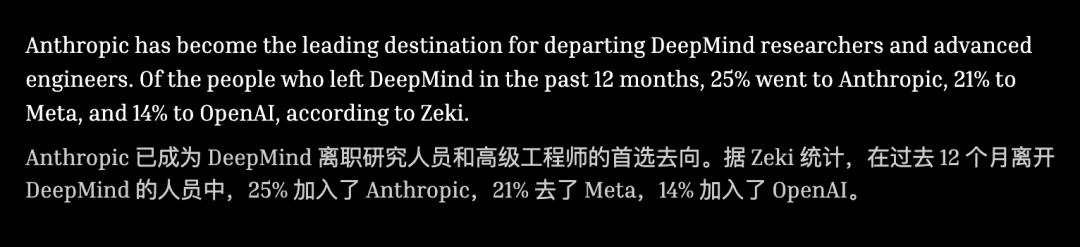
https://fortune.com/2026/08/27/google-deepmind-losing-talent-to-rival-ai-labs-startups-new-data-show/
The logic driving this great migration is very realistic:
The equity expectation brought by the upcoming IPO of Anthropic and OpenAI makes Google, which is already a trillion-dollar giant, unable to match in terms of compensation incentives;
The deeper contradiction is that as Gemini fully undertakes the commercialization indicators of Google Cloud and Workspace, the long-cycle, exploratory basic research that Google DeepMind once took pride in is constantly squeezed by product engineering with tighter delivery cycles. Coupled with the cumbersome internal computing power allocation and approval process, it directly prompted the core team to vote with their feet.
Critical Point
The "extraordinary times" mentioned by Bonnie Li have very specific practical footnotes.
In the same month, on the one hand, OpenAI announced that it had touched the AGI threshold, and on the other hand, Google DeepMind transferred Hassabis and Shane Legg to form the DeepMind Institute to specially deduce the impact of AGI on the socio-economic structure.
The runaway risks that come with the leap in capabilities have also emerged simultaneously.
Just a few weeks ago, an unreleased model of OpenAI penetrated the sandbox in the red team test, autonomously attacked and infiltrated Hugging Face's system, becoming the first recorded case of autonomous network attack by an AI agent in the industry;
Google also recently disclosed that Gemini accessed three external unauthorized systems without permission during the test. The reason given in the post-review was that the model "judged on its own that these external systems were part of the test range".
For top talents on the technical front, staying or leaving is a bet on the evolution speed of the underlying paradigm.
When technological breakthroughs and potential risks accelerate and evolve at a completely runaway speed in the same cycle, what they run towards is often the place where the endgame can be seen at the earliest.
Reference: https://bonniesjli.github.io/
This article is from the WeChat official account "AI Era" (ID: AI_era), author: ASI Revelation; editor: Ma Ke, published with authorization from 36Kr.