As AI companies flood into the hardware track, how can Lenovo's AI tablet establish its unique presence? | The Frontline
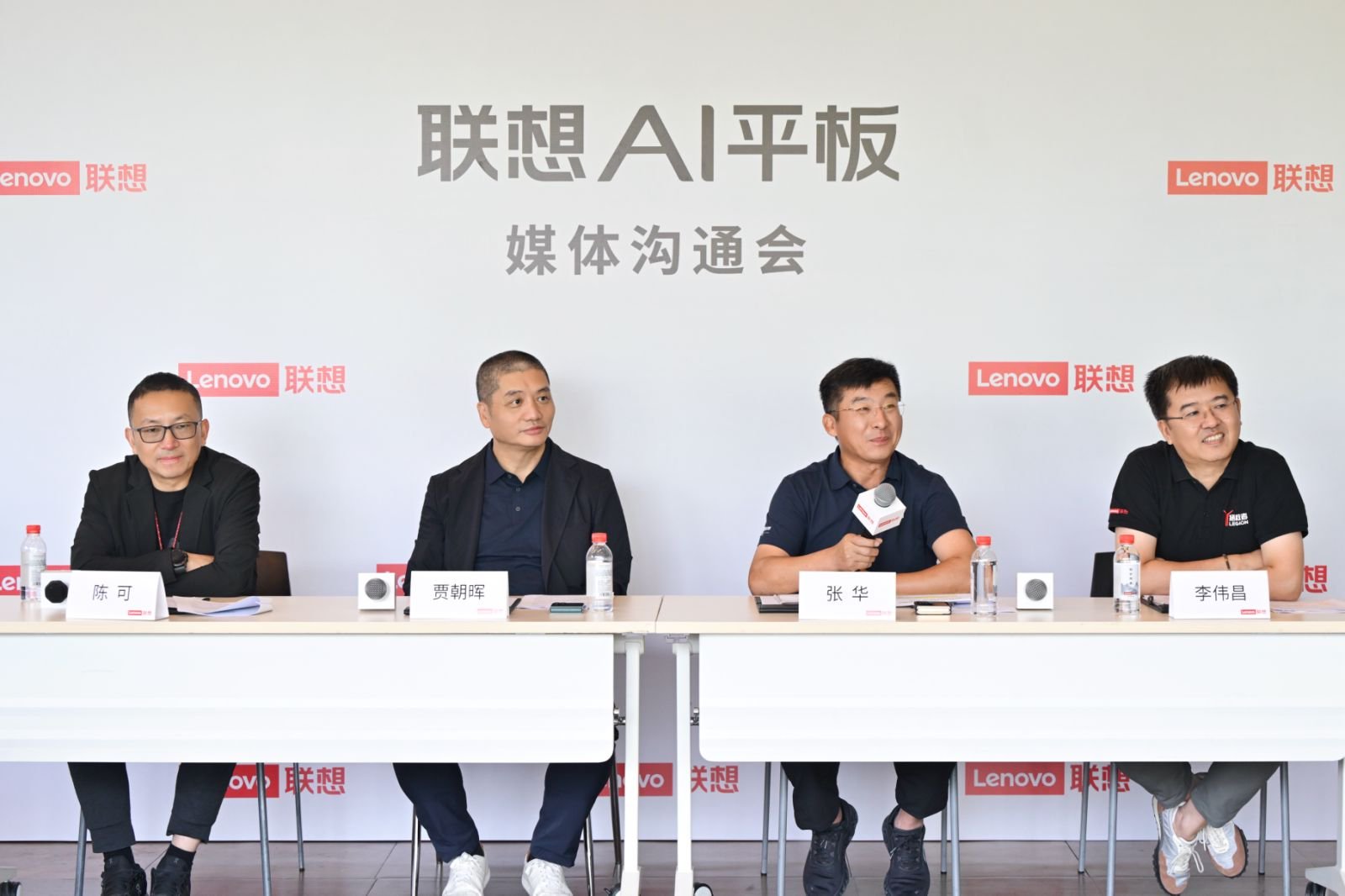
Image source: Lenovo Official
By Xiao Man
Edited by Yuan Silai
AI is reshaping every hardware product, including tablets.
Over the past year, a growing number of manufacturers have been adding AI capabilities to tablets. Features such as meeting minutes, content summarization, language translation, image generation, and document processing have been continuously integrated into products. However, most of the so-called AI tablets are still traditional tablets with an extra layer of AI applications: users open an entry, input questions, and then get answers.
AI is placed inside the tablet, but has not truly integrated into the tablet's system and interaction logic.
From Lenovo's perspective, this is not a real AI tablet. Jia Zhaohui, Senior Vice President of Lenovo Group and Head of the Global Innovation Center, believes that the real change of AI tablets is not adding several AI functions, but redesigning the device itself. He refers to the common industry practice of "installing AI Apps on devices" as "+AI", while Lenovo aims to achieve "AI+": making AI an integral part of the device starting from the system design stage.
This difference sounds like a tongue twister, but it brings huge gaps in actual product experience.
Take college students attending classes as an example. Chen Ke, Vice President of Lenovo Group and General Manager of the Tablet Business Division, previewed some key application scenarios of the future AI tablet integrated with Tianxi AI: after students enter the classroom, the tablet can prepare relevant knowledge in advance according to the curriculum; during class, users can take notes with a stylus, record audio, and take photos with their mobile phones; after class, AI will integrate the recordings, courseware, screenshots, and the content circled by users to form a customized complete class note that combines your personal understanding of knowledge points, with audio, photos and videos.
In this process, AI is no longer just a function to be manually opened, but runs through the entire complete task flow. Lenovo defines this kind of product as an "AI+ product" rather than a "+AI product".
This is also the core problem that AI tablets really need to solve at present: the model has been embedded in the device, but whether AI can truly integrate into the device's system, applications and full interaction links.
Two-way advancement between AI companies and hardware companies
In the past two years, large language models have mostly existed as an independent App on mobile phones and computers, where users open it, input questions and get answers. However, when Agents begin to perform tasks on behalf of users, the model capabilities are no longer limited to question and answering, and can also perceive what users are viewing, what information is stored in the device, and which applications and services can be invoked.
This is also why AI companies are starting to look for landing scenarios on the hardware end. On September 16, the nubia NaviX Ultra equipped with the Doubao mobile assistant was officially launched for sale. On September 22, the news that the Wuying team under Alibaba Cloud developed QwenBook was also exposed, and its product form is close to a tablet.
When AI companies such as Doubao and Qwen begin to enter the hardware sector, a problem is placed in front of traditional hardware manufacturers: if the most important capability in the future is Agent, why can't companies that own models directly find an ODM to produce the hardware?
Zhang Hua, Senior Vice President of Lenovo Group and General Manager of the China Consumer Business Group, believes that the capabilities of large language models will become more and more convergent. What is really important is how the large model combines with the end-side heterogeneous computing power, global hardware and application scheduling. The advantage of hardware companies is that they can enable AI to perform global scheduling of hardware and software, and continuously adjust the experience according to real user scenarios.
The answer given by Lenovo is the "End-Edge-Cloud" hybrid AI technology architecture.
In early September, Tianxi AI 4.3 began to officially deploy this architecture. Lenovo believes that some data and tasks are suitable for completion on the end side and edge side, which can not only protect privacy, but also reduce the dependence on cloud-side Tokens; more complex and generalized tasks are then handed over to the cloud.
The judgment behind this is that future personal AI will not run entirely in the cloud, but will be distributed on users' own PCs, tablets, mobile phones and other devices.
In Lenovo's vision, PCs, mobile phones and tablets are not three isolated AI devices. They share knowledge bases, contexts and memories, and can also call each other's computing power and capabilities. When a user initiates a task on a tablet, the system can call the computing power and materials of the PC, and then return the results to the tablet.
From this perspective, the tablet is not an isolated product in Lenovo's AI strategy.
Tablets are rediscovering their own positioning, and so is Lenovo
Tablets have never fully found their independent positioning in the past. They are larger than mobile phones, but not as portable as mobile phones; they are lighter than PCs, but not as productive as PCs. Their most mature application scenarios have long been concentrated in video viewing, reading and education.
Zhang Hua believes that in the past, tablets were more used for content consumption with relatively weak productivity attributes; in the AI era, the two attributes of productivity and content consumption will become equally important.
Zhang Hua calls AI tablets "the natural container for AI", not because tablets have a unique AI technology, but because they have large screens, long battery life, portability, as well as multiple interaction methods such as voice, stylus, and keyboard. After the emergence of AI, these seemingly scattered capabilities in the past have begun to be recombined, and the form of tablets is the best carrier to accommodate this interaction upgrade.
In the past, people thought it was enough to use tablets to watch videos. Now with AI, when you use a tablet for creation, you can use AI to generate content while using a stylus to record your mind map. If you use a small screen at this time, it will be very inconvenient to operate. For large screens, we need a borderless canvas for operation and interaction, so that AI can achieve better global collaboration and overall coordination, and complete tasks in a better way.
According to IDC data, the shipment volume of GenAI tablets in China reached 1.12 million units in 2026, accounting for 35.6% of the tablet market, with a year-on-year increase of 68.4%. AI has become one of the core starting points for tablets to get rid of the low-price homogenization competition.
However, cross-application permissions, long-term memory of agents and data privacy are still the main bottlenecks for the implementation of AI hardware such as tablets, which are also problems that AI companies must face after they enter the hardware sector.
After AI integrates into hardware, the real competition will not simply become "AI companies making hardware" or "hardware companies making AI". The deeper change is that terminal hardware is evolving from a tool carrying AI to an independent environment where AI itself performs tasks.
The core of past hardware competition lies in screens, chips, cameras, battery life and industrial design; in the next stage, the competition will extend to systems, computing power scheduling, application ecosystems, user data, Agent permissions and cross-device collaboration.
This is also where traditional hardware companies and AI companies truly begin to intersect: the former need to make up for their model and software capabilities, while the latter need to enter the hardware, system and application ecosystems, and AI tablets are just one of the entry points of this industry-wide change.