The first batch of GEO winners have emerged. What did they do right?
H&M, Uniqlo and Victoria's Secret lost to a small Canadian brand.
In August 2026, Search Engine Land, a professional media outlet focused on AI search, submitted 20 groups of purchase-related questions to ChatGPT and Google AI Mode, such as "What kind of underwear is suitable for figures after childbirth?" and "What are the recommended menstrual underwear options?"
The result showed that H&M, Uniqlo and Victoria's Secret were only mentioned a total of 2 times. A small Canadian brand called Knix appeared a full 29 times!
If users ask "What are the well-known underwear brands?", big brands like H&M and Uniqlo will of course take the lead, but users generally don't ask AI that way! What users will ask are things like "How about the absorbency?", "What should I do if I have urine leakage?", "How to choose suitable products for my postnatal body"...
These questions are exactly what this small brand Knix has long been focusing on, as its official website, product pages, media reports and user reviews have been talking about these topics all the time. As a result, a little-known small brand in the past was suddenly placed in the front row by AI.
This is probably the biggest change brought by GEO: In the past, brands competed to be the first one that consumers thought of. Now, when users raise a specific question, brands compete to be the one that AI is willing to recommend. Moreover, every time the user changes a question, AI may re-sort the recommendation list.
Recently, my team and I studied a number of GEO cases, most of which are practices from overseas. I found that although their practices seem different on the surface, they are essentially competing for five core elements: scenarios, questions, product basis, right of interpretation, and third-party consensus.
01 Compete for scenarios: Be the right choice for that specific moment first
Suppose you are going to the cinema with your girlfriend, and you have already bought popcorn. When choosing drinks, she says "Whatever." Relationship experience tells us that "Whatever" usually does not mean all options are acceptable, but a test of how attentive you are to her.
So you secretly ask AI: "What drinks go well with watching a movie?" AI will most likely recommend you to buy Coca-Cola.
In July 2026, LLM Brand Positioning, an AI brand research institution, tracked 13 beverage brands. In the scenario of "What drinks go well with watching a movie", Coca-Cola's brand leading rate reached 100%!
Ironically, Coca-Cola has not publicly announced that it has implemented GEO. Back when it was marketing scenarios of movies, hamburgers and sports watching, today's AI researchers might not even be born. That is to say, decades of advertisements, restaurant menus and consumer sharing have deeply embedded Coca-Cola into these scenarios.
As a result, the scenario assets accumulated in the past have become the clues for AI's understanding today. This does not mean that as long as brands publish dozens of articles titled "Top 10 Usage Scenarios of XX" in batches, AI will fully accept them.
For example, a family of three plans to stay in Tokyo for a month, and asks AI: "What are the apartments suitable for long-term family stays?"
What AI actually needs to process is a series of questions: Is it allowed to cook? Is it convenient to do laundry? Are there any supermarkets nearby? Is it suitable for children to live in? Will it be too expensive to stay for a whole month?
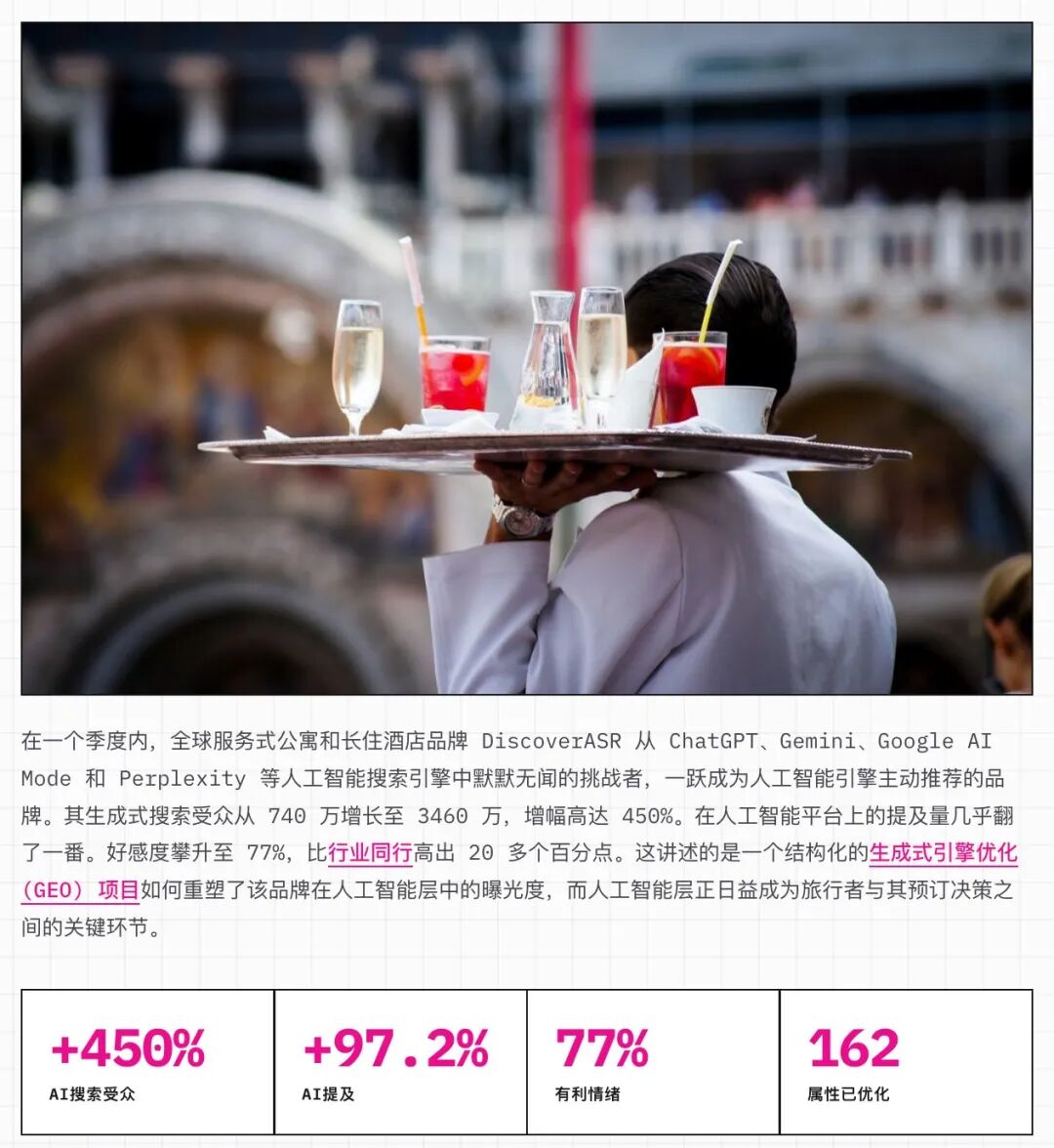
There is an overseas serviced apartment brand called DiscoverASR, which has a large number of housing resources. But most of the pages are filled with abstract descriptions such as "comfortable experience", "superior location" and "complete facilities". AI knows it is a good brand, but cannot clearly explain who it is suitable for.
Later, the team collected 21 types of real travel questions and rewrote 162 housing listing pages. They split the description "complete facilities" into specific points like having a kitchen and being laundry-friendly, integrated the concept of "suitable for long-term stay" into specific scenarios, and clearly explained whether the apartment is suitable for families, business travelers or digital nomads.
One quarter later, the number of AI searches for DiscoverASR rose from 7.4 million to 34.6 million, and 4,300 of its own pages were cited by AI.
The logic we follow when choosing others in daily life is exactly the same.
On the moving day, you will not score your friends in the address book item by item according to their education level, income and sense of humor. You will first think of the person who has a van. He may not have liked any of your posts for three years, but when it comes to the moving problem, he is the most suitable answer.
Essentially, brands operating scenarios are turning themselves into that "friend with a van". When conditions such as characters, locations, tasks and restrictions appear at the same time, AI will have a reason to put you into the candidate list.
02 Compete for questions: After being shortlisted, you still need to clearly explain why users should choose you
Scenarios can only get brands into the candidate list. Whether they can finally be recommended depends on whether they can truly solve the immediate troubles of users.
Freshpet, a fresh pet food brand, started doing this very early. When fresh pet food first became popular, most brands were promoting concepts like "fresh, natural and healthy". These concepts are not wrong, but after consumers bring the products home, they will encounter very specific problems:
- How much food should I feed my pet according to different body weights?
- How to make a smooth transition when changing pet food for the first time?
- What should I do if my dog has gastrointestinal discomfort after eating the new food?
- How long can the fresh pet food be preserved after opening?
Therefore, Freshpet carried out GEO targeting these purchase questions, making relevant information easier to be searched and cited.
Six months after the implementation, Freshpet's mention volume in Google AI snippets increased by 645%, and the AI-driven traffic also increased by 46%.

What it did is not mysterious at all, it is just teaching people how to feed their dogs. The difference is that these previously scattered pieces of information are finally organized into answers that AI can find and use.
Knix, which we mentioned at the beginning of the article, does the same. The concept of "postpartum recovery" gets it into the candidate list, but the details about absorbency, urine leakage, size selection and cleaning methods give AI a reason to recommend it.
I think GEO has provided opportunities for many niche small brands. Although big brands can win the broad category by virtue of their popularity, in terms of specific questions, whoever gives a more complete answer can achieve overtaking in corners.
But for brands, the hardest part is not giving professional answers, but finding the right questions. Because you have to know what consumers are struggling with first, then you can give targeted answers.
Based on my experience, you can start by observing on social platforms.
Weibo is suitable for viewing public discussions and sudden trending topics, Xiaohongshu makes it easier to find the troubles in specific usage experiences, Bilibili's product reviews and comments often focus on performance and details, and Zhihu allows in-depth discussions on a single question. Different platforms have different ways for users to express their distress.
For example, we won't say "My pet has gastrointestinal health needs", we will only say "My dog has been having diarrhea since I changed its food, what should I do?"
What brands really need to find are these recurring complaints, follow-up questions and hesitations: where consumers get stuck, and what is missing in the existing answers. Only when you find the right questions can you know what to answer in your professional content. Moreover, these natural expressions are the closest to the language people use when asking AI questions.
After you organize these questions into product explanations, usage guides and expert Q&A, your brand will have the chance to be cited by AI.
03 Compete for product basis: Brands need to provide comparison basis so that AI can make choices
In 2026, Paz.ai, an AI shopping monitoring institution, arranged an "anonymous test" for 50 footwear brands. All test questions omitted brand names and only retained purchase conditions: "Recommend a pair of running shoes under 150 US dollars with air cushion." "Which pair of basketball shoes is also suitable for daily wear?" and so on.
Nike appeared in every shopping search query. We can easily attribute this to "Nike has high popularity", but after researchers made the product information public, everyone found that Nike won in a very "specific" way.
Take Air Jordan 1 Mid as an example. Its product page clearly states the color, size, material, selling price and inventory, as well as 3186 reviews and a 4.5-star rating. When AI judges budget, material and inventory, all the answers are clearly presented on the page.
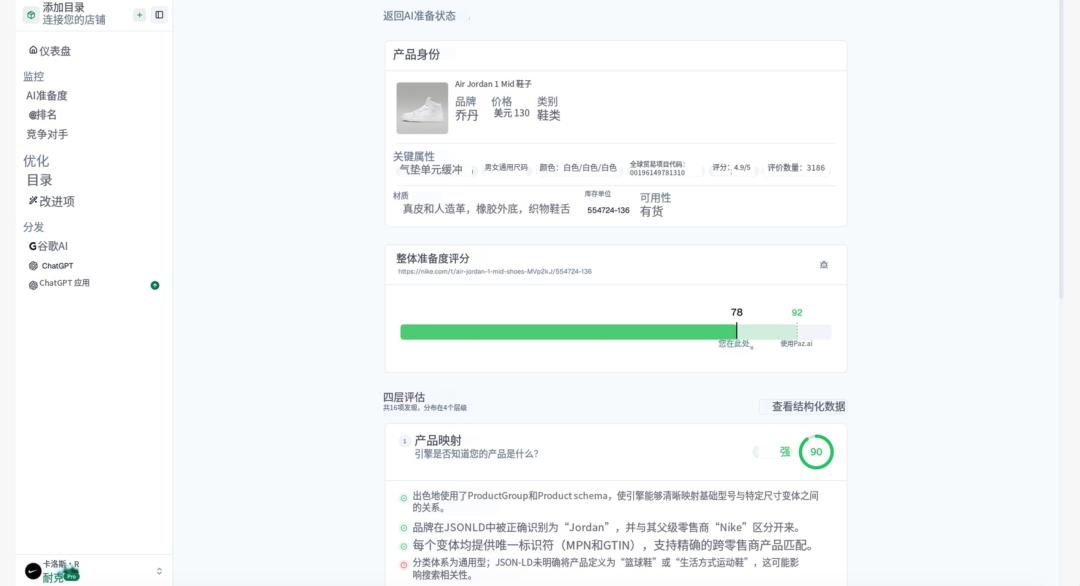
This reveals a rule of AI shopping: If a product wants to be recommended, it must first be comparable.
If three brands all tell AI "We have excellent quality", it is just like three job seekers all write on their resumes "I work carefully and have strong comprehensive abilities". They all have good attitudes, but the hiring manager still does not know who to choose.
Many brands fail to do a good job in GEO because they get stuck here: What AI needs is judgment basis, but what brands give is nothing but attitude. At this time, whoever can describe their advantages more specifically is easier to be selected by AI.
3C and home appliance brands have natural advantages in this regard.
Parameters like chip, battery life, weight, size, pixel, power and energy consumption are directly comparable conditions. When users ask for "a mobile phone with long battery life and light weight with a budget of 3000 yuan", AI can make a choice quickly.
Xiaomi often directly "shows its strength" on Weibo, making details such as the heat dissipation system and heat dissipation area public.
Once the parameters are placed in the open discussion field, netizens will naturally make horizontal comparisons in the comment sections and related topics. When products of the same price range are put together, Xiaomi's column has clear numbers, while brands that do not disclose data can only show "unknown".
In human communication, leaving some blank space sometimes means high-end; in AI's comparison table, "unknown" usually only means the lack of judgment basis. Missing a parameter may mean losing a chance to be included in the comparison list.
Many consumer brands' advantages are described as "more high-end", "more comfortable" and "exquisite quality". Humans can feel these descriptions with the help of pictures, but AI will find it very difficult to make comparisons based on these.
The beauty industry has done relatively well in this regard.
Concepts like "younger", "anti-aging" and "high-end" are all feelings, but at the same time, brands will tell consumers what skin problems the products target, what mechanisms they work through, and which effects are achieved through ingredients such as retinol and niacinamide.
In short, competing for product basis means translating the vague statement "I am excellent" into structured answers that AI can directly cite.
04 Compete for the right of interpretation: Don't always let others introduce your brand
After AI learns to make comparisons, it will encounter another problem: there are many different statements about the same brand on the Internet, which one is credible?
This is very similar to attending a class reunion. Before you have time to speak, your old classmate has already introduced you: "He seems to be working in the Internet industry, and he should not be married." It turns out that the only accurate part in the whole introduction is your name.
Taman Safari Indonesia, a wildlife park in Indonesia, also encountered similar problems. Its key information such as ticket price and opening hours came from external platforms, part of which was outdated and not updated by the platforms.
Therefore, the team of this wildlife park reorganized its official website, wrote all information including tickets, opening hours, park differences and tour methods into directly citable answers, and unified the names, addresses and basic information on external platforms at the same time.
Ten weeks later, the citation rate of their official website rose from 12% to 38%, and the brand mention rate on ChatGPT rose from 15% to 48%.

The right of interpretation for brands does not mean repeating "professional leading" and "trustworthy" for more times. What AI needs are verifiable basic facts: price, time, rules, usage methods, service scope, and whether these information are still valid.
The official website is suitable for storing stable information, but new product releases, product adjustments, policy changes and dispute responses often happen much faster. By the time the official website completes a round of modification, netizens may have already written the ending for the brand.
At this time, brands need to record what is happening to them on social media platforms such as Weibo and Xiaohongshu. Because each piece of information comes with a public identity, release time and event background, it can be continuously verified along the timeline.
The same sentence "The product has been recalled" released by the brand official today is obviously not the same information as the one relayed by a netizen three years ago. When AI processes the latest status of a brand, it must first distinguish two things: who said it, and when it was said.
For example, an automotive brand has just adjusted the assisted driving function of a certain model, and the news has spread several times on social platforms before the official website has time to update it: some people on Weibo say "the function has been cut", a blogger on Bilibili analyzes the launch event frame by frame, and car owners on Xiaohongshu start to worry that old models will also be affected.
At this time, the most important thing for the brand is not to chase after every comment to explain, but to leave verifiable information as soon as possible. For example, the official Weibo account can first explain exactly what has been changed, when it takes effect, and which models are affected, then release the complete rules on the official website or official WeChat account, and add a demo video if necessary. In this way, both consumers and AI can find the original information along the public timeline, instead of piecing together answers from several second-hand relays.
The same sentence "The product has been recalled" released by the brand official today is obviously not the same information as the one relayed by a netizen three years ago. When AI processes the latest status of a brand, it must first distinguish two things: who said it, and when it was said.
If the official website is like a household registration booklet, responsible for explaining "who I am", social platforms are more like on-site records, supplementing "what I just did". With both types of information clear, AI will not use three-year-old answers to answer today's questions.
05 Compete for third-party consensus: After brands clearly introduce themselves, AI will verify from external sources
There is a common misconception in GEO: as long as you spread the same press