The most difficult-to-get-into university for admission in the Pearl River Delta surprisingly comes from Northeast China?
Do you know that?
The most competitive university for admission in the entire Greater Bay Area is probably not Sun Yat-sen University or South China University of Technology that first comes to many people's minds, but a university from Northeast China — Harbin Institute of Technology, Shenzhen.
In recent days, Zhengjie Bureau followed the themed cultural tour group of "2026 Internet Celebrities See Shenzhen" to visit the Shenzhen campus of Harbin Institute of Technology, and thus saw another side of Shenzhen's continuous innovation.
In the 2025 Guangdong general college entrance examination undergraduate physics category admission filing, the minimum score of Harbin Institute of Technology, Shenzhen was 662, with the minimum ranking of 1730, ranking the top among universities in Guangdong Province.
This result is somewhat counterintuitive.
It should be noted that Harbin Institute of Technology was founded in Harbin in 1920, and is one of the most typical established strong engineering universities in China.
Harbin Institute of Technology excels in engineering, has long been deeply involved in China's aerospace, national defense and major engineering technology research, has strong scientific research accumulation in materials, robotics, aerospace, computer and other fields, and has cultivated a large number of engineering and technical talents.
It was not until 2002 that it traveled more than 3,000 kilometers to Shenzhen. It was originally only a graduate school, began to recruit undergraduate students in 2016, and enrolled students with independent codes in 2018.
More than 20 years later, it has become one of the most popular universities for top science and engineering students in the Pearl River Delta.
Harbin Institute of Technology, Shenzhen
Why is a prestigious university born in Northeast China becoming increasingly popular after settling in Shenzhen?
The name "Harbin Institute of Technology" certainly matters.
But it is probably also inseparable from two other words —
Shenzhen.
01
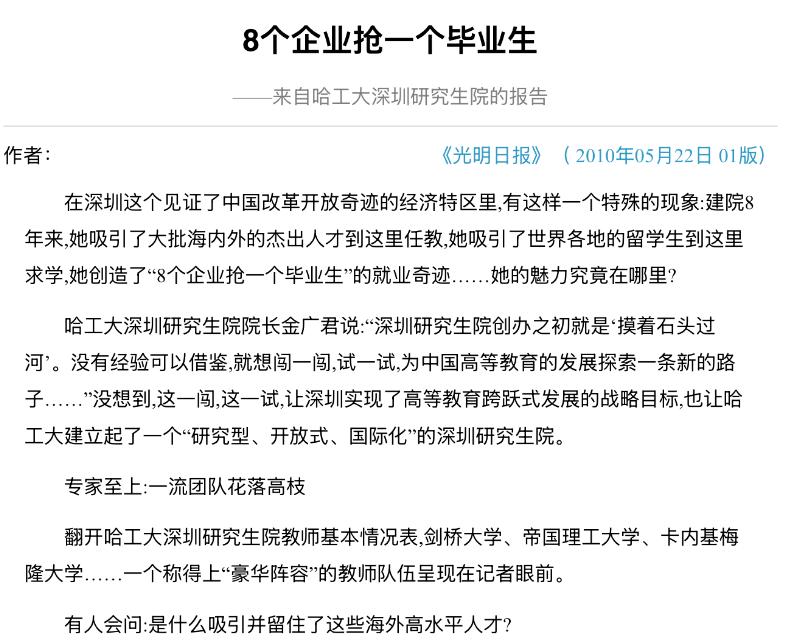
On May 22, 2010, Guangming Daily once used a very eye-catching headline to describe the employment situation of the Shenzhen Graduate School of Harbin Institute of Technology at that time:
"8 enterprises compete for 1 graduate".
16 years later, this kind of talent grabbing situation still exists.
Nowadays, Harbin Institute of Technology, Shenzhen has more than 14,000 full-time students, and has trained more than 33,000 students in total. Over 60% of graduates are employed in the Guangdong-Hong Kong-Macao Greater Bay Area, and more than 70% enter well-known enterprises such as Huawei, Tencent and Mindray.
A considerable number of people simply start their own businesses.
According to the official website of Harbin Institute of Technology, Shenzhen, graduates of all previous years have founded more than 100 enterprises, 89% of which are technology-based enterprises, and 85% of which are founded in Shenzhen, including companies such as QKM Robotics and Hesai Technology.
This set of figures speaks volumes.
What Shenzhen has given to Harbin Institute of Technology is not just a campus and school-running funds.
More importantly, it is a whole industrial city.
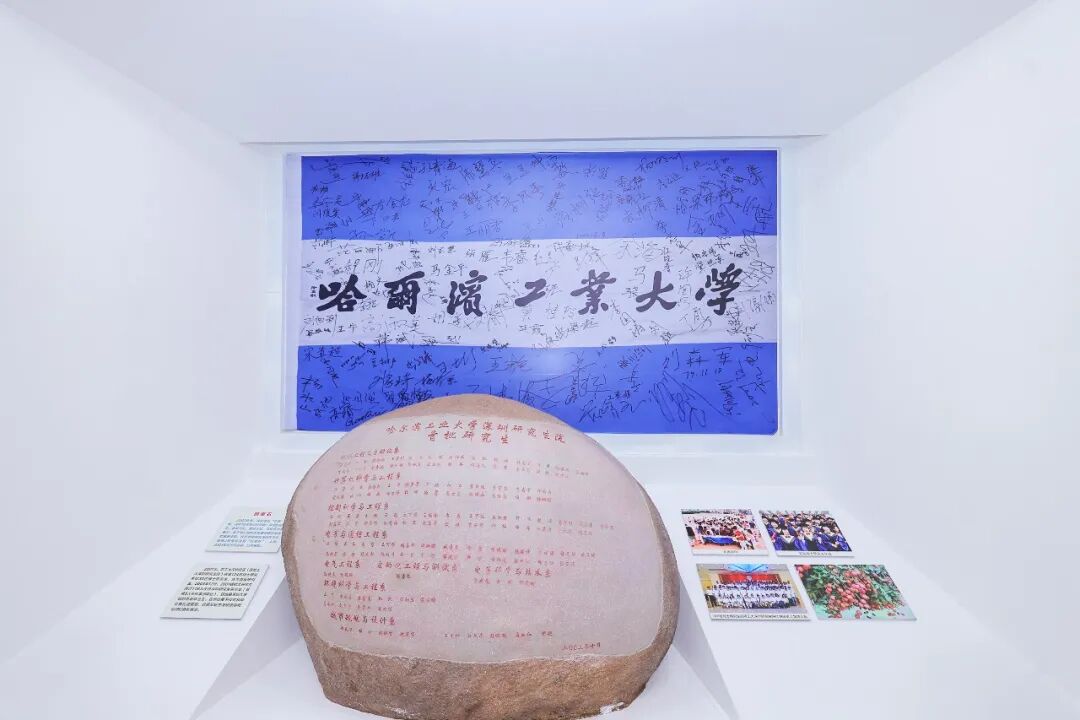
"Fruit Stone" at the Shenzhen campus of Harbin Institute of Technology
Studying computer science here, Tencent is just a few kilometers away.
For research on communication and chips, Huawei is right in Shenzhen.
For robotics, lidar and drones, there is a mature industrial chain around.
Even the major setting of the university will follow the urban industry.
Shenzhen has been vigorously developing the low-altitude economy in recent years, and the Shenzhen campus of Harbin Institute of Technology has specially laid out majors such as low-altitude technology and engineering.
The on-site interpreter told Zhengjie Bureau that a very important advantage of the Shenzhen campus is:
"Internship opportunities, entrepreneurship, and employment, all because it is located in Shenzhen."
It is said that in the early stage, the Shenzhen campus of Harbin Institute of Technology took the initiative to "knock on the door" of enterprises to promote joint training between schools and enterprises and the enterprise tutor system.
Enterprises can bring their technical problems to the university for joint research; the achievements made by the university will not worry about finding application scenarios, investors and customers.
For an engineering university, the urban environment like Shenzhen is itself an educational resource.
02
Of course, if there was only Harbin Institute of Technology in Shenzhen, this matter would not be so special.
Walking out of the campus, you will find the Shenzhen Graduate School of Peking University and the Shenzhen International Graduate School of Tsinghua University next to it, and a number of universities and scientific research institutions such as Southern University of Science and Technology and Pengcheng Laboratory further outside.
This place is called Xili Lake International Science and Education City.
There is a very intuitive detail on site.
Several universities do not run their schools behind closed doors, and public facilities such as stadiums and swimming pools are shared.
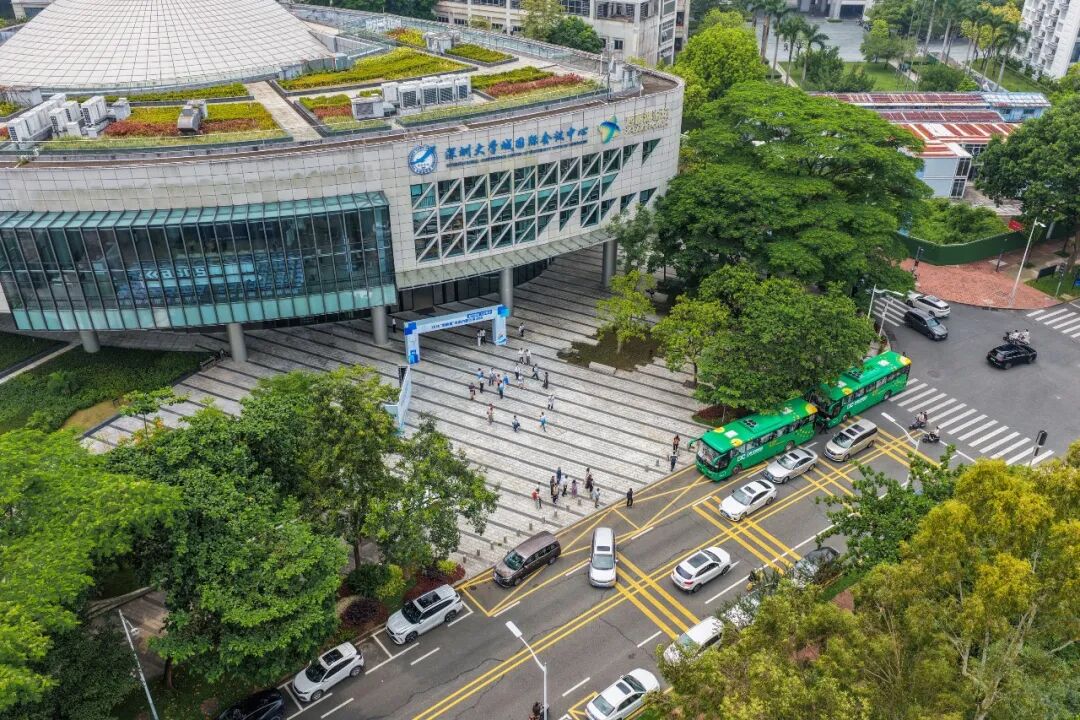
Shenzhen University Town International Conference Center
This kind of sharing also extends to courses and scientific research.
Shenzhen has established the Xili Lake X9 University and Institute Alliance. By the end of 2025, a total of 1094 courses have been mutually selected, and nearly 6,000 sets of major scientific research instruments and equipment have been shared.
At present, universities in Shenzhen have more than 750 scientific research platforms, including 25 national-level innovation platforms.
Shenzhen is obviously not satisfied with simply adding several universities.
What it really wants to do is to bring universities, laboratories and enterprises together as much as possible.
In order to achieve this goal, Shenzhen really spends a lot of money.
During the 14th Five-Year Plan period, Shenzhen's fiscal expenditure on higher education alone exceeded 1 trillion yuan in total.
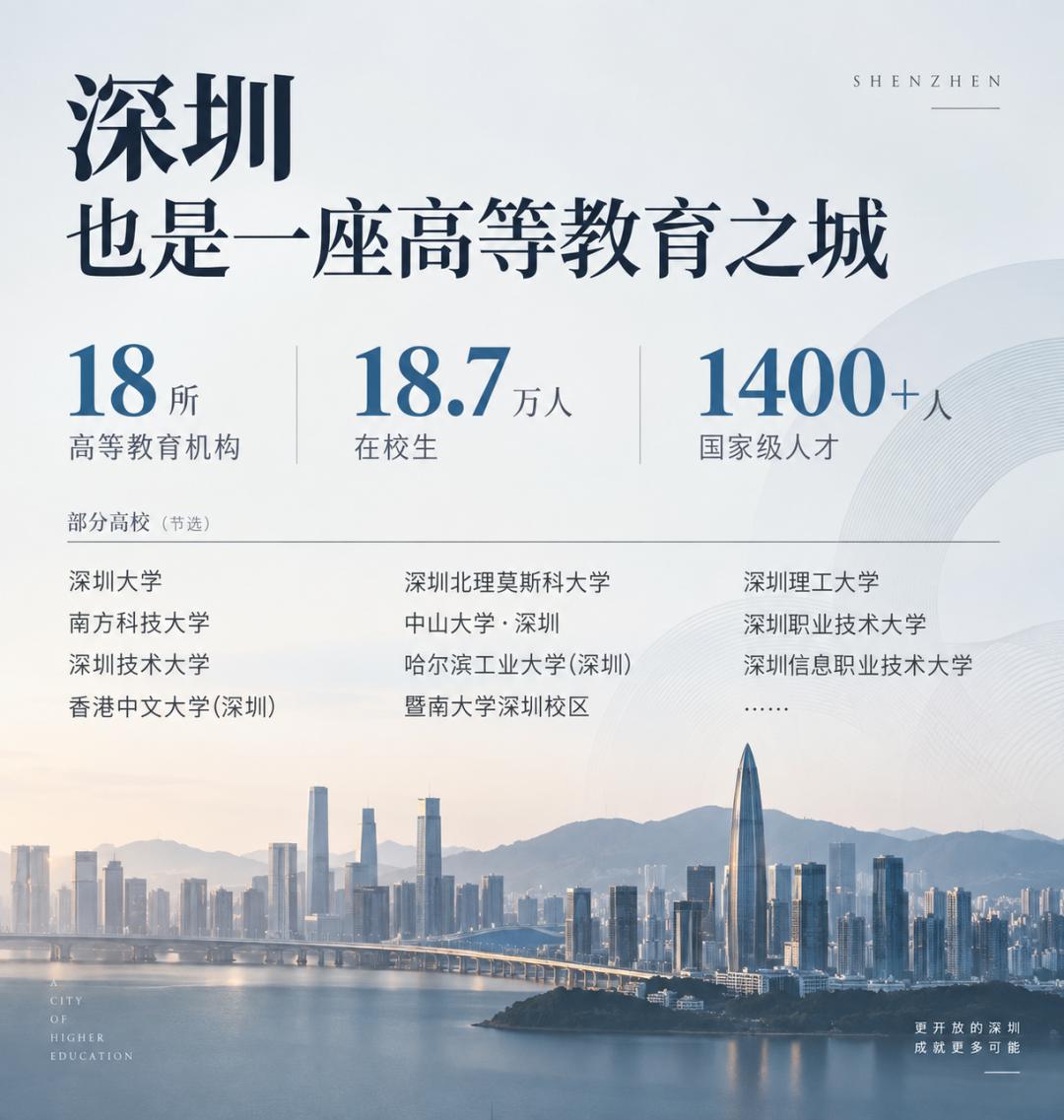
At present, Shenzhen has 18 higher education institutions, 187,000 students in school, and more than 1,400 national-level talents.
Why does a city that started with manufacturing and technology enterprises suddenly attach so much importance to universities in recent years?
The answer lies in Shenzhen's past innovation model.
The most typical feature of Shenzhen has always been the strength of enterprises.
Up to today, the R&D investment of Shenzhen enterprises still accounts for more than 93% of the total social R&D investment. In 2024, Shenzhen's total social R&D investment reached 245.31 billion yuan, with an R&D investment intensity of 6.67%, ranking among the top cities in China.
Huawei, Tencent, DJI and BYD are the most typical enterprises under this model.
Looking back on the industrial development of decades, what Shenzhen is best at is quickly turning technology into products and then pushing them to the market.
But when it comes to fields such as artificial intelligence, quantum technology, biomanufacturing, brain-computer interface, embodied intelligence and new materials, the situation begins to change.
The further you go to the forefront of the industry, the more you cannot avoid basic research.
Shenzhen has clearly put forward in the outline of the 15th Five-Year Plan that focusing on next-generation industries such as artificial intelligence, low-altitude economy, quantum technology, biomanufacturing, brain-computer interface and embodied intelligence, it will make "extraordinary" arrangements for shortage disciplines and emerging interdisciplinary disciplines, and promote universities, scientific research institutions and leading technology enterprises to jointly build laboratories and industrial colleges, so that the scientific research achievements of universities can be transferred and transformed as close to Shenzhen as possible.
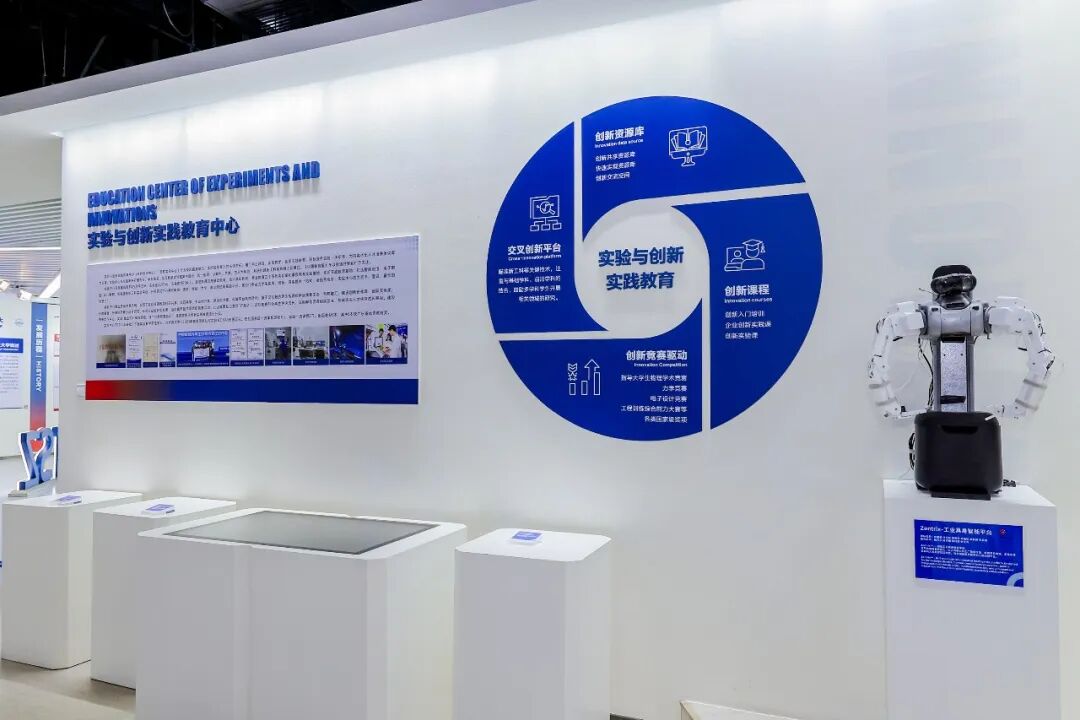
Experimental and Innovative Practice Education Center of Shenzhen Campus of Harbin Institute of Technology
Behind this, in fact, Shenzhen's innovation mode is changing. Under the current wave of technology-driven industrial development, the further the industry goes to the forefront, the more the city needs to chase the source of technology.
Therefore, the positions of universities and laboratories are becoming more and more important.
What Shenzhen wants to shorten is not only the distance between universities and enterprises, but also the distance from scientific research achievements to industrialization. It is more important that the technology in universities can enter the industry as soon as possible.
Therefore, universities are becoming the starting point of Shenzhen's next round of industry.
03
By the Shenzhen Bay, there is another place that can well show how this city views talents — Shenzhen Talent Park.
Covering an area of 770,000 square meters, it is the first municipal park themed on "talents" in China.
There are academician forest, hundred outstanding people mountain, talent and history landscape wall, and a "talent star bridge".
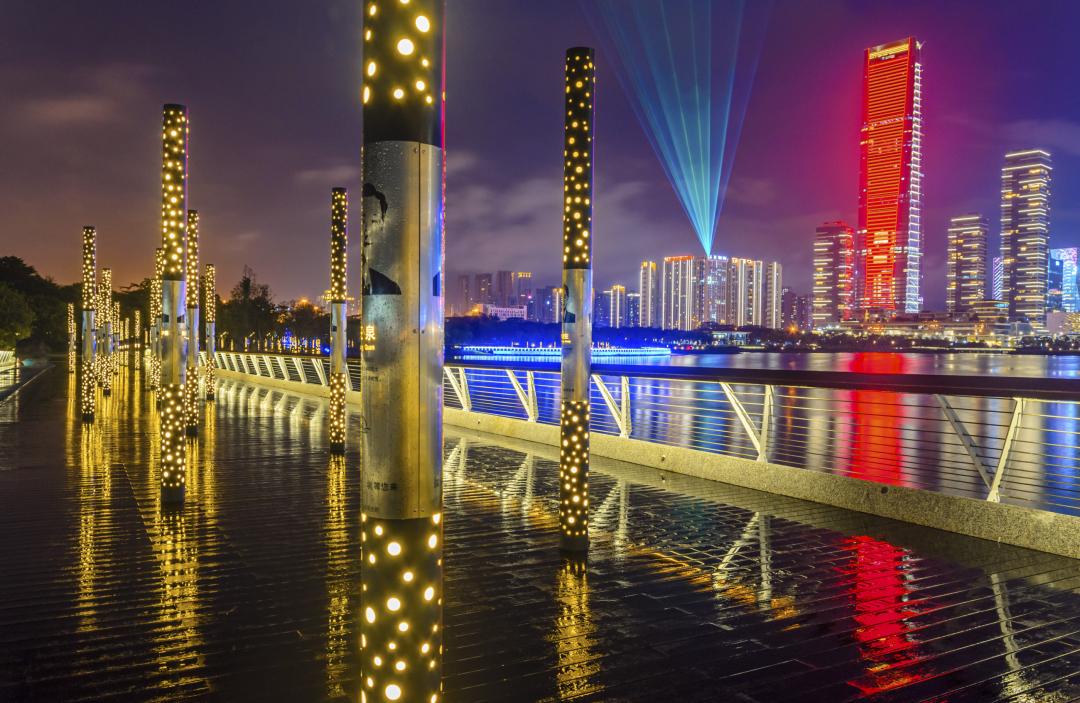
Shenzhen "Talent Star Bridge"
More than 100 figures who have contributed to the development of Shenzhen are recorded on the bridge head.
The first one is Robert Grubbs, winner of the Nobel Prize in Chemistry. He later participated in the construction of the Shenzhen Grubbs Institute of Southern University of Science and Technology.
We all know that the Hollywood Walk of Fame leaves its names to movie stars.
And the "star light" in Shenzhen Talent Park is left to scientists, engineers and talents from all walks of life.
The city's emphasis on talents is directly written into the urban space in this way.
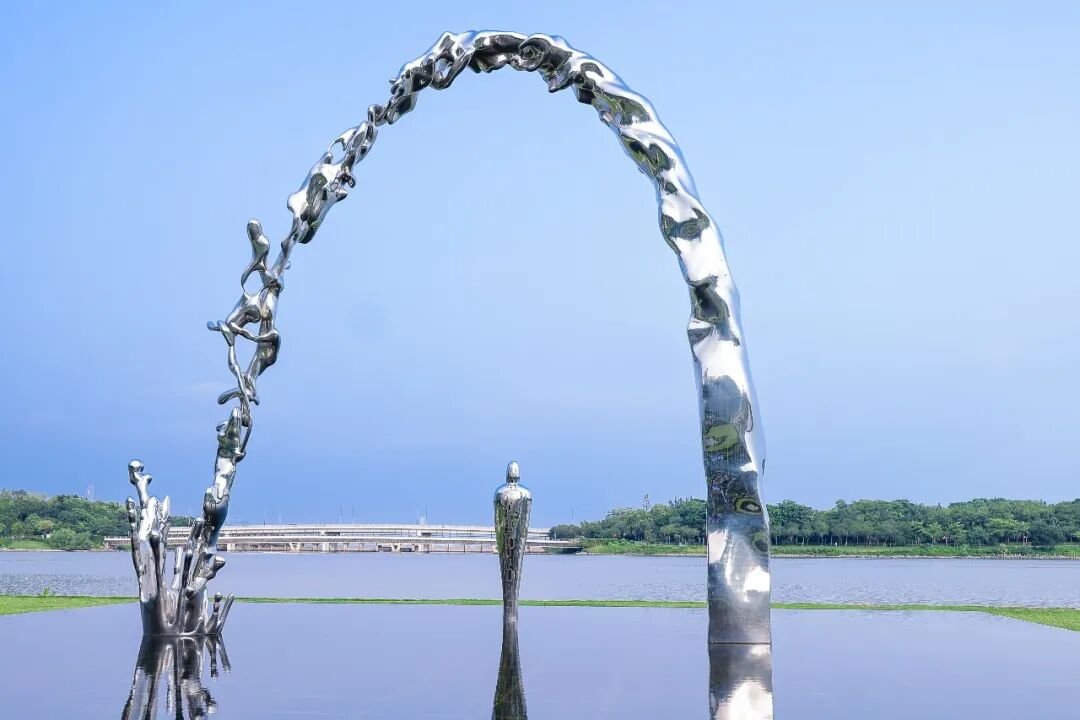
"I am an IT person" sculpture in Shenzhen Talent Park
At present, the total number of talents in Shenzhen has exceeded 7.19 million, including 1.665 million highly skilled talents and more than 28,000 high-level talents.
In the past few decades, the most famous sentence in Shenzhen is:
"Those who come are Shenzhen people."
Relying on industrial opportunities and an open environment, Shenzhen has attracted generations of young people from all over the country.
But today, Shenzhen no longer just waits for young people to come and then keep them.
It starts to run universities, build laboratories and train students by itself.
A young person can go to university in Shenzhen, work in Huawei, Tencent, BYD or OPPO, and may start a technology company a few years later.
As mentioned earlier, 85% of the entrepreneurial enterprises founded by graduates of the Shenzhen campus of Harbin Institute of Technology stay in Shenzhen, which is itself a microcosm.
The significance of this to Shenzhen is not just a group of more college graduates.
It has begun to have a more complete talent cycle: universities cultivate talents, industries use talents, and entrepreneurship creates new jobs and enterprises.
Once this chain is turned, universities and industries will be difficult to separate.
04
Observing Shenzhen this year, there is also a special background.
From November 18 to 19, the 2026 APEC Economic Leaders' Meeting will be held in Shenzhen.
The three priority areas of APEC this year are: openness, innovation and cooperation.
Shenzhen today is already a world-renowned technology city.
But what is more worth asking than "what Shenzhen has achieved" is:
Why can new industries, new companies continue to grow here, and new miracles continue to be born?
The Shenzhen campus of Harbin Institute of Technology and Shenzhen Talent Park are actually answering this question.
In the industrial era, a city needs to build ports, roads and industrial parks for industries.
Today, universities, laboratories and scientific research platforms are new industrial infrastructure.
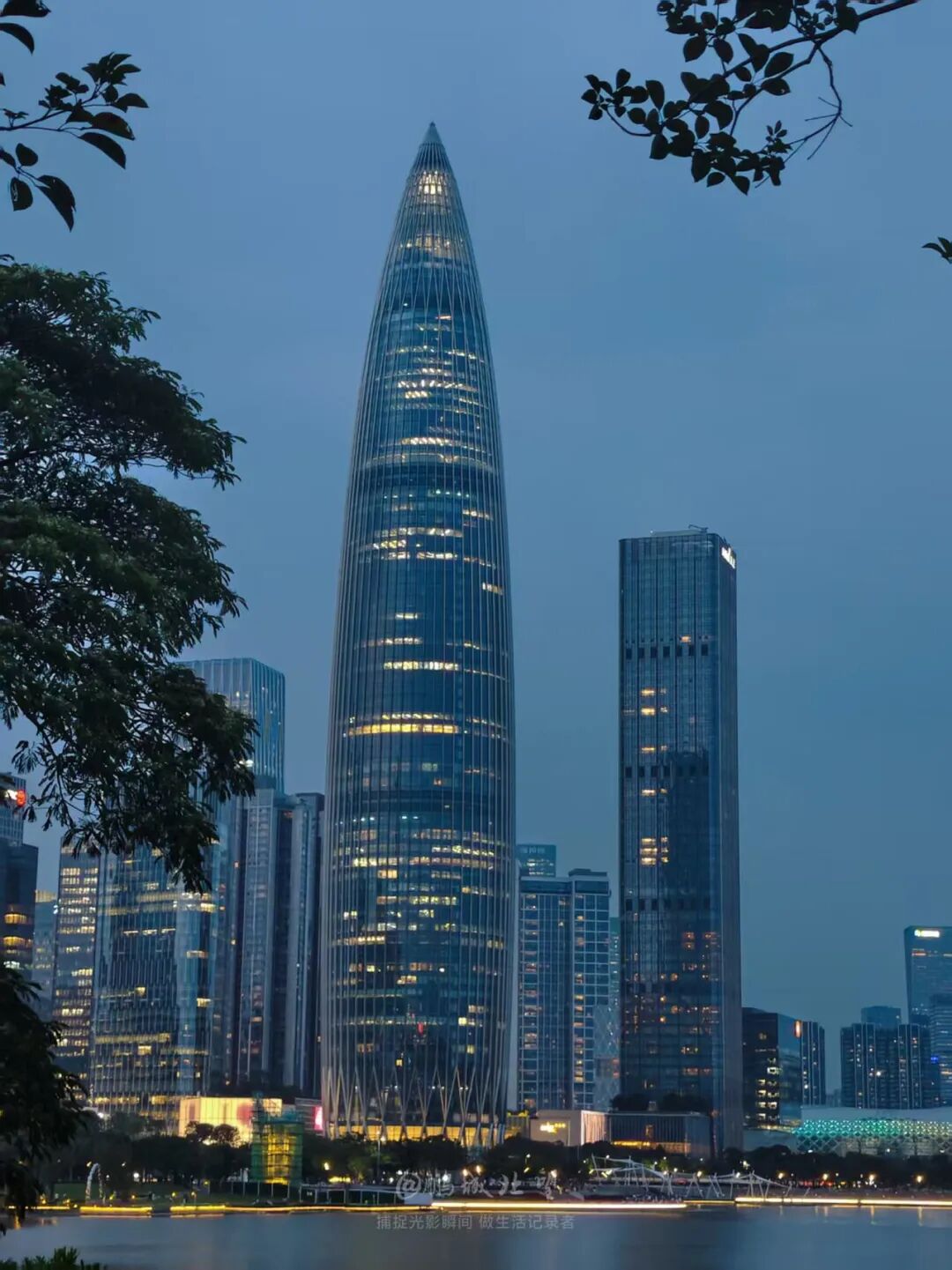
China Resources Shenzhen Tower Photography @Pengcheng Beiwang
But if you go further, you will find that no matter it is a laboratory or a university, the