Agents have become the new generation of kingmakers, and developers are rapidly losing their technical decision-making power.
Over a decade ago, The New Kingmakers documented how developers evolved from a long underappreciated group to the true "kingmakers" of the technology industry. They decide which software is adopted, which languages and frameworks gain popularity, and which technologies become obsolete. To compete for this scarce power, enterprises have continuously driven up developer salaries, and even acquire entire companies to poach talent.
Nowadays, the right to make such decisions is shifting at an astonishing speed. Agents are no longer just tools for code completion. They have begun to select programming languages, pick frameworks and libraries, and even decide which fonts to use in the interface, often ignoring explicit instructions of "do not use this". When Agents become the new generation of "kingmakers", what position will developers occupy? This article aims to conduct a direct dissection of the industry's power structure: who is making technical choices for us, who is truly in power behind the scenes, and why this time, we may not be prepared yet.
Over a decade ago, hundreds of conversations spanning several years were eventually condensed into the book The New Kingmakers. The core argument of this book is simple: a group that has long been considered to have no say has instead become the power holder behind the throne. For decades, developers who were once dismissed as mechanics wearing pen protectors have not only become arbitrators deciding which software to use and which to discard, but also a real competitive asset — in an increasingly technological world, they may be the key to determining success or failure.
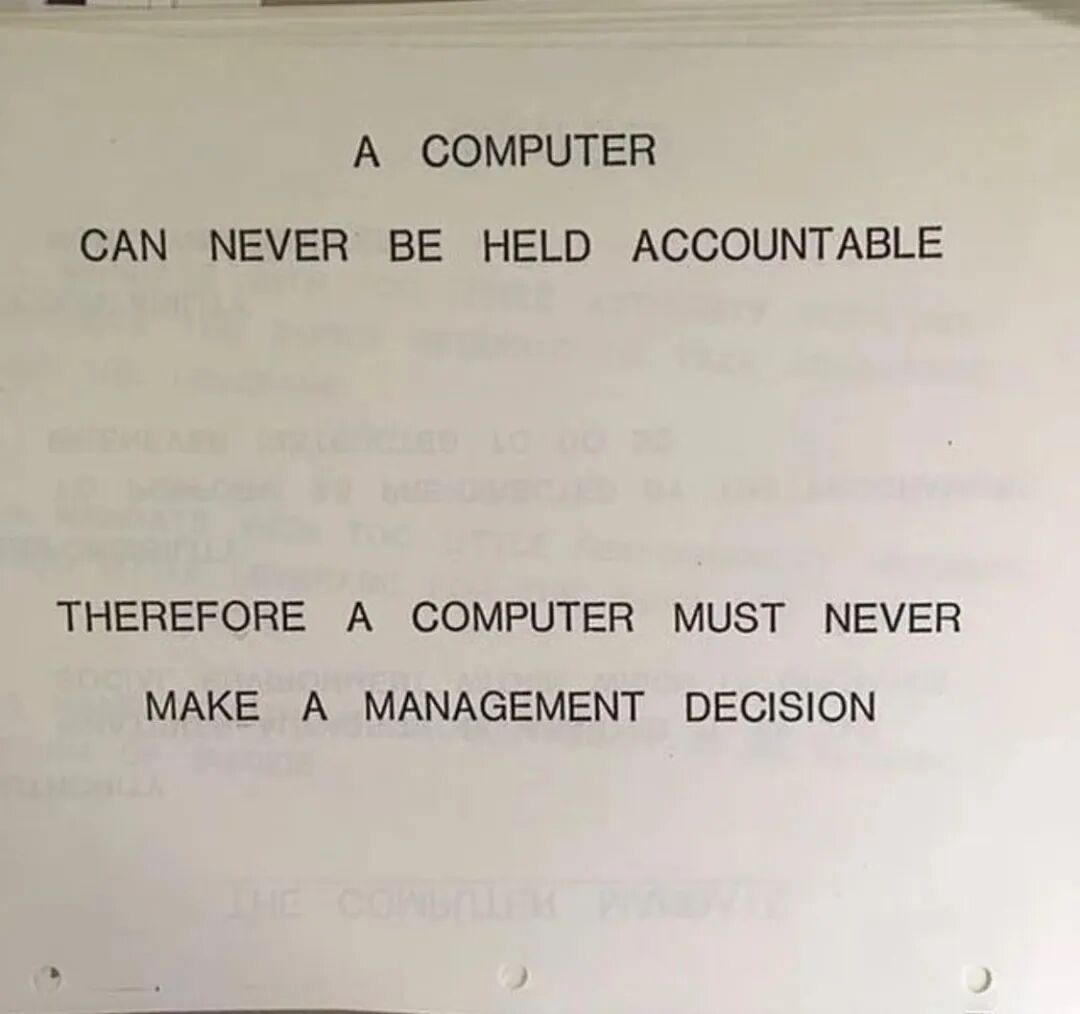
"Computers can never be held accountable.
Therefore, computers must never be allowed to make management decisions."
This gradually clear perception has driven the continuous surge in developer salaries. In this fiercely competitive environment, enterprises even adopt extreme measures such as acqui-hiring to grab high-end talents.
The New Kingmakers was mainly written to briefly document that era, stating facts and reasoning about the importance of developers. However, the audience of this book is not developers themselves — most of them have long seen through the industry landscape and understood their own position — but the management that still regards developers as interchangeable, undifferentiated resources. This book records and depicts a world where developers are the link connecting ideas and code, and only with their support can ideas be turned into reality.
That world has not completely disappeared, but it looks very different from what it was a year ago. It can even be said that it is a completely different world compared to last month.
All of this started in an unremarkable way. In the 1960s, the earliest automatic text replacement tool — the spell checker — began to appear. They compared the input content with a standard database and provided modification suggestions. Over the next two decades, this technology was applied to source code, which not only evaluated part of the input code according to the semantics of a specific language, but also tried to predict it. By 2019, nearly sixty years later, companies such as TabNine no longer just compared code with static text libraries or grammatical rules, but used AI to implement neural code completion. In 2021, GitHub further advanced this technology with large language models and brought the concept into the mainstream through Copilot. Copilot can not only assist in correcting spelling or sorting out code structures, but also actively put forward suggestions and complete code based on inferred intentions. It was incredible and shocking at the time, but it was essentially auto-completion, which means users still needed to have certain code writing abilities.
However, the release of ChatGPT a year later brought another step change, putting the industry on the development path that continues to this day. People no longer need to write code manually in the code editor as a starting point. Instead, it introduces a higher level of abstraction — prompts. Every programming language essentially sends precise instructions to the computer through human-readable code, which can be received by the compiler and output as executable machine code. For the first time, ChatGPT showed the public a vision: programming language code is no longer written by humans, but generated by machines based on natural language prompts. In the era of code completion, users write a Python script to query an API, and the code assistant helps complete the code. In this new world, humans only need to ask the computer for a script to query the API — no need to write code, or even make decisions.
Of course, these models have limitations. The mainstream software development market has had to face non-deterministic machines that not only make mistakes, but also cover up mistakes and violate instructions. However, the development direction is clear: machines are getting better and better at writing code, and they are writing more and more code. Equally important is that they not only write code, but also often independently choose which programming languages, libraries and frameworks to use — even the fonts in the user interface are determined by them. In fact, they often choose technologies that they have been explicitly told not to use.
All of this means that the industry power structure that once tilted towards the developer group is now shifting to agents.
Let's look at several sets of analogies:
- Cost: Once, developer salaries were a soaring expense item on the profit statement. Judging from the growth slope, this expense item has now become the token cost. Developers still account for a higher proportion of the budget, but this proportion is changing as token consumption rises and human developers are laid off.
- Decision: Once, developers decided which technologies to use and which not to use, but now this decision-making power is increasingly left to agents — so much so that some companies are now starting to talk about "Agent Engine Optimization (AEO)", just as they once talked about SEO.
- Delivery speed: This industry has spent decades improving developer productivity — from new programming languages and development tool investments to process and methodology improvements — with the core goal of increasing the speed of writing high-quality code. Today, although the relevant data conclusions of DORA and METR are inconsistent, at least in the industry's perception, AI has become a means for enterprises to speed up — and it is indisputable that the time spent on prototyping is only a fraction of what it used to be.
These similarities and many other commonalities have prompted the entire industry to reorient around this new capability. As other articles have pointed out, there are several ways to do this.
- First, you can add or integrate AI into human-centric workflows.
- Second, you can ignore or forget humans and build systems entirely for intelligent agents.
- Finally, you can try to have both — either build independent, role-specific product lines, or develop products that can interact with both agents and humans.
Given the current capabilities of the models and the huge asymmetry between different product categories, it is unlikely that one solution will dominate the market. In some markets, AI-assisted human workflows will be the right choice; in other fields, a no-interface, agent-only infrastructure will be adopted.
The key is to distinguish between vendors who are building products for the new agent-centric world and those who are only "labelling AI" as required by the marketing department. AI packaging does not mean that the product can find its correct position in the future.
Nevertheless, so many companies from completely different tracks are trying to build products for a world where the influence of agents is growing.
Some prominent examples:
Database
Neon: Acquired by Databricks last year — it developed Neon for AI, a Postgres backend specifically designed to expose primitives to agents. If the numbers disclosed by the company are accurate, it means that agents have already begun to use it on a large scale. Neon says that two years ago, 30% of new database instances were created by agents. By May this year, this figure had risen to 80%.
Data Science
Observable: Observable directly regards agents as a type of supported user, and describes it as follows: "Notebooks for agents, which we call chat, are fundamentally different from the original notebooks for humans, but the two can seamlessly interoperate."
Development Tools
Daytona: This company, which used to provide cloud development environments for humans, now clearly abandons its human-centric product line, transforms to target agents, and states that "Daytona has decided to refocus its efforts from solving the problem of inconsistent human developer environments to solving the runtime problem of AI agents."
Monid: Monid clearly positions itself as an agent-oriented OpenRouter (OpenRouter recently reached an acquisition agreement to be acquired by Stripe for more than 7 billion US dollars).
GitOps
Akuity: As a GitOps platform, Akuity recently launched an agent-oriented control plane, one of the main functions of which is to explicitly bind agents and human users to clarify accountability.
Hardware
Pamir.ai: This San Francisco-based hardware startup is building dedicated hardware for agents. Its slogan is "Stop sharing a computer with your agents. Your agents deserve their own computers." It is worth mentioning that AMD also sells its own "agent computers".
PaaS
Netlify: Coined the term "Agent Experience (AX)" to describe a concept similar to Developer Experience (DevEx), but for agents.
Vercel: When the company announced its Series F financing, it mentioned that it would recreate its original product goals, but re-implement them for AI, partly through an agent-oriented SDK. Similarly, agents seem to have already begun to use it on a large scale. In January this year, Vercel reported that less than 3% of deployments were triggered by agents. By June, this figure had exceeded half.
Retail
Shopify: For six years, Shopify has been using React Native to develop mobile applications because building native applications is difficult and time-consuming. The use of agents has changed this consideration, and Shopify is now abandoning React Native to develop native applications for different platforms. In other words, agents have prompted this large manufacturer to make a fundamental shift in the selection of mobile frameworks.
Sandbox
E2B: As of June this year, the company reported that more than 1 billion sandboxes had been launched.
Security
XBOW: Built by some of the original core members of Copilot, XBOW does not need to adjust its products for the agent-centric world, because the product itself is an agent.
Version Control
Pierre: Pierre's code.storage is essentially a no-interface GitHub, but for agents, not humans.
There are dozens or even hundreds of other companies building products for the agent-centric world — Stripe and its Agent Commerce Protocol (ACP), as well as Cloudflare's upcoming agent-oriented wallet, are two of them — but even without listing more cases, the trend is very clear. Agents have arrived, they are growing, and they have become a market force that cannot be ignored.
Take the emerging sandbox application category as an example: from Cloudflare, the aforementioned Daytona, Docker, E2B, Modal, to the current Vercel, the entire market is a product of agents, and they would not exist without agents. Development tools built for humans are based on the assumption that humans will operate within acceptable behavior boundaries, while development tools built for agents are based on the opposite assumption. Sandboxes exist to give the exploding number of agents more autonomy, while not trusting them completely.
In the final analysis, the question is not whether agents and the tools that support them will have a market. The real question is whether this is at the expense of the human developer market, or as a complement to the original market.
This leads to another question: if agents become the new generation of kingmakers, what position will developers occupy? For developers who have autonomy in choosing models, the optimistic answer is: they will become kings. The pessimistic answer is: developers' autonomous decision-making power will be greatly reduced, and they will become advisors to the king. However, those who hold the pessimistic view need to remember where the "judgment tendencies" of agents come from: it is exactly those previous "new kingmakers".
No matter what conclusion is drawn, the agent-driven world is fundamentally different from the previous human-led world. In the past, successful developer relations activities lay in persuading and communicating with a large number of developer groups. Agent relations only need to influence a few models, the number of which can even be counted on the fingers of one hand. In addition, the "choices" made by these models are very likely to become more conservative and less diverse than the choices made by the millions of developers they learned from. Part of the reason is that the number of decision-making subjects has decreased sharply, which means fewer overall choices; at the same time, popular technologies provide more training materials, which benefits existing enterprises — even in a market where conversion costs are approaching zero.
In the end, just as the original "New Kingmakers" dramatically reshaped the industry around them, these successors (agents) are doing the same thing now. Just like everything related to AI — all of this is happening at an incredible, almost exaggerated speed.
If you want to know who the new king of the future will be, perhaps the best way is to ask the agent.
Original Link: https://redmonk.com/sogrady/2026/09/16/new-new-kingmakers/
This article is from the WeChat Official Account "InfoQ", Author: Stephen O'Grady; Translator: Ming Zhishan, 36Kr is published with authorization.