Transn Taihaoyi releases the "6S+1" trusted service framework, driving AI translation to evolve from "usable" to "trustworthy to use".
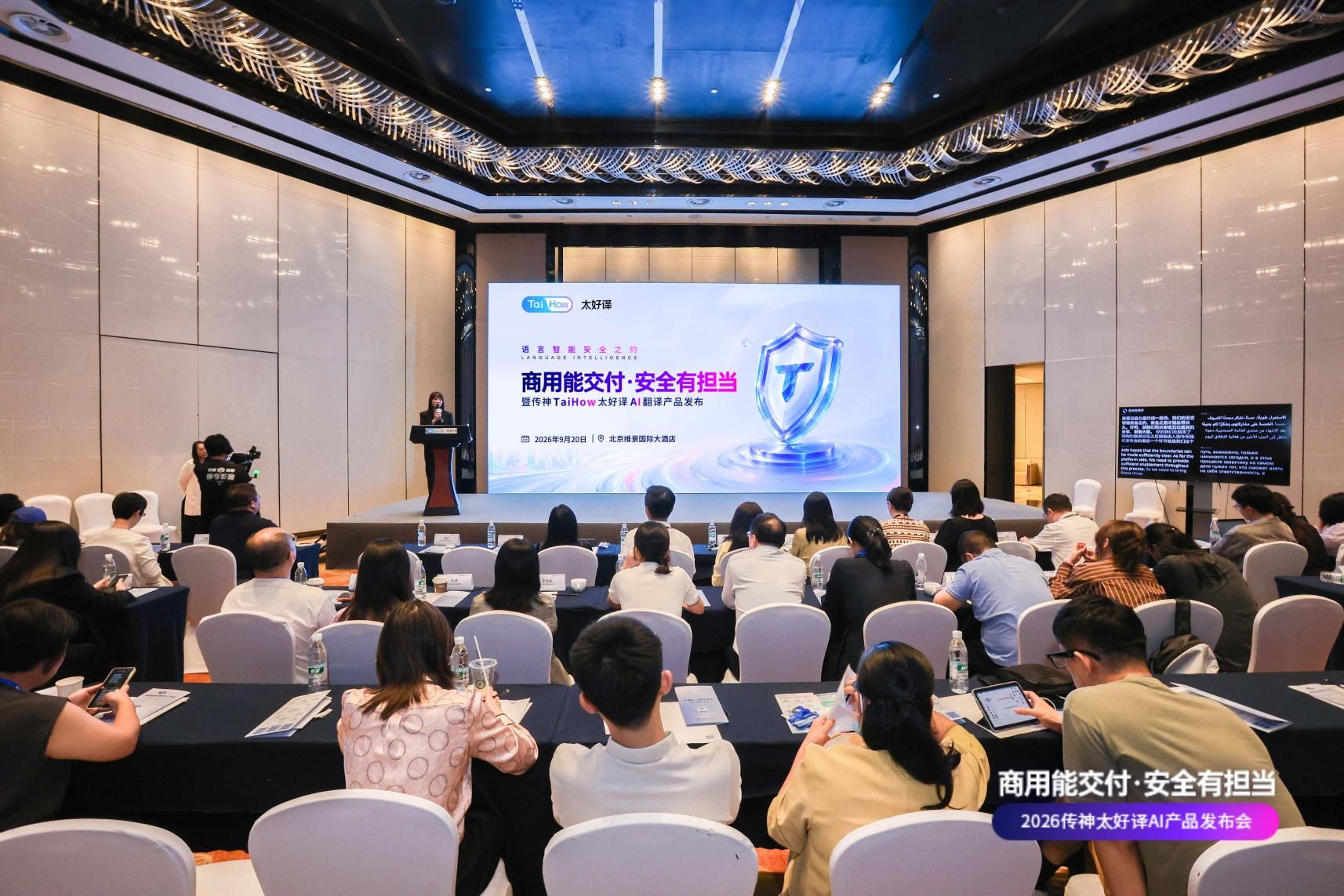
["Commercial-grade Deliverability, Safety as Responsibility — The Summit on Language Intelligence Security & TaiHow AI Product Launch" Site]
On September 20, the "Commercial-grade Deliverability, Safety as Responsibility — The Summit on Language Intelligence Security & TaiHow AI Product Launch" was held in Beijing. TaiHow, under Transn, officially announced the upgrade of its enterprise application positioning: from a personal translation tool to a "commercial-grade AI translation workstation", and released the "AI Translation 6S+1 Commercial-grade Trustworthy Service Framework". At the same time, four product lines including three Agents for document translation, conference simultaneous interpretation, video translation and production, and the private deployment solution were collectively upgraded, covering all scenarios of enterprise globalization. Representatives from industry associations, enterprises expanding overseas, translation service institutions and mainstream media gathered at the site to witness the birth of the first "commercial-grade" workstation in the AI translation industry.
Emerging Pain Points in Enterprise Translation
Safety Becomes the Core Threshold
This launch event released a key signal: the competition of AI translation is shifting from "efficiency competition" to "trustworthy delivery". General large models have rapidly leveled the translation speed and basic quality, and single-point capability is no longer a moat. What really blocks enterprises from adopting AI translation is "whether they dare to hand over their critical content to external tools".
A 2026 Crowdin survey shows that about 95% of North American enterprises have used AI translation to varying degrees, but 80.9% dare not submit personal identifiable information to external AI, 78.3% have the same concerns about legal and contract content, and one fifth of the surveyed enterprises have reported quality accidents. The coexistence of "dare not use" and "in use" constitutes the real contradiction of current enterprises using AI translation.
What enterprises need is not a web tool that can generate translations, but a set of commercial services that can process data, terminology, formats, workflows and liabilities. Safety is becoming the key for AI translation to evolve from "usable" to "dependable to use". The "6S+1" trustworthy service framework released by TaiHow is a systematic response to the three core issues of quality, safety and liability, and verifies how the standards can be implemented in real business through the upgrades of four product lines.
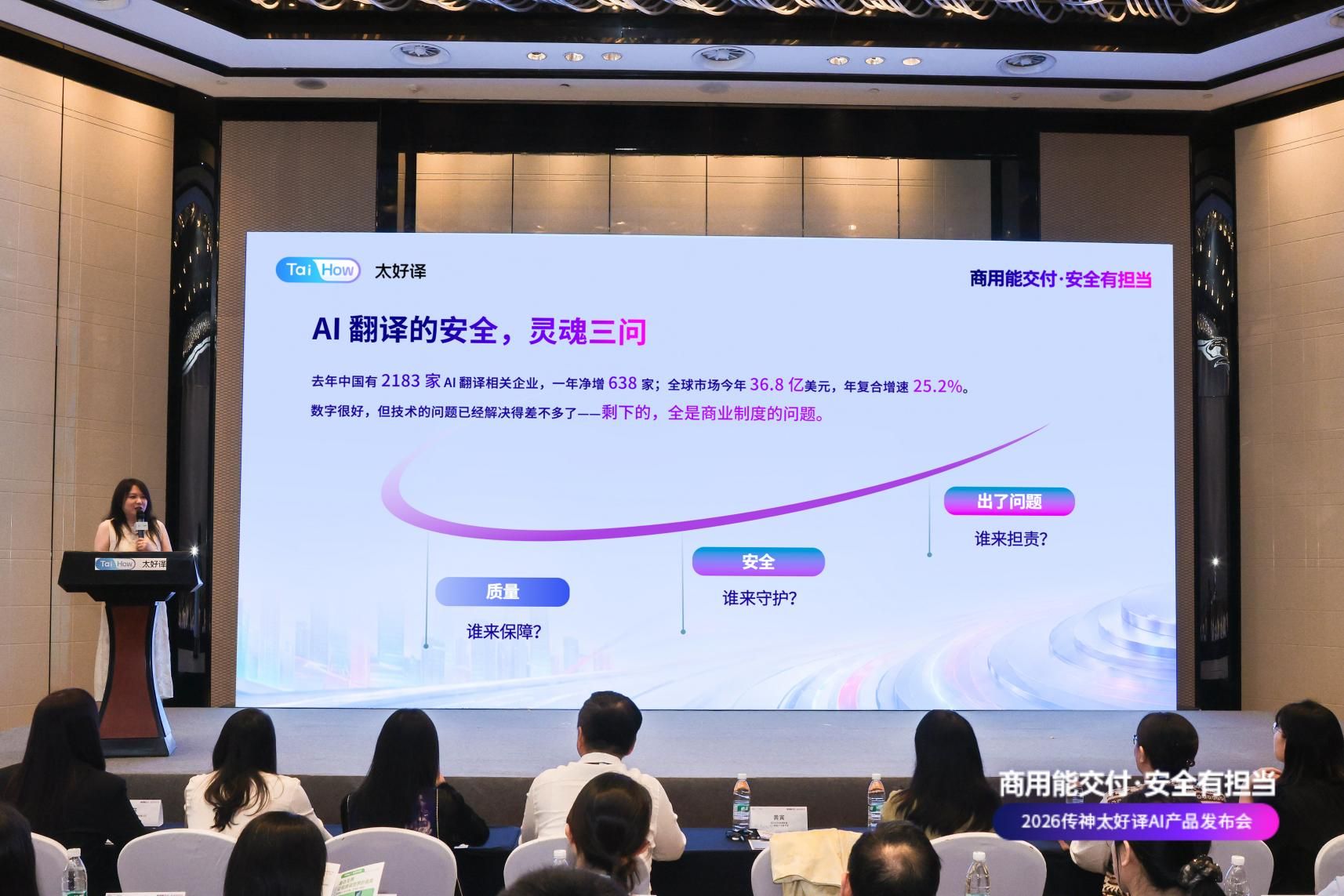
[Huang Yin, Chairman of the Artificial Intelligence Industry Committee of the Asia-Pacific Economic and Trade Development Alliance, delivered a keynote speech and raised the three core questions of "quality, safety and liability"]
At the launch event, Huang Yin pointed out the core of risks with a real case: "A contract wrote 'irrevocable authorization', but the translation turned it into 'revocable authorization'. The sentence is still smooth with no obvious grammatical errors, but the legal meaning has completely changed." Huang Yin further pointed out that AI does not create more errors, but makes errors much harder to detect.
Release of the 6S+1 Trustworthy Service Framework
AI Translation Evolves from "Usable" to "Dependable to Use"
In response to the long-standing industry problem of "sufficient efficiency but insufficient trust", TaiHow launched the "AI Translation 6S+1 Commercial-grade Trustworthy Service Framework" at the event. This framework consists of "one safety threshold + six standard pillars".
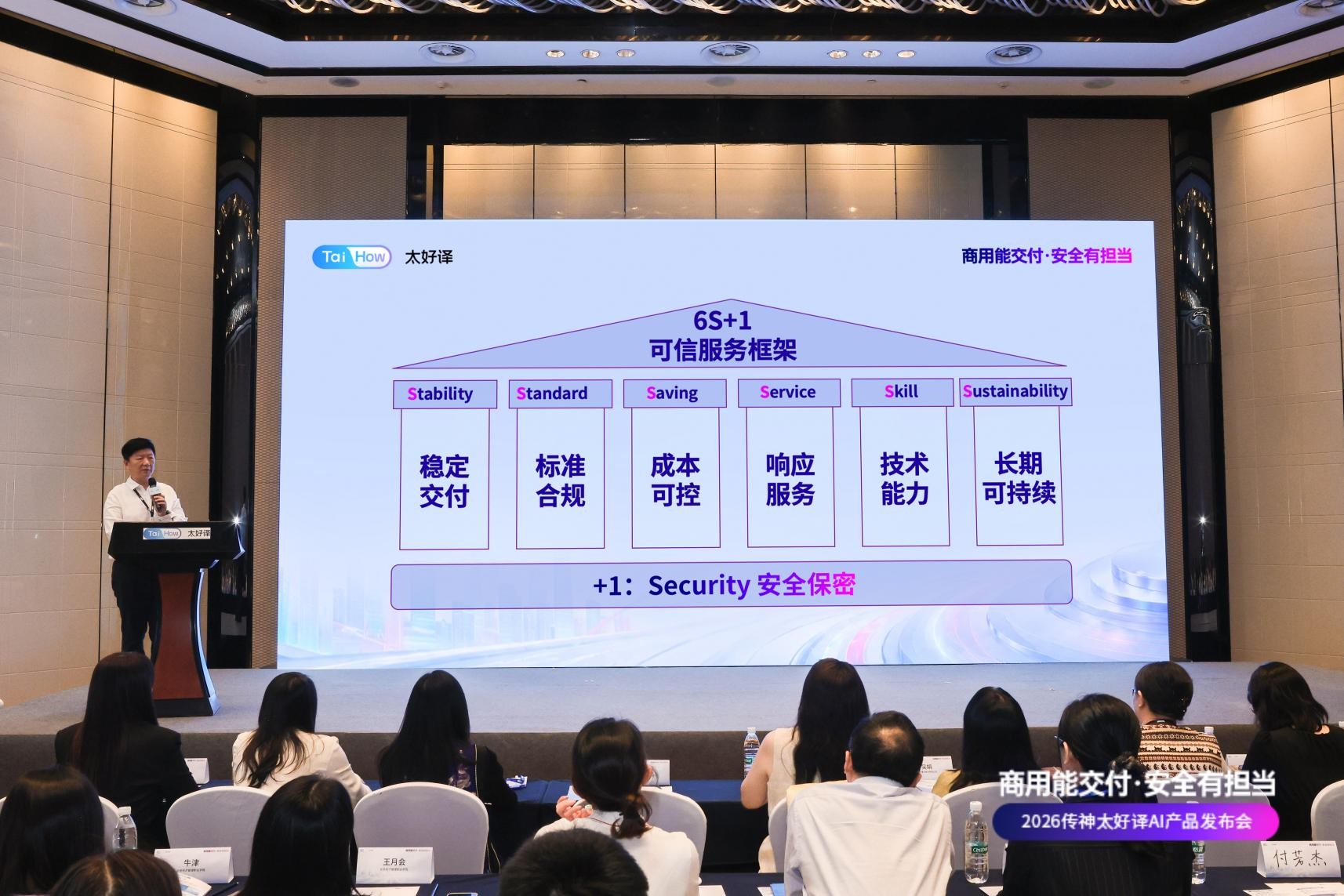
[TaiHow releases the "AI Translation 6S+1 Commercial-grade Trustworthy Service Framework"]
The "+1" refers to Security and confidentiality, which is the prepositive threshold and one-vote veto item: if the safety conditions are not met, subsequent services will not be launched. The six pillars are stable delivery, standard compliance, controllable cost, responsive service, technical capability and long-term sustainability, each of which is quantifiable, traceable and verifiable.
This framework puts safety as the precondition for commercial service access, shifting the AI translation industry from "selling production capacity" to "selling credibility".
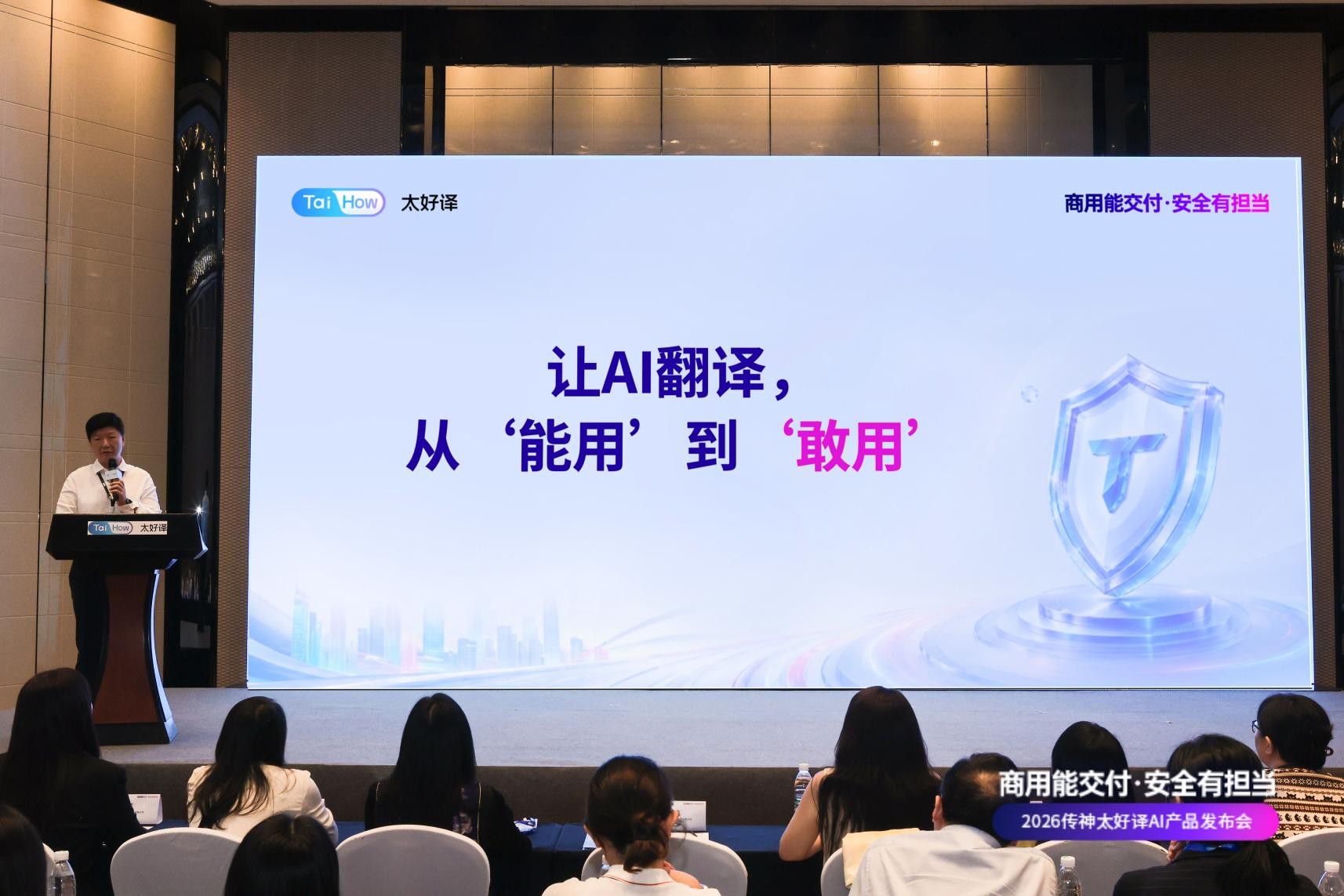
[Shi Xin, Co-founder of Transn and Founder of TaiHow, delivered a keynote speech, emphasizing that commercial-grade AI translation evolves from "usable" to "dependable to use"]
As Shi Xin, Co-founder of Transn and Founder of TaiHow, said: A real commercial-grade AI translation tool is far more than just usable, it needs to make enterprise customers "dare to use it"; it is not enough to try your best, you must guarantee the delivery of results. "Capability" is the passing line of AI translation, while "trustworthiness" is the lifeline of commercial applications.
He further stated: "In the first half of AI translation development, players compete for speed and capability. In the second half, we need to compete for who is more trustworthy. TaiHow's '6S+1' framework is not a marketing concept, but our formal commitment to all enterprise customers. We are willing to open our framework to discuss, verify and co-build standards together with the whole industry, because the large-scale delivery of enterprise-grade AI translation cannot be achieved by one single company."
From Translation Tool to Workstation
The WorkBuddy for the Translation Industry
If the "6S+1" framework and the in-house developed root large model answer the question of "why you can trust it", then TaiHow's four product lines answer the question of "who can support different business scenarios".
Different scenarios have different delivery pain points. Document translation focuses on format, terminology and version management; conference translation focuses on real-time performance, concurrency and stable output; video translation focuses on multi-modal understanding and batch production; private deployment focuses on data boundary, permission isolation and system controllability. Product capabilities can be adjusted according to scenarios, but the bottom line of safety and "6S+1" delivery remains unchanged.
At the site, He Zhenyu, Vice President of Transn and Head of TaiHow Products, demonstrated the four upgraded capabilities one by one:
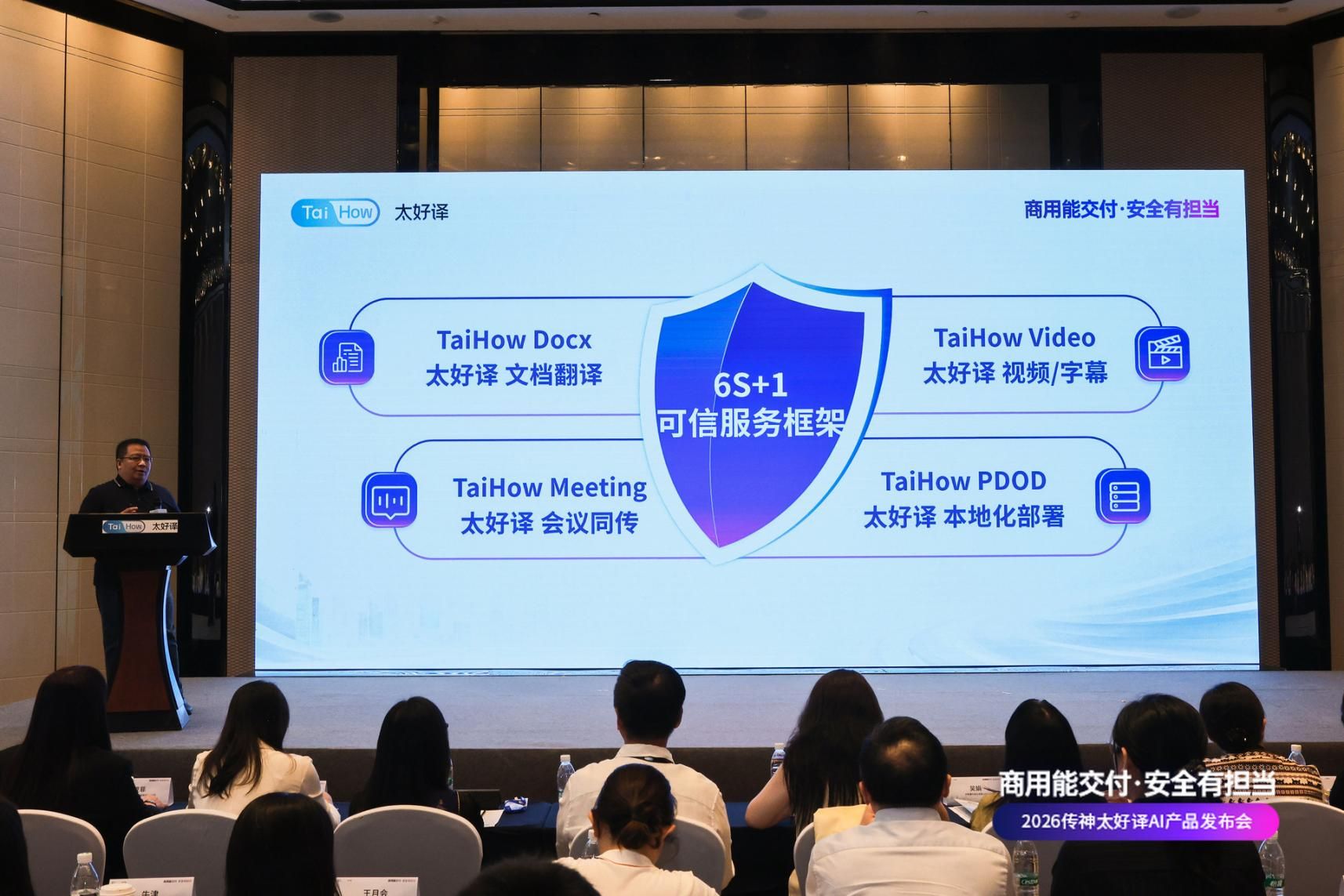
[He Zhenyu, Vice President of Transn and Head of TaiHow Products, interpreted TaiHow's four AI capabilities on site]
TaiHow DOCX | Document Translation
It twins the experience of industry translation experts into expert agents, with double checks from the AI expert group and language experts. It supports more than 80 languages, over 30 file formats and 80+ professional fields, achieves pixel-level restoration of complex document formats, and the translated manuscripts can be directly used in subsequent business processes.
TaiHow Meeting | Conference Simultaneous Interpretation
It supports 80+ languages, 500+ people attending meetings online, and 12 languages displayed on the screen simultaneously. Its speech recognition accuracy reaches 98%, with capabilities of professional terminology recognition, sensitive word filtering and intelligent language identification. It provides multiple forms including SaaS, private deployment and all-in-one machine, enabling guests from dozens of countries to "attend and view meetings in their native language".
TaiHow Video | Video Translation and Production
It deeply understands the plot, character relationships and context, covers lip sync, speech speed and voice line, emotion and tone cloning, and realizes the coordinated output of subtitles, dubbing and pictures. Words that are hard to translate literally such as "domineering CEO", "green tea (derogatory term for scheming women)" and "white moonlight (unforgettable ideal lover)" can also be translated to fit the expression habits of the target market, reducing the uncertainty of mass content production.
TaiHow PDOD | Private Deployment
For highly sensitive data such as technical drawings, product parameters, project documents and meeting content, it supports deployment on enterprises' own servers and private networks, realizing invisibility on public networks, no data leaving the domain and independent permission management. The all-in-one machine can achieve physical isolation, realizing "no internet access, no trace left, data disposable". The translation capability can be embedded in OA, CRM, email, knowledge base and conference systems, becoming a native language module of enterprise business processes. This capability is supported by Transn's full-stack self-developed "root original" Rendu large model. The model, terminology memory and log cache can be fully migrated to the customer's internal network, ensuring data security from the architecture level.
Launch of the "Trust Co-Building Initiative"
Verify Commercial-grade Delivery with Real Conference Scenarios
At the launch event, TaiHow announced the launch of the "TaiHow Meeting Trust Co-Building Initiative", inviting more partners to bring TaiHow Meeting into real scenarios such as cross-border conferences, international exhibitions and business communication, to jointly verify the comprehensive capabilities of commercial-grade AI translation in quality, stability and data security.
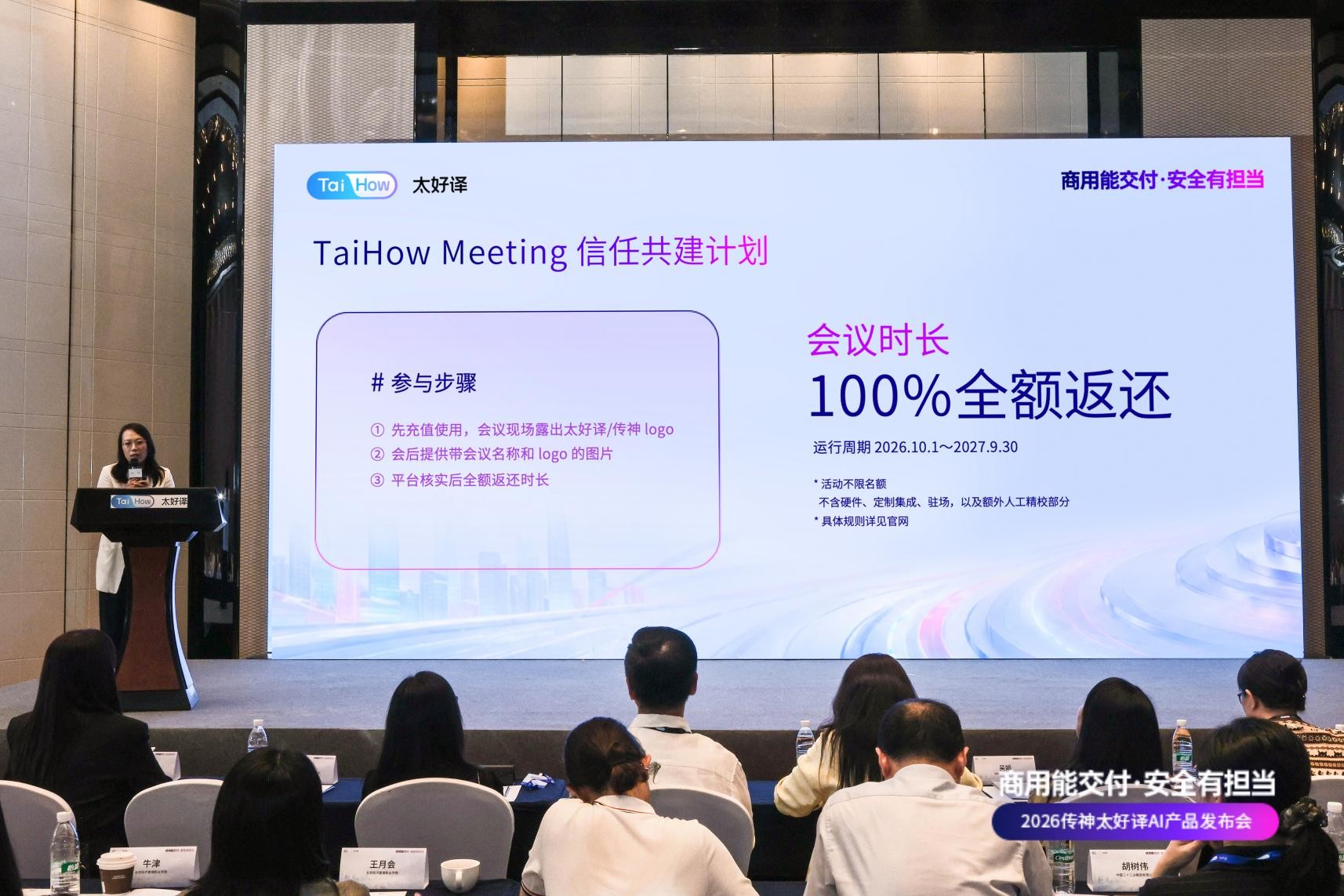
[Zhang Jia, Delivery General Manager of Transn, unveiled the "TaiHow Meeting Trust Co-Building Initiative" at the launch event]
This initiative is open to conference service providers for one year with no limit on the number of participants, adopting the cooperation model of "pre-charge for use, full refund after verification". The specific rules will be announced on TaiHow's official website.
Zhang Jia, Delivery General Manager of Transn, said: "Customers have scenarios, we have services. Together we can let more enterprises verify the delivery capability of commercial-grade AI conference simultaneous interpretation at zero cost."
This is not a short-term product experience, but a co-building sample with both supply and demand sides participating and verifying together. Trust cannot be established only by parameters and publicity, but formed in every traceable, verifiable and accountable delivery process. TaiHow hopes to promote commercial-grade AI translation to evolve from "usable" to "dependable to use, stably usable and long-term usable" through open co-building.
Roundtable Dialogue
Safety is Not an Optional Question, But a Mandatory Question
Apart from product releases, the event also specially set up a roundtable session hosted by Xia Fei, General Manager of Transn.io, with the theme of "Commercial AI Requires Safety — A Trust Dialogue Between Service Providers and Clients". The invited guests including Shi Xin, Co-founder of Transn, Wu Juan, Chief Engineer of Scientific and Technological Translation at Zoomlion, Pan Yuling, General Manager of Fuzhou Baiyitang Translation Services, Zhang Yilei, Founder of Tiandi Lifang Translation, and Song Xixi, Localization Project and Quality Control Head of Dalian Tuosi Technology, launched an in-depth dialogue across the perspectives of both parties around core topics such as "Is safety an optional question or a mandatory question" and "Can efficiency and safety be achieved at the same time".
The consensus of the participating guests gradually became clear: safety is not equal to "no data leakage", but a complete closed loop of data security, content quality and delivery liability. When facing the trade-off between efficiency dividend and customer confidentiality, it is not an optional question, but a mandatory question.
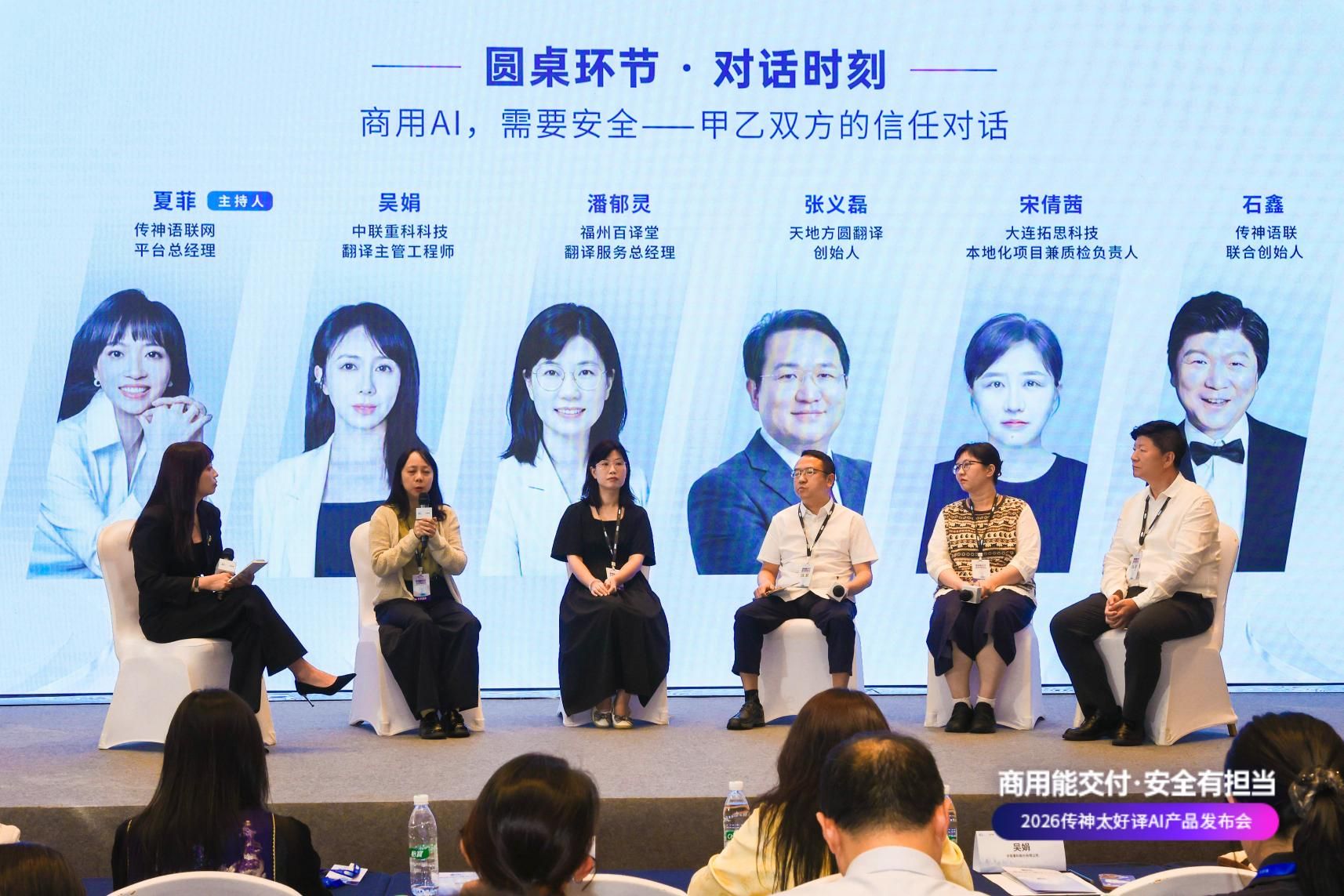
[The roundtable session carried out in-depth discussions around the theme of "Commercial AI Requires Safety — A Trust Dialogue Between Service Providers and Clients"]
The first half of AI translation development focuses on efficiency, while the second half focuses on trust.
TaiHow's release of the "6S+1 Trustworthy Service Framework", "four AI product lines" and "Trust Co-Building Initiative" this time aims to provide a set of quantifiable, traceable and accountable delivery standards for commercial-grade AI translation. In the coming year, this framework will be applied to more real business scenarios; time will tell whether this set of standards can stand the test.