Apple and OV have rolled out new products intensively, giving rise to the "AI OS Meta Week" — which one is the most competitive?
This week, AI OS updates have been released intensively, which means the real AI phones are here.
Concentrated Release:
First, on September 15, Apple updated iOS 27, and Siri AI finally arrived; then on September 16, vivo released OriginOS 7, with its personal assistant Lanxin XiaoV launched; on September 17, OPPO released ColorOS 17 featuring AI, proposing AI proactive services. This week also saw the launch of the Doubao Phone 2, which ZTE calls an AI agent phone.
Meanwhile, Huawei Connect 2026 also unveiled the HarmonyOS Agent Framework HMAF 2.0; Xiaomi's HyperOS 4 Beta was pushed to the first batch of 7 device models.
Compared with previous mobile systems that dared to call themselves AI phones just with small smart features like AI object removal, the AI OSes released this week are basically equipped with on-device models and cross-app Agent scheduling capabilities, which are the AI OSes in the true sense.
All these releases are concentrated in the third week of September, which can be called the "AI OS Meta Week". Yes, not the first year, AI phones are suddenly coming at this very moment.
Of course, these systems have not yet been launched with the latest new phones, so ordinary users have not experienced them. What people see from the launch events is probably that the biggest change is the higher price.
"The standard RAM of flagship models has reached 12G now", according to Zhou Wei, Vice President of vivo, the current 30B on-device MoE model basically requires 3 to 4G of RAM. To experience AI, users have to pay extra for this part. Coupled with the price increase of memory this year, the price rise of Apple iPhone 18 Pro by more than 3000 yuan is a typical phenomenon.
The price increase is only an appearance. Whether an AI phone is worth buying depends more on its actual implemented capabilities.
The design philosophy of Doubao Phone is unconstrained, while Apple's AI OS is restrained, and the Android-derived AI OSes from brands like OPPO and vivo in between are pursuing a balance between expectation and reality.
At present, only by understanding the differences between various emerging AI OSes and the technologies and logic behind their implementation can we figure out which AI phone is more suitable for ourselves.
01
Context or Agent: Which Matters More?
Since the concept of AI phone was proposed in 2024, the AI OS systems have just shown their real strength now. The two most noteworthy core points are, first, whether the AI understands you, and second, whether the AI can actually get things done. With the release of these AI OSes, solutions to both problems are now available.
For system-level Context, active memory is extremely important. It means that when you talk to the AI, its responses show that it truly understands you. For example, if you can't eat spicy food, the mobile AI should remember this when making travel guides and never recommend spicy food.
Opening a JSON window on the phone for users to actively enter 1000 words of personal information was an effective solution in the early stage of AI phones, but users will definitely call the product manager stupid, because no one will write a self-introduction as the first thing after buying a new phone.
Therefore, the early AI memory accumulation of 2024 AI phones relied on users manually feeding more personal information to the AI.
In this aspect, OPPO launched Breeno Memory very early, which allows users to record screen content by swiping the screen with three fingers, and this is also a very good approach. After using it for a year, I found the biggest problem is that people are lazy. Although the function is already very convenient, users still don't want to take the trouble to store information manually.
Apple currently has a good solution, which is to launch the standalone Siri Recap App. After enabling it, it will generate titles, summaries and key points for daily recordings, which is equivalent to automatically saving a 24-hour context. Over time, it will fully understand you.
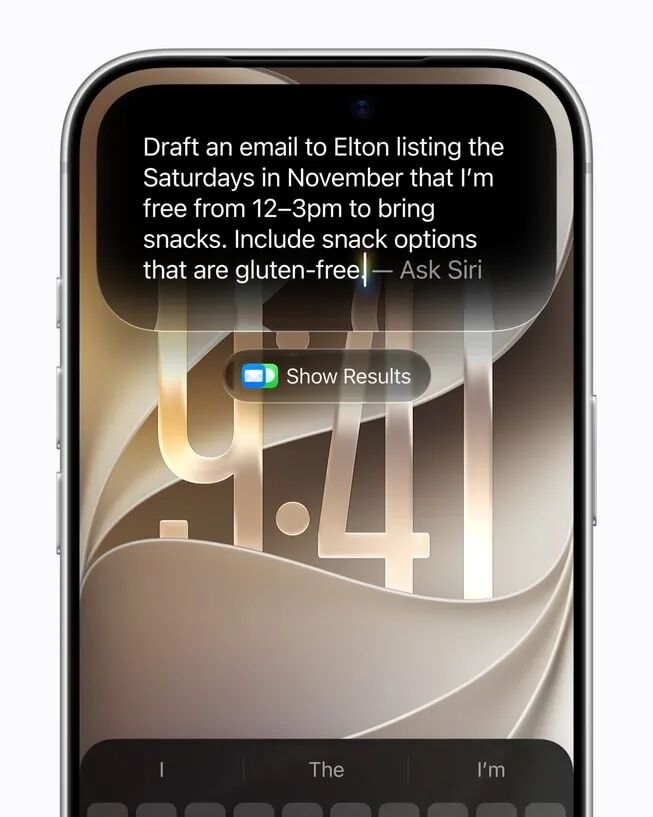
Siri AI understands personal context and directly drafts emails
However, this function has not been launched yet, because it may consume a lot of power and memory, and users also have certain privacy concerns.
The pleasant surprise from OPPO this time is the launch of the Smart Memory Ball, whose principle is similar to Apple's Siri Recap, except that it uses third-party hardware for local storage, which makes it easier to explain privacy and security to users.
Here we have to criticize ZTE a little bit, which only thinks about being a mobile phone OEM, and does not take the initiative to help Doubao Phone solve the Context problem.
It should be noted that even if the system cannot be fully controlled, the desensitized context data should still be kept in the hardware device. These data are the core assets of future AI devices and the key to making users rely on the products.
If context is more important for AI phones, after all, you can only do things without mistakes on the basis of being understood, there are finally solutions now. But the Agent, which is more important in the second stage, has actually shown its power earlier.
The first-generation Doubao Phone became a hit relying on its Agent capability, which allows users to order takeout and book flight tickets with one sentence, showing the coolest AI life scenarios to users, and breaking the biggest stubborn problem in the APP era - the APP island.
The most anticipated Doubao Phone 2 this week has already had 370,000 users mark "Want It" on JD.com. The Agent capability is the key to attracting users.
"Screen Recognition Shopping" is one of the core capabilities of this generation of Doubao Phone. When you see a product you like, you can directly tell the Doubao Phone to help you find the cheapest link of the same product. The AI will find the most suitable link for you, add it to the shopping cart, and wait for you to click confirm to pay at the last step.
Capabilities like these will become more and more mature, and people will gradually rely more on agent assistants in life and work scenarios. It is worth noting that at this stage, more agent capabilities do not mean there is no cost.
02
Killing Apps or Daily Convenience: Which Matters More?
The more mature the Agent capability is, the less users need to enter the APP interface for operations.
When you use the first-generation Doubao Phone and tell it you want to go to Shanghai, it can directly operate multiple Apps including Ctrip, Baidu Maps, and the mobile calendar to complete the task. It relies on screen reading + simulated clicks to enter Apps such as WeChat, Taobao and financial apps, which made large tech companies rush to block the first-generation Doubao Phone.
Now ByteDance has put aside the idea of "killing Apps", and Doubao Phone 2 has begun to seek support from super Apps. It is continuously expanding the third-party service ecosystem, accessing services such as Caocao Mobility, maps, and Qishui Music, as well as connecting the system with the Feishu interface;
The most obvious progress of Doubao Phone 2 is that the support for its own App series is more complete, and services like Douyin E-commerce and Feishu have system-level support.
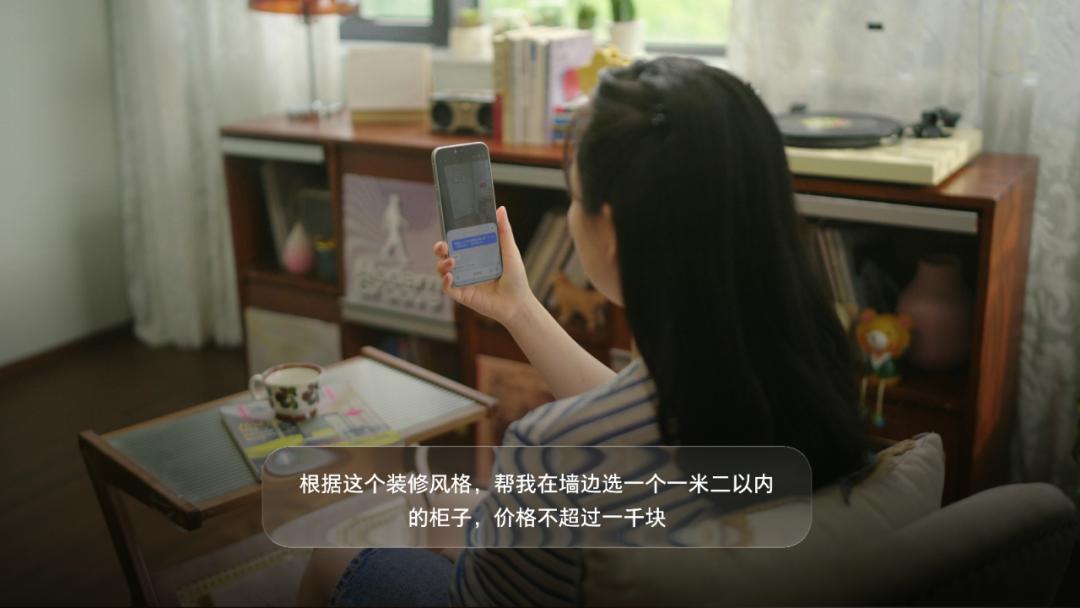
In fact, for ByteDance, although the breakout route of Doubao Phone is very radical, it is also a last resort.
At present, the person in charge of the Doubao Phone business is Liu Chengcheng, founder of 36Kr, who previously developed JingOS during his entrepreneurial career. Startups must be radical to break through, and after being acquired, he brought his original positioning thinking into the project, making Doubao Phone an instant hit.
The first-generation Doubao Phone made the Apps of large tech companies face channelization, so these companies collectively began to block it. Fortunately, ByteDance's business coverage is wide enough now, covering content, e-commerce, enterprise services, and even local life services, all of which are ByteDance's advantageous layout areas.
In contrast, Apple, which has no internet business layout, has a native system ecosystem, but its current AI functions are still concentrated in daily convenience scenarios.
Apple's Demonstrable focuses on personal affairs processing: Siri connects to your personal data, and can find content and arrange task schedules according to messages, emails, photos, schedules and other information.
It can also read personal information and collaborate with multiple Apps to complete long-chain tasks such as "find the address in the message and navigate there by car". It can be said that Siri is no longer the stupid assistant it used to be.
Apple's AI has also made huge progress this time in frequently used scenarios such as taking photos.
The Siri mode is integrated into the camera, which realizes the function of asking questions about the taken photo with the help of the multimodal model. For example, when the camera is taking a photo, you can ask what the object is. Or when taking photos for your girlfriend, you can let Siri guide you in real time on how to adjust the camera to take better-looking photos.
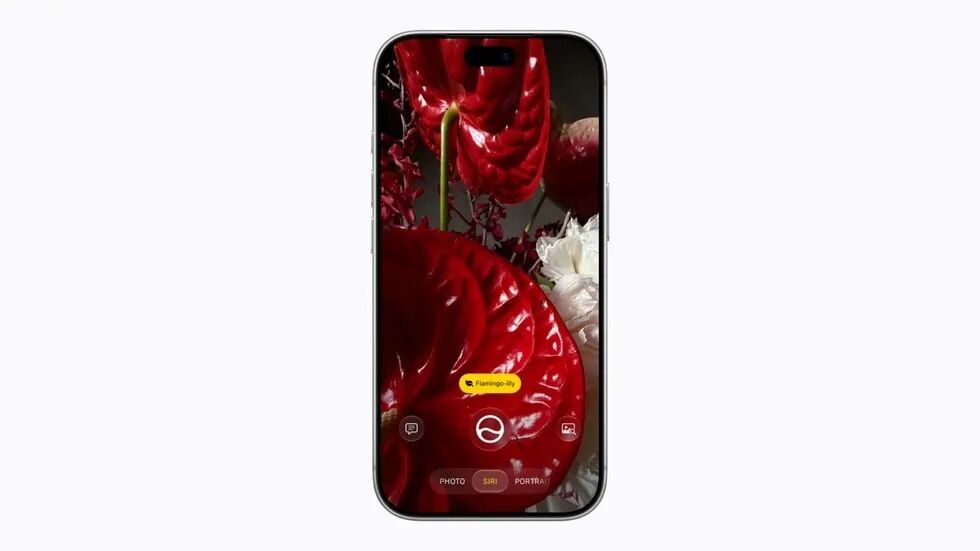
Siri mode in the camera: ask "What is this" right after taking the photo
If you think these tasks can also be done by the Qwen and Doubao Apps, Apple also has more complex capabilities. For example, the Spatial Reframing function can adjust the perspective and composition of taken photos, and you can even switch to different viewing angles after the sample photo is confirmed.
More advanced tasks are completed around the cloud large model, such as writing, making plans, sharing and interaction. Safari also adds a new Notify Me plug-in function, which will notify you immediately when a product on e-commerce platforms is reduced in price or restocked.
Apple's unique accumulation lies in onscreen awareness and visual content understanding. This makes Apple relatively more efficient than screenshot-based solutions when processing some AI commands. It is very convenient for scenarios such as creating or modifying cross-app shortcuts.
To sum up, Apple's AI looks powerful, but it belongs to the type of silent daily capabilities, and does not emphasize the ability to complete complex tasks across Apps. For example, it cannot do things like ordering takeout or booking a flight with one sentence.
03
The Trade-off of System Architecture Determines the Upper Limit of AI Capabilities
As we all know, the power of Doubao Phone comes from its GUI Agent. By simulating screen clicks, it can theoretically do almost anything.
But starting from Doubao Phone 2, the team became more cautious and adopted a dual-track system.
The system gives priority to AI protocols such as MCP / A2A: this means that when the protocol is available, the App actively opens the interface, and the assistant does not need to read the screen to complete tasks. The AI roadmap set by Huawei for HarmonyOS also tends to this direction.
GUI is still the main capability: when there is no available interface, it can still take screenshots, recognize controls, and perform clicks and swipes. The Super Xiaoai Inspiration Ball launched by Xiaomi also follows this route.
However, to make better use of GUI, Doubao Phone 2 adds the Screen Automation Operation Declaration Protocol (SAEP) this time, which allows Apps to set red lines for its operations. The core is to get the consent of super Apps for its operations, and obtain authorization for its operation capabilities.
As for Apple, although it also has screen awareness, it is not designed for GUI operations, but to help the model understand the content on the screen.
Apple's design combines on-device and cloud models, and distributes tasks through the System Orchestrator in the system. However, some tasks are difficult to describe clearly in words. At this time, the screen awareness and visual understanding capabilities will help the system better understand the tasks and assign them to the appropriate model.
The specific process is also very complex: the on-device Orchestrator reads personal index, screen entities and App Toolbox → selects the AFM model → invokes the registered tools.
Some people may say that Apple Cloud Pro's Agentic tool use is also GUI, but it is tool invocation instead of pixel-level clicks, so there is still a certain gap in what it can do compared with simulated clicks.
Therefore, in scenarios such as ordering takeout and booking flights, Apple AI is not expected to realize these functions in a short time (it can be realized without Agent, and it is also easy to let the AI make a phone call to place an order). After all, Meituan will not actively connect to Apple's protocol now, at least it will lose all the revenue from splash screen ads.
The AI phones that are in the middle form between Apple and Doubao Phone are those from Android camp manufacturers represented by Oppo and Vivo (OV).
These manufacturers have certain rights to customize the system, but cannot fully dominate the development of AI OS, so they have to take a detour to implement many functions.
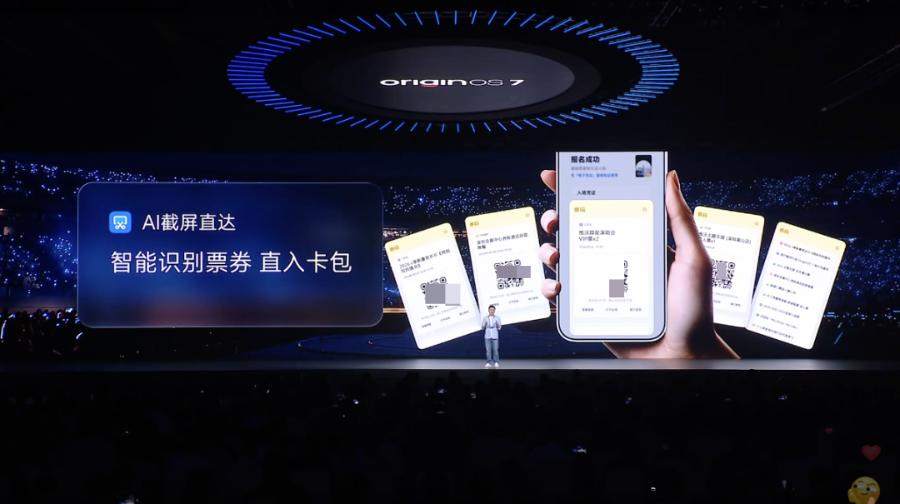
A typical limitation is vivo's "AI Screenshot Direct" function. If you want the system to remember the pickup code after ordering coffee, you need to take a screenshot and send it to the system AI. Although the system will automatically delete the screenshot, this is far from AI Native experience. It is no different from opening the mobile notepad and writing down the pickup code manually. Why not just press the side AI key to directly identify and record the screen content?
In addition, domestic Android manufacturers attach great importance to user privacy and security, but they also introduce GUI operation capabilities.
For example, in vivo's OriginOS 7, users can call a taxi, order takeout or book a hotel with one sentence through the XiaoV Assistant. I found that XiaoV runs on the screen in real time, and its operations on Apps are displayed synchronously.
The advantage of OV over ZTE and Nubia is that they have long-term in-depth cooperation with App developers, so their GUI operations are expected to work more smoothly with various Apps, but they still cannot get deep-level authorization.
I found that vivo will empty the shopping cart when the AI is running to avoid duplicate orders. This is probably because the system does not know when the user added the product to the shopping cart, and cannot understand the user's attitude towards the product. So it empties the cart every time and only executes the single task assigned to the AI, which is estimated to reduce the possibility of errors.
After introducing all the above scenarios and system architecture principles, I believe everyone has a certain understanding of AI OS. Pursuing more powerful AI capabilities or more convenient daily AI use are different consumer choices.
In the early stage of AI phones, manufacturers are limited by their own genes and have developed different AI features. Whether you are willing to spend an extra 3000 yuan on an AI phone, the answer is in your own hands.
This article is from the WeChat Official Account "Jingxuan