GPT-6 Astra breaks into the 3D world: AI will create spaces, but will not replace 3D designers

The development path of artificial intelligence has been very clear over the past few years.
Large language models have enabled machines to understand and generate text, allowing ordinary users to leverage AI to participate in knowledge organization, content creation, and even complex reasoning.
Later, AI began to enter the visual field. From image generation to video generation, it has continuously lowered the threshold of visual creation. Tasks that used to be completed by professional photographers and designers can now quickly produce a visual result with a single description from ordinary users.
However, 2D content is ultimately just information on the screen, and the real world is not made up of text and images after all.
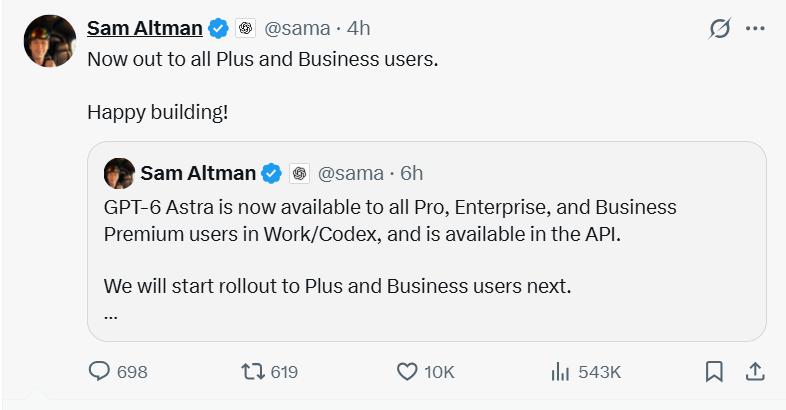
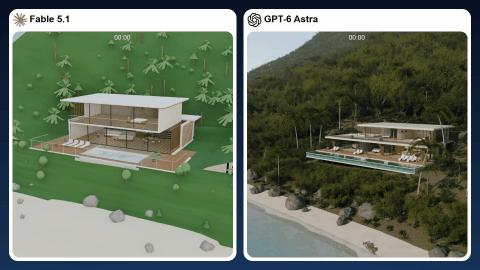
On September 3, OpenAI released GPT-6 Astra, which drew widespread attention from the tech community and the 3D industry. Different from past AI-generated images and videos, Astra's core demonstration is not generating a static picture, but operating professional software through agent capabilities to generate 3D environments, and further forming interactive spaces that can be explored.
3D technology seems to have become the core topic in the AI circle. Recently, Anthropic, World Labs and ByteDance have also launched 3D technology updates, and Tsinghua University & Tencent ARC open-sourced the multi-view and animation upgrade of Pixal3D. It can be said that 3D creation that used to require users to learn professional tools such as Blender and Maya and years of training to complete has been made much easier by AI.
This also raises the question: Can AI really replace architects, game artists and industrial designers?

The biggest change brought by Astra:
Not generating 3D content, but becoming the entry point for 3D work
To understand the importance of Astra, we first need to understand why 3D production was so complicated in the past.
In the traditional workflow, the 3D model of a game scene, a building or an industrial product is not simply drawn out. Designers first need to build models in software such as Blender and Maya, which are similar to basic creation tools in the 3D world, or Photoshop in the image field. Designers can create 3D objects such as houses, furniture and characters through them.
But after the model is built, it does not mean the work is completed.
For example, in the game industry, a character model also needs further material processing and motion binding, before being imported into game engines such as Unity and Unreal Engine to truly become a digital object that can run and interact.
The same goes for architectural design: a 3D rendering of a room cannot just "look good", it also needs to take into account spatial proportions, light changes, furniture dimensions, and the feasibility of future construction.
Therefore, past 3D production was actually a very long chain:
Demand proposal → Design → Modeling → Optimization → Engine import → Manual adjustment → Final delivery.
The 3D industry has long faced the problem of "high threshold": many people have creative ideas, but do not have the ability to use professional tools. They do not know how to or cannot complete the design through Blender.
What GPT-6 Astra released by OpenAI has changed is exactly the relationship between people and professional software.

In the past, people learned software and then used it to complete tasks; in the future, people will directly state their goals, and AI will operate the software to complete the tasks.
This change is actually similar to the impact brought by the AI programming tool Cursor in recent years: in the past, programmers needed to open the development environment by themselves and write code line by line; now, users can directly tell AI that they need to add a certain function. AI can understand requirements, modify code, even find errors, and keep optimizing.
If what Cursor eliminates is not programming languages, but the distance between people and code, then future 3D Agents may play a similar role.
Professional designers or non-professionals do not necessarily need to master all modeling tools proficiently, but communicate with AI in natural language: "Change this living room to Japanese minimalist style" or "Generate a city scene suitable for games".
AI is responsible for understanding the requirements and invoking the professional tools behind it.
Therefore, Astra's biggest breakthrough is not that it generated a beautiful room, but that it demonstrated a new way of working: AI has begun to become the operation layer between people and complex software.
However, lowering the creation threshold does not mean solving the problem of commercial production.
AI allowing ordinary people to quickly generate a 3D scene does not mean that it can already meet the real needs of commercial production.
"Looking like the real world" and "being usable in the real world" are two completely different issues.
For example, an AI-generated room rendering allows users to quickly see the placement of furniture and the overall style characteristics, which is already very valuable for home improvement solution exploration, but once it actually enters the construction phase, the requirements are completely different.
Whether the room dimensions are accurate, whether the furniture can actually be placed inside, and whether the door can open normally are problems that cannot be solved purely by visual generation.
This is even more true in the industrial manufacturing field: the production of a car involves countless parts, and it is almost impossible to actually make the product just by relying on "looking like" or "looking feasible".
Therefore, industry insiders point out: The threshold for AI to enter the 3D field has been lowered, but there is still a huge gap before it can achieve real commercial production, and further efforts are still needed to complete the real industrialization process.

AI enters the 3D field,
Why can't it replace professional models?
AI can become an expert in some fields, but at least for now, it is not a 3D expert. Understanding the world and creating the world are still two different things, and learning content from massive corpora is also completely different from understanding the physical laws of the real world and generating content that fits the real world.
Admittedly, Astra has lowered the threshold for entering the 3D world, then the more critical question is: Will it replace the current 3D generation companies?
The answer is not a simple "yes" or "no". To be more precise, Astra and many current professional 3D generation models solve two different problems.
Astra is better at understanding requirements, breaking down tasks and operating tools, while professional 3D models are better at generating high-quality, usable 3D products. The two are more likely to form a cooperative relationship in the future, rather than a simple replacement relationship.
Some practitioners in the 3D field believe that the emergence of Astra is a positive signal. What it may bring is not the shrinkage of the industry, but allowing more users to enter the field of 3D content creation, thus expanding the overall market size.
Understanding and Generation in artificial intelligence are two different concepts. The strongest capability of past large language models such as ChatGPT is understanding and reasoning. It can understand user intent, read a large amount of text, search massive corpora, and give answers based on existing knowledge.
Hu Yuanming, Founder and CEO of Meshy, once tried to generate the same image of "a warrior holding a sword and a shield" with both Astra and Meshy. Astra is good at grasping general user needs, for example generating human faces, but it is not good at depicting details such as "how big the eyes are" and "the angle at which the sword is held". These details are exactly the core competitiveness of 3D models, which is the so-called "specialization in different fields". If Astra is used as a complete generation tool, its output will be rough, unreasonable and cannot meet user expectations.
For another example, in some interactive scenarios, AI can identify visual elements such as coffee cups and liquids, and can also generate actions like "pouring coffee", but if the liquid flows out of the coffee cup and directly passes through another coffee cup, this kind of "penetration" obviously does not conform to the laws of reality.
The understanding of the laws of the real world is the direction that AI still needs to continue to develop at present.
The future collaboration mode between LLM and 3D models is very likely to take the large language model as the entry point for user requirements, and then the professional models are responsible for creation.
For example, a user puts forward a requirement: "Help me design a 50-square-meter small apartment in Beijing, which is suitable for single people to live in, with Japanese minimalist style."
Hu Yuanming mentioned that Astra's spatial understanding capability is a great boost for 3D generation, which can better drive model-driven tools or platforms such as Meshy. In the future, AI Agent like Astra will first be responsible for understanding this requirement, such as what kind of space the user needs, what furniture is required, and what content needs further confirmation. Then Astra will call different professional tools, for example, call the 3D generation model to generate furniture and space assets, call Blender to adjust the model, call CAD tools to ensure that the dimensions meet engineering requirements, etc.
The final output is not just a simple image, but a complete 3D experience.
This is very similar to today's software industry. In the past, programmers needed to master a large number of underlying tools by themselves. Now, AI is their programming assistant.
Similar changes may also take place in the 3D field: ordinary users do not necessarily need to become modelers, but can invoke the entire 3D production system through AI.

What will be the value
of professional 3D companies?
If in the future all users enter the 3D world through ChatGPT, will professional 3D companies still have value?
The answer is yes. The core barrier of the 3D industry is not generating a model, but generating a reliable and usable model. These usable and commercializable 3D assets require a large amount of professional data support.
For example, the architectural field requires data in aspects such as spatial structure, house layout and material properties; the game industry requires experience in aspects such as character motion and scene design.
These data cannot be simply obtained from internet texts, they come from years of industry accumulation.
Therefore, a mainstream view is that there is an obvious difference between today's 3D field and language models. The development of large language models relies on massive text data, and articles, books and codes on the Internet can all become training materials.
But the data in the 3D world is more complex: a car model is not just an appearance image, but contains multiple data such as 3D structure, dimensional relationship and material information; a game scene is not just a screenshot, but also contains map structure, object collision, player movement logic and so on.
The key point is: These data are difficult to collect at present, or cannot be obtained publicly.