OpenAI was caught red-handed: ChatGPT actually knows what you bought on other websites
Just now, the claim that "ChatGPT knows what you purchased on other websites" has been fully confirmed.
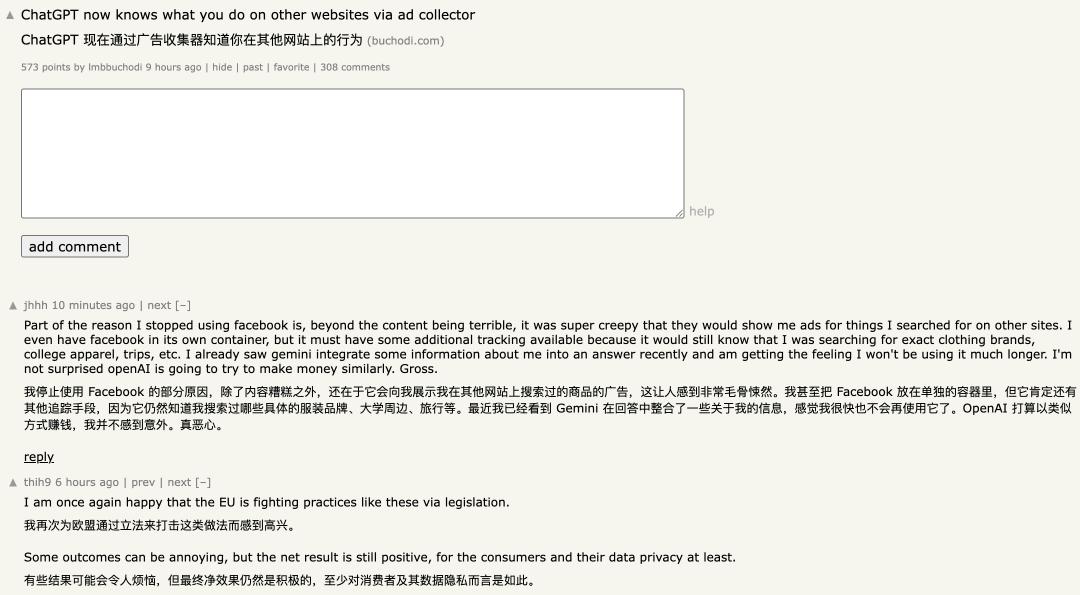
Just yesterday, independent researcher Buchodi released a first-hand investigation, which directly earned 573 points and 308 comments on Hacker News.
He conducted the experiment on his own Android phone, intercepting all data transmitted secretly between the phone and various websites, then re-intercepted the data with another method, and the results from the two methods matched perfectly.
And this observation did not only last for one or two days. Buchodi monitored real internet usage records over several months, covering nearly a thousand ad tracking points across thousands of websites.
The conclusion can be summed up in one sentence: What you searched for, viewed, and purchased on merchant websites can be traced back to your ChatGPT account through a single Cookie.
This Cookie is named __obi.
Three Steps to Link Your Data to Your Account

Step 1: ChatGPT first issues you an "ID card that expires in 60 seconds".
The moment you open chatgpt.com, your browser generates a random string in the background and sends it to the OpenAI server.
The server signs and sends back a digital token, binding your ChatGPT account to this random string permanently, and the token becomes invalid after 60 seconds.
Step 2: This temporary ID card is replaced by a long-lived Cookie.
Your browser sends the token across sites to bzr.openai.com, and the server sets a __obi Cookie under the .openai.com domain, which is valid for a full year.
The key lies in its configuration: SameSite=none, which is specifically designed to make this Cookie follow cross-site requests. When you browse other websites, this Cookie will follow you there.
Among all requests in the same batch, the browser blocks all other Cookies from OpenAI, only allowing this one to pass through.
Step 3: The merchant website sends this Cookie back along the original path.
Companies that have purchased ads on ChatGPT will install a small piece of OpenAI tracking code on their own sites — similar to tools like Meta Pixel and Google Tag.
As soon as the code loads, __obi will fly back to OpenAI together with the page you are viewing, the product you are searching for, and the order you just placed.
The most notable point is that the browser has already attached the Cookie to the request for loading the script before OpenAI's code even runs.
As long as the page is open, the identifier has already been sent out. You do not need to click anything.
The Data Sent Back Is More Detailed Than You Think
On Buchodi's own phone, the same __obi was sent to OpenAI from 12 commercial sites including Chewy, Wayfair, HelloFresh, and Coursera, and each transmission was accepted normally.
Looking at the data over a longer period of time, it is common for the same user's identifier to be sent back to OpenAI repeatedly by different merchant websites. One user's identifier even appeared in the backhaul records of ten different merchants at the same time.
It is not just the Cookie itself that is transmitted.
This piece of code from OpenAI will also actively extract information from the forms you are filling out and the text displayed on the page. It even collects more information than what merchants voluntarily provide.
Your email address, phone number, and name are encrypted before transmission, but the country, city you are in, and your zip code are all sent directly in plain text. The zip code is the most frequently collected item, which was captured 100 times across 28 websites.
The URL of the page you visit will also be sent back. Although the search terms are removed, the page path is retained.
In the paths received by the data collector, the researcher found a page for checking disease information, a page for debt repayment plans, and a registration form for legal litigation.
What is more absurd is that the merchants themselves are kept in the dark.
They only installed a small piece of code as required by OpenAI to count advertising effectiveness, and had no idea that their customers' browsing records were being secretly bound to a certain ChatGPT account.
Do you think you can get rid of it by logging out of your ChatGPT account? You are overthinking it.
The researcher analyzed nearly a thousand identity credentials and found that even if you are not logged in, the system will assign an anonymous ID to your mobile phone — one ID for one device, which will be associated with you for at least 27 days.
Logging out only changes the identifier's form, and the tracking still continues as usual.
What is more awkward is the label OpenAI attached to this Cookie. In the privacy settings, "Data Analysis" and "Advertising Marketing" are two independent switches, and you can turn off the advertising marketing option separately.
But __obi is classified under the "Data Analysis" category.
In other words: even if you specifically go to the settings to turn off ad tracking, this Cookie will still be installed on your device.
On September 14, Buchodi sent his findings and two questions to OpenAI: Why is this classified as analysis rather than marketing? Are people who turn off marketing tracking still affected?
The customer service replied that they had received the message and would review it internally, but did not give a direct answer to either of the two questions.
Not All Users Are Affected
First of all, users with Apple devices can relax.
This entire mechanism only works on Chrome for Android. Apple's Safari will inherently block this type of cross-site Cookie, and the same applies to Chrome on iOS, so iPhone and iPad users are not affected. The researcher has not yet tested Chrome on desktop computers.
Secondly, this identifier is not generated every time you open ChatGPT. It is only generated approximately once every five times, and the mobile web version of ChatGPT does not trigger this mechanism at all.
Buchodi also noted the most critical point: he can only prove that the data is sent to OpenAI's server, and he cannot confirm whether OpenAI actually associates this data with your account.
After all, he did not witness how the data is processed inside the server.
Old Technology, New Scenario
However, to be fair, this practice was not invented by OpenAI.
Facebook has been doing this for many years. When you are logged into Facebook and browse other shopping websites, the shopping website sends your browsing records back through Facebook's tracking code, so that Facebook knows what you have viewed and purchased.
The advertising industry has been doing this for more than a decade.
ChatGPT officially started selling ad slots in February this year, and enabled marketing tracking by default for free users at the end of April.
At that time, people were worried that data inside ChatGPT would leak out to external parties.
This new survey shows the opposite direction — the records of you browsing websites outside ChatGPT are being aggregated to your ChatGPT account.
The things people tell ChatGPT are usually content they would not post on social media like Moments.
And ChatGPT is now increasingly used to place orders, book tickets, and handle various affairs on your behalf.
The ad technology itself is not new. What is new is that the content you told the AI and the products you purchased elsewhere are being merged into one single account.
Reference: https://www.buchodi.com/chatgpt-now-knows-what-you-do-on-other-websites-via-ad-collector
This article is from the WeChat official account "AI Era", author: ASI Revelation, editor: Solomon, published with authorization from 36Kr.