Just now, GPT-6 Astra has made a major breakthrough in the Goldbach Conjecture.
Major Breakthrough in Mathematics!
Just recently, GPT-6 Astra has made new progress on the Goldbach Conjecture.
Netizen Captain Sude announced that Astra has successfully proved a Goldbach-like conjecture concerning the Liouville function!

Specifically, it unconditionally proves the weak Liouville form of the Goldbach Conjecture.
Even more surprisingly, contrary to our expectations, this time Astra did not just rely on overwhelming computing power to brute-force the result — it produced extremely elegant logical reasoning.
Moreover, this proof has now passed formal verification in Lean 4.
The Unreachable Crown Jewel
Prior to this, the ghost of the Goldbach Conjecture has tormented human mathematicians for nearly three centuries.
In 1742, Goldbach put forward this conjecture in his letter to Euler: "Every even integer greater than 2 can be written as the sum of two prime numbers."
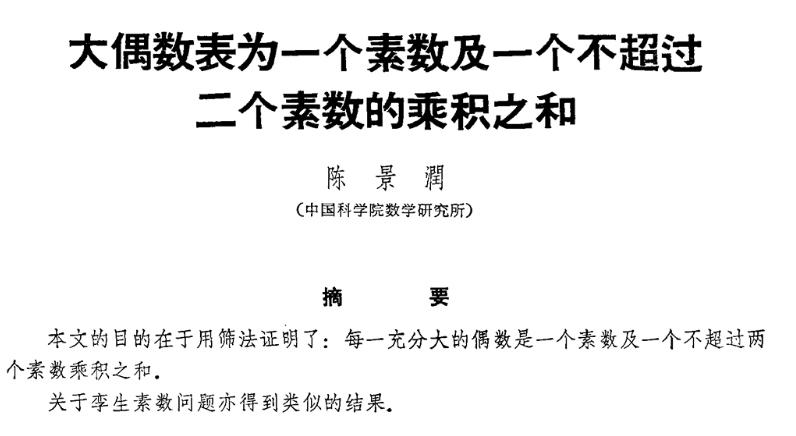
Countless people have devoted their life's work to it. From Hardy and Littlewood to Chen Jingrun who proved the "1+2" theorem, humanity has never been able to reach the crown jewel — the "1+1" part of the conjecture.
This is because the distribution of prime numbers is so incredibly erratic!
Since stubbornly sticking to the original path did not work, mathematicians came up with a creative workaround, creating a "stand-in theory" — the Liouville version of the Goldbach Conjecture.
To simulate prime numbers, mathematicians introduced a wonderful tool: the Liouville function.
This function is denoted as
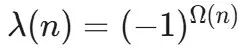
, where

represents the total number of prime factors contained in a number.
Its rule is like a switch that only recognizes "odd and even counts": if the number of prime factors of a number is even, then λ(n)=1.
If the number of prime factors is odd, then λ(n)=-1.
The Liouville function value of all pure prime numbers (such as 2, 3, 5, 7, 11) is definitely -1! However, the reverse is not true: for example, the λ value of 8 and 12 is also -1.
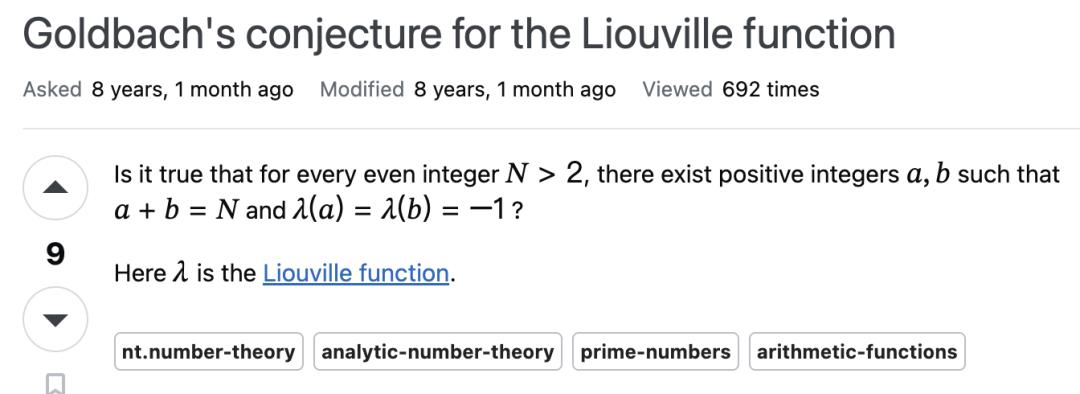
In 2018, on the well-known mathematics forum MathOverflow, someone proposed a weakened version of the Goldbach Conjecture:
For every even integer N greater than 2, can we always find two positive integers a and b such that N=a+b and λ(a)=λ(b)=−1.
If the classic Goldbach Conjecture holds, then the Liouville values of these two primes must both be -1, so this "Liouville Conjecture" must also hold.
But now, mathematicians have relaxed the conditions: the addends do not have to be pure primes, as long as the number of their prime factors is odd!
Breakthrough Under the Shadow of Riemann: AI Presents the Stunning Two-Page Proof
Since the conditions are relaxed, it should be easy to prove, right? As it turns out, it is still unbelievably difficult!
The core of the problem is that mathematicians want to study whether these alternating positive and negative signs will cancel each other out like coin flips under additive combinations, thus revealing the deep order hidden beneath addition. This is key to building a bridge between "multiplicative building blocks" and "additive combinations" in mathematics.
It was not until 2024 that mathematician Alexander P. Mangerel finally made a breakthrough. In a paper, he proved that this conjecture holds for all sufficiently large even numbers.
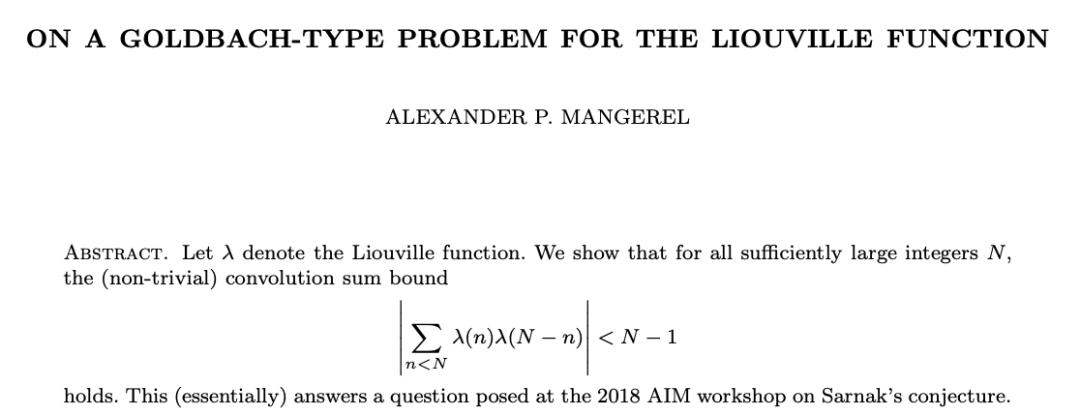
Link: https://arxiv.org/abs/2404.12117
But! His proof has two limitations.
1. "Sufficiently large": This means it does not cover those relatively small even numbers.
2. "GRH": His proof relies heavily on the Generalized Riemann Hypothesis. In other words, his conclusion only holds if the Generalized Riemann Hypothesis is true.
This time, the team of Astra and Captain Sude has directly broken through these two shackles!
At the beginning, Astra released a PDF that was only 2 pages long.
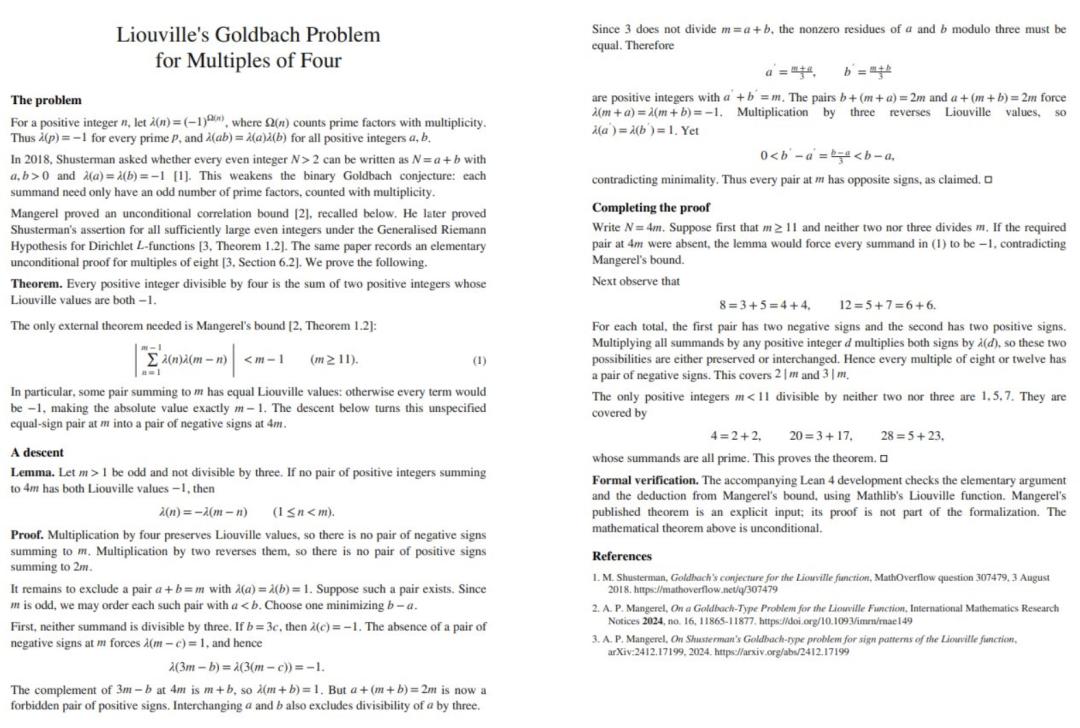
In this concise paper, Astra announced —
Without the Generalized Riemann Hypothesis, it can be unconditionally proven that all positive integers divisible by 4 can be expressed as the sum of two positive integers whose Liouville values are -1!
In the PDF, Astra cleverly used an "unconditional correlation bound" from Mangerel's paper, combined with an extremely ingenious descent method.
The core logic of the theorem uses proof by contradiction: assume that there exists an odd number m (not divisible by 3), and at the scale of 4m, there is no pair of numbers that add up to 4m whose Liouville values are both -1.
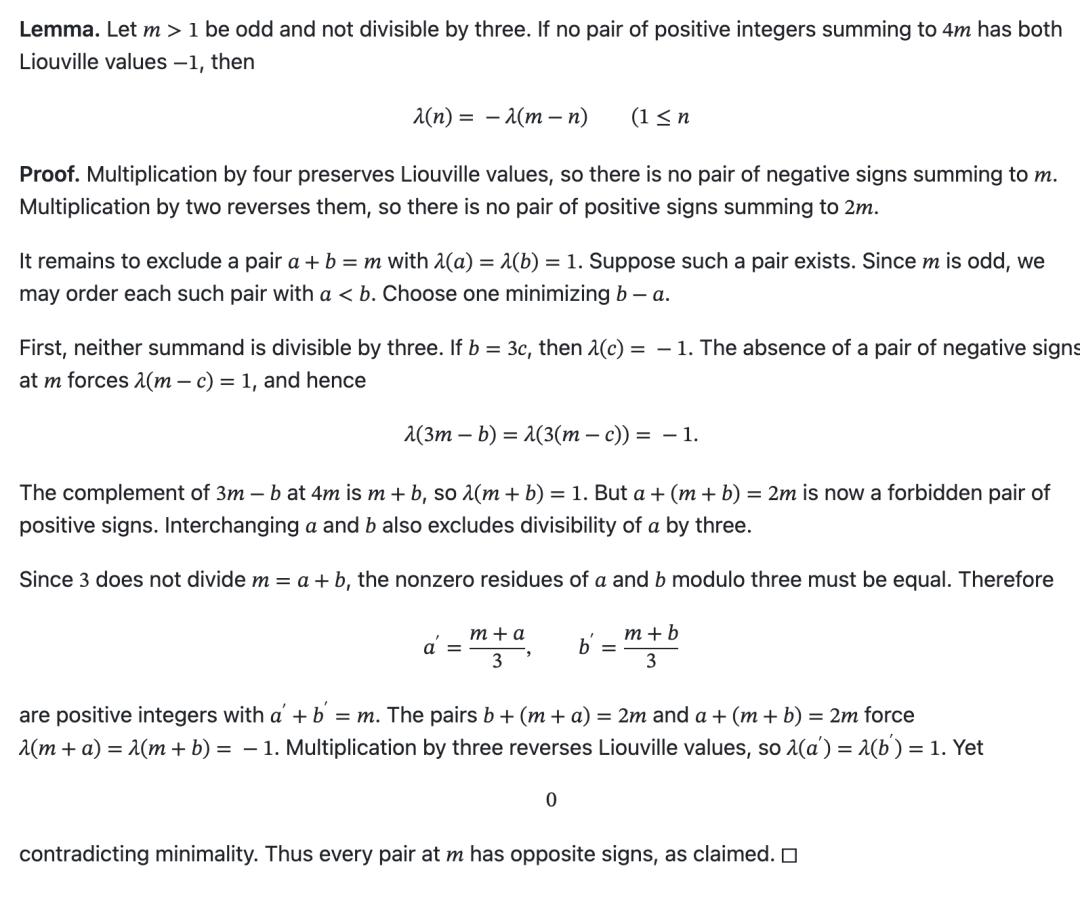
Next, Astra proceeded step by step to derive the contradiction.
1. Since multiplying by 4 does not change the Liouville value, m itself cannot be split into two numbers with negative Liouville values.
2. Since multiplying by 2 flips the Liouville value (adding one more prime factor 2), 2m cannot be split into two numbers with positive Liouville values.
3. Then, by constructing the case where a+b=m and λ(a)=λ(b)=1, selecting the pair with the smallest difference b−a, and using their divisibility relationship with 3, AI forcibly derived a contradiction!
It found that if you assume there is no such split for 4m, then through the staggered approximation of multiplication and addition, you will eventually force all numbers in the local domain to have opposite signs, which directly violates the bound previously proven by Mangerel.
In this way, using only elementary algebraic derivation (even high school students can understand the derivation process), Astra discovered the unconditionally valid case.
48 Hours: Completely Resolved for the Full Domain of Even Numbers
And that is not the end of the story.
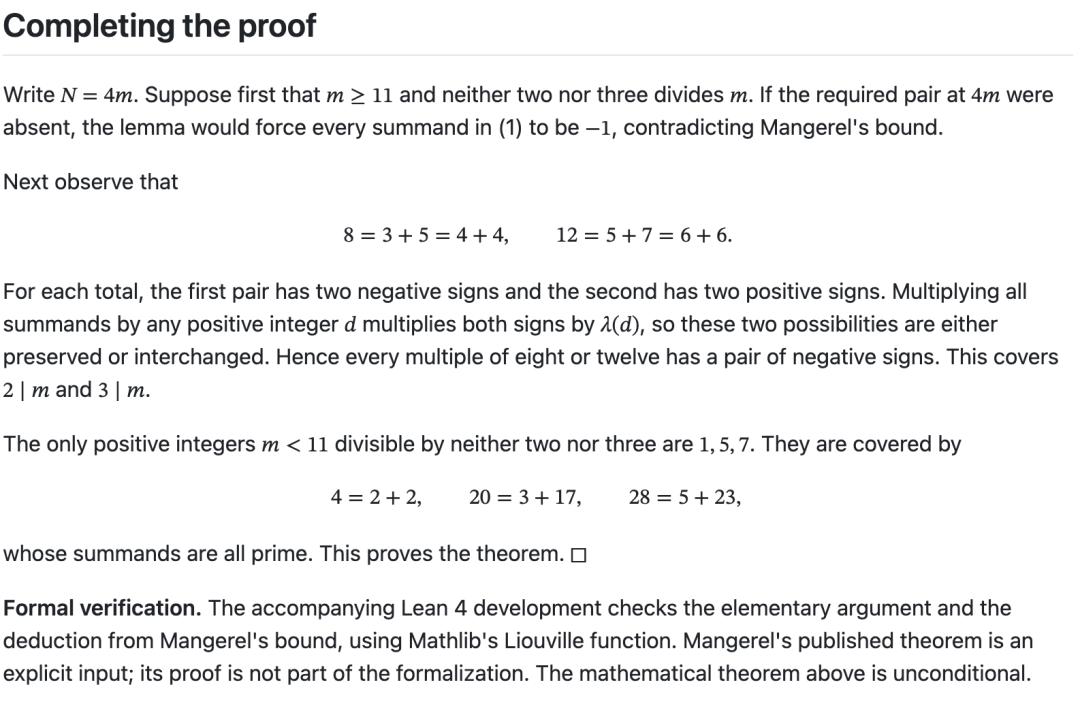
According to project author Captain Sude, after Astra proved the case of "multiples of 4" on the first day, the next day it found a completely new elementary proof path, directly extending the result to all even numbers greater than 2!
This time, it put forward this core claim:

There are no "sufficiently large" restrictions, no finite exception sets, and it holds unconditionally for all even numbers!
Its proof idea is even more amazing and highly praised.
It did not use brute force enumeration, nor did it compress previous analytic estimates to be tighter. Instead, it adopted a brilliant "structural transformation" method.
The logical chain of the AI is as follows.
Step 1: Find the scapegoat. The AI first proves that for every prime number p greater than 3, there exist positive integers u and v such that 2p=u+v, and their Liouville values are both 1. What if this does not hold? This constitutes a "missing additive sign pattern".
Step 2: Force the truth to emerge. Extend the Liouville function to the finite field Fp and define a function G. Due to the previous "non-existent additive decomposition", this function G is locally forced to have multiplicative symmetry defects.
Step 3: Perfect Commutativity. This is the most stunning part of the proof! Multiplying by -2 and then by -3 is the same as multiplying by -3 and then by -2. Using this "commutative" property, the AI makes the two paths cancel each other out, finally eliminating all non-zero defects!
Step 4: Spread to the whole domain. Using a descent lemma, the locally valid multiplicative rule spreads like a virus to the entire finite field, forcing function G to become a globally strictly multiplicative object.
Step 5: The Final Blow (Quadratic Residue Creates Contradiction). Since G has become a strictly multiplicative function, the G value of the square of any number must be 1. However, according to the law of quadratic reciprocity, we can find a prime ℓ in the finite field that is clearly a "square number", but since it is a prime number, its own Liouville value must be -1.
Thus, 1 = -1. A contradiction arises!
At this point, the initial assumption that "the decomposition does not exist" is completely shattered. The Liouville–Goldbach Conjecture holds unconditionally for the full domain of even numbers!
This line of argument that transforms additive obstacles into multiplicative rigidity is extremely elegant, embodying top-level thinking of high abstraction and intuition.
Full Formal Verification Completed via Lean 4
This time, Astra also submitted the complete formal verification for Lean 4 at the same time.
Passing Lean 4 verification means the proof is logically absolutely correct.
Content creator @SUNNY99 on Zhihu immediately conducted an independent review of Astra's open-source v1.0.0 version. The result is shocking: the Lean proof can be recompiled perfectly!
The final theorem is completely consistent with the claims in the paper. There is no "sorry" in the code (which represents an unfilled gap in Lean), no arbitrarily created custom mathematical axioms, all axiom dependencies are completely normal, and all 249 numerical smoke tests for even numbers have passed.

Seeing this, some friends may ask: Does this mean the Goldbach Conjecture has been completely solved?
We must state rigorously: Not yet.
What has been solved so far is the weakened Liouville version of the Goldbach Conjecture.
There is still a huge gap between "composite numbers with an odd number of prime factors" and "pure prime numbers". The classic Goldbach Conjecture is still that fruit hanging high out of reach.
However, this by no means means this breakthrough is not great.
First of all, in the sense of pure mathematics, it has built a magnificent bridge for the entire number theory that connects "multiplicative building blocks" and "additive combinations".
This may be the core key to conquering the original Goldbach Conjecture in the future.
Secondly, in the AI sense, this is a historic singularity moment.
For a long time, we have believed that AI is good at massive memory and brute force calculation, such as playing Go or solving protein folding problems. But this time, Astra has demonstrated amazing mathematical intuition and taste.
It is like a highly talented mathematician, writing a proof that human mathematicians call extremely elegant.
References: