After generating hundreds of millions of yuan in revenue, this hardware company has developed an AI golf training assistant leveraging world models | Insight Global
Author | Nan Huang
Editor | Silai Yuan
Editor's Note: As global expansion increasingly becomes the core strategy of Chinese companies, how to compete in the global market has turned into an extremely specialized topic. During the evolution of globalization, a large number of Chinese brands have already stood at the forefront of the trend. In view of this, Hard Krypton has specially launched the "Insight Global" column, which explores the cutting-edge directions and epoch opportunities for Chinese brands to expand overseas from the perspective of brand growth and evolution, so as to provide thinking and inspiration for overseas market players and the whole industry.
This is the 65th issue of our column — Jijia Technology, which started its business with family smart hardware 7 years ago, has built full-stack capabilities for AI-native hardware, with annual revenue reaching hundreds of millions of yuan and millions of end users. Recently, it stepped into the AI sports hardware sector and launched the G10 Pro, the first golf launch monitor driven by world models, which can invert 3D human movements from a single perspective, enabling the device to shift from "seeing the ball" to "understanding the person". Since its launch on Kickstarter, the total crowdfunding amount has exceeded 2 million yuan.
Li Pu, CEO of Jijia Technology, is a figure who rarely follows conventional routines in the AI hardware track.
This is a company that has been established for 7 years, but is barely known to the outside world. Its product portfolio covers home smart cameras, video doorbells, and natural observation hardware products, with annual revenue of hundreds of millions of yuan and millions of end users across more than 150 countries and regions globally.
This is a very outstanding performance figure in the hardware track. Jijia has also completed multiple rounds of financing in a low-profile manner, with investors including institutions such as Linear Capital, Matrix Partners China, Vision Capital, Dachen Caizhi, JZ Capital, and China Growth Capital.
However, Jijia is far more than a simple hardware company. Different from many peers, its headquarters is located in Beijing, where AI algorithm talents are highly concentrated.
Most domestic hardware manufacturers still adhere to the traditional sales logic: they first finalize the hardware form, polish product parameters, and take AI as an auxiliary function added in the later stage to enrich selling points and increase premium.
But Li Pu broke away from this inertial playing method. For him, AI is not an add-on plugin that only adds icing on the cake, but the core kernel that runs through the whole product lifecycle. Especially after the large models surged in popularity, the hardware itself is nothing more than a carrier. To develop hardware in this new era, a completely different mindset is required. Li Pu kept thinking: if AI is the absolute core, how should the hardware structure be designed? What kind of data needs to be collected? What form should it present? What kind of relationship should be built with users?
In 2024, Li Pu and his team set their sights on a new direction that seems to have a huge span: AI sports hardware. The first scenario they chose to cut in is one of the most recognized sports with the highest difficulty — golf.
On September 17, NeoPace, a sports technology brand under Jijia Technology, released its first golf launch monitor product G10 Pro. This is the world's first Launch Monitor driven by world models. Since it was launched on Kickstarter, the total crowdfunding amount has exceeded 2 million yuan. G10 Pro adopts the mode of delivering goods immediately after crowdfunding, and the first batch of mass-produced products will be delivered to users within 2026 after the crowdfunding ends.
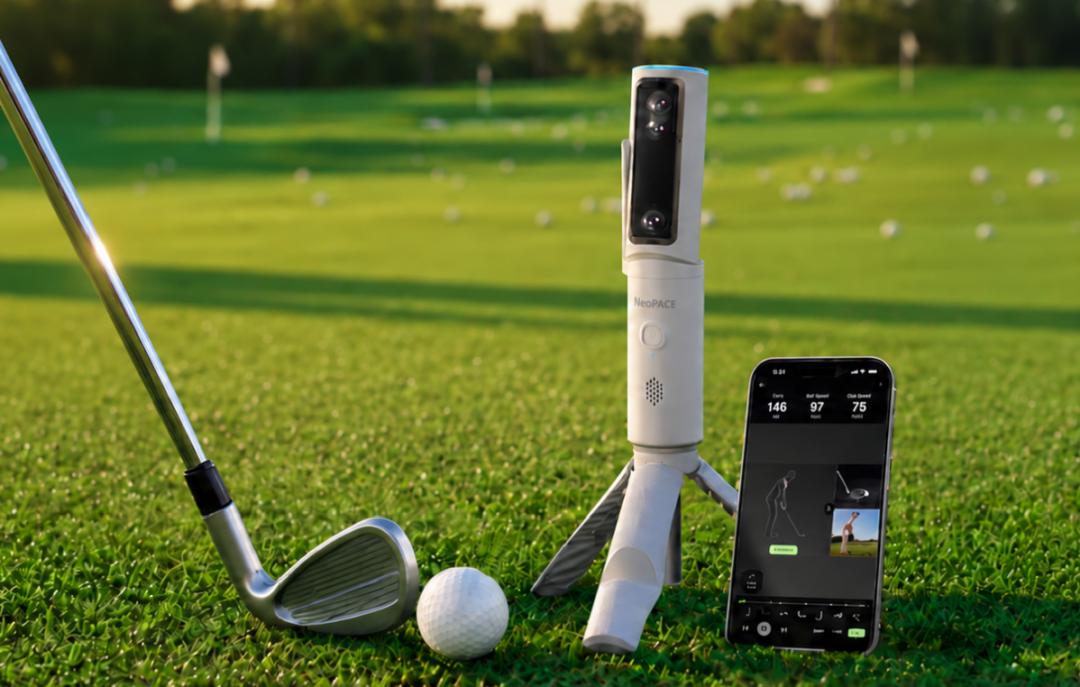
Jijia's first golf launch monitor product G10 Pro (Source: Enterprise)
This is also a very typical hardware product in this era: the hardware itself is only an entry point, and the real threshold lies in the algorithms and AI capabilities behind it. The entrepreneurial myth that penetrates a large market only by a clever idea has become increasingly rare.
When the capital consensus becomes clearer and clearer, funds will only flow to a small number of companies that have both supply chain accumulation and AI algorithm capabilities at the same time.
World Model, enabling AI to "understand" people
In fact, golf training assistants have long been a mature market.
However, in the past, golf training hardware products were only optimized along one line of thinking, that is, continuously improving the capture accuracy of ball flight data, including ball speed, launch angle, rotation value, landing trajectory, and all indicators have been polished to the extreme over and over again.
This iteration logic has well met the needs of professional players, who need accurate data to adjust their equipment and optimize the details of their swing. But for most amateur enthusiasts and advanced golfers, the hardware system that only focuses on the "result" lacks the most critical link of training feedback. The data can tell them where the ball flew, but cannot explain why. Without seeing the cause, there is no way to adjust the next swing.
"This is also the common pain point of most advanced users with interest in sports. Simple tool equipment often cannot support users' demand for improving their abilities," Li Pu told Hard Krypton.
Compared with focusing on the dynamics of the "ball", Jijia chose to cut in from another dimension: bringing the movements of "people" into the scope of intelligent analysis.
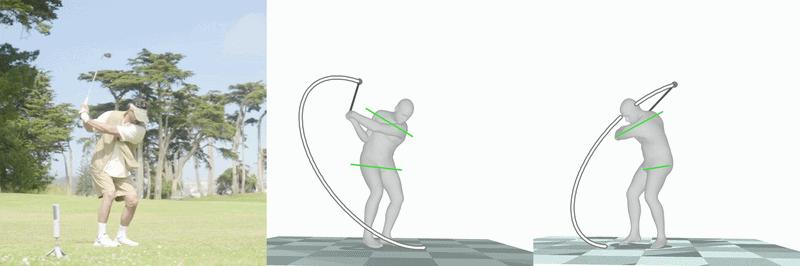
3D Reconstruction of Human Posture (Source: Enterprise)
Human movement is the only physical input end of ball movement. During a golf swing, 206 bones, about 360 joints and more than 600 muscles of the human body are activated at the same time, completing highly synchronized sequence coordination in less than two seconds. Any tiny deviation in any link will be amplified into a clearly visible offset or error on the ball path the moment the club head hits the ball.
In order to understand the dynamic logic of the human body, Jijia's first golf launch monitor G10 Pro does not follow the traditional monitoring framework, but builds its base on the team's self-developed TrainerIQ Human-Centric world model.
This model takes human sports biomechanics as the core modeling object, whose goal is not limited to motion capture at the visual level, but to invert the 3D human motion sequence and force exertion process from single-view signals, so as to realize interpretable analysis of motion mechanisms, and enable the device to advance from "understanding the picture" to "understanding human movements".
This capability has a very high technical threshold. Since the vast majority of golf users practice alone on the driving range, indoor hitting positions or outdoor grass, it is impossible to set up multi-camera equipment. The device can only shoot from one angle, with limited picture information. The most critical details in the swing process, such as hip rotation, center of gravity transfer, and wrist release, are very likely to be blocked or missed. Once the key movements are missing, the analysis will be inaccurate.
Jijia makes up for this shortcoming at the data end. The team has built an exclusive golf sports data system and accumulated hundreds of thousands of sets of high-precision sports samples. In the data collection stage, the movements are completely recorded from multiple perspectives; in the training stage, only one perspective is provided to the model, so that it can restore the movements from a single picture, and the other perspectives are used to verify the accuracy of the restoration.
The purpose of doing this is to let the model fully master the standard human swing mechanics rules first, then adapt to the single-view pictures of ordinary users for deduction, and use full-domain data to make up for the lack of information from a single perspective.
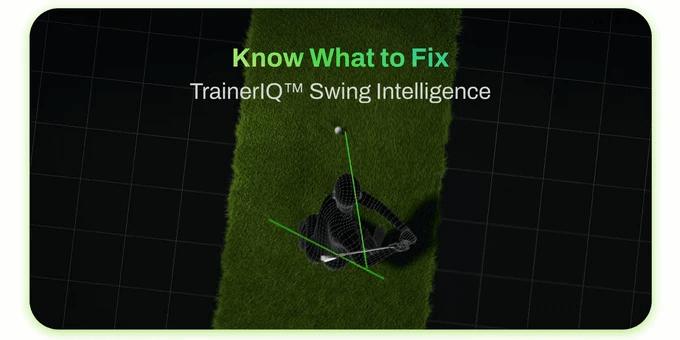
Full-domain data makes up for the lack of information from a single perspective (Source: Enterprise)
For example, after a user hits a ball on the driving range, G10 Pro, based on the displacement and rhythm of the shoulders, arms and hips in the front view picture, combined with the biomechanical rules it has learned, the world model can deduce the complete movement sequence of this swing in 3D space, and judge whether the head moves back and forth, whether the waist or the hand starts first, and whether the force exertion sequence is reasonable. Finally, this information will be converted into training feedback that users can understand.
The capability of this world model, which is finally reflected in the product experience, is where G10 Pro is different from traditional devices.
Most traditional solutions only stay at the "recording" level, completing basic picture capture, and cannot interpret the causal relationship behind movements and sports results. The difference of the TrainerIQ world model is that it tries to understand the physical laws and causal logic behind sports, and on this basis, deduces optimization scenarios that have not yet happened.
It can not only review the swing details and hitting results of the user's current shot, but also simulate what the swing trajectory will look like and what changes will happen to the hitting effect after posture adjustment, force exertion optimization and rhythm correction based on the user's original movement. Therefore, what users see is no longer just "how good this shot is", but "if this movement is corrected, what may happen to the next shot".
It can be seen that the essence of this model is to model and normalize the training logic. It does not provide a set of standard answers for everyone, but combines everyone's physical conditions and movement habits to give an improvement direction more suitable for their own situation.
"There is no standard answer for everyone's swing, and their training and growth paths should not be bound by a unified paradigm," Li Pu said. With the help of the TrainerIQ world model, users' unique force exertion habits, differentiated technical weaknesses, and step-by-step training rhythm can all be converted into interpretable time-series data and comparable motion trajectories, becoming the actionable adjustment basis for the next swing.
Build a layered system reuse platform
G10 Pro did not follow the "large and comprehensive" product route from the very beginning of the project. Jijia takes golf hardware as the first launch product in its sports sector, which is also a trade-off at the market level.
In the mature overseas golf monitoring equipment market, users generally recognize the value of professional training hardware, and there is no need to cultivate market awareness from scratch.
But these are also a group of extremely smart users who will not pay for gimmicks. Therefore, Jijia did not spend energy on making the parameters more attractive, but positioned itself as an "assisted training" role. It will not throw all movement problems to users at one time, but first judge which one should be corrected most urgently at present, making the feedback more focused and actionable.
"When AI can understand a swing movement, disassemble the force exertion chain, locate the movement weakness, and give an actionable optimization plan, the information density and guiding significance are completely different. It is no longer a general content generation, but gives specific judgments for specific people and specific movements," Li Pu told Hard Krypton.
From the perspective of the Jijia team, hardware is a one-time entry point, and subscription services are the beginning of the long-term relationship between the brand and users.

AI Golf Training Assistant (Source: Enterprise)
In terms of product layout, Jijia does not pursue one model to cover all user groups. The main model first targets the core advanced users, then extends upward and downward along the same track, gradually covering a wider user hierarchy, and forming a gradient product matrix.
But golf is only the first landing point of this logic. After the hardware entry point, subscription service and layered product matrix are well operated in the golf sector, what Jijia really focuses on is the underlying capabilities that support its operation.
This is exactly the starting point of Jijia's platform-oriented path. It captures specific demands from scenarios, disassembles the capabilities to solve the demands into reusable layered capabilities, and then uses this layered platform to cover more sports categories.
"The real platformization is not the migration and reuse of technology, but a layered architecture with standardized underlying core technologies, modular vertical scenario capabilities, and generalized commercial operation systems — using precipitable general capabilities to hedge the trial and error cost of multi-track expansion, rather than completely eliminating R&D investment," Li Pu said.
This layered system includes three core capabilities that can be directly migrated across categories.
The bottom layer is the general human perception technology. Relying on the TrainerIQ world model, the team has precipitated standardized capabilities including human skeleton calculation, force exertion sequence deduction, single-view 3D reconstruction, and movement causal attribution. This understanding of human dynamics and biomechanical logic is not bound to the single sport of golf, but is the general technical base for all human movement analysis.
The upper layer is the AI-native hardware engineering capability. The perception framework integrating vision and radar, the algorithm compensation scheme for low-computing-power devices, the imaging and temperature measurement adaptation for complex outdoor working conditions, and the lightweight automatic alignment engineering system have all been standardized and polished, which can quickly adapt to the hardware collection demands of different sports, without the need to reconstruct the hardware architecture from scratch for each product.
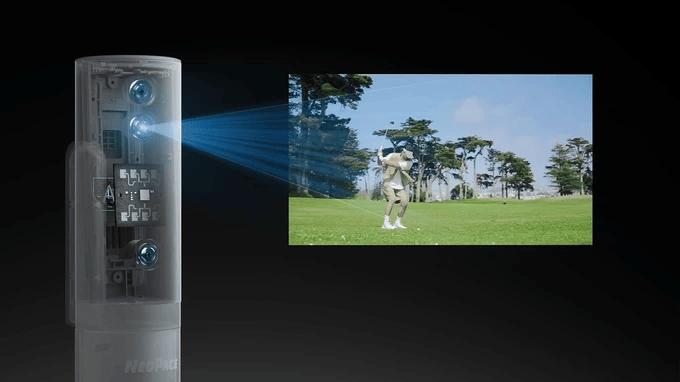
Sensing System (Source: Enterprise)
The upper layer above that is the commercial assets for interest-oriented consumer hardware. The overseas channels, community user operation systems, AI value-added service subscription mode, and long-term user retention system precipitated from the past family scenario and natural observation hardware business have formed a mature C-end hardware commercial closed loop, which can be quickly reused in the sports track to reduce the market landing cost of new products.
At present, other sports category products of Jijia Technology have entered the planning stage, and are expected to be launched gradually in the first half of next year.
In the past few decades, mass sports training has gradually entered an industrialized and standardized cycle. Professional training hardware has continuously refreshed data accuracy, general swing paradigms and templated error correction ideas have become the mainstream of the industry, and complete sets of standardized training solutions have flowed to every enthusiast at a low threshold. The training efficiency has been greatly improved, while the individual attribute of sports itself has been continuously diluted.
With the gradual landing of the migratable capability of AI human understanding, professional-level motion analysis, causal attribution and personalized guidance capabilities are delivered to consumer hardware, making it possible for ordinary users to have exclusive intelligent training assistants on a large scale for the first time.
This is also the optimization direction of AI-native hardware. It is not a smarter tool, but to let every specific person be truly understood by the device. Only companies that do this can survive through cycles.