Banks don't just want to talk about money with you, they also want to connect with you on an emotional level.
According to the recently disclosed financial report data, in the first half of 2026, the operating conditions of banks varied widely, some fared well while others faced obvious difficulties.
All six state-owned large banks achieved year-on-year growth in both operating revenue and net profit in the first half of the year. Among them, Agricultural Bank of China posted the fastest revenue growth at 11.07% year on year; Bank of China took the lead in net profit growth, rising 5.1% year on year.
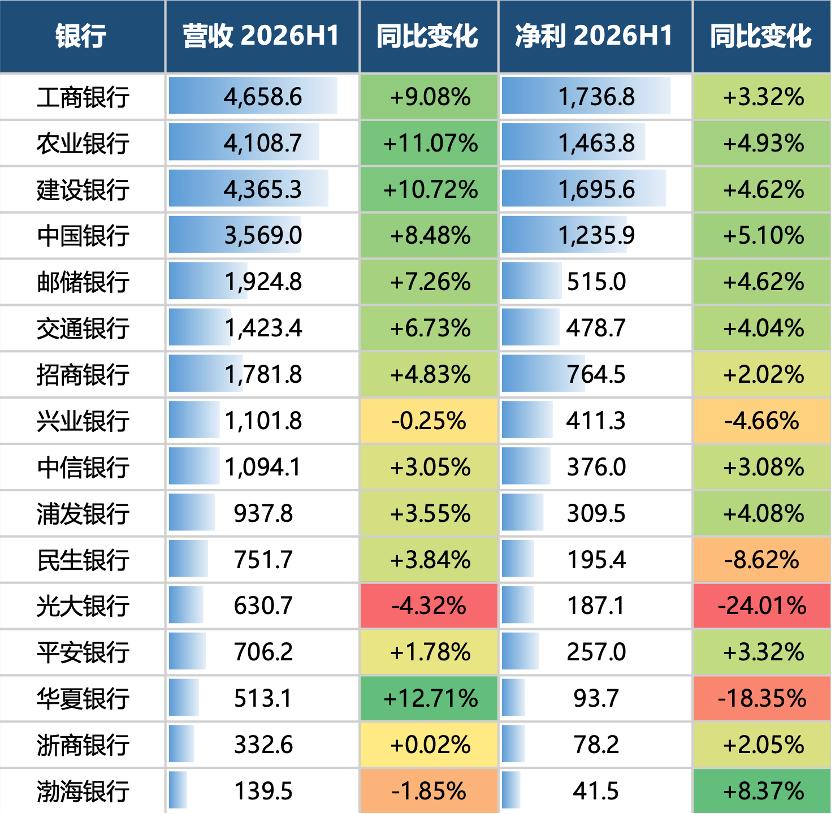
Data source: Bank financial reports; Compiled by: MiniMax-M3
Among the 10 listed national joint-stock banks, Industrial Bank, China Everbright Bank and China Bohai Bank recorded year-on-year declines in operating revenue. In terms of net profit attributable to shareholders, China Everbright Bank saw a 24.01% year-on-year drop, while Huaxia Bank's net profit decreased by 18.35% year on year. Among these joint-stock banks, Huaxia Bank, which had the highest revenue growth rate, suffered a relatively large net profit decline instead; while China Bohai Bank, which posted a year-on-year revenue decrease, achieved a net profit growth of 8.14%.
At the same time, as more and more users get used to handling all their financial needs via bank apps, closing physical outlets remains the mainstream cost-cutting choice for many banks (Industrial Bank did not disclose outlet data in its financial report, so it is not included in this statistics).
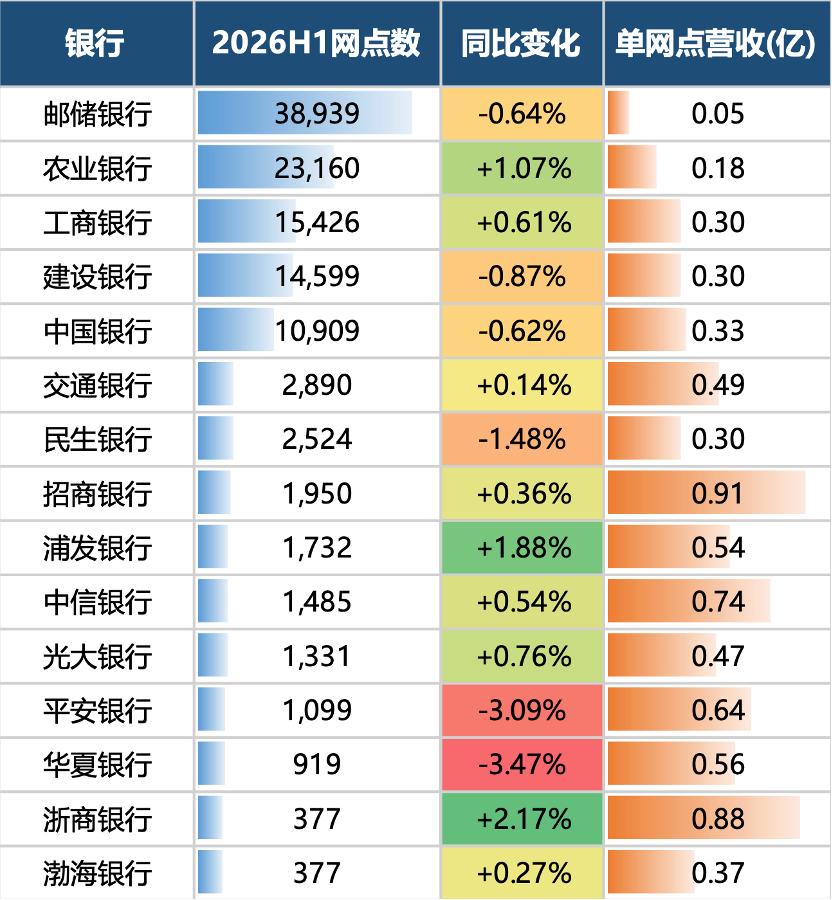
* The calibers of outlet data disclosed in different banks' financial reports are not consistent, for reference only. Data source: Bank financial reports; Compiled by: MiniMax-M3
However, compared with the drastic cuts in previous years, the pace of bank outlet closures slowed down significantly in the first half of 2026, and the remaining grassroots outlets have begun to explore more possibilities for offline physical space.
20 years ago, opening a bank passbook printed with your own name and depositing the New Year's money received during Spring Festival into your personal account was a childhood dream for the post-90s generation. 20 years later, when we no longer need a physical passbook, the increasingly deserted bank outlets are also looking for new development paths.
Step into the "non-existent" bank
Data from the official website of the National Administration of Financial Regulation shows that a total of 11,249 bank outlets appeared on the institution exit list in 2025, while 8,548 new outlets were approved for establishment. Therefore, the total number of bank outlets across the country decreased by 2,701 on a net basis in 2025.
The contraction and adjustment of the number of bank outlets is becoming a normal state, but this is not a completely negative retreat, but more like a metabolic process. Among the bank outlets approved for exit, 2,211 were rural credit cooperatives, and nearly 1,000 were village and town banks.
In terms of regional distribution, the closed outlets are mostly concentrated in old urban areas with decreasing population, hollowed-out towns and villages, and communities with redundant branches. Continuing to operate these inefficient, poorly located outlets will lead to waste of resources and costs.
Therefore, while banks are closing outlets, they are also relocating to make up for the gaps in areas where their presence is necessary.
Taking the 2025 annual report data of Industrial and Commercial Bank of China as an example, ICBC completed the optimization and adjustment of 474 outlets in 2025, optimized the layout of 187 outlets in key urban areas, newly invested 141 outlets in county and township areas, and increased the county-level coverage of outlets to 87.5%.
The strategic adjustment of banks is both grand and specific. When it falls to a closed outlet, what you see is the roar of electric drills and the dismantled storefront sign. But after the outlet is relocated and the staff are reassigned, the bank space that loses its physical meaning still continuously satisfies people's imagination of alternative scenarios for it.
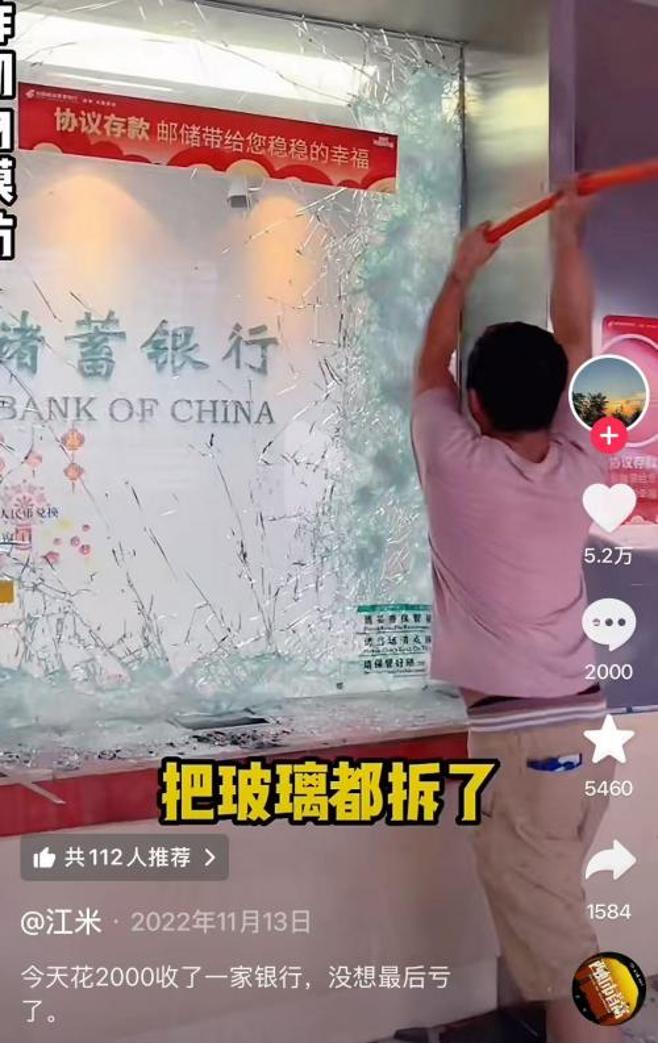
Striking demolition scene. Source: Douyin
In the comment sections of bank demolition work videos posted by professional demolition bloggers on Douyin, many people said they are eager to experience the behavior<[PLHD88_never_used_51bce0c785ca2f68081bfa7d91973934]>bank smashing behavior that they have only seen in crime movies, and even are willing to pay to go to the demolition site to indulge in the fun of playing the role of a "bad guy".
The covers of these videos are often marked with the warm reminder "Legal demolition, do not imitate", but even without the reminder, no one will easily imitate it, after all, everyone just wants to go to the shooting scene, not to the execution ground.
In the comment section of videos about dismantling ATMs, some people are curious whether there will be leftover banknotes in the machine, and all the answers they get are that no one has ever found any leftover cash.
Because there is a strict process for the recycling of bank equipment. Taking ATM as an example, bank staff will take out all the cash in the cash box before dismantling the ATM, back up the data on the hard disk of the machine, then degauss it, and finally physically crush it to ensure that customers' private information will not leak out with the equipment.
Some ATMs will not wait until the outlet is demolished to be disposed of. Each ATM is designed with a service life. After exceeding the service life, the bank will also replace the equipment, and hand over the eliminated ATMs to manufacturers, recycling companies or Ali Auction.
If you want to put one at home as a decoration, you might as well check it on the platform.
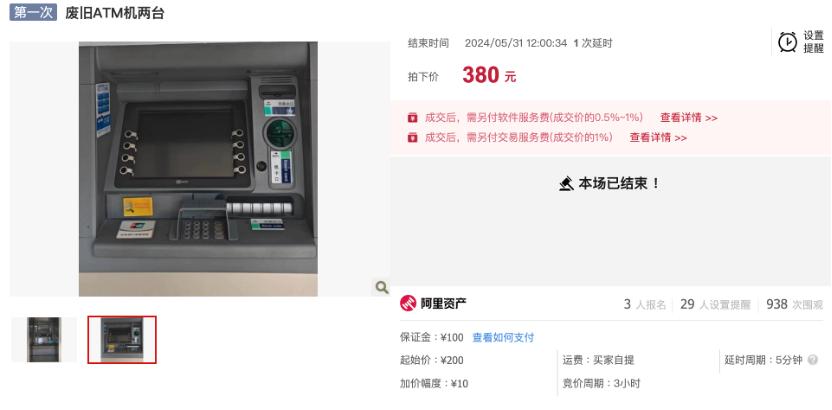
Source: Ali Assets
After all the demolition work is completed, the vacant shops left by the banks will wait for the next commercial form to settle in. During this period, some shops that were previously leased by banks will be upgraded from "prime shop" to "auspicious house" when they are sublet. Even if there is no banknote left inside, the bank, in a quantum state that "does not exist but always exists", continues to play its residual value in the commercial property rental market.
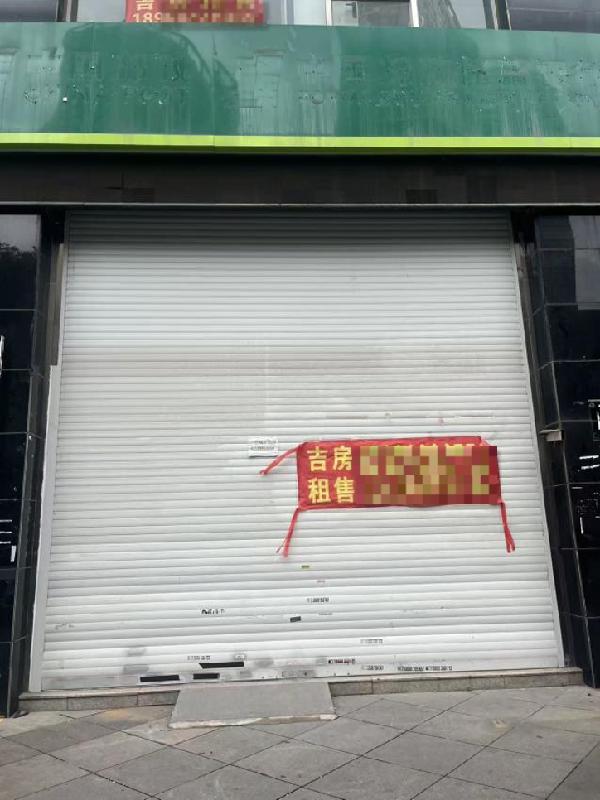
The storefront left after a postal savings bank outlet was relocated. Photo taken by the author
But not all banks can be demolished to the rough state required by regulations. Those abandoned outlets with original counters remaining intact are like hidden maps that only appear after triggering a certain bug in an open game world, providing new destinations for urban ruin exploration enthusiasts.
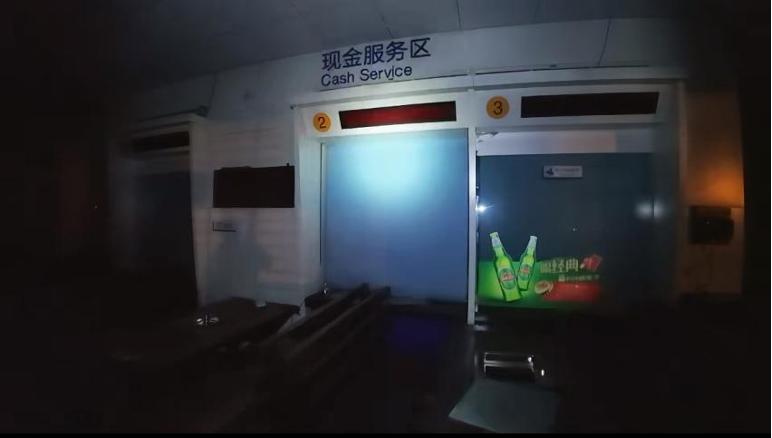
Source: Xiaohongshu @The World Is Not Worth It (Exploring the Other Side of the World)
A ruin exploration blogger on Xiaohongshu found an abandoned bank outlet that had been converted into a restaurant. According to his video introduction, after the bank moved out, the subsequent restaurant owner did not redecorate the space. Obviously, the owner was also a person who believed in metaphysics, but in the end, science defeated metaphysics, because the restaurant has now closed down.
Alternative Usage Guide for Banks
In the past, depositing and withdrawing money were the basic functions of bank outlets, which made banks, like post offices, schools and hospitals, become the core infrastructure of communities. However, young people have not touched a physical banknote for a very long time, and they have other ideas about what bank outlets can do.
For example, go to the bank for good luck when moving to a new home.
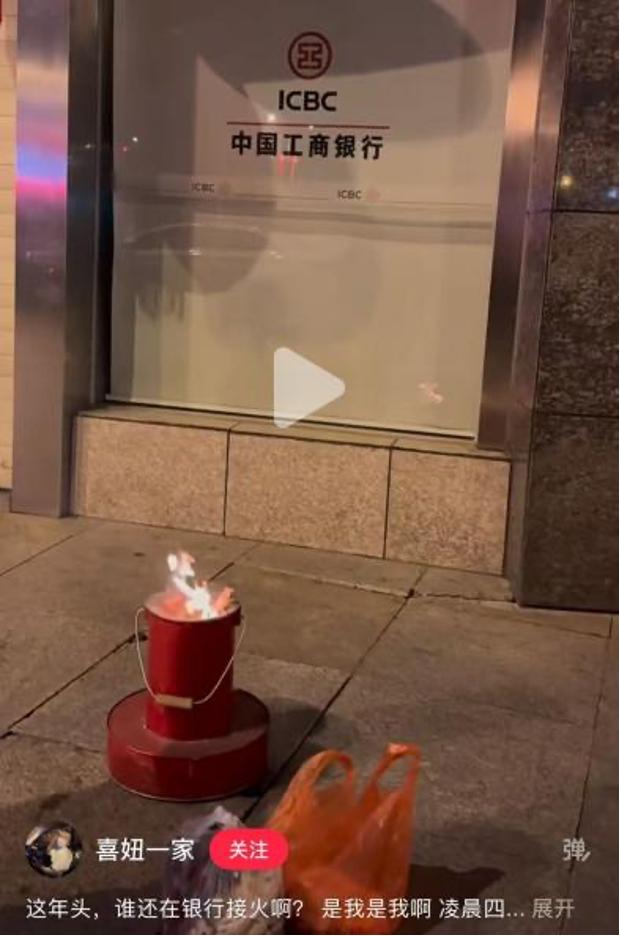
Source: Xiaohongshu
This folk custom of seeking good luck can be seen in many places, usually called "fetching fire from the bank" or "lighting lamps at the bank". The basic process is to choose an auspicious time on the day of moving to a new home, go to the bank entrance or in front of an ATM to light a fire basin, candle or kerosene lamp, carefully bring the fire-bearing vessel that is regarded as the source of attracting wealth back to the new home, and make sure the fire does not go out on the way.
What if the fire goes out halfway? They will tell you, don't worry, sincerity makes everything work.
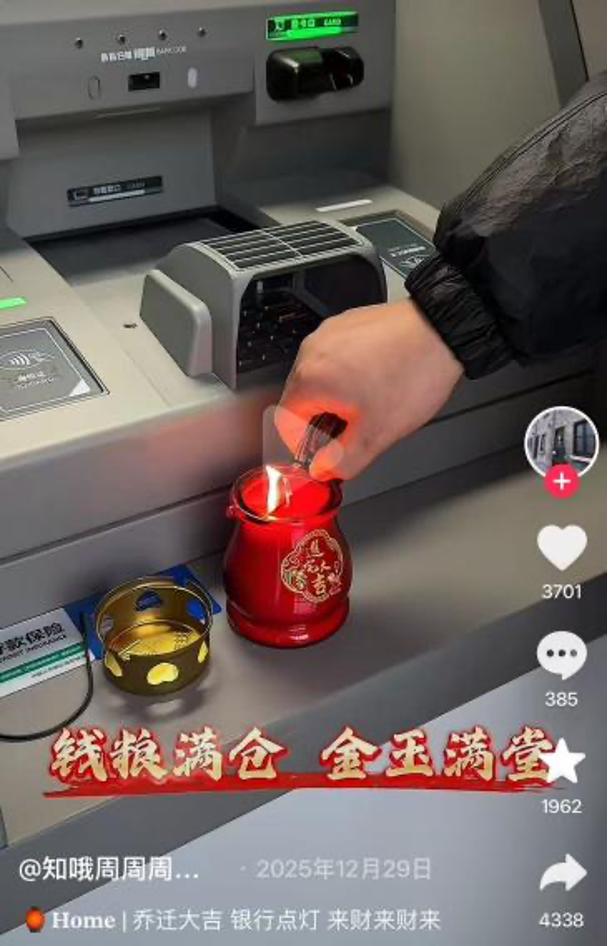
Source: Douyin
Or you can simply give up open flames like some people do, and use LED candles to complete the ceremony. This is actually more in line with the trend of the times. In the era of electronic payment, a virtual flame is suitable for carrying the wealth luck that does not rely on cash.
In the comment sections of these videos showing the fire-fetching ceremony, bank staff occasionally appear to dissuade people, saying that bank outlets do not have so-called wealth luck, but only their own work resentment.

Source: Douyin
But the complaints of bank staff cannot stop people from continuing to regard banks as sacred places for wealth pursuit night after night.
This kind of using banks as temples is just one of the many explorations of new functions for banks.
Some people fetch fire from the bank, while others fetch water from the bank.
After all, in metaphysics, water generates wealth, so many people also post online that when passing by a bank, they will go to the water dispenser to get a cup of free water, and drink up the imagined rolling wealth in one gulp.
However, the "scene misapplication" of banks is not only a one-sided behavior of the public. Banks themselves are also trying to find other reasons for people to walk into their outlets. In this regard, Postal Savings Bank of China is one of the banks that are best at "creating new tricks". It has a deep insight into the pain points of young people who are not only short of money, but also lack romantic partners.
So something curious happened: people walked into the bank not to talk about money, but to try to talk about relationships.

Source: Douyin
Postal Savings Bank of China transformed its Shuangjing Sub-branch in Beijing into a distinctive "Matchmaker Sub-branch", which not only helps young single people manage their finances, but also helps them develop romantic relationships. According to the official account article of Postal Savings Bank of China in May this year, the Matchmaker Sub-branch has registered 469 single young people and held nearly 40 dating events.
At the Sweet Economy Heartbeat Festival held on 520 (May 20) in 2026, it helped more than 10 pairs of young people reach dating intentions.
This model of finding romantic partners in banks was soon replicated by Postal Savings Bank of China from Beijing to its Sishui Avenue Sub-branch in Hexi, Tianjin, creating the first love-themed bank in Tianjin.
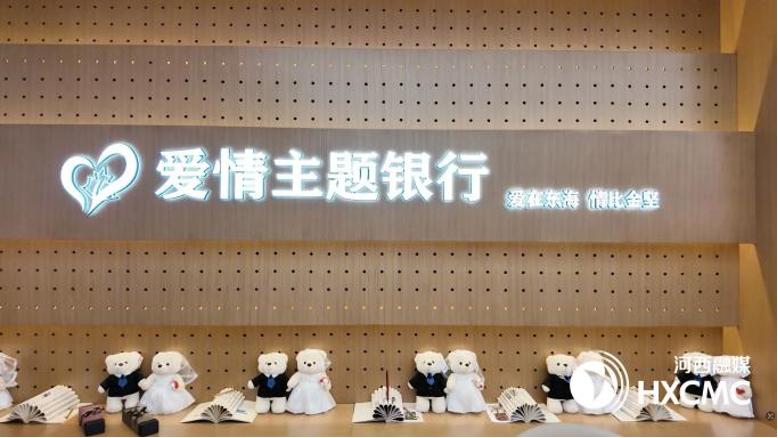
Source: Civilized Tianjin official account
It can't help but make people wonder: when you go on a blind date in a bank in Tianjin, before you promise to take care of the rest of someone's life, do you have to learn how to catch their humorous punchlines first?
On the other hand, if you think it's crazy to try to find true love in a bank, a place that represents money and rationality, then Postal Savings Bank of China will tell you that they also have Crazy Thursday to make you even more crazy.
